Hi everyone. I am very thankful for being able to post here. This one is (to me) a bit less obvious than a previous query. I’m left with a pair of these from my suspected epns pile. They are cruet sets shaped as little acorns. The reason I am asking is that I am toying with replacing the cobalt glass inners for them. If they are epns I don’t think the cost of replacing the inners is worth it. I suspect this will again be a dead ringer for a more experienced eye. The smaller are from an inner pepper pot.
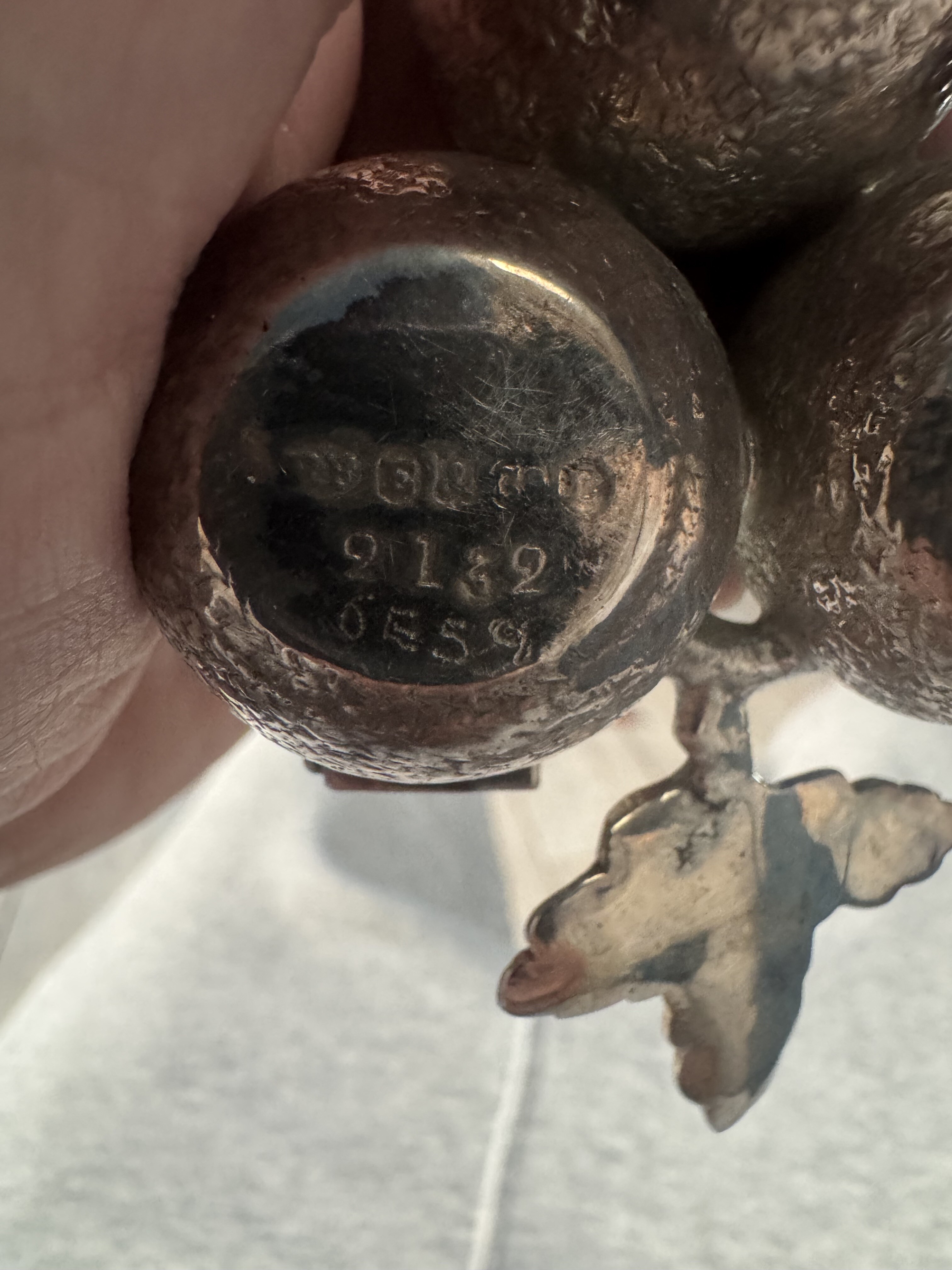
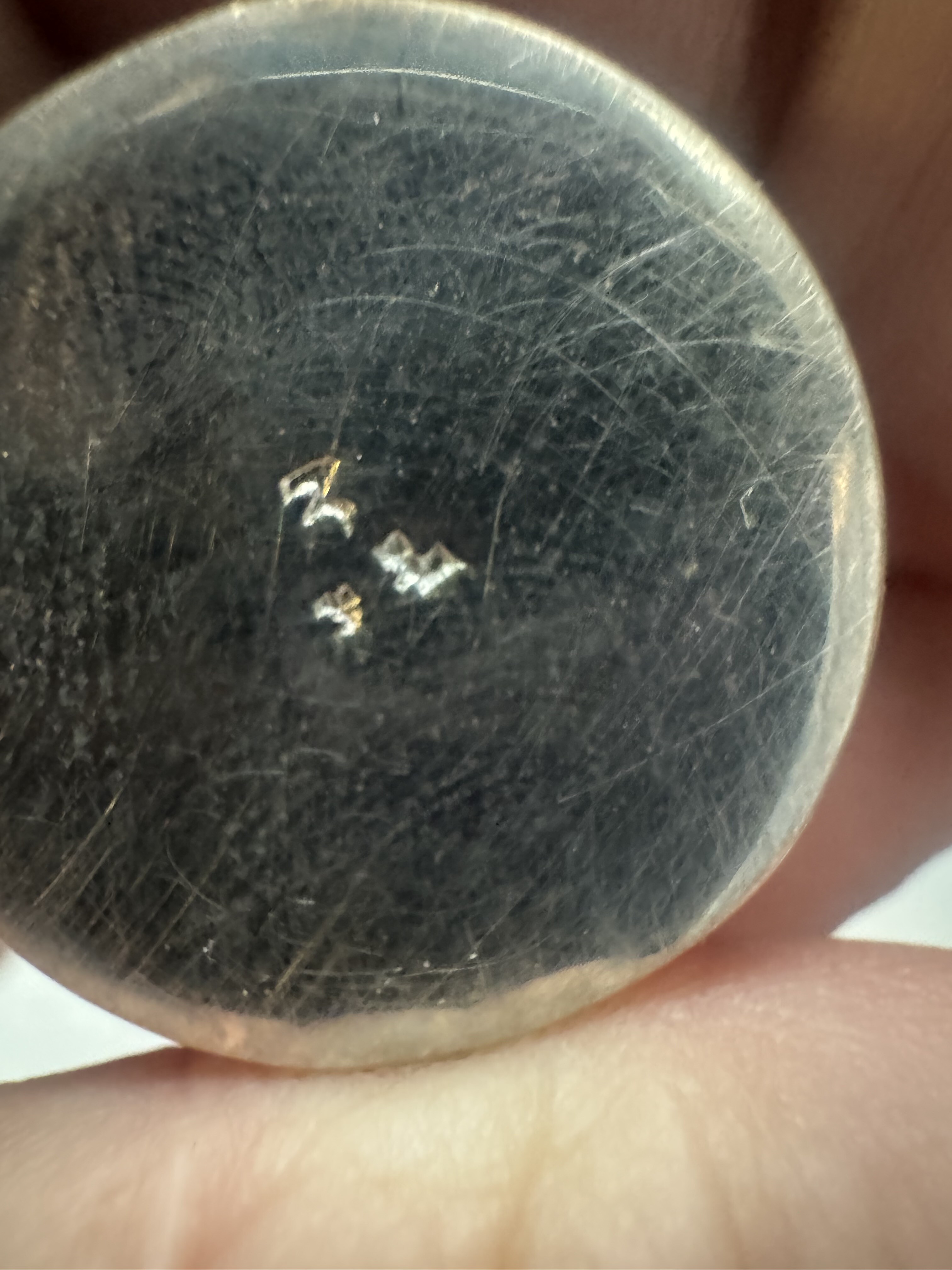
If a piece is from the U.K., but doesn’t have sterling hallmarks, it’s not silver. That has been the law for centuries.
Familiarize yourself with what real hallmarks look like. Browse this site:
It’s a very regular system. Generally, the lion passant for sterling, usually a city mark for the assay office (sometimes omitted on very small pieces), a date letter, and sometime a duty stamp or jubilee mark showing the profile of a monarch.
If you’re not seeing anything that looks like these, and you’re sure it’s from the U.K., it’s not silver.
North American silver almost always says “STERLING,” or at least “925.” Things get a lot murkier when dealing with Continental silver, since each country had its own system, and observance was sometimes spotty. When you get further afield, like the Middle East, India, or China, you’re in no-man’s-land. 
Why thank you. You make a very good point in there (among many!). It is strongly ASSUMED to be from Britain, which bears saying only given the rest of the collection it came out of. Most of it is betjemann/ Dixon/ Lias/ grinsell and some “hallmarked” kusht which is very difficult because as you say it is total no man’s land.
Other than that howler of a tea pot the other day this is the only one I am/ was still left with in the “what is this thing” pile.
I’m going with - it’s British and another elaborate epns/ epbm/ sbc over-brand. A nice piece but not worth getting inners blown for. Much appreciated
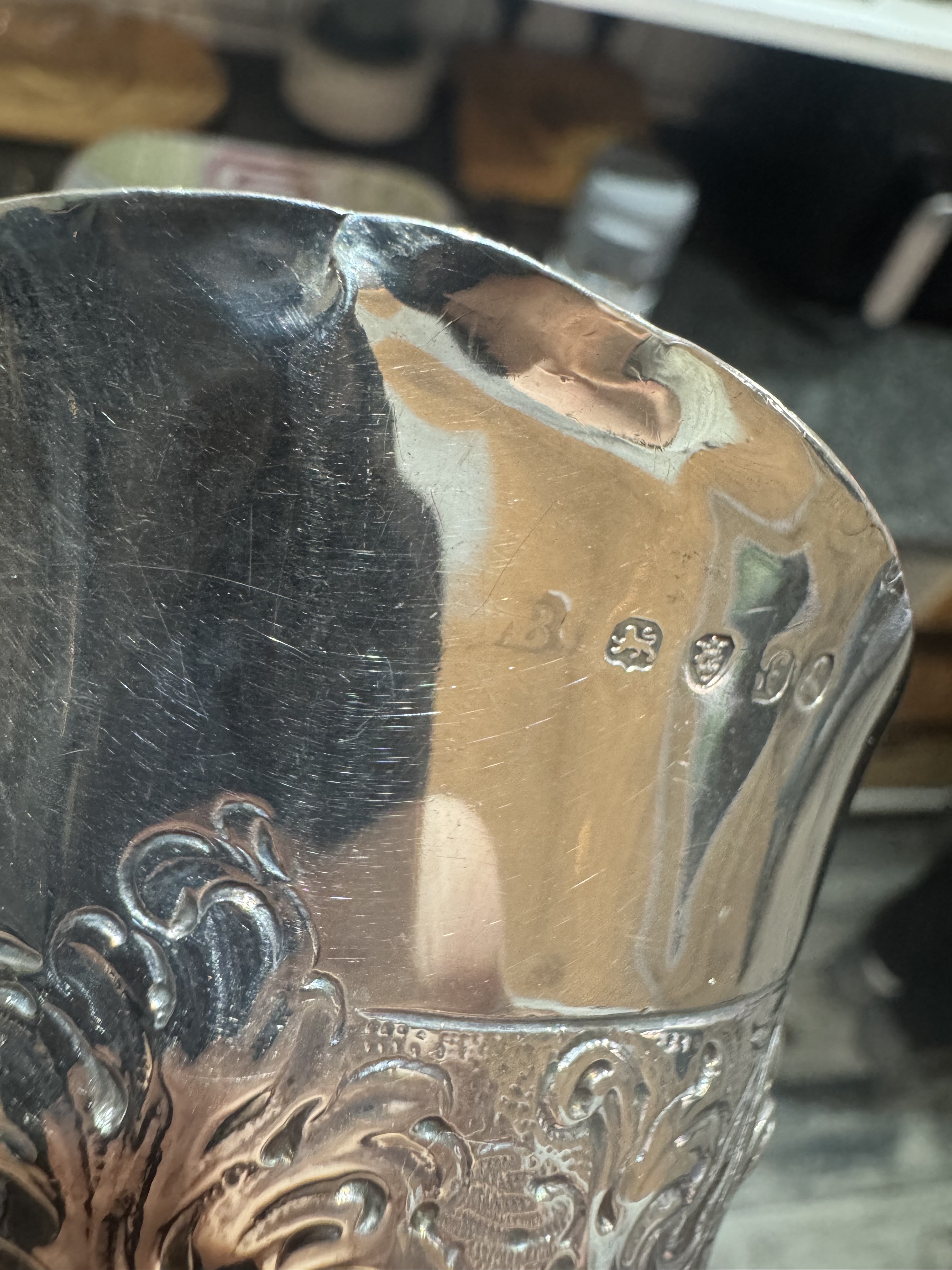
Well it’s made by William Bateman I and assayed as sterling in London in 1821.
Your picture doesn’t show enough of it to tell us what it is other than it needs the attention of a metal banger.
William was the grandson of Hester.
CRWW
1 Like
Hm. As to value, here’s a guy who wants £250.00 for another set:
That means he paid about a hundred.
And here’s a guy itching to sell you liners at exactly three times what he is paying for them.
https://www.etsy.com/ca/listing/985837540/1-34-diameter-replacement-circularround
Best bet is patience. They come up at auction in job lots from time to time. I found a local who will blow me what I need when I need it at $50.00 each. I mean glass blow.
If you clean off the marks Jeff will tell you who made them. I think its RF something Co Ltd but get some silver dip and an old tooth brush and go to work.
CRWW
2 Likes
Already on it! It’s from Rupert Favell, Elliot, & Co., 1880’s.
ETA: The last punch appears to be “L,” which would suggest it came from their London shop.
Brilliant.
Which allows us to tell you what Favell Cruets sell for.
Here’s one by Charles. It’s sterling.
Note the absence of liners. And the auctioneers isn’t telling us who CF is.
But Phil is.
And he notes parenthetically the CF “Mark is not shown in the Sheffield Register but may be the mark of Charles Favell who traded as Creswick & Co until 1887”. Which is the company that made the ebay acorns
https://www.silvermakersmarks.co.uk/Makers/Sheffield-C.html#CF
I found three more all about the same price, lowest £80 from Partridge Media. All sterling.
Which means the ebay guy is likely open to offers if you want a pair of them to sell.
“From little acorns grow great something or others…” to slightly misquote Geoffrey Chaucer writing “Troilus and Criseyde” back in 1374.
2 Likes
Yes everything on it is clear to me except the makers mark…
Oh my word you are the best. I thought that makers mark was a write off forever.
Cream jug in a melt/ fix pile. Been clearing an old colonial estate for five blummin years.
But this isn’t Charles Favell. It’s Rupert.
Would it be worth me replacing the inners (want to keep them) ? Are we saying they may be sterling if Favell?
No! Once again, a completely tangential discussion has derailed us.
The piece in your first photo is silverplate from Rupert Favell, Elliot, & Co., London, 1880’s.
It’s not sterling, and it has nothing to do with Charles Favell, Mark Creswick, any of the sterling cruet sets that have been mentioned, or any of the other red herrings that have been lobbed into this thread.
1 Like
Super. Clear and thanks.
The guys I was going to work with quoted 58 for mismatched but fitting, and 142 pound plus plus for a blow. Of an inner. Times four… I think not.
Jeff you’re very patient. Just for your interest- my goal as of the last few minutes is to get myself a sterling set on auction or something. Think they are very beautiful and would gladly pay up on one I’d keep for life/ pass on. The inners will remain a mystery - I can’t find any consistency online. I think one flat walled one fluted both blue. Will pursue that once I’ve secured what I’m now after. People also sell them with two pepper shakers I think in error. Anyway thanks as ever.
Even for a sterling set, replacing the liners might make sense for a collector who wants to keep them. But for a reseller, it probably wouldn’t pay. And for silverplate, the cost of replacement liners would probably exceed the value!
Exactly. So I’m going to get a proper one (cruet) and take it from there long story short.
Happy you got it all sorted.
The ownership of the acorn casts was always with the Favell family. As Phil Osborne in his authoritative website pointed out they sometimes trade under different corporate names and unless the company is sold pass them down the generations.This is not something unique to this family but general in the silver trade.
The silversmiths will use the same mould for copper which they subsequently silver plate or sterling silver which they simply finish and polish. Different marks of course.
One of the oddities of pricing is \you can buy something created out of an early 19th century mould which was assayed last week. It’s going to be the mirror image of the product of the mould when it was first created but will reflect current rather than antique silver prices.
So good luck on your search for a sterling set. Currently with silver relatively high what you pay for workmanship as opposed to the metal is very little, indeed sometimes less than nothing.
Which I frankly find very depressing.
Christopher Wilson
Guildhall Antiques
Toronto
1 Like