Hello,
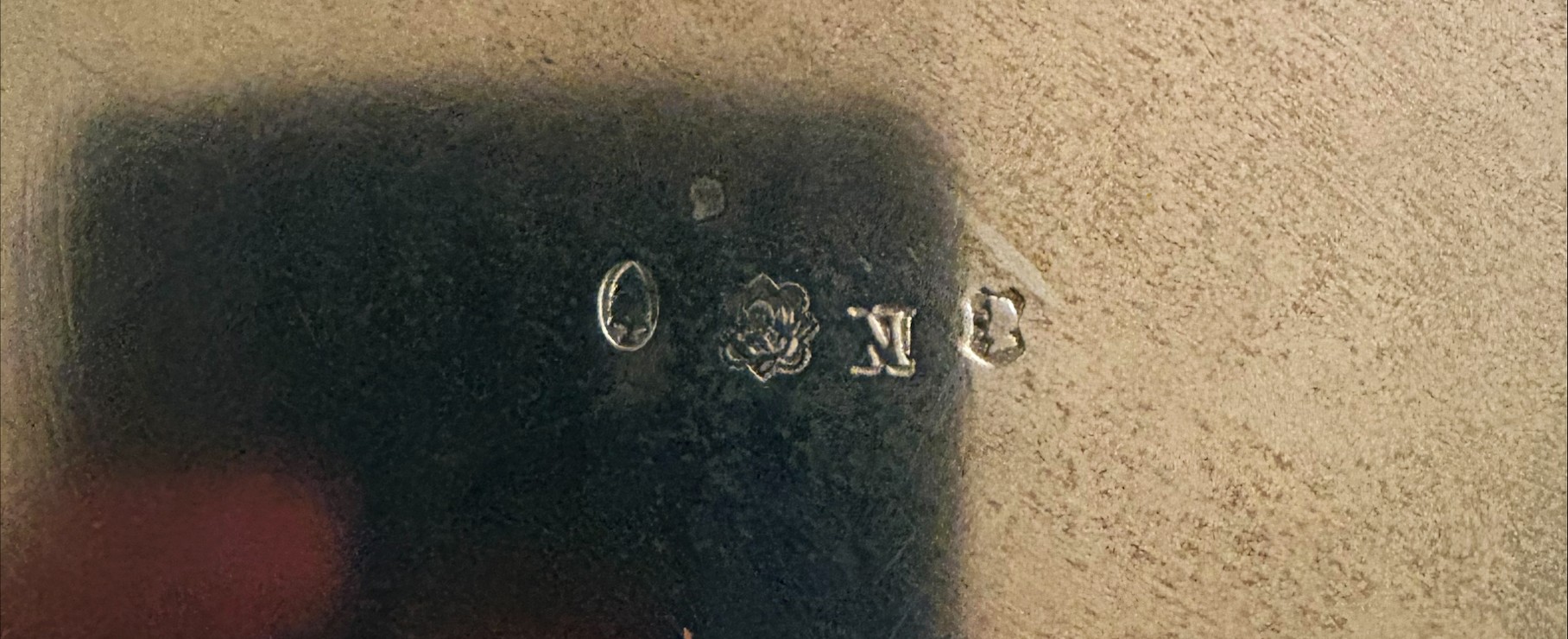
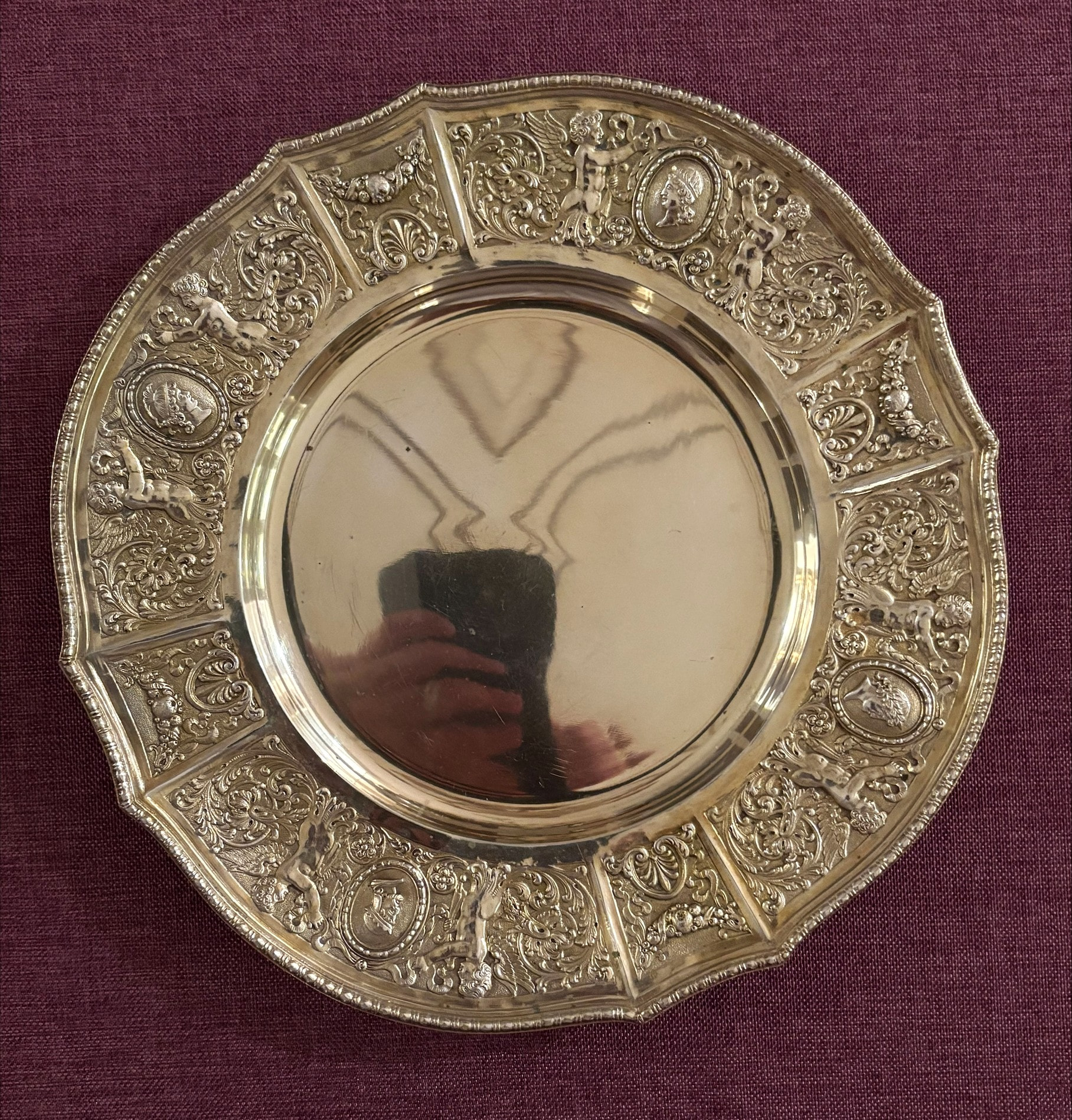
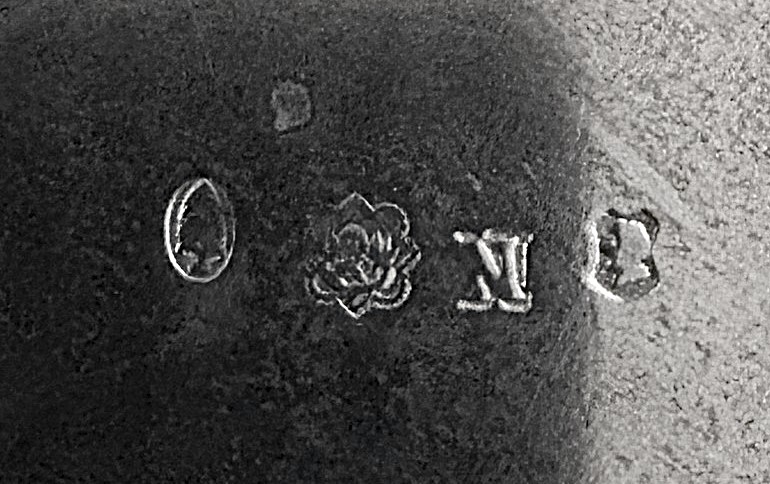
I have eight 10 1/2 inch plates that I believe were probably made around 1900 in Hanau Germany. The backs are marked as shown. I believe these are so-called pseudo marks typical of the faux historical silver produced there.
The plates weigh approximately 16 Troy ounces (they vary a little). They are a pleasing shade of relatively pale gold all over and have elaborately chased borders as shown. This work is clearly done by hand by a skilled artisan. I purchased them at the late great Baltimore Summer Antique Fair about 20 years ago from a dealer based in LA and have not given them much thought since.
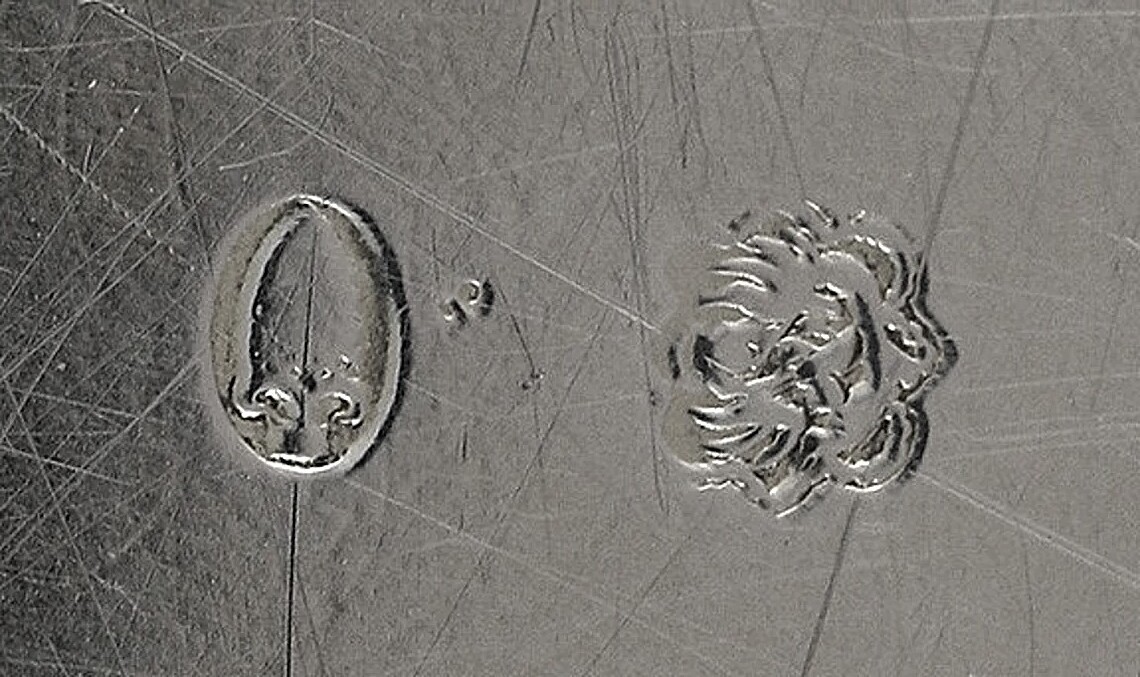
However, I recently stumbled across an IDENTICAL plate in a smaller size (8 1/2 inches. 300 grams) offered for sale online by an established dealer who “guarantees” the their plate is 850 silver. They declined to answer my query about how they could possibly know, which is why I am trying here. That plate has only 2 of the pseudo hallmarks (the two on the left).
I have always assumed my were a movie prop and made of something other than silver, but I could not imagine why anyone would go to that much trouble on a base metal. They do not tarnish much under the gold they way other Victorian gilt silver I have does. I have a Regency wine funnel by E. Barnard & R. Eames which also does not tarnish much.
I would appreciate any insight anyone might have about these plates. I am just a collector and buy things because I like them and I don’t have much (any) specialized knowledge about this. Thank you.
Thanks for the quick response and references. You found the listing for the plate on sale, I was trying to be discrete, but I am still puzzled about what it is made of: the pseudo marks and style make it pretty certain it is from Hanau, but they don’t provide any clue what it is made of and it seems like a complete leap of faith to assume it is 850/1000 silver or anything else. Unless the style, workmanship, marks combined make it somehow likely.
1 Like
Hi Robert:
I recall with pleasure the afternoon my wife and I visiting your fine store on the Hill and was sorry to see you close a while back.
Your expertise in domestic silver was prized and relied upon by many Mass. residents back then and, I am sure, will continue to be.
In your ETSY advert for the Hanau silver plate, op cit, you are confident in your assertion and assurances it is gilt .850 silver.
Here you are saying that assumption is a “complete leap of faith”.
What changed you mind?
Given that the Silver Forum is to date unable to provide you with anything more than references back to a general page on Hanau faux marks and refer you to your own advert’, mightn’t the prudent path be to XRF test it?
Are you able to confirm these trademarks are of “Georg Roth & Co or (a) pseudo mark crossover” as is being proffered here?
Not entirely sure what a “pseudo mark crossover” means in this context. In intellectual property law, the concept of a “pseudo mark” refers to an automated database indexing tool used by patent and trademark offices to identify potential conflicts among alternative spellings, phonetic equivalents, or literal descriptions of design elements. It maps how consumers might conceptually or phonetically perceive a brand, even if the exact characters don’t match.
1 Like
Hi,
Thank you for responding, but I am not “Robert” and I am not the seller of the plate on Etsy. My name is Eric and I am just a collector looking for enlightenment about the set of plates I got many years ago. I am sure Robert, whoever he is, would appreciate your kind words. The plates I have happen to be identical to the plate on Etsy except a larger size. What is an XRF test?
1 Like
In that case you have the assurance of the seller of the somewhat large but similar plate that it is .850 silver lessening the gap between assertion and certainty. I have rarely found him incorrect in his findings and, with his permission, I can give you his data.
I am not yet as certain about the hallmark which may belonged to a precursor of Georg
Roth’s company also in Hanau.
XRF testing is something most coin dealers use. Here’s a description of how it works. Unlike the nitro test it does not require any small incursions into the object.
1 Like