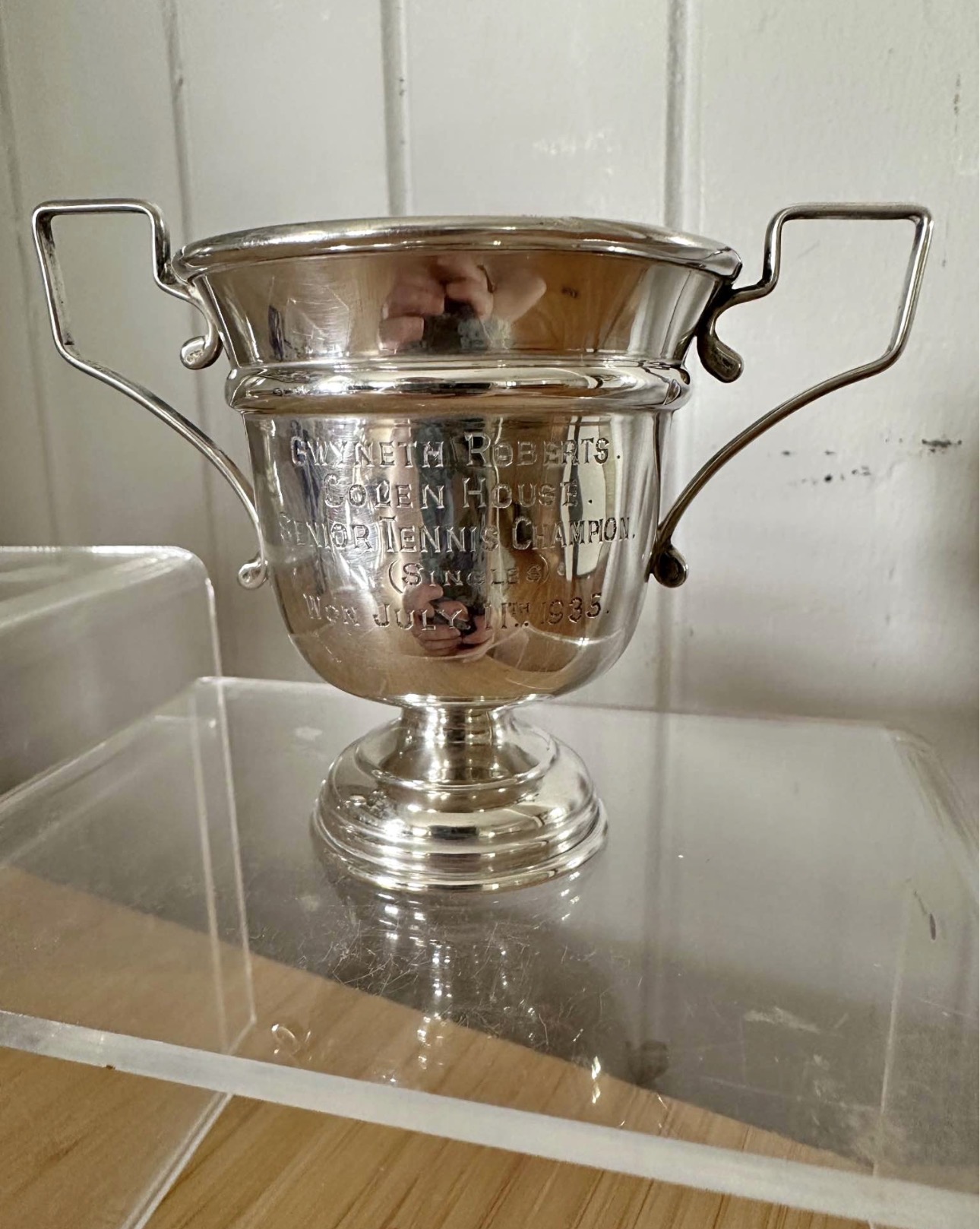
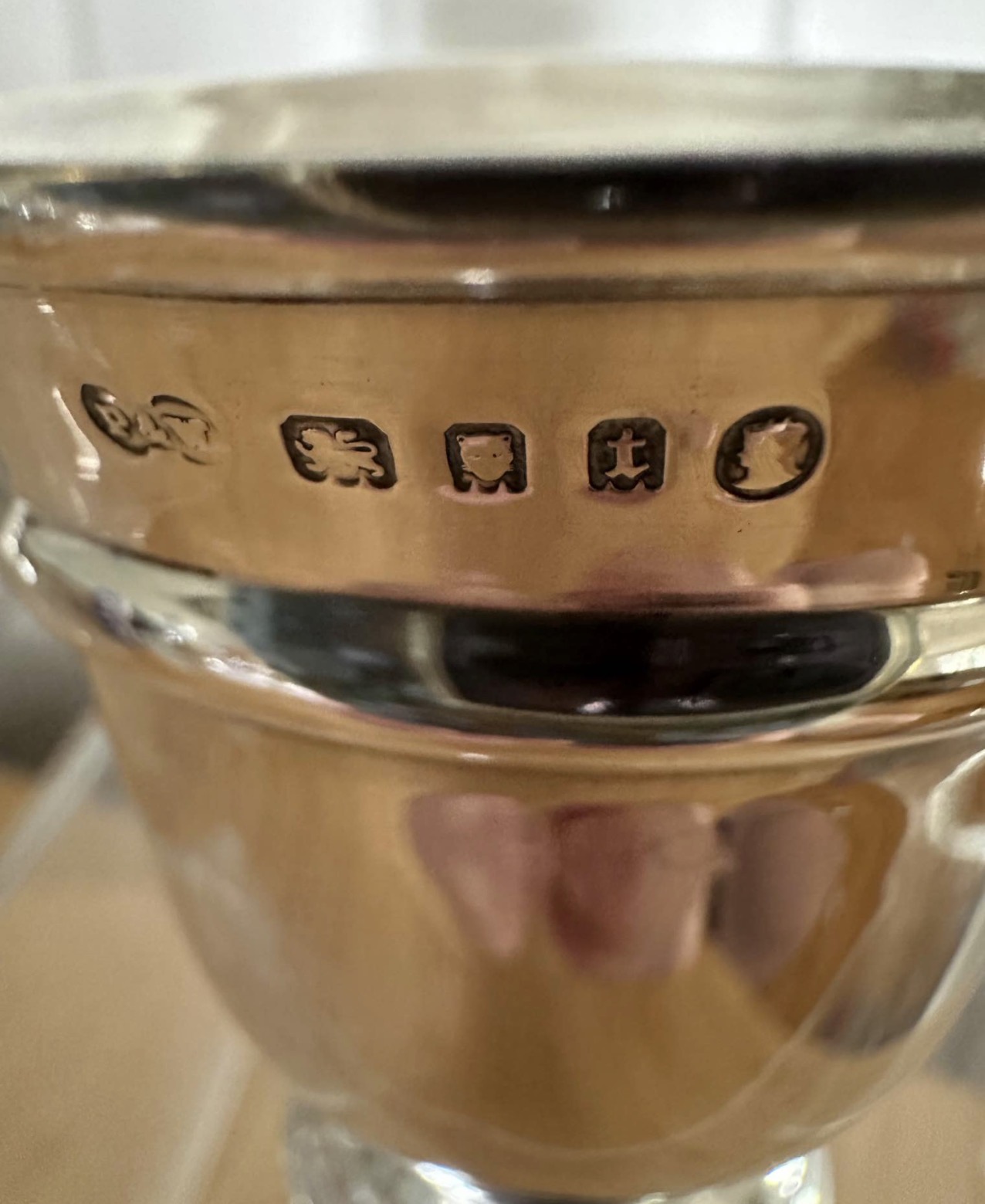
Hi Everyone,
Can I please have assistance identifying these hallmarks? I would specifically like to know the year the trophy was made. Thanks!
Your trophy was assayed in London during the assay year 1934/35 (29th May1934 to 28th May 1935). There would probably not have been much delay between manufacture and assay. It has the sponsor’s mark of Preece & Williscombe, a London manufacturing silversmith company.
Thankyou for your help. Although I had this feedback “Because it is Queen Victoria, it narrows the date of production to her reign (1837–1901)” ??? So why would it be stamped with the queen. What do you think?
It’s not Queen Victoria but rather the combined heads of George V and Queen Mary used as a commemorative mark to celebrate the silver jubilee (25 years on the throne). The mark is much worn but should look like this (from my web site):
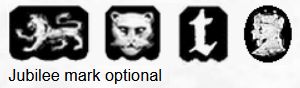
While a monarch’s head had historically appeared on British precious metals to prove a tax or “duty” had been paid for a period until 1890, the Jubilee mark was the very first voluntary commemorative mark introduced in the history of British hallmarking.
This mark was proposed by the goldsmithing trade associations and entirely voluntary. Silversmiths and goldsmiths paid a fee to the assay offices to have it struck alongside the legally required statutory hallmarks,such as the maker’s mark, standard purity mark, and date letter.
The punch was made available by the Goldsmiths’ Company Assay Office and other UK assay offices for a two-year period spanning 1934 and 1935.
Because of the success of this mark the British Hallmarking Council subsequently approved similar special profile marks for major royal milestones, including the 1953 Coronation of Queen Elizabeth II and the 2023 Coronation of King Charles III.
But why both monarchs? It would be difficult to imagine Queen Camilla will ever get her head anywhere even half as interesting as her husband’s is reputed to have gotten his.
Queen Mary died just a fortnight before her granddaugther Elizabeth’s coronation.
She had been brought over from Teck to marry George V’s elder brother who was to be king and who died after she arrived.
Following a tradition first set by Henry VIII when he married his eldest brother’s widow. she married George.
George was brought up to be a naval officer not a king and he needed all the help he could get. His preference was for stamp collecting and shoot pheasants not ruling the greatest empire ever cobbled together.
Upon Edward VII’s death in 1910 challenges for the couple came thick and fast and Mary was involved in solving every one of them. Typical was George and the government of the day sending a British cruiser to rescue his look-alike cousin the Czar after the Revolution in Russia. Mary nixed it, reminding her husband and they were still a German family and in WWI Germany was the enemy so bringing over dethroned Czars was exactly the sort of thing to end the British Crown’s fragile grasp on power. Two weeks later the Czar and all his children were shot.
Earlier she has supported a decision to ditch the German family name for Windsor – a solidly British sounding name and incidentally that of a castle where they lived.
Mary, or May as she was known in the family, also invented the royal walkabout, telling a stiff-necked George if he wanted to keep his throne he’d better mingle with the masses. They did.
And then there was David. Her son the most popular prince ever but a man both terrified and enthralled by woman who, it was predicted by her and George, would ruin the monarchy within a year of taking over. It actually didn’t take him that long
In 1935 George V was nearing death and more and more of the Crown responsibility devolved to Mary.
It was undoubtedly Mary who set the example for her grand-daughter Elizabeth’s long and successful reign .
The people were aware of her contribution.so the suggestion she should be conjoined at the head with her husband on the hallmarks of '34 et seq. silver was an easy sell.
I sort of met her when my Dad got his war gong at Buckingham Palace. In those days there was a tea party in the garden for the masses afterwards and I got in as a very young attendant because of a babysitting failure. Several other children were there and we were corralled to the side and fed fig Newtons and orange squash while the grownups paraded their medals and couponed finery and the ladies high heels aerated the lawn.
Queen Mary was part of the receiving line and had escaped it “to see the children”. So we were inspected. Rather a grubby lot as it had rained the previous evening and everything was damp and muddy. Including us.
And apropos of those of us who spend far too much money on 300 year old silver items with little modern practical application, King George, an avid stamp collector was asked by some lord or other whether he had noted that “some damned fool had paid 1400 pounds for a single stamp”, to which his Majesty replied, “yes, I was that damned fool.”
Was that the Mauritius Two Penny Blue?
I seem to recall at some point the capital resale value of that tiny shard of paper exceeded the annul GNP of the Islands?
I wonder if someday we silver collectors will seem as quaint as stamp collectors of the 20th century now appear to many?
Correct.
And Mauritius is doing rather well these days and is one of the wealthiest and most developed of the African nations. I wonder if they still have any 16th c Portuguese silver?
There’s a lot of things I’d like to be. Quaint isn’t one of them. And on the plus side for stamp collectors, at least you can’t melt down that Mauritius 2d Blue.