i had always understood that couples represented their initials by putting their surname above their two first names.
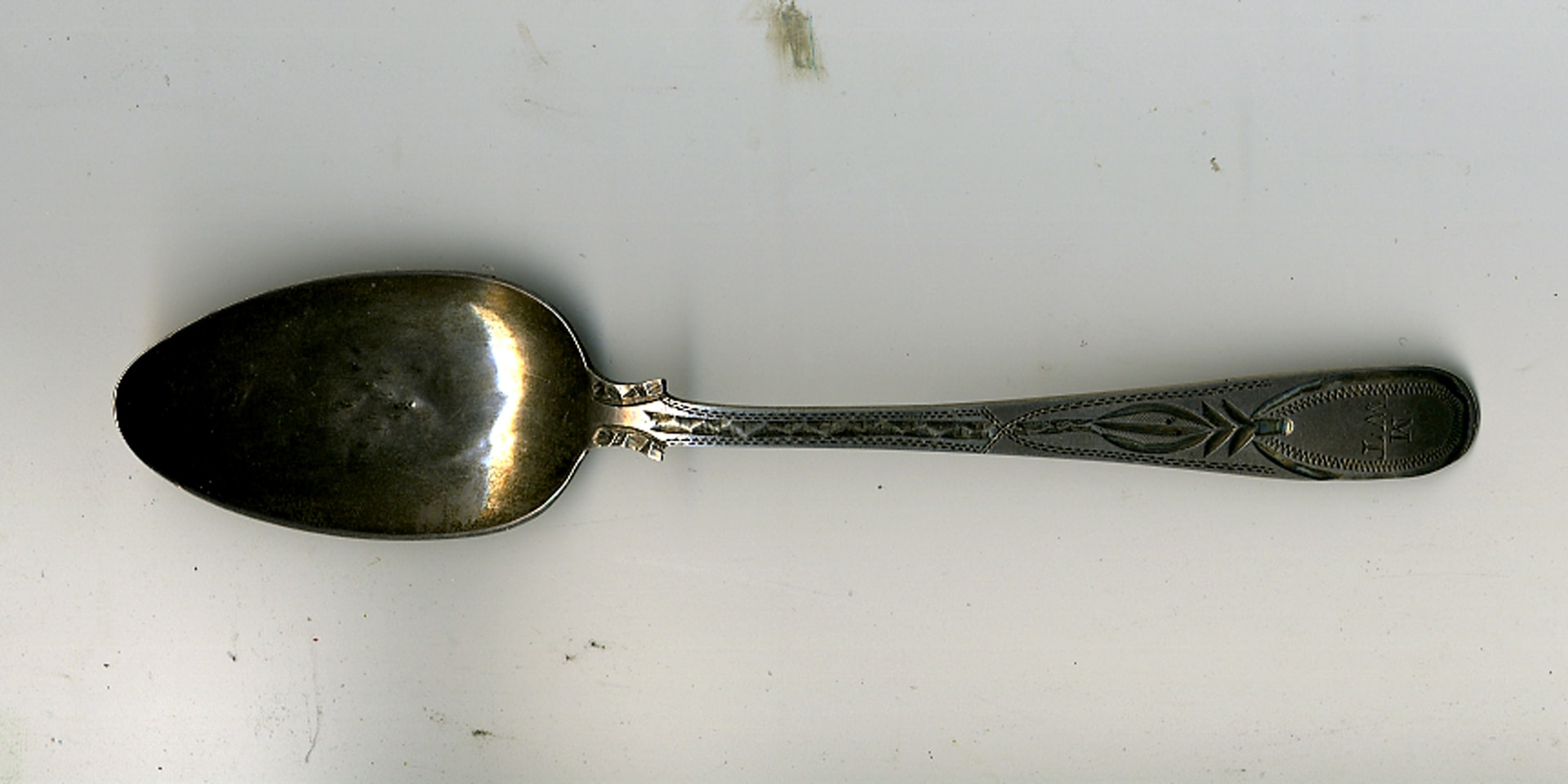
The c1790 spoon is supposed to have been owned by William and Mary Treeby (married 1785). Is this possible?
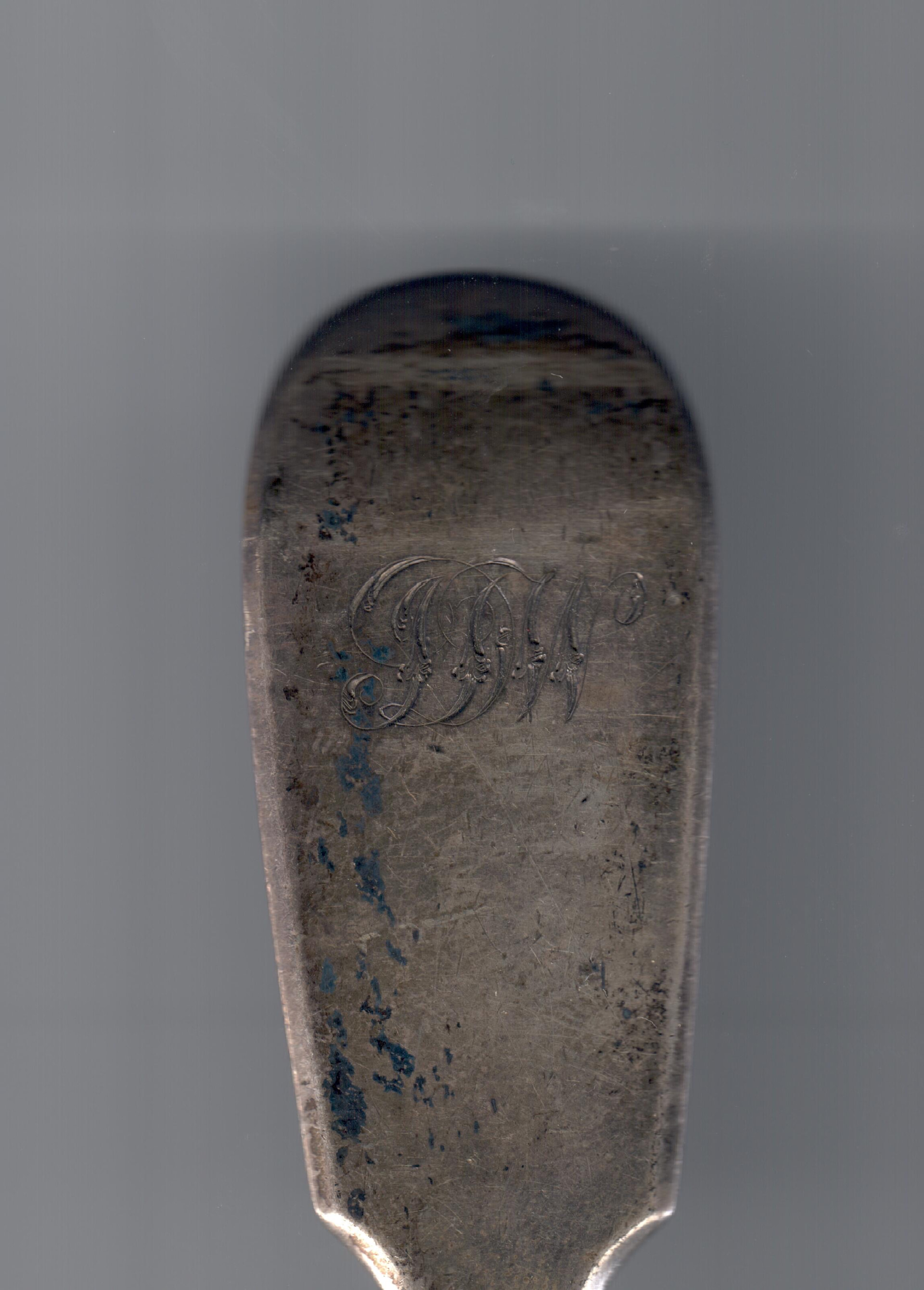
The 1846 spoon, where the initials look loke JDW, is supposed to be owned by John and Dinah Webester whop married in 1847. Is this possible?
If you are asking whether the people you quote would have owned these spoons then I have to say that I think it unlikely. The c1790 spoon has the wrong configuration of initials and the later spoon (in my opinion) would more likely have been owned by one person with the 3 initials JDW. Of course it is not possible to give a definitive answer with 100% certainty…
Yes, thanks, I agree with both thoughts.
It just seemed such a conincidence, especially with the 1790 spoon which I know was inherited through he daughter of William and Mary Treeby, that I wondered whether anyone had come across a spoon with initials arramged like that.
The JDW is less certain, but I haven’t found a JDW individual and the marriage fits with the date and family.
Richard
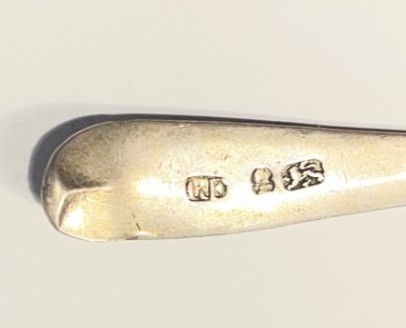
You don’t really need a silver expert but a genealogist.The assay marks on the two spoons were not disclosed, but had they been, I wonder if the Treeby spoon would be west country, Treeby being a quintessential Devon name? If so I am wondering if your forebears hail from Brixham?
The plain fiddle spoon with three initials will be harder to track. But it will have occurred to you that John D. Webster might have decided to immortalize himself on family flatware?
While everything that Phil of www.silvermakersmarks.co.uk states is entirely accurate, west country folk did indeed have a habit of putting a lot more data on silver than Londoners.
Sometimes inscribed on Exeter assay-marked spoons in the 18th and even 19th century are duplicate initials, wedding dates and even subsequently-welcomed childrens’ initials. The pattern-work or brightcut on the earlier spoon looks later than the spoon given it is 18th century spoon as you have discovered.
Might be helpful to post the entire of the two spoons and their hallmarks.
CRWW
1 Like
Well that’s good, because I am a genealogist!
Thanks for your helpful comments. I think I may have to give up on the later spoon (London 1848) as I have no evidence that it definitely comes from the Webster family (there is another starting with W that it might be). There is no-one in either family with the initials JDW and neither John (nor his son John nor father Joseph) ever had a middle initial on documents.
However the older spoon is worth taking further. There is no date letter, but there is a family story (possibly wrong) that links the spoon to Susan Treeby, daughter of William and Mary; and William (a miller) left Susan six silver teaspoons in his 1834 will. They are a Devon family (Modbury).
The 1790 date may be wrong, but someone who knew more about spoons than I did gave that as an estimate and there are similar spoons online (although the book on spoons I have suggests it may be closer to 1770).
Of course, the spoon may just have been bought with those initials…
Richard
2 Likes
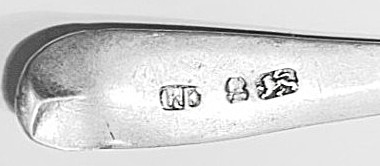
The photo is of poor quality, and the symbols are blurry. Gently clean the markings, especially the artist’s initials.
We’ve got standard mark and duty stamp. Initials are illegible.

2 Likes
I’m not sure I can get a better photo with what I have but I’ll try.
I’ve always read it as RF for Richard Ferris, but that may just be because the dates work.
Whoever he maker was, the real issue was whether an M over a W and T could ever represent anything other than a Mr W M marrying a T.
Richard
2 Likes
Yes, RF is Richard Ferris and it’s an Exeter mark so that ties up with your West Country ancestry. However it is later than 1790 as that lobed form of the duty mark was not introduced until 1797 and was in use until 1809. The lack of an Exeter town mark does not tie the date down any more precisely.
2 Likes
If William and Mary married in 1785 and the spoon was produced at least 12 years later that decreases the chances of it being a west country marriage spoon.
At least not for them.
But while sometimes we can use owner marks on silver to confirm genealogical data or even trigger an avenue of exploration for ownership it is difficult to rely too much upon it without specific family crests or idiosyncratic initial arrangements.
We lack either here. If you have your family tree unfurled on one of the heritage or ancestry sites you are in a much better position than us to resolve the mystery!
But at least you have discovered you have a turn of the century OE spoon and a very nicely decorated one at that.
But when those initials were added and for what purpose is probably not something that this Forum can take much farther but thank you for sharing and do let us know in you solve the riddle.
CRWW
I forgot to mention the initials are probably not inscribed at the same time the brightwork is done.
This post of a similarly-decorated spoon by Ferris on another Forum shows his shop was producing pre-decorated spoons for retail sale at which point, or later, the buyer might add his or their initials.
CRWW
1 Like
Thanks for all the help and suggestions.
Clearly not their wedding spoon so the reason for the initials will remain unknown . I feel the T must be for Treeby but who knows.
The tree is long established but I was just trying to (dis)prove the family legend that Susan eloped taking only this spoon! It seems unlikely given that she was named in her father’s will but we’ll never know
R
2 Likes
Interesting. Her elopement with cutlery gives a whole new meaning to the verb “spooning”.
At some point the Treeby family arrived over here and fruit farmed in the Grimsby, Ontario area.
Proving perhaps, once again, that it’s not only apples that don’t fall far from the tree(by)
CRWW
1 Like
People have been severely flogged for better puns.
2 Likes
Yes, well even the lowliest of wordsmith-ing has its rewards. If that’s your sort of thing.
pip pip!
1 Like