18th CENTURY DUTCH FISH SLICE

Hello! We have what appears to be a Dutch fish slice from the 18th century. It was my husband’s grandmothers and has been in an attic for the past 50 years. The server has a wooden handle that is 5 1/2 inches long. The total length of the server is about 13 1/2 inches, and it is about 3 1/3 inches at its widest point accross. On the front there is a crowned v in a shield, which I believe is the Dutch tax mark.
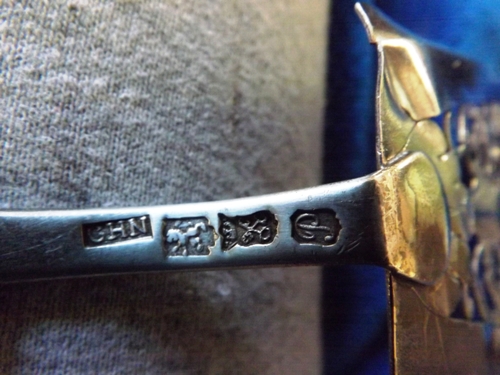
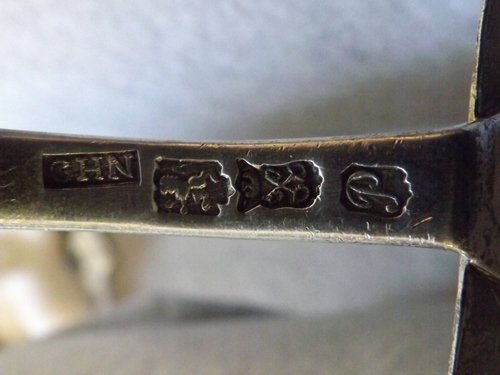
The following marks are on the back of the handle:

1.) GHN in a rectangle. 2.) Lion Rampant in a shield 3.) crossed keys under a crown in a shield. 4.) Script P in a shield.

I’m a complete novice at this, but from what I’ve researched the maker is Gerardus Hendrikus Nieuwenhuyzen…Leiden, Holland, 1797. It looks like its in good condition to me for being over 200 years old, but again, I’m not a collector, so not sure. I’ll try attaching pictures. If anyone is able to confirm the information that I found out, and has any idea how much this might be worth I would SO appreciate it.
THANK YOU!!! :slight_smile:
(I can not add the pictures from my IPad, so I will try to post them from my computer in a few minutes)
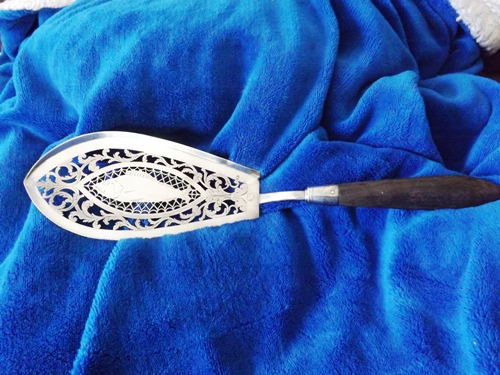
Here are the pictures of the fish slice…
DSCF2395b.JPG
DSCF2401b.JPG
DSCF2394b.JPG

1 Like

Dutch silver hallmarks and year letter chard 1814-2009 and beyond - www.925-1000.com

1 Like

:+1: - - - - - - - - - - - - - - - Confirmed.

1 Like

Pretty piece, loving the fish detail :wink:

1 Like

Check the date on the original post. You might be talking to a phantom. :wink:

1 Like

Value: At auction probably around $US500 to 800. At retail or on Ebay, which seems to be sort of retail, might see it go higher and in a good store where the merchant knew how to tell the story of your grandmother’s slice you might well see north of a thousand.

So exactly what is the story of a fish slice? And it’s about here I get accused of waffling by my critic on this site so I will keep it succinct.

The Q&A in London which has an excellent collection thinks the British invented fish slices in or about the 1730’s.

When fish slices first turned up they were more like trowels or pudding or cake slices, triangular blades with a wood or bone handle.

This fine piece is a direct adaptation of that early form with the handle joined to the middle of the body of the slice and the triangle reversed so the apex is nearest the handle.

This form continued into the turn of the 19th century when the Knights, London silversmiths occupied the field to the point where in some circles fish slices stopped being called fish and became “Knight slices”.

They also pioneered changing the form so the blade was designed for a side not a point scoop and the handle became silver not wood or bone.

By the middle of the 19th century every self-respecting American flatware set included a pair of fish servers (note the nomenclature has changed) and the Belle Epoch wouldn’t dare display a sideboard without a footman or two armed with a pair of servers in attendance.

It became a joke. One best exploited by 20th century English writer PG Wodehouse in his Jeeves series who made the fish slice the go to wedding present for his main character, Bertie to offer when one of his Drones Club friends tied the knot.

It is only natural that two competing 18th century nations, the Lowlands which by rights should be three fifths underwater and the UK which is surrounded by the stuff and owes its independence to water should lead in the fish slice stakes.

Here’s a Bateman fish slice of similar vintage which because of CITES concerns went into the Canadian collection at an affordable price. It was sold before the big bump. But if I had it today it would be on offer for four times purchase.

CRWW

1 Like

Oh dear :flushed_face:, I see dead people :ghost:

1 Like

Me 2. :rofl:
haley-joel-osment-i-see-dead-people

1 Like

I often wondered about that too. The ability to have useful conversation with dead people. Hamlet managed it and not just about “Poor Yorick” the court Jester of childhood memory

In Canada we had a prime minister who conversed each evening with his deceased mother and used her advice to get the country through WWII and the Depression. I wonder if the great attraction of many religions – especially the ones that believe in an afterlife-- is that you can chat with those who have “passed on” .

I think we have a fair amount of time for the deceased as they are generally far more predictable, less self-absorbed than those of us still clinging to this mortal coil.

Much of this site is preoccupied with the work product of silversmiths who have long since put down their planishing hammer, traded in their furnace bellows and folded embossing tools into their leather cases for the last time.

I dare say for every inquiry about a living goldsmith there are a hundred or more about the deceased. Why exactly do we care so much? It cannot be because we wish to learn anything from them as humans seem to be the only species on the planet which does not absorb and use data of past experience to inform current conduct.

Even the mallard on my pond have learned to stay again from the sucky bit of water at the end of the pool where the recycled water goes. Humans, in between declaring war on each other, would have to stick their toe in the down-pipe generation after generation.

CRWW

1 Like