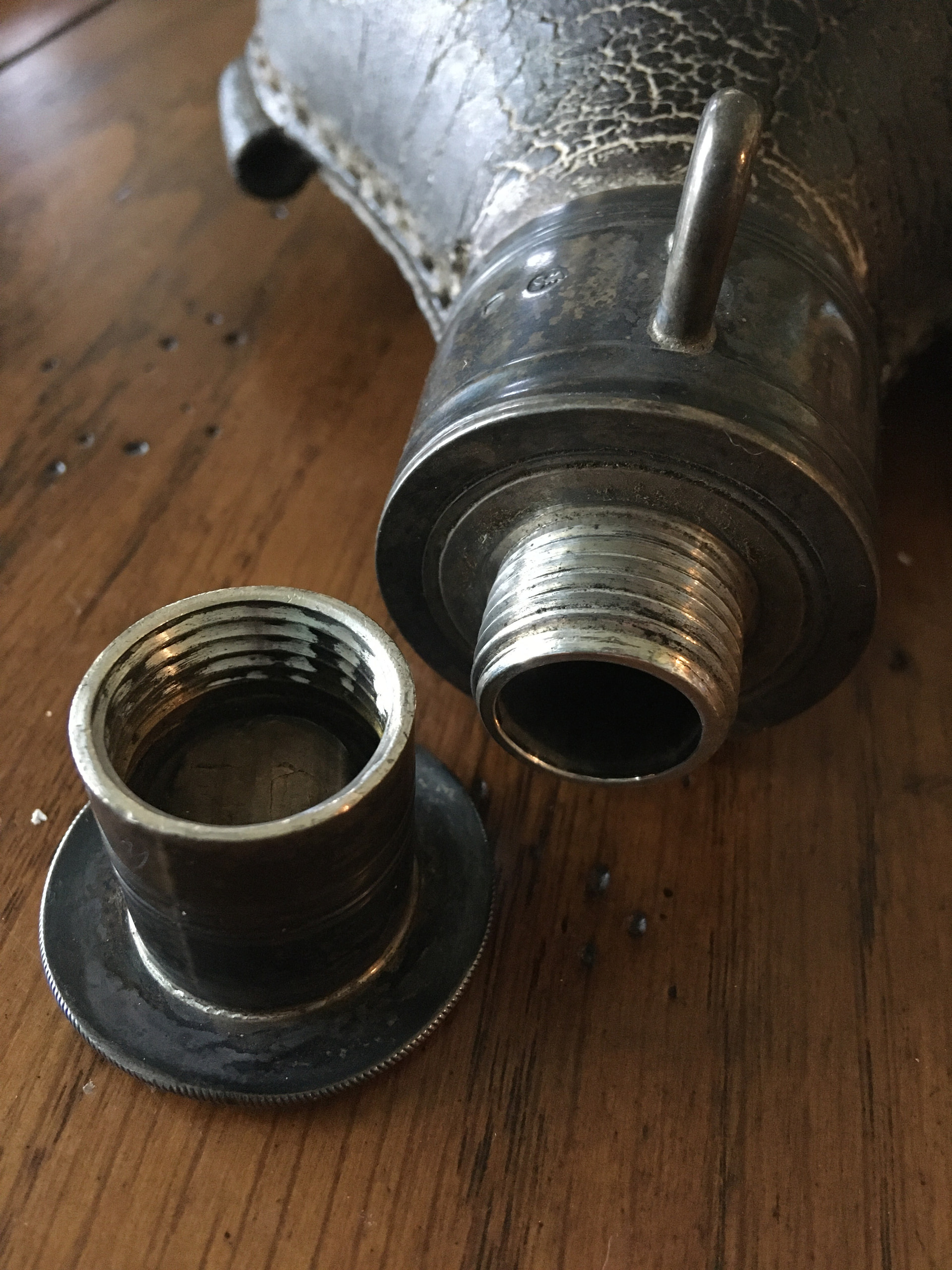
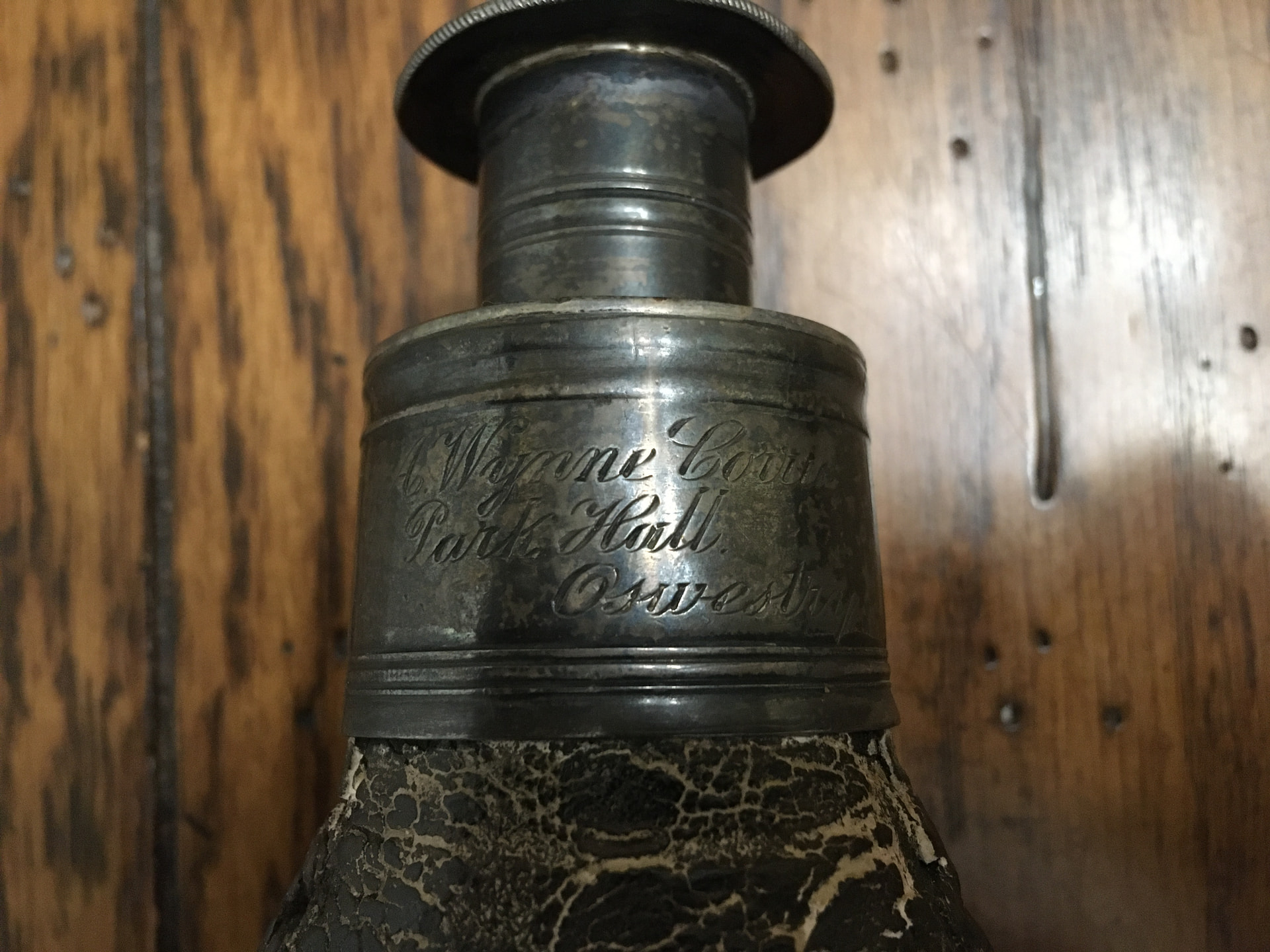
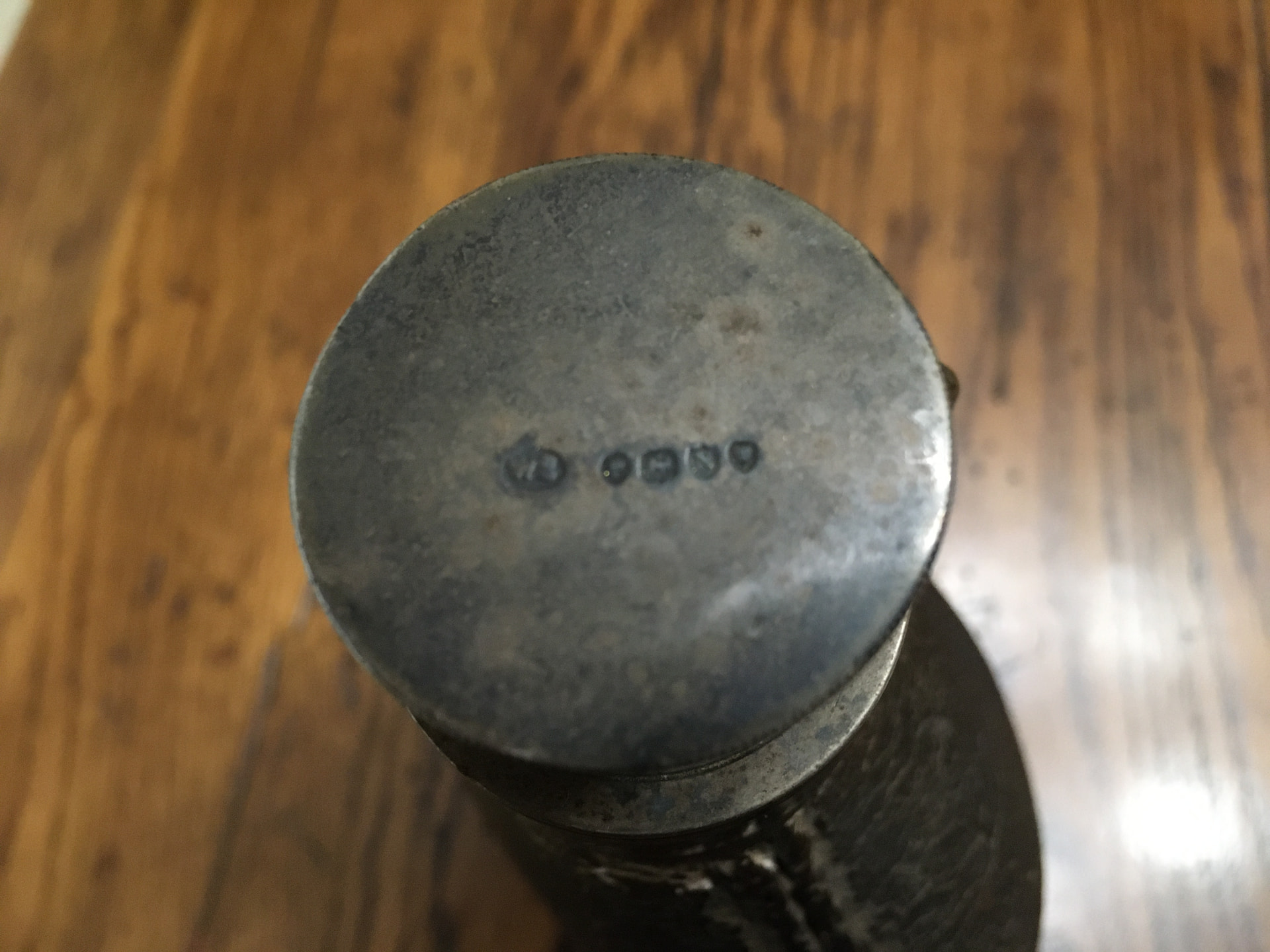
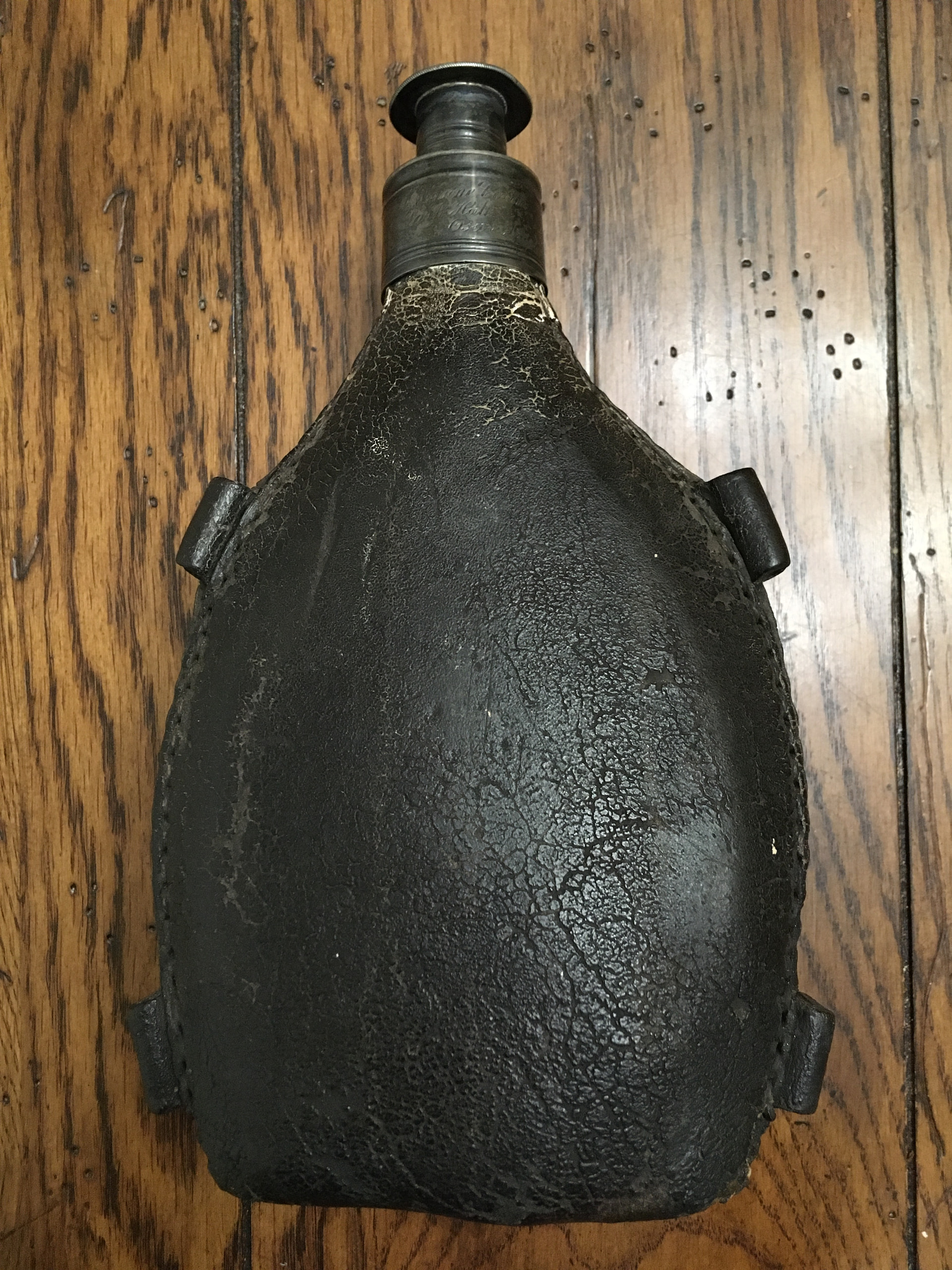
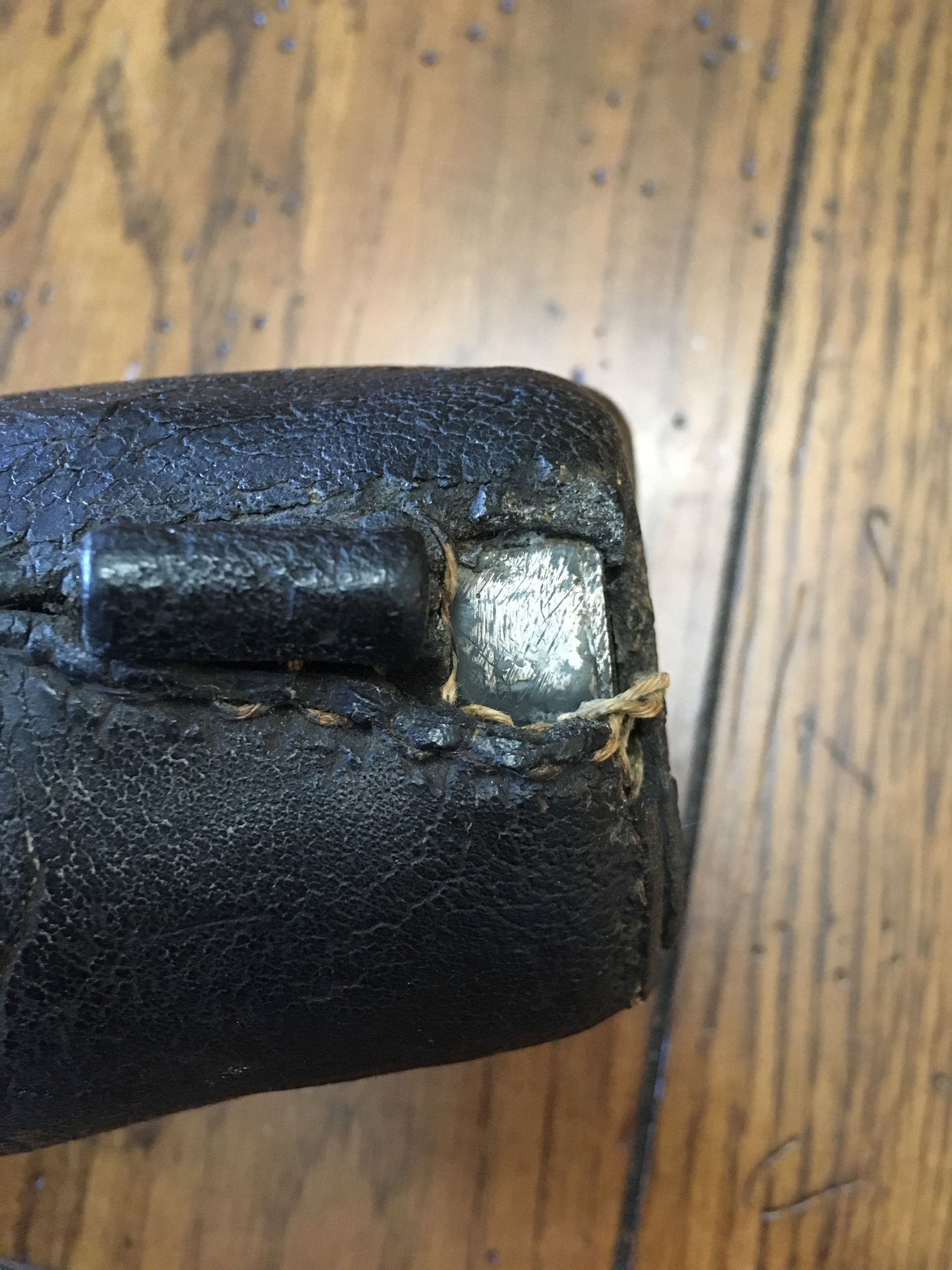
This large, 2 1/2 lb., sterling, leather bound flask was made by William Summers in 1888. It is in the form of what I believe to be a British, 18th century, powder storage flask. All the examples of those I have seen are brass.
The rifle and powder flask folks I have visited with acknowledge the form but suggest the flask is for liquor, not powder. It’ll hold a litre of your favorite booze. It won’t fit in your jacket pocket.
This flask once belonged to a distinguished member of the landed gentry in western England. Major Alfred Wynne Corrie, esq., a mayor of Oswestry, a Sheriff of Shropshire.
My questions are, has anyone seen a sterling flask similar to this? Was this common with British gentlemen, to craft a spoof shooting flask as a drinking flask?
2 Likes
The answers provided on the other forum November 11th, 2022 by “Shelby” clearly didn’t cover the ground adequately for you hence your renewed inquiry.
It is certainly modeled as a black powder flask and it does seem to have been converted or devised to hold liquid of some sort given the neck and stopper.
Park Hall’s pheasant shoot closed down. I do not know if that was related to unfortunate shooting accident there in September 1975.
I recall being invited to shoot there twice in the early sixties. The owners were Shropshire neighbours of ours and I think the shoot was then in private hands. I don’t see any record of the visit being reciprocated in my grandfather’s game books.
This flask is capable of containing, as you note, something in excess of two pints of liquour so I wouldn’t want to be walking up game in line with anyone consuming that much booze of a Saturday morning, far less to be in the beater’s ranks facing him!
I would suggest a novelty item manufactured for and presented to a generous host.
Mrs. Wynne Corrie purchased the Park Hall estate in Oswestry in 1870 . While the Corrie family held the estate for some time. Major Wynne Corrie handed the camp over to the military at the beginning of WWI and eventually sold the 487-acre estate.
So short answer: I don’t think it is suitable for either drinking or shooting, much less drinking when shooting!
CRWW
1 Like
I looked through auctions for other examples of novelty flasks by William Summers and came up with this one; a long cylindrical flask in the shape of a telescope dated 1867.
Here’s a story of hip flasks selling in the US. Prices realized reflect a strong collector market:
When Flasks Were Hip - The Hunt Magazine.
William Summers was a noted 19th-century London-based silversmith known for crafting high-quality, solid silver hip flasks. His works are highly collectible, with examples dating from around 1872 to 1880, representing the peak era of personalized, luxury silver flasks until prohibition in the US saw their rapid revival in the next century.
He was a London silversmith, free by patrimony in 1826 as a goldsmith and jeweller. He entered his first mark entered as gold worker in 1826, his second as a small worker, in partnership with Edward Rawlings in 1829 then six new marks starting in 1840. He was granted Livery by the Guild in 1850. Grimwade describes him as a maker of good quality snuff boxes, wine labels and other small items and does not refer to the flasks that today seem to be a large part of his surviving stock-in-trade. His four sons; William, Edward, James Lea and Henry were all free by patrimony between 1858 and 1866.
The last reference to him is in 1891 attributing a table lighter made, according to Hawleys, the Auctioneers, at 12 Vigo St. in London by his company. www.silvermakersmarks.co.uk also suggests 1891 as his last hurrah.
CRWW
1 Like
Thank you very much CRWW,
All well put.
I appreciate you sharing the pheasant hunting stories. I read in Oswestry’s online archives that the Major hosted hunts at Park Hall. Apparently on one occasion a fellow gentleman fell ill and died on one of those hunts.
Perhaps the old flask was a silent witness.
At any rate, the flask shall stand on a shelf in the library and continue to stoke imagination.
Again, thank you for your time in responding. Us Americans don’t really have a solid grasp on the upper class world in Victorian England. The best we have is Downton Abbey. Fun note, a former matriarch of the actual property featured in that series was a Wyoming (my home) girl, Ms. Jean Wallop.
2 Likes
I’m definitely not the right guy to explain the UK class system to you. But Downton pictured a way of life that disappeared with WWI when Lloyd George introduced wealth tax and the mercantile class took over after the county set immolated itself or its sons in the trenches.
At that point the iron masters, the brewers and the mining engineers took over the country and bought up many of the estates. A new top group to replace the lot which had made their brass out of slavery and colonial endeavours like selling opium to the Chinese.
Unlike France which had a revolution, replacing the aristocrats with middle class people, the Brits had had their revolution a couple of hundred years earlier, executed a rather annoying Stuart king and then decided that republics had their flaws too and went back to kings.
Logically they should have had another revolution about 1920 but the war had exhausted appetite for violence – unless you happened to be Irish — and the Russian Revolution has scared all the people in power so much they decided the best thing for it was to include the working folks in the running of the country, a policy which bit them in the proverbial after the next war when Churchill was voted out and the Labor Party took over introducing social welfare and health care.
Of course that failed too, because the country was in debt to the US and Canada for the war effort and by the eighties, Mrs Thatcher took over and things go so bad she had to declare war on Argentine to take people’s mind off the poverty.
CRWW
1 Like