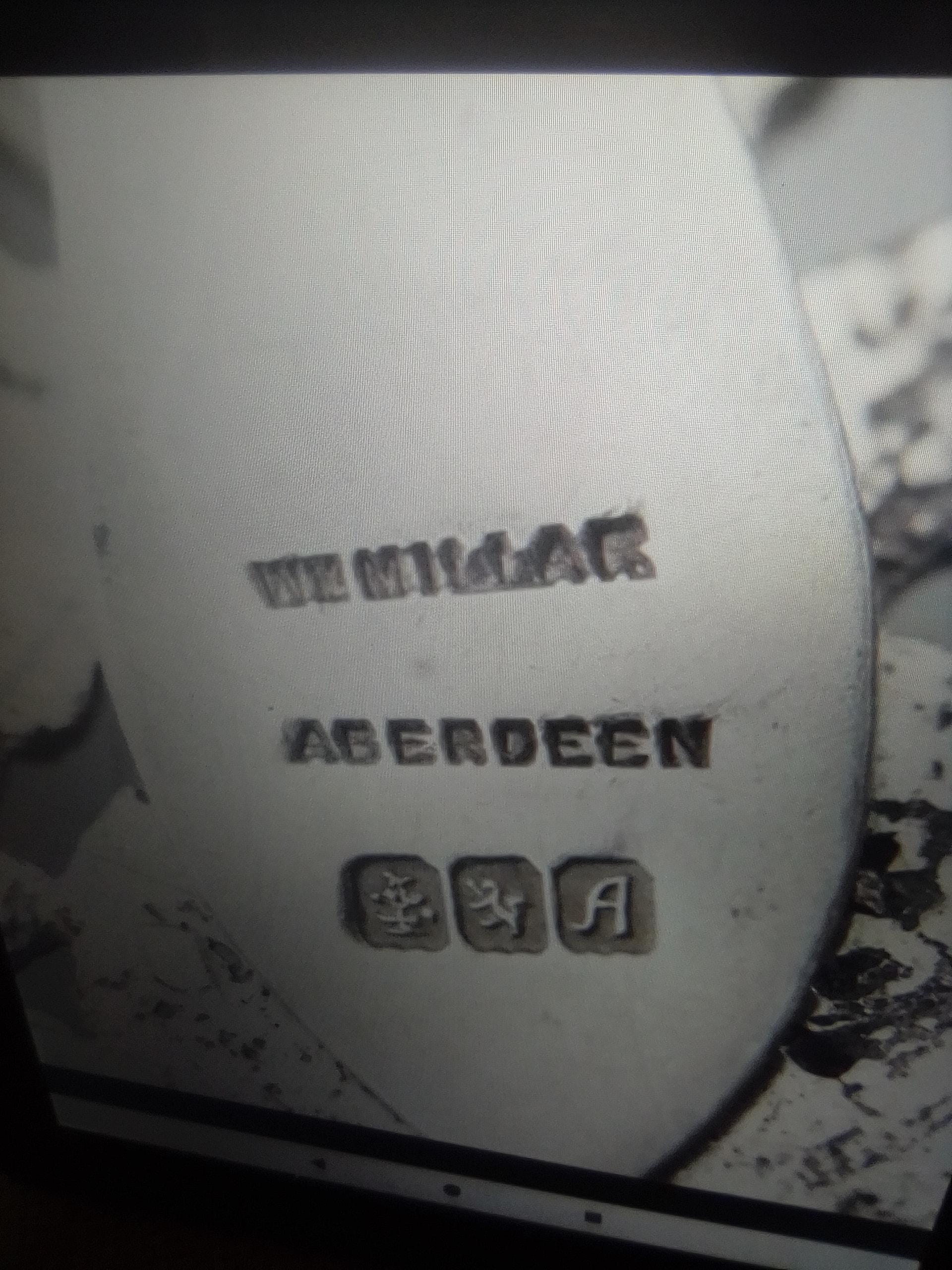
Hello have hall marks for a WM Millar of Aberdeen but cannot find him in the provincial makers marks the one I have found is in Dundee but wrong years the A is for 1897 (yes) the first one is for Glasgow the funny lion matches the year
Any help most welcome thanks in advance
1 Like
I don’t think Millar is the silversmith in this case. I believe W. Millar operated a well-known retail establlshment on Union St, Aberdeen, in the late 19th Century, and stamped his name on all sorts of things that he sold. There doesn’t appear to be an actual maker’s mark on this piece, so the hand that crafted it will probably never be known.
ETA: And I agree that the hallmarks are unmistakable - lion rampant for sterling (unlike the lion passant seen on pieces from the English assay offices), Glasgow, 1897. Glasgow and Edinburgh were the only Scottish assay offices - there wasn’t one in Aberdeen.
2 Likes

MILLAR Andrew
active c. 1871?
2 Likes
I don’t think that’s relevant. Walter Millar was a fruit merchant, not a silver seller, he apparently conducted business in Glasgow, not Aberdeen, and he died over 20 years before this piece was assayed. Millar is a fairly common Scottish surname.
ETA: Scottish provincial silver was generally not presented to one of the assay offices, like Glasgow. And Glasgow makers’ marks don’t have the maker’s name spelled out, along with the city - they’re more like typical English makers’ marks, i.e., just initials in a punch, the same size as the assay office marks.
2 Likes
Yeah, Jeff, I understand. I just tried… 

2 Likes
William Millar was a jeweller who began his career at M. Rettie and Sons on 131 Union Street, Aberdeen’s only surviving jewellers ln the city directory making his home at The Cottage, Bridge of Dee.
Source: Aberdeen City Directory 1897-8
If there is a connection between him and Andrew Millar shown as an Aberdeen silversmith in 1871 in the Old Town directory it is not yet recorded in the geneology data on line and is unlikely.
William Millar was only an employee of Rettie & Sons not one of Middleton’s 10 children or married to any of the female children.
It is apparent he adopted the practice of his former employer and emblazoned his store name on items sold by him.
It is also true that by the end of the 19th century the era of the small Scottish silversmith is over, chased out of the market by the mass production of domestic silver enabled by steam driven machinery employed by better capitalized firms in larger communities.
The Glasgow Assay office does show an 1891 “W.M” mark which www.silvermarkermarks.co.uk does not identify as William Millar but the date is right and at some point Millar will have had to have been approved by the Assay office there and assigned an alphabetical punch to have slipped this trademark-only spoon through the system there.
CRWW
1 Like
Yes, he might be the unknown W.M., but in the absence of a mark to compare it to…
It would be helpful to know if the object in question is a spoon - that would make the connection a bit more likely, at least.
1 Like
The interesting point about the Glasgow mark, which may well have been Millar’s, is why bother when he opened his own store and why didn’t he continue to bother six years later?
Was it general policy change or was this something else? He pays the duty to the British Crown when the assay mark’s applied regardless of the absence of formal punch mark so it’s not duty dodging so we need another explanation.
CRWW
1 Like
Perhaps he was taking advice about setting up his “operation” from Doug and Dinsdale Piranha.
2 Likes
Always good to meet a Python fan.
While the Glasgow office was closed in 1964, its records are at the Edinburgh office so the ownership of the W.M. Glasgow mark is probably capable of being verified.
CRWW
2 Likes
Thank you jeff for that thought as much after I couldn’t find him under maker
Thank you for confirming and telling me the jeweler ,
1 Like
It might be worth taking a run at the Edinburgh assay office. They might be able to shed some more light on it.
1 Like
Thank you jeff I think you nailed it I don’t think the Edinburgh assay office will turn up any more information then you .The piece in a auction was seeing if the piece was made by a provincial silver smith would have been worth having a go at it .The piece is nowadays not used it who have been on the house keeps belt a chatelaines
1 Like