Hi , I have a ladle with this hallmark. Any ideas? Thank you
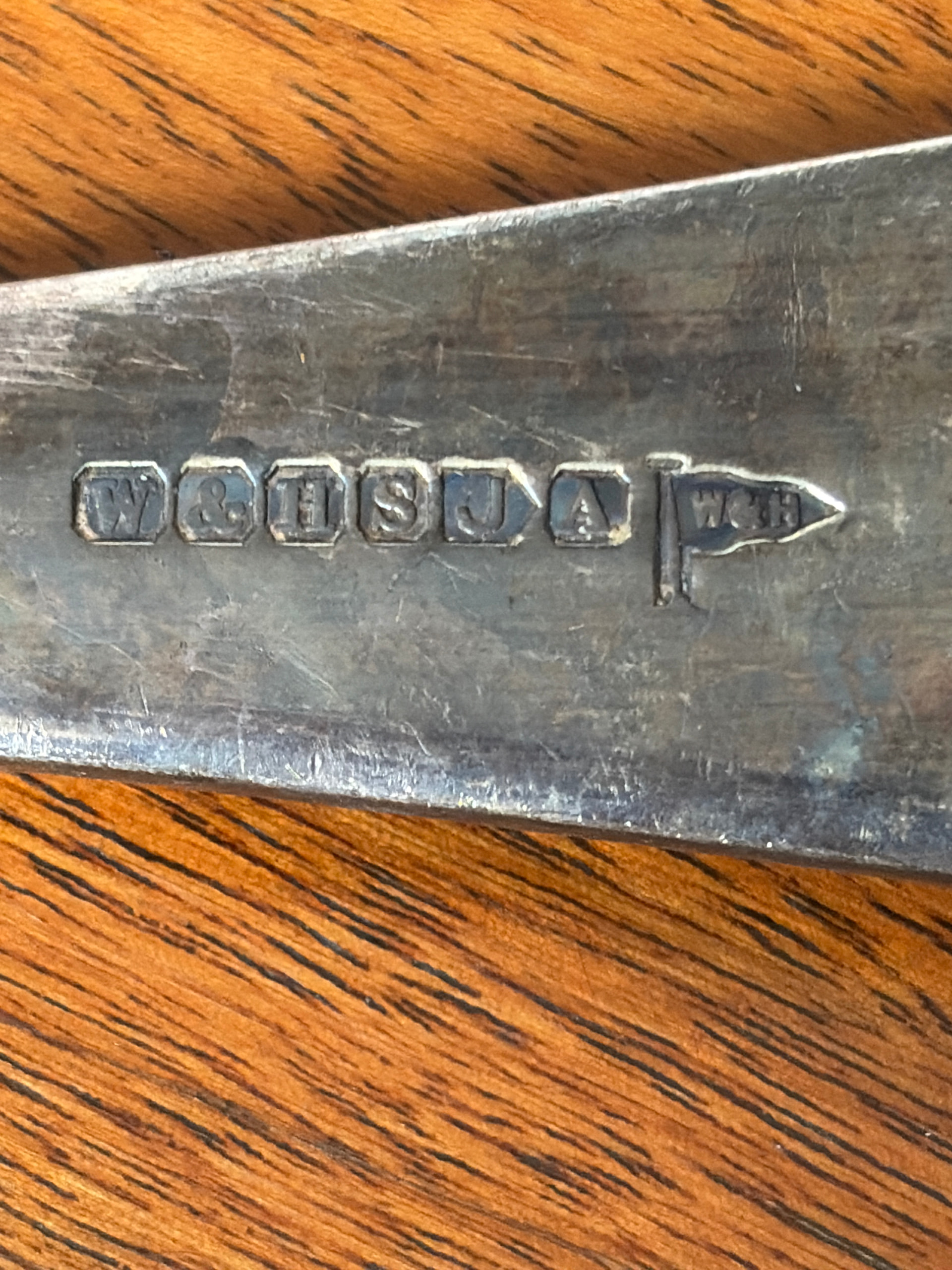
Walker & Hall, Sheffield,1845, George Walker who secured the royalty of electroplating for Sheffield. The business was joined by Henry Hall and became in 1853 Walker & Hall at Howard St with showrooms at 45 Holborn Viaduct, London followed by Liverpool, Manchester, Leeds, Glasgow, Edinburgh, Newcastle, Cardiff, Belfast, Hull, Bristol Then abroad to Melbourne, Sydney and Adelaide, Cape Town, Wellington, Auckland, Christchurch and Dunedin in New Zealand. The business was converted into a limited liability company in 1920 under the style Walker & Hall Ltd. “S” is for Sheffield." A" is the quality of plate and “J” is a batch code probably 1938.
CRWW
1 Like
George had travelled to Birmingham to secure the right to produce electro-plated goods in Sheffield from George Richards Elkington and his Brother Henry who held the master patent for commercial electroplating, developed by John Wright from whom they had purchased it outright.
The Elkington Brothers’ British Patent 8447 was approved in 1840 for “Improvements in Coating, Covering, or Plating certain Metals”. The process used potassium cyanide as an electrolyte to deposit gold or silver onto base metals.
They registered several patents between 1836 and 1840, including a US patent US741A in 1838 for an improved method of gilding copper and brass. The 1840 patent expired in 1900.
The license fee was £150 per annum (modern equiv. c. £20,000) for the right to deposit 3,000 oz. of silver. For any amount exceeding that the license required a payment of 1s per oz..The terms included a 10% royalty for gold deposits.
This license was financed with capital advanced by George Walker’s brother-in-law, Samuel Coulson a school master in Chesterfield.
Walker & Hall grew to be one of the most prominent 19th-century silversmiths, eventually merging in 1963 to become part of British Silverware Ltd, along with Elkington & Co from whose directors they had purchased the original licence to electroplate which allowed for the creation and profit of the entire company.
CRWW
1 Like
What I had never realized until reading this Elkington patent is it was also foundational in the establishment of early forms of photography.
Patent magneto silverplate, produced from 1843 in Birmingham under this patent “…offered three significant advantages to the daguerreotype process in comparison to both clad silverplate and standard electroplating techniques in use at the time, which used a higher voltage and faster rate of deposition: it was softer, purer and more photo sensitive.”
I realize we are drifting far from your ladle but the process that produced the ladle had also pioneered image-making in the early 19th century.
Of course that advance was quickly eclipsed by photographic processes which are the basis of what we use today now employing digital pixel count rather than shadow and light without which this silver forum could not exist.
So from Dr Wright’s work on disease control resulting in a patent he sold outright for £300.00 to a Birmingham metal-banger who wanted to turn base metal into something finer, to a Chesterfield school master’s savings to Walker & Hall an international company with stores throughout the Empire to modern photographic processes to … whatever is next.
CRWW
1 Like
Wow, how interesting ! Thank you.
1 Like