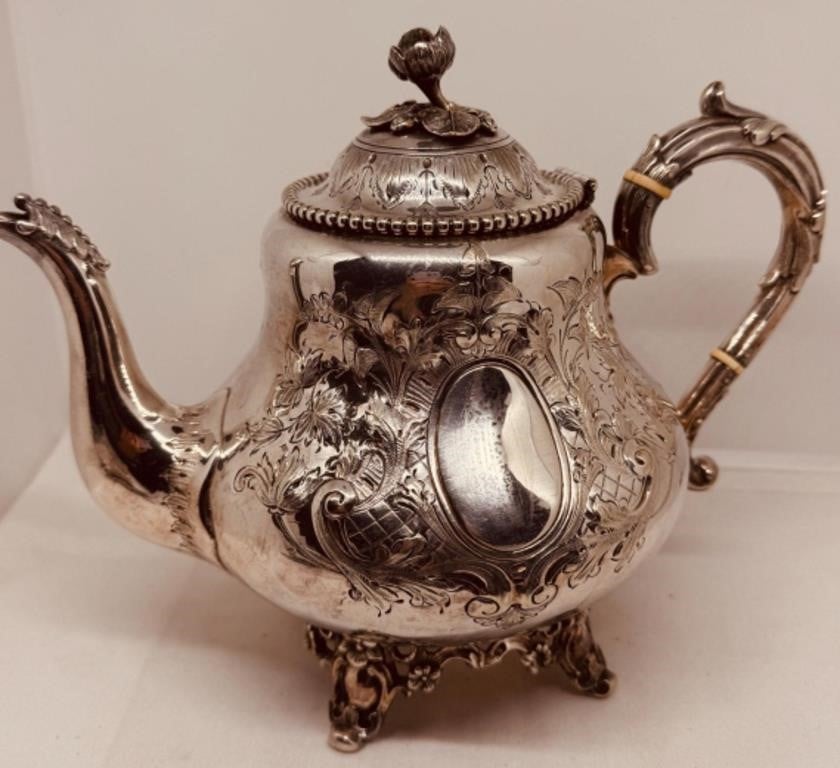

I’m guessing with the absence of a proper hallmark that this is silver plate?
Yes, Keith I think that’s a safe bet. But the cataloguers get onto less firm ground when they attribute this mark or a variation there of:

But before looking at what they think it might be let’s look at the teapot itself. Classic shape with the flower and leaf finial which first found popularity in the trade in the 1820’s and it’s probably part of a four tea set.
Let’s presume it’s neither European nor American and concede it looks exactly like the sort of product coming out of Sheffield and Birmingham after the Elkington’s licenced their patent for electroplate
Here’s what silver collection.it says it might be word for word:
"William Batt from 1861 active at 69 Broom Spring Lane, Sheffield. In 1863 the business became William Batt & Sons (John, Joseph and Thomas Batt).
“In 1866 John Batt retired from the partnership and the activity continued under the same style by Joseph and Thomas Batt and Francis Howard. Later (c. 1895) the firm was managed by Thomas Nowill Batt at 17 Sycamore St, Sheffield. The firm used (possibly) the trade mark four star.”
“The “WB into heraldic shield” is the same used by William Batt & Sons (attribution confirmed by the presence of the figural trade mark with crossed cricket bats). The incongruous “L” (London) could be justified by the London interests/connections of the company which registered hallmarks in London Assay Office in 1895 (TNB for Thomas Nowill Batt).”
And then he ends with “This attribution is undocumented and hypothetical”.
Now go back to your mark. It’s what someone once called a “stutter mark” where the plater hits the pot twice, having failed to make the first mark deep enough to account for the curvature of the target plate and seeing the end letters bleed off into oblivion. Remember this is plate so stamped first then a micron or two or pure silver coated over the pot and the stamp.
If we are okay with the W and the B in shields, what’s this strange mark which appears to be on its side if the one in the illustration is up the right way? Supposedly it’s two cricket bats. (Batts/Bats get it?)
Now, back then cricket bats were not a straight piece of willow with an ash handle dovetailed to the top, they did have a curve.
So I suppose this could be crossed cricket bats. Or just something stuck on the stamp bar to keep the W and the B separate from the L?
Later the L could have stood for Ltd but the cataloguer knows this is too soon and suggests it might stand for London because the Batt brothers had registered a sterling mark there.
Your mark had the W in a shield and the B in a a camphered rectangle followed by the “Cricket Batts” and then the L in a different sort of shield. No cross not even the modified Celtic Cross and no stars as mentioned in the attribution
The best argument in favour of this being a Batt mark is there’s no other UK tinker with either marks like it or initials that fit.
I looked elsewhere for support or dismissal of the Batt attribution. Found five items all electroplate and all with different marks in different configurations.
So the best I can come up with to support the attribution which looks sort of different to your mark and casts doubt on his own examples is perhaps whoever had the stamping job found it really boring and played “shuffle the punches” to amuse himself.
Thank you Irishsilver for the information!
1 Like
So the upshot of all that is your teapot is going to remain “unattributed” until we can find something solid to link a maker, possibly Batt, to your mark. A task made impossible presently because none of the online or printed marks are anything more than similar.
To do that we might start with a vey simple question: do we agree or disagree either the cataloguer’s mark or yours, could represent old fashioned cricket bats? If not that is the end of the link to William Batt.
There is a John Batt but he did not use pictures only full names and initials.
If it is not a Batt pun picture, then do we agree the item is English and likely Sheffield or Birmingham and made by electroplate not close plate or OSP?
If we have agreed on that then we have just added yet another to the list of unattributed platers marks of which there are hundreds as, of course, there was no central registry and, not until later, a registered trade mark.
If not then it is probably Batt
We found five other similar marks but didn’t post any links to them as they did nothing to resolve the absence of a particular link.
Given this posting remains live for a while someone may have another Batt attribution question in the future and may produce some collateral evidence of a connection. Remember this teapot is part of a set so, unless it has already been scrapped, there’s a milk, sugar and hot water jug/ coffee pot out there somewhere
There is, of course, one way to search for a trade mark and that is to complete a government search in the trade mark office.
But you have to go to Kew Gardens and pull the register because this trademark is not live and not even recently dead and in any event was registered by the Sheffield-based Cutlers Hall prior to the Act being created so not online. There is a fee for this work undertaken by one of the clerks on site at your instruction
This is going to tell you that one or both of these marks the one you have. being slightly different from the Silver Collection.it example are registered by Mr Batt or the successor company created by his sons after his demise.
We already know. …"the company registered silver marks from Sycamore Street in 1881, 1888, and 1901 (besides a London mark in 1895) and that “…the trade mark was crossed cricket bats and ‘WB & S’.” because the mark was registered after 1863 when the company was incorporated.
This mark is just W B so was before registration or incorporation.
We also know “In 1861, William moved to West End Works, Broomspring Lane, and sold silver-plated table cutlery…” Cutlery you note not hollow ware.
So if he made this teapot – then it was between 1861 and 1863.
Remember this man is a bankrupt pawnbroker not a silversmith. With a lot of children. Some of which took over when he passed on.
If we think there is a very slight chance of him actually making this pot or the tea service it is a part of and that he stamped it as a retailer then that raises a whole new rather exciting possibility.
That it isn’t made between 1861 and 1863 by a bankrupt former pawnbroker but it is much older and had no maker’s mark on it at all until he got it and cold-stamped it “WB (batts) L.”
Electroplate created under licence from the Elkington Bros had, pursuant to the licence agreement, be identified by maker and, so far as I know, all of them did as it was a good form of advertising.
So if this is an earlier un-marked by maker teapot it may well be close plate rather than electroplate after all.
In which case it is a rather more interesting item and much more valuable.
The post construction stamping, a process which involved putting a brace inside the pot to prevent damage from the stamp would also explain the juddering stamp mark . It occurs when the foot-operated press with the letters hits the mark and judders and hits it again. If this happened on a EP item it would have occured when the metal was flat and unjoined to the rest of the pot and the metal would have been scrapped and a replacement re-stamped. If the metal was already joined and part of a teapot starting again would not have been an attractive or inexpensive option.
So would you mind examinig your teapot to determined if it might infact be OSP rather than EP?
The indicators are seams on the edges, clear joints where the foot stand is attached, copper showing through on worn protuberances, a darker blue surface for a sheet of .925 silver rather than the .999 white silver shine and the style and weight.
There’s nothing on your photo inconsistent with that but I can’t tell from photos alone.