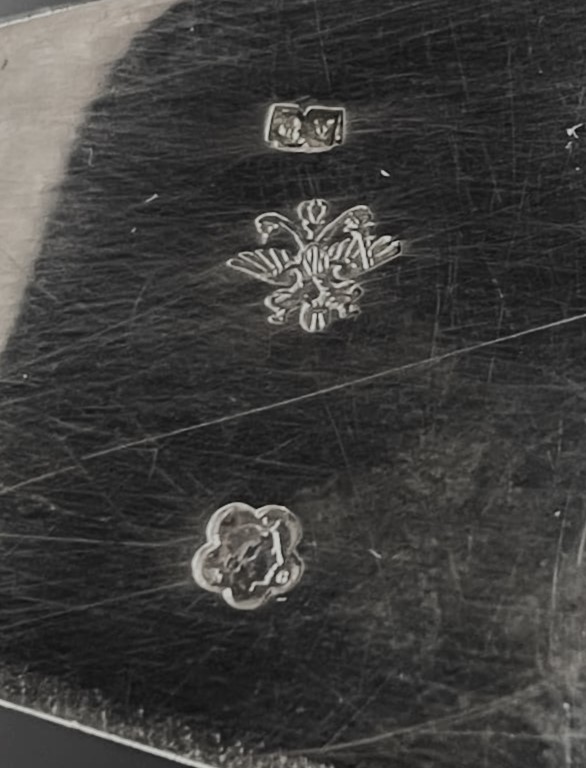
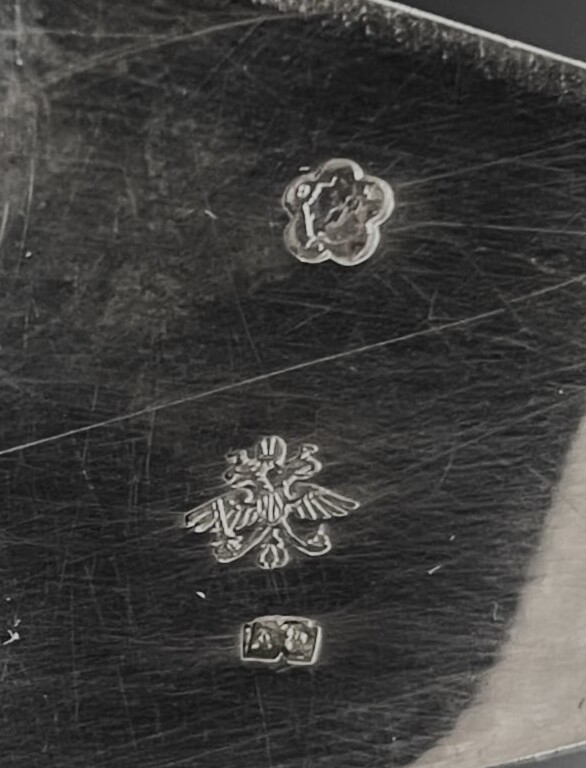
Can anyone help me identify the maker of this decanter based on the hallmark (initials A.P.)?
Based on my own research, I’ve discovered that the piece was made between 1872-1922 in Prague, back then part of the Austro Hungarian Empire.
The second hallmark, representing a double-headed eagle, is pointing to the Coat of arms of Austria-Hungary.
Taking into account these arguments, I don’t have any doubts regarding the place of origin. The only information left unknown is the master behind this piece. Any help would be appreciated.
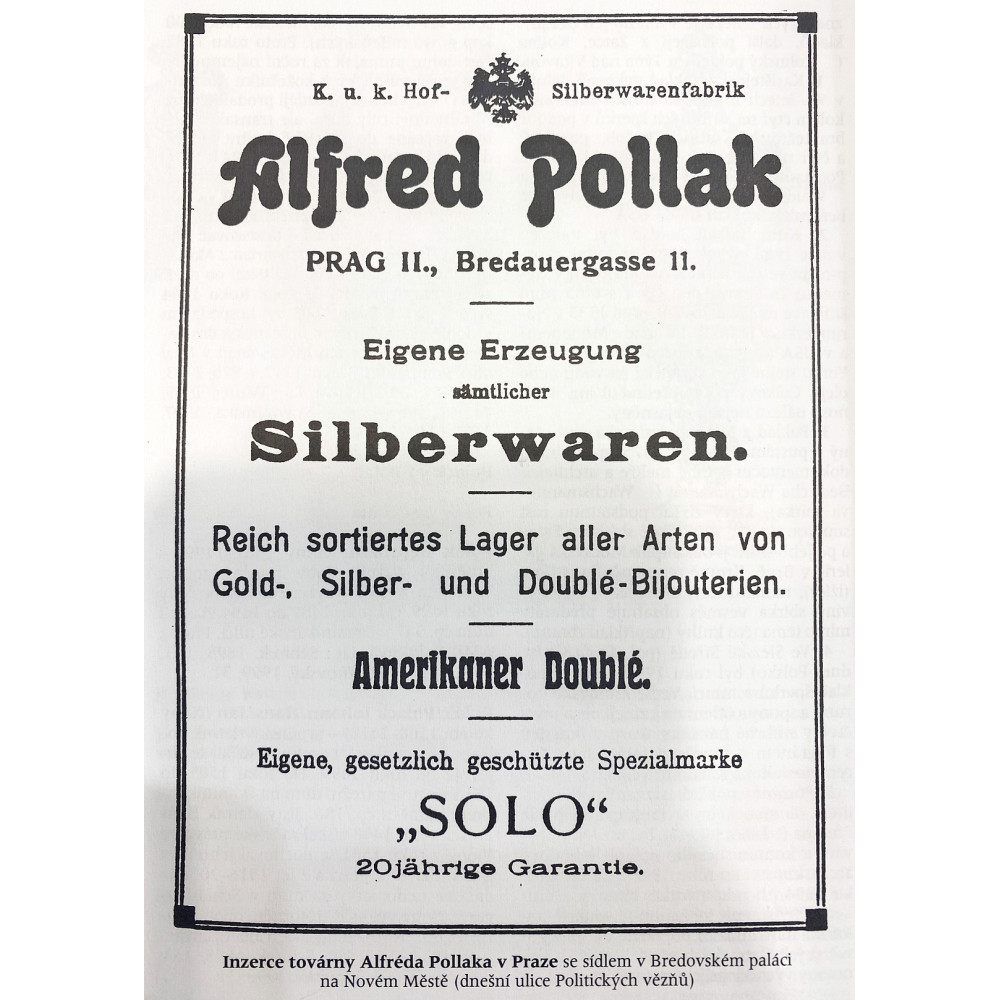
Alfred Pollak was born in 1852 in Bohemia and established a silver factory in Prague in 1878. The business expanded steadily and became known within Austria-Hungary for its range of silver goods. A branch opened in Budapest in 1892 and another in Vienna in 1896, allowing the firm to serve clients across the region. Pollak’s work was recognised with international awards and the firm exported its products throughout continental Europe.
The company supplied the upper bourgeoisie, the nobility and the imperial court. Pollak was appointed k.u.k. Hoflieferant and the firm was authorised to use the title k.u.k. Hof-Silberwarenfabrik. Designers associated with the company at the turn of the century included Hans Bolek, Franz Barwig, Rudolf Hammel, Ernst Lichtblau and Nechansky, who contributed designs for silver cutlery, chandeliers, coffee and tea services, carafes with silver mounts, honour pieces and jewellery.
Alfred Pollak died in Prague in 1909. The company continued under Arthur and Waldemar Busch. At its height the factory employed around fifty workers. After the First World War the dissolution of the monarchy disrupted established markets, and the firm was removed from the commercial register in 1922. Examples of its work are held in institutions including the Museum of Applied Arts in Vienna and the Military Historical Museum in Prague.