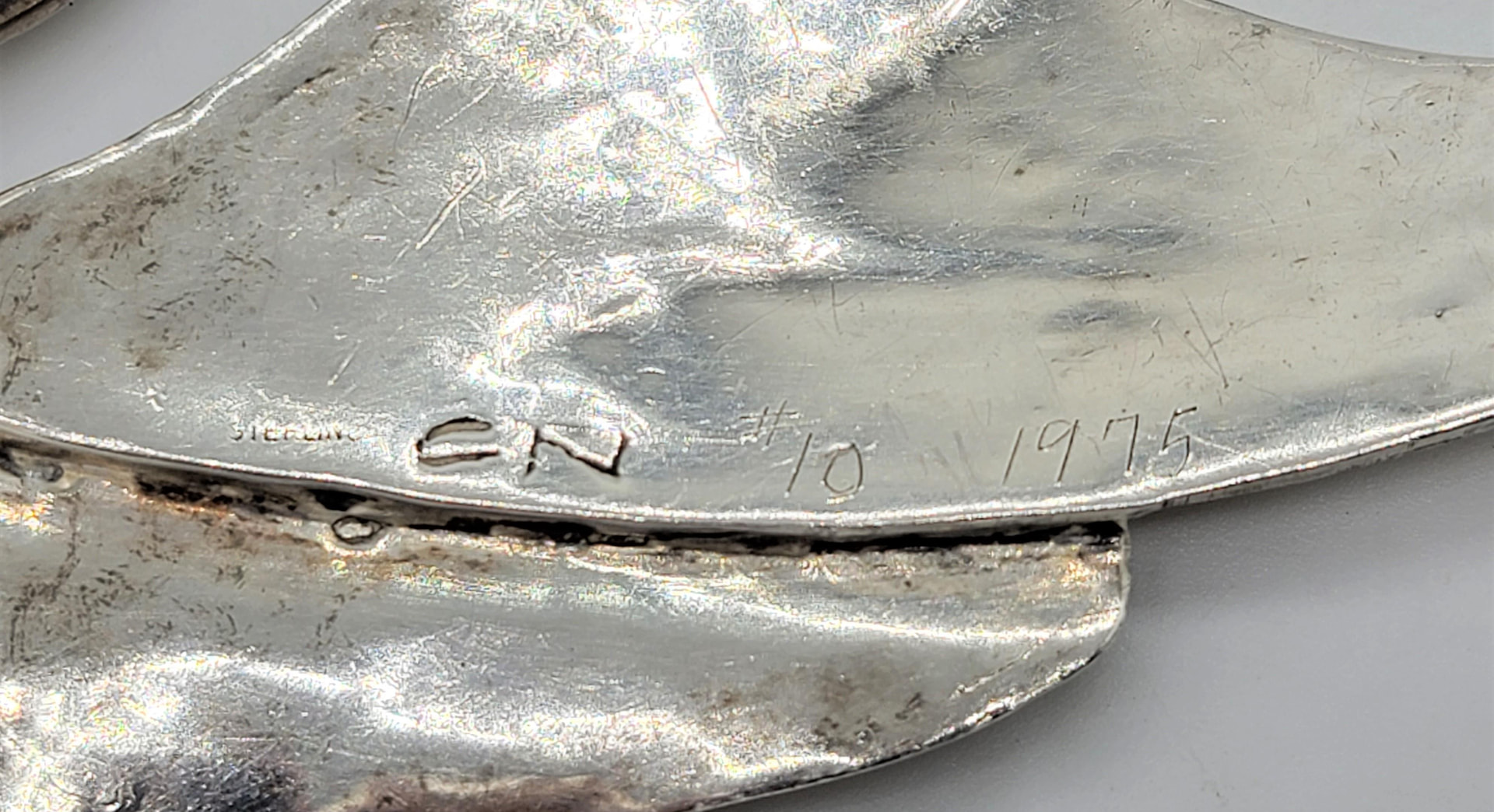
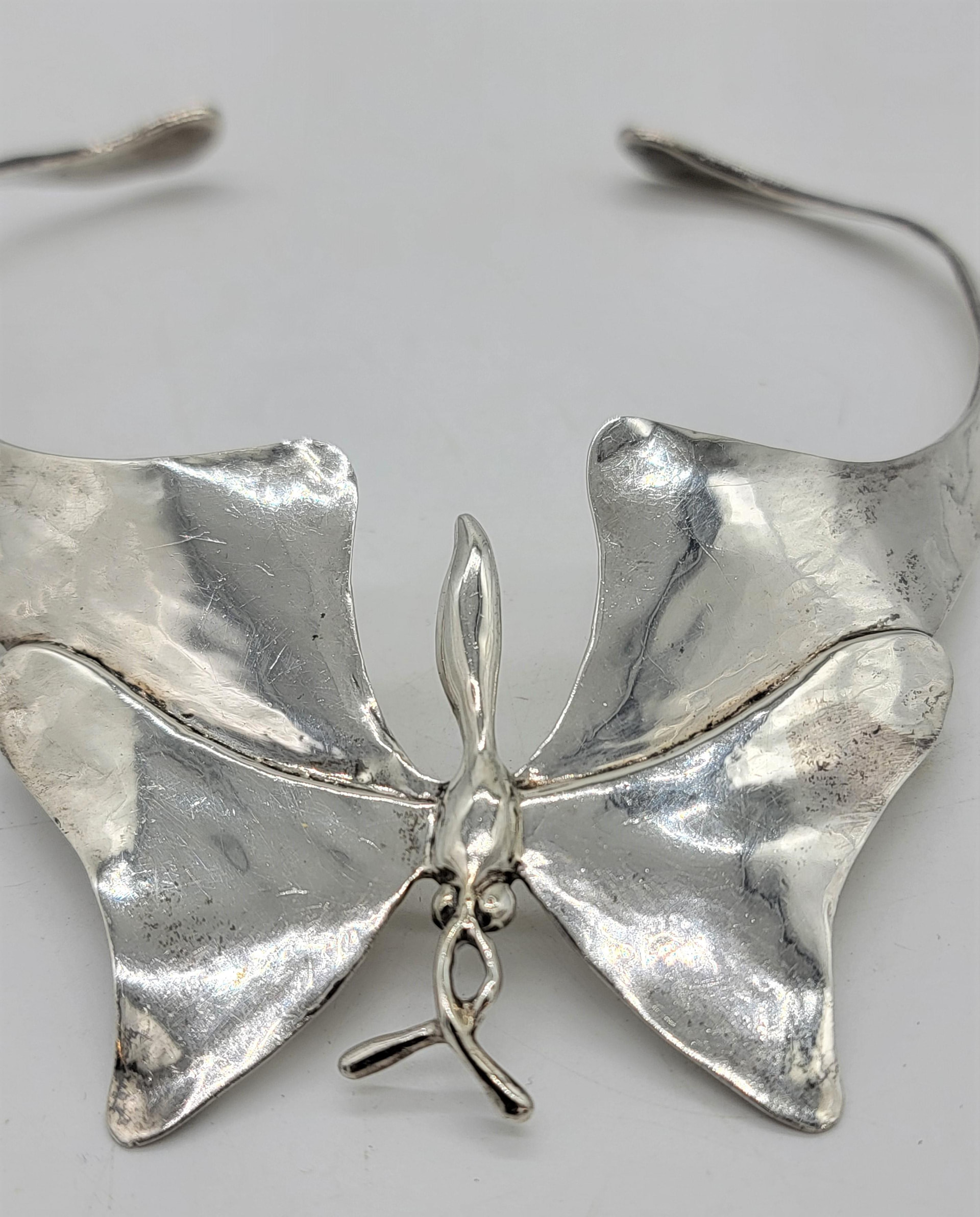
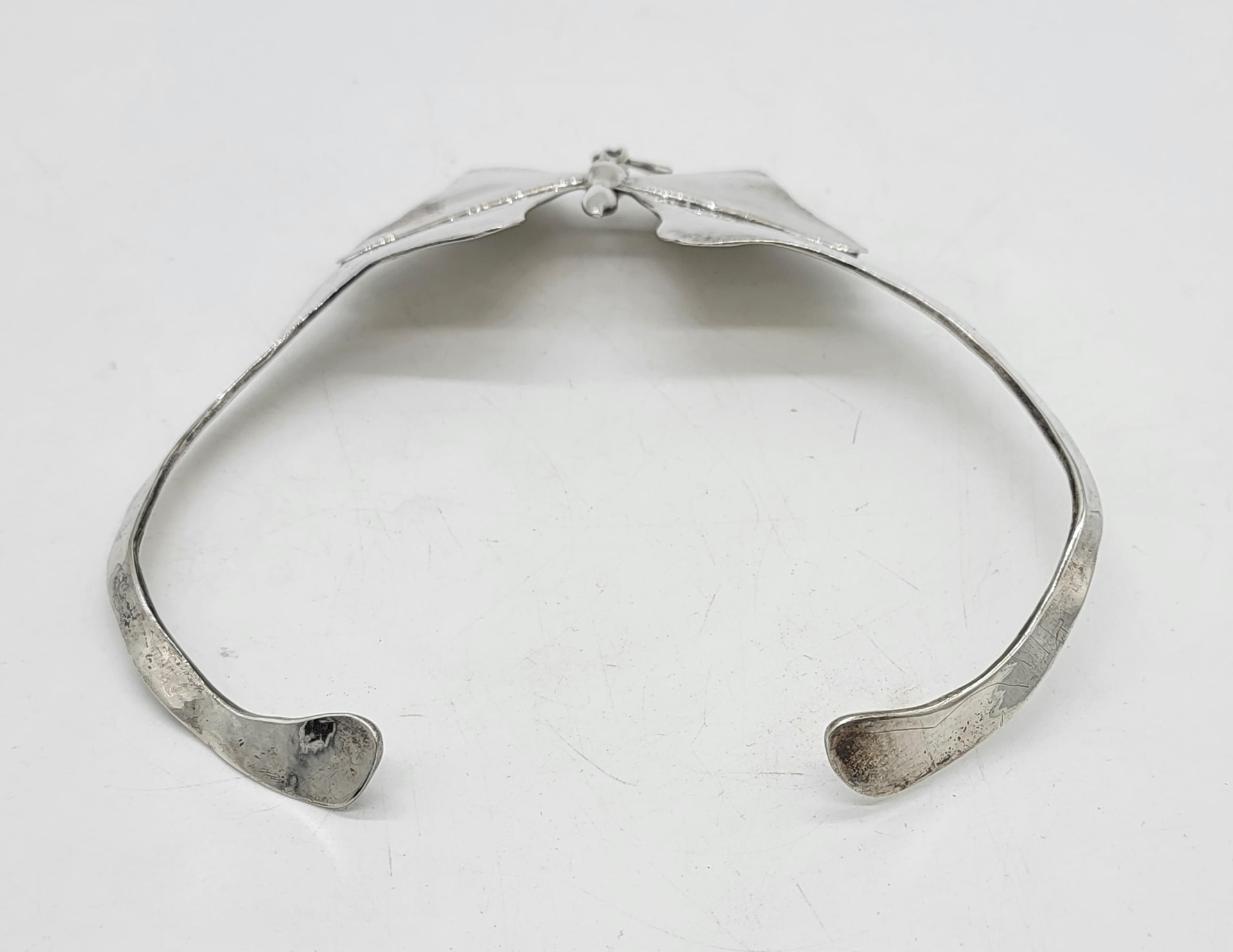
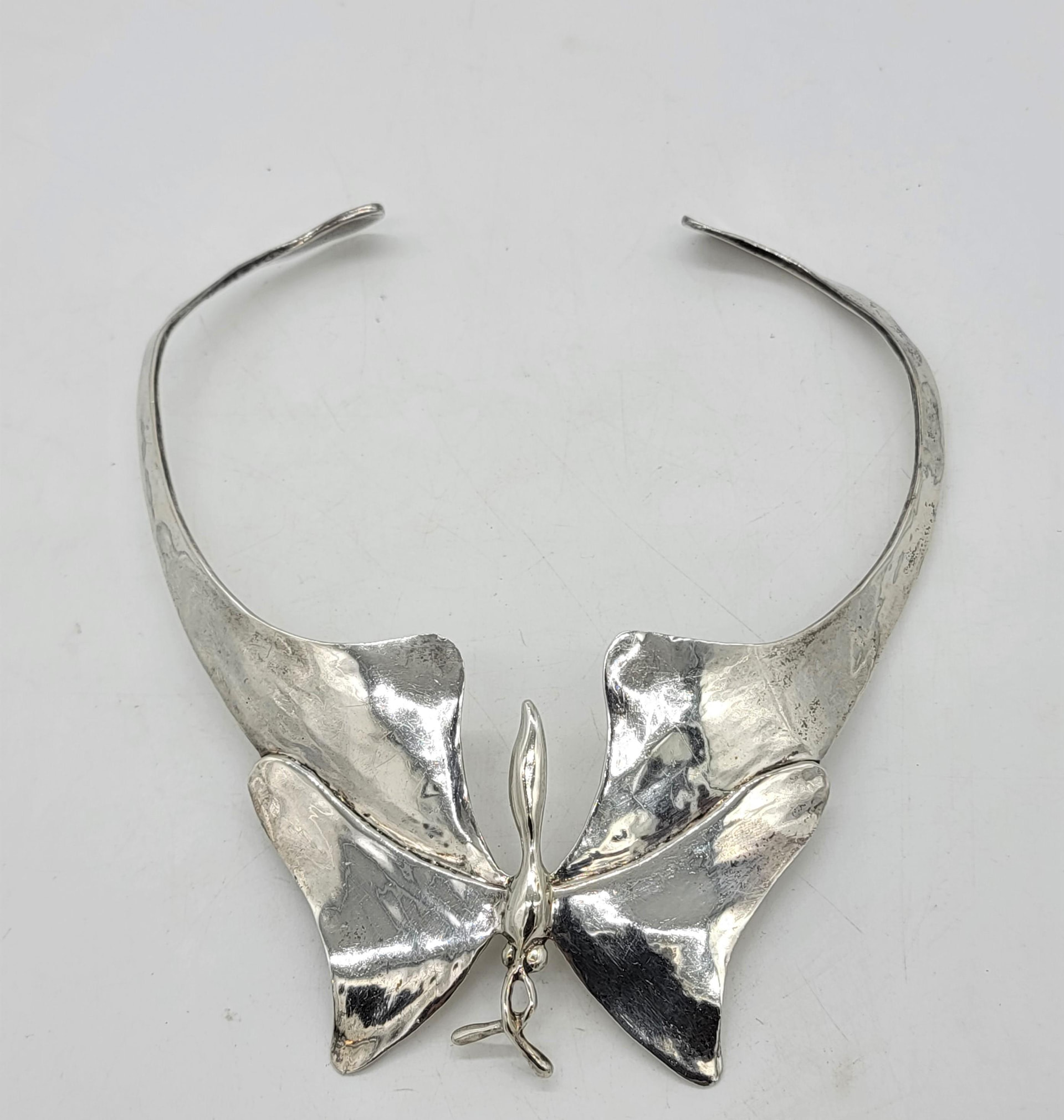
I bought this lovely collar from a Northwest Texas Goodwill store in 2022 for only $101. The marks are “CN #10 1975” and Sterling. It weighs 70 grams. I’m guessing it was made by a professional jeweler with a studio, however I can’t find any info on the maker’s initials. Any insight or research recommendations would be greatly appreciated!
"The “CN” hallmark on Navajo silver jewelry stands for Clem Nalwood. He is a well-known Native American silversmith recognized for his traditional sterling silver work, which frequently incorporates colorful inlay. [1, 2, 3, 4, 5]
While Nalwood is renowned for his stone inlay, necklaces, and cuff bracelets, authentic “CN” butterfly-themed pieces do exist in the vintage collectors’ market. If you are looking to research, buy, or authenticate a Clem Nalwood piece, explore the Art-Amerindien Hallmarks guide for visual examples, or browse current market availability on Etsy Navajo Silver Butterfly Brooches. [1, 2, 3, 4, 5, 6]“”
I cannot take any credit for this. I simply asked Chat GPT the question. which was who considers butterflies to be sacred symbols and which native craftsman made them out of silver."
Depressing for all us “silver experts” to be replaced by a computer.
Oh. well on to the next thing. Maybe I should join an aboriginal group and make butterflies.
On the bright side Chat GPT might be wrong and it is actually made by Cedric Navenma Kuwaninvaya a Hopi craftsman whose initials on the Art Amerindian Hallmark site looks much more like the one on your butterfly.
Yeah, google’s AI robit gave me some similar, eyebrow-raising answers.
If it’s any consolation, my other hobby is collecting violins, and people wanting a quick ID of a cheap fiddle are also asking AI. Nothing replaces seeing a violin in person and AI only spits out what billions of fingers have typed into the internet, so that’s about as reliable as you would expect it to be.
I’m experienced with Native Indian jewelry, particularly vintage Hopi, and antique Victorian jewelry. I’ve run a few antique art deco diamond rings and some Navajo old pawn pieces (yeah I have a few of each of those too ha!) through the AI option on google just to see what it knows. Knowing the market for both as I do, I would say it’s not entirely off. But, it’s so obvious where it’s taking bits and pieces of listings, conjecture, comments, reddit posts, ebay, etc. and making it into a persuasively “accurate” narrative.
When you say you have “run pieces though” the option, what does that entail for you?
Most of the work now done on this site involves finding a similar makers mark and posting it together with a duplicate of the original item and declaring it as a likely origin.
This technique depends on having access to up to date AI and being skilled enough with its use to pose the questions most likely to trigger answers — very different from pre-internet silver evaluation that relied upon print material especially annotated auction catalogues and hands on experience.
This modern system of silver identification depends on two skills which apply regardless of whether you are searching online for a well-priced septic sewer system or fine art.
Its Achilles heel is the limited capability of cameras most inquirers use and having enough background to formulate triggering questions in the first place.
And that “triggering question” hazard is the third and greatest flaw. Every time you ask the question you educate the system to replace real knowledge of silver earned in a workshop or on the auction or sales floor with ersatz knowledge where the answer the bots provide is entirely predicated on the question’s phraseology and where a desire to please replaces actual expertise.
But back to your item, given you have “run it through the options”, and you share a view it is “Grandma Moses” calibre of jewellery owing more to its naïveté than disciplined craftmanship two questions:
Does it really matter who CN is unless she or he has a cult following you want to tap into commercially and given there is no central registry of indigenous art makers that is wholly detached from the ambitions of the makers themselves how, even if you do find an exact duplicate set of initials on another item, are you going to know the assertion there are any more reliable that the AI assertions made so readily on your item’s behalf?
Ah yes. This is not my first rodeo with the “Don’t train the robot” conversations on an ID forum
I know what I have, but sometimes I want confirming examples or even just another listing with the hallmark where the owner / seller has the info I want. What I do is simply ask what the hallmark is. I know it’s probably American, clearly it’s marked 1975 but maybe some Trocadero seller posted something 15 years ago and the old listing has the maker’s name.
Google AI gives links to every site it pulls information from. That’s useful to me because I just go to the links and in the past I’ve found information I wouldn’t have otherwise found. This isn’t because I’m not good at searches but more because I lack the infinite time and computational power to search billions of things online in a matter of seconds.
For example just two months ago I bought a 19th century Russian Orthodox 14k gold cross to replace the one that was stolen from my friend’s house 15 years ago (it was her grandmother’s) I asked AI about the hallmarks and got mixed results. Way down at the bottom of the list of sites it pulled its information from, I found just a photo of the cover of a Russian reference book of Russian silver and gold hallmarks, assay masters, makers marks etc. It took some digging but I eventually found an inexpensive copy of the book on ebay. Sure enough the marks on the cross were in that book - and nowhere online.
I was just curious about CN. I’ve had this for a long time and hoped to find out who made it but it’s not vital that I do. It’s a nice piece, and when I croak my niece and nephew will have no problem unloading it for the estate- along with all the other unknown silver I collected because it’s pretty.
But I take your point about the random nature of google searches and what a target site might regard as collateral data become the key lead to a new and profitable area of inquiry.
You inquiry on this site will sit there un-answered or answered for decades and who knows someone may generate a useful response based on an entirely unrelated search.