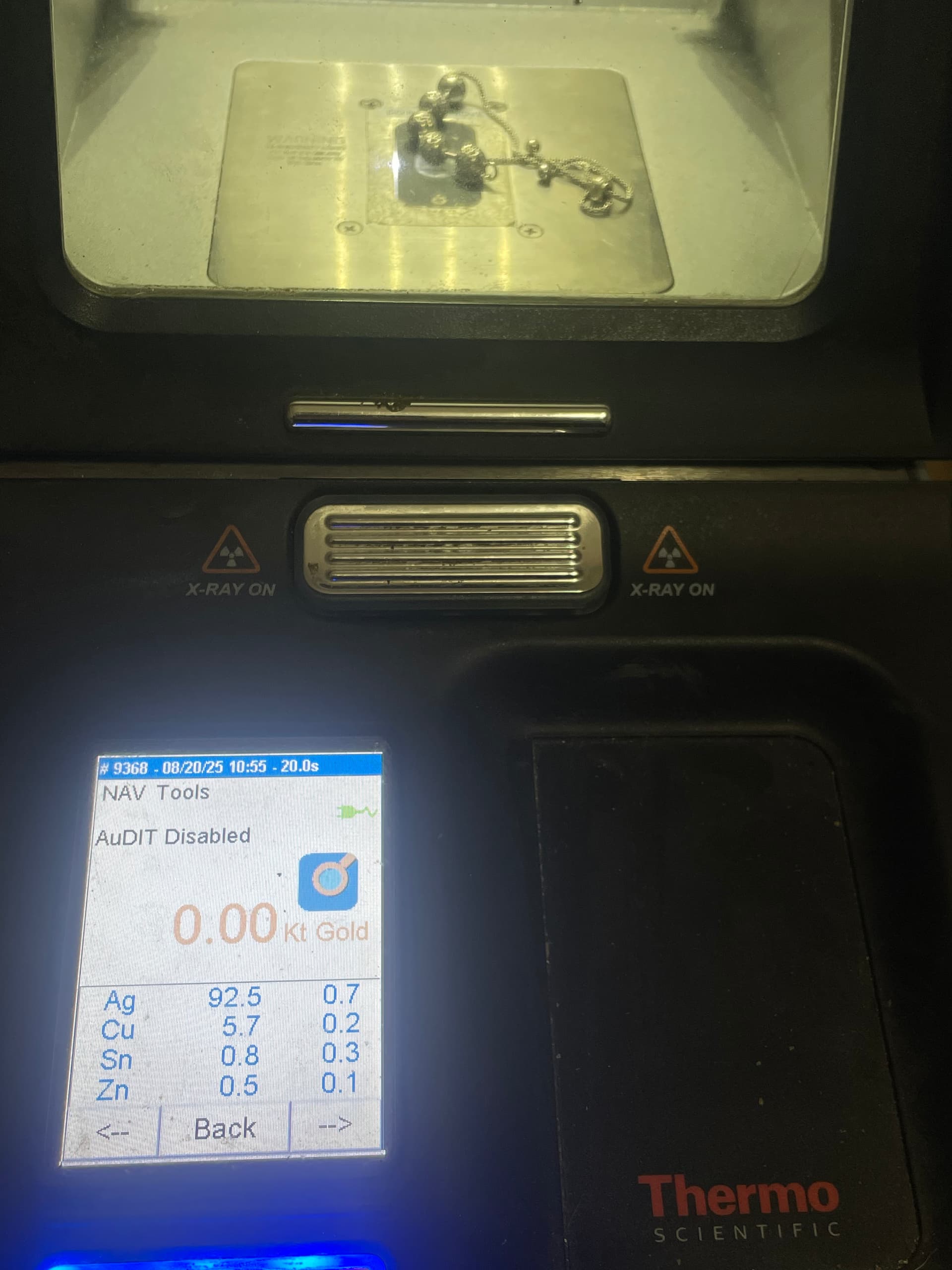
Cute little ingot

I’ve got this cute little ingot which is presenting me with some questions. Please se pic.


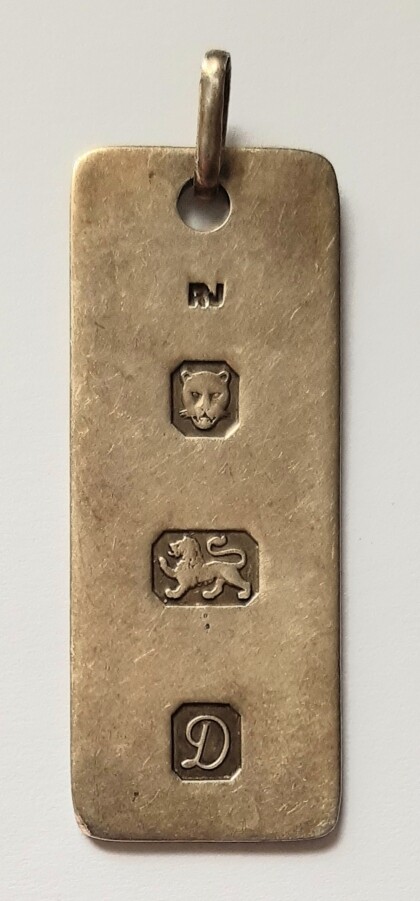
It measures 40 x 17 mm and is about one mm thick.It weighs 7,3 gram. I had it scanned; It is 88,56% Ag, 5,45% Au, 5,17% Cu and there’s also smatterings of Cr, Fe, In and Zn.
Maker’s name: RJ. There’s the London leopard’s head, the lion passant and the year date D for 1978. The maker RJ seems to be unidentified at present, but there’s a stamp for an RJ (1977…1983), in an oval shield, known to have produced gold rings and ingot pendants.
The RJ on this ingot has no shield. It seems to have been produced for a double purpose, namely as a pendant to be worn on a chain, as well as a kind of bullion investment.

Besides the matter of the RJ mark without shield, I’m also wondering about that strange scan. Why all that gold if the lion passant declares the metal to be sterling (92,5% silver alloyed with copper). And those hallmarks - are they genuine? Did the London assay office actually do the stamping? To me this bauble presents itself as a misrepresentation of an ingot.

Any ideas, friends?
Regards
Jan

1 Like

I think the answer is that this should have been registered as .88 silver with a gold part mark if that is even possible.

This is 94.1 precious metal so better than sterling which is what it is marked for although the silver percentage at .88 is below the sterling standard.

Since the value of gold in 1978 was some eight times the value of silver it seems rather an expensive mistake for RJ to have made.

Perhaps you might ask the assay office why they marked it sterling.

Perhaps you could let us know the answer. You might want to tell them you are asking. as a subscriber and contributor to this blog so they don’t feel gottcha-ed.

This is the year after the Jubilee year so no Jubilee mark which is what had promoted the sale of these neck things and cufflinks and other gear.

If one was a conspiracy theorist this might be part of a plot to smuggle gold in or out of a country. Not as exciting as Ian Fleming’s Goldfinger making his antique Roller bodywork out of gold, but more imaginative.

But, ask the assay office.

RJ - Rudolph Jan. :wink: :wink: :wink:

1 Like

My otherwise canny friend Bart is out of plausible ideas, for once. :wink: :stuck_out_tongue_winking_eye:
Guildhall, I will undertake your suggestion to contact the assay office, and if I get response, I’ll gladly share.
The precious metal content is better than sterling as you say, so I thought of working out some comparative money values. Taking rounded-off figures (R20/g for Ag and R1000/g for Au), I calculated the ingot to be worth R527. If it were sterling, it would be worth R135. That’s a whopping difference.
Something else: I always thought a bullion ingot/bar should have the exact weight stamped on it. The 7,31 gram-weight translates to 0,258 ounce. That’s a quarter ounce of an alloy. It makes no sense.
In carats Au it would not even reach 2 ct. You will have noticed the gold gives the pendant a yellowish hue.
As such, I can only conclude the pendant is made of electrum. You will know that electrum also occurs naturally, consisting of gold and silver, with trace amounts of copper and other metals. Colour-wise, it goes from pale to bright yellow, depending on the proportions of gold and silver.
Which brings us back to that mystifying sterling hallmark.

“I’ll be back” after approaching the London assay people.

Regards
Johan

1 Like

This one was nonsensical, but funny. :rofl:

I’ve not lost my sense of humour, Bart. :stuck_out_tongue_winking_eye:

Friends, I’ve sent the letter of enquiry to the London assay office, and we’ll wait and see what their comments will be, if any.

Regards
Jan

2 Likes

The Assay Office notes on hallmarking are of some interest. They do address mixed metal marking but don’t specifically deal with a circumstance where either or both of the mixed metals are below minimum percentage but combined put its precious metal content well above the minimum of one.

People had been making pendants out of. electrum for thousands of years so you are in good company!

Here’s Pliny on the subject in his “Natural History” Book 33. (The translation is not mine)

All gold contains silver in various proportions, a tenth part in some cases, an eighth in others. In one mine only, that of Gallaecia called the Albucrara mine, the proportion of silver found is one thirty-sixth, and consequently this one is more valuable than all the others.

Wherever the proportion of silver is one-fifth, the ore is called electrum; grains of this are found in ‘channelled’ gold. An artificial electrum is also made by adding silver to gold. If the proportion of silver exceeds one-fifth, the metal produced offers no resistance on the anvil.

Homer represents the palace of Menelaus as resplendent with gold, electrum, silver and ivory. There is a temple of Athena at Rhodes in which there is a goblet made of electrum, dedicated by Helen of Troy. History further relates that it has the same measurement as her breast.

A quality of electrum is that it shines more brightly than silver in lamplight. Natural electrum also has the property of detecting poisons; for semicircles resembling rainbows run over the surface in poisoned goblets and emit a crackling noise like fire, and so advertise the presence of poison in a twofold manner.

I think it is safe to say Pliny was a gold standard guy. He wanted to determine the relative value of metals, especially mixed metals relative to purchase power. The entire paper is of interest today 2,000 year after it was written, if only to tell us how this first Imperial power thought and how amazingly similar it is to the thought emanating from centres of government today.*

Today as Trump wonder how to expand the US to include Greenland, one is reminded of the Roman expansionism:*

“Imperium sine fine dedi” is cited in Virgil’s Aeneid as a prophecy by Jupiter. *

Hadrian’s war and the retreat to it under attack from the Caledonian tribes in what is now the eastern lowlands, Berwickshire etc. proved Jupiter rather an unreliable prophet. Pliny died in Vesuvius’s explosion, an ignominious end for a guy studying metallurgy one might say.

CRWW
2 Likes

Hi Jan,
I use an XRF daily for my business.
I believe your item is nearly all sterling and a thin gold plate.
Plating on sterling items have a thin layer of between 2 - 7 percent
gold usually. The gold layer is affecting an accurate scan of the silver underlying it.
The scanner can not go very deep into the surface and analyze.
Most scanners also have a 1-2 percent range of inaccuracy too.
Perhaps this piece of jewelry is similar to dog tags and people engrave one side with a name
to use on a necklace? I have seen similar ones engraved.

When I get in .9999 gold coins. The xrf scanner can not be counted upon to identify a fake coin.
I have to use a Sigma tester that knows gold density by weight.

I think your markings are stating that it is mainly sterling.
Hope I helped.
Susan

Very helpful. I have now learned two things from this discussion,

  1. All that glitters is not gold – well not entirely anyway and
  2. Gold trumps silver when it is applied as a vermeil.
    CRWW
1 Like

Yes, thank you, Guildhall. I did read through those notes and it made me cautious while compiling my letter to the assay office. I did not want them to think I spurned their FAQ advice. We’ll see what they reply.
Susan’s kind thoughts coming from her experience is valuable in this matter of the sterling mark. I’ve talked much with boffins on XRF and I’ve not yet got clarity on the matter of plating. Perhaps you could tell us what the purity of the gold is when sterling items are plated. What did you mean when you stated 2-7%? Just for further clarity. :nerd_face: Oh, and by the way, I sat upright when I got the notification on my cellphone that “Susan” had something to say concerning my cute little ingot! My kind and loving wife is also Susan. But that Susan does not care a fig about my little silver collection.
Regards
Jan

1 Like

Hi Jan, I have been away. I have something to add. First your words convey to me that you are a friendly and pleasant fellow. Susan your wife must be wonderful.

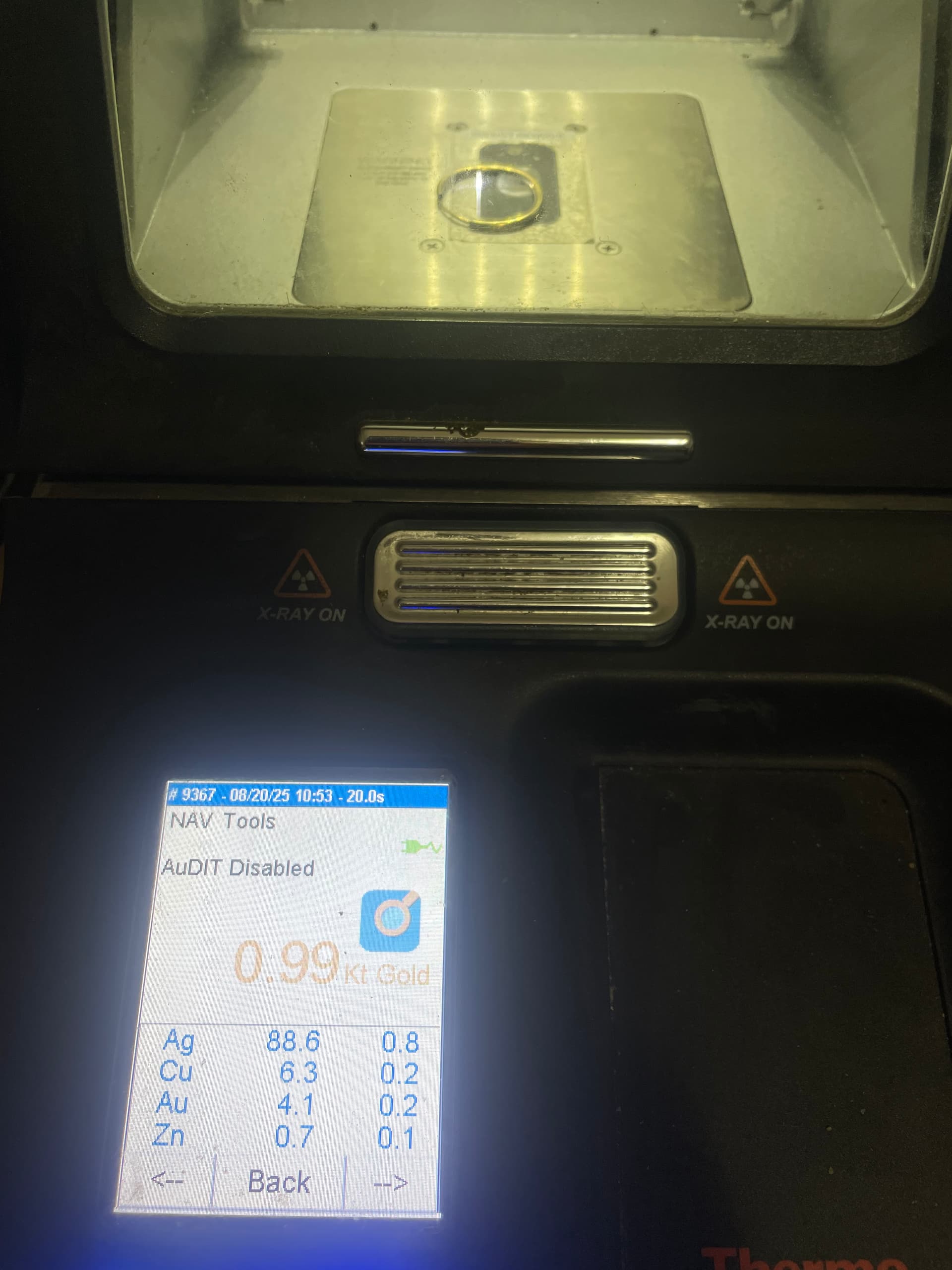
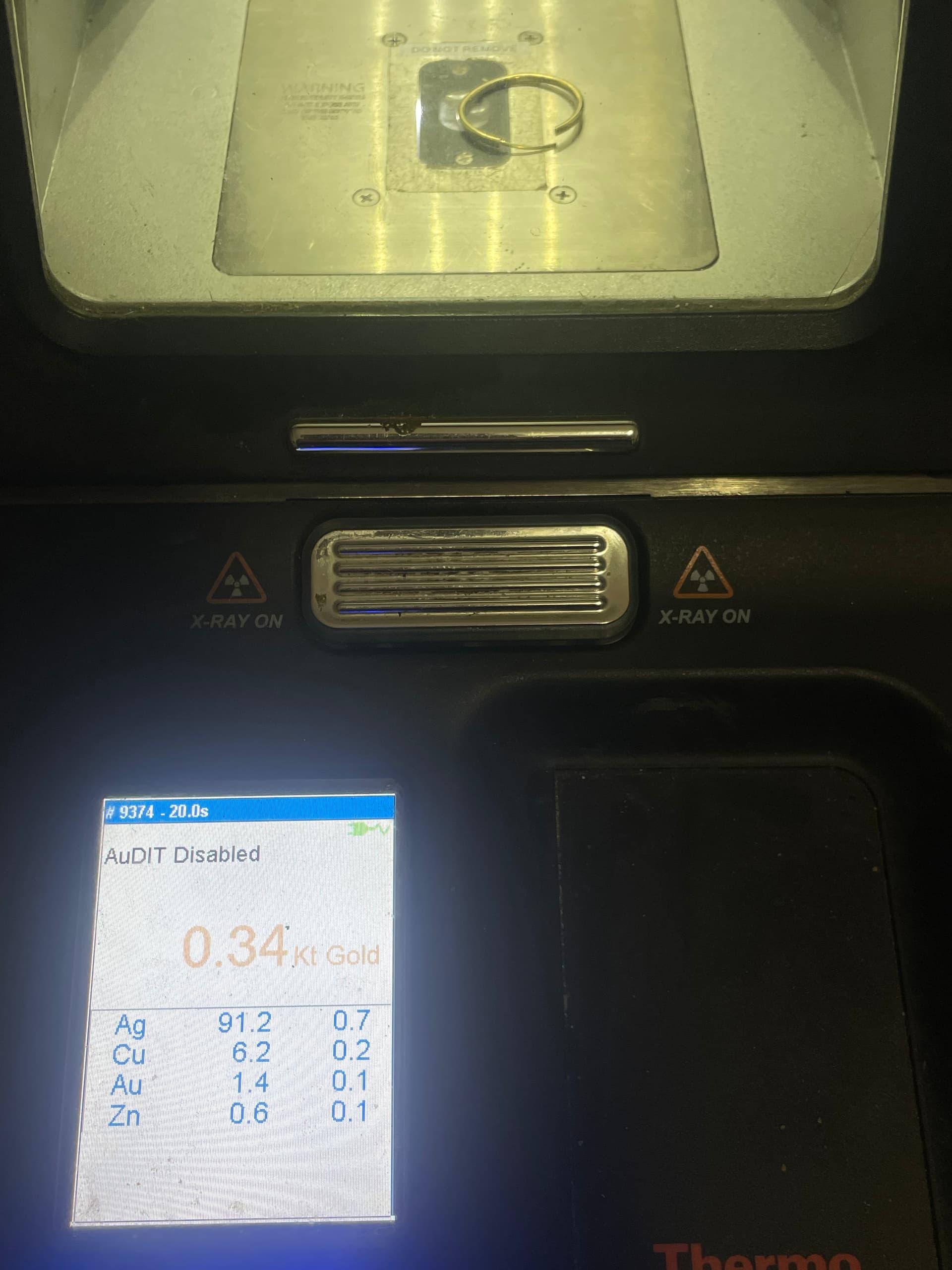
My understanding of an xrf is this. It takes a sample of 3-5 microns deep. The gold wash on your item may be 1/2 a micron or even much less. So it’s reading the surface gold and combining it with the sterling to make up the 100 percent elements it gives you. Gold plating is thicker, at around 1 1/2 microns and would read a much higher percent for 10, 14, 18 k .and its is nearly always marked.

I am going to try to post some pics of my xrf reading a stamped 925 earring with a gold coating, but no marks other than 925. A before pic untouched, the second lightly filed. The third pic is a 925 sterling bracelet, no gold.

Happy Saturday!

Susan

1 Like

Thank you, Susan. You have gone out of your way to explain away my XRF uncertainties. I do appreciate!

Regards

Jan

1 Like

Hi Susan, thanks for the interesting post. So, as I understand it, plating can befuddle the xrf if it is more than 5 microns deep. So if something is “gold fill” ie 10+ microns deep, then it would read as pure gold? And Sheffield plate might read as sterling?

Hi friend,

If a gold item is thickly plated but unmarked it doesn’t usually read in the higher karats. I would test a gold item in multiple places and look for consistent numbers and file if needed.

10k/,41% 14k/ 58% 18k/ 75%

I don’t have to test gold much as I get 100 gram lots of jewelry and then melt into a bar.

Then each side is tested 3 x in different spots and a purity average is determined.

So if there is fake gold I wouldn’t be paying out on it.

If it’s an unmarked item and they aren’t declaring any gold content then I would think they would use the lowest gold alloy mix possible.

With silver plate it is a 100 percent silver plating. I have made many mistakes on plate in my early years with the xrf scanner because I only scanned once and the spot I hit might have been 95percent (and I had a big lot to process.) If I scan multiple spots and get a range of silver content it will be suspect for sure, If I get a 99 percent reading, then a 96, then a 94 it will show the plate wearing in certain areas.(If the customer doesn’t want the item back, I can file it). The xrf scans should be a reasonable range of consistency and nearer to 91 and 92 percent for sterling.

The only real 99 percent silver I usually see is unmarked Indian silver jewelry such as bracelets.

random info:

There has always been fake Tiffany jewelry in the market, Every piece I have ever tested wasn’t even sterling, mainly copper with slight silver plating. They count on people not being able to tell if the metal is real and also the workmanship of the pieces is not up to Tiffany standards, especially the links.

A lot of 18k gold necklaces were around in the last 6 months, and the stamp was poorly done. They didn’t have the right weight to hold (too light) and came out as maybe 2 percent gold covered. Apparently out of China.

Happy Monday!

Susan

1 Like

Very interesting. Thank you Susan!

1 Like

As instigator of this topic of the ingot/pendant, I am happy that the likes of Susan and Paul have chimed in.

About the only little aspect of the item we have not addressed, is the fact that the maker’s mark consisting of the two initials RJ is not surrounded by a shield of some sort. I am not accustomed to a silver maker’s mark looking like that. I know there have been exceptions, but they are few and far between. Surely, it is not “normal”?

Regards

Jan

1 Like

Certainly it is a fact that most British sponsors’/makers’ marks are in cameo form. However as you point out there are exceptions. There are no rules preventing the use of incised marks like this so I guess that, as it doesn’t look quite as professional as a cameo, most silversmiths don’t use this form of mark.

2 Likes

Spouses who don’t hanker after your silver collection are much to be prized. If you can find one who is equally laissez-faire about real estate holdings, stock portfolios or exactly who gave you that rather fine silk scarf for your last birthday you have the makings of a great life partner.

1 Like