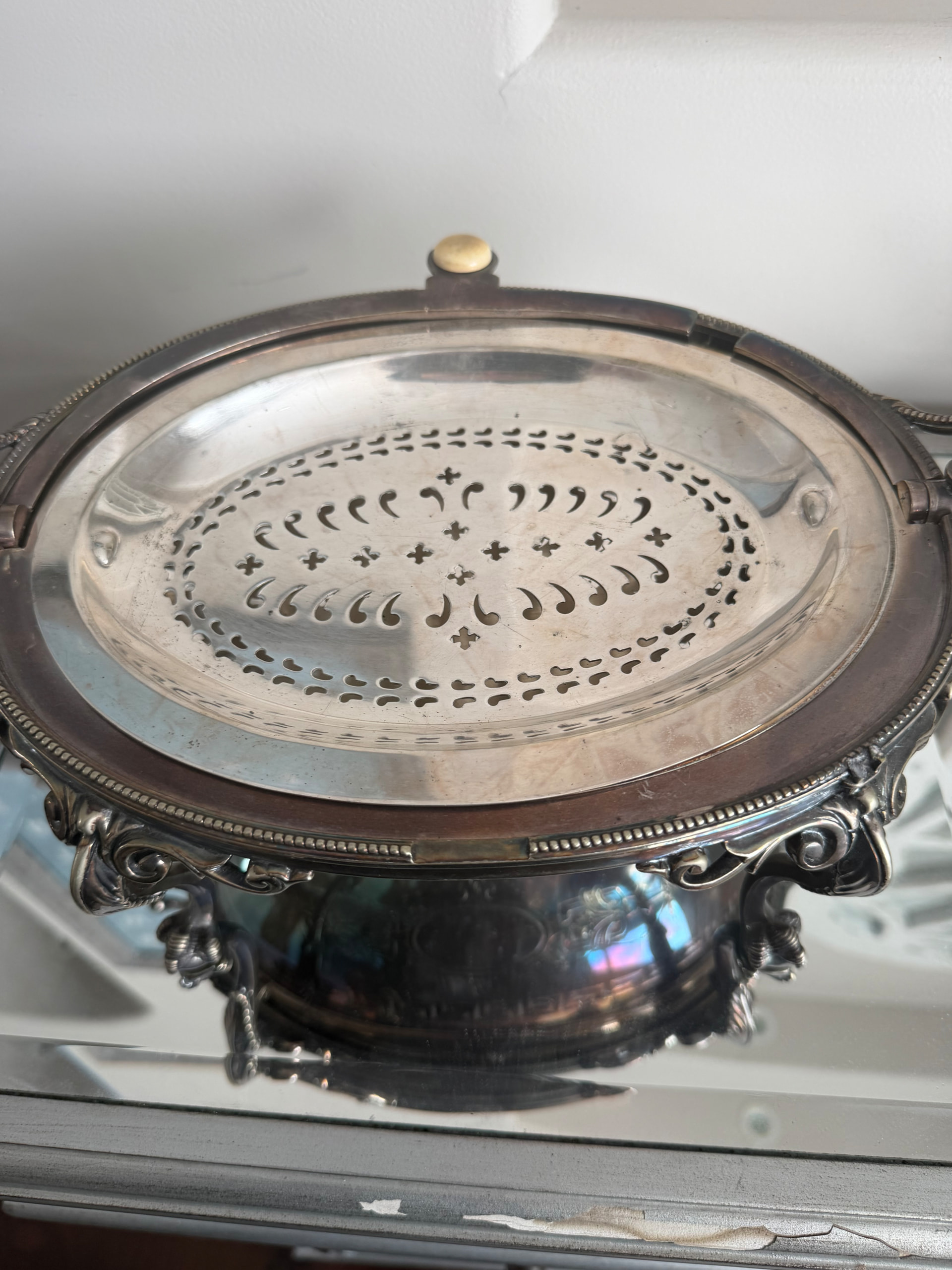
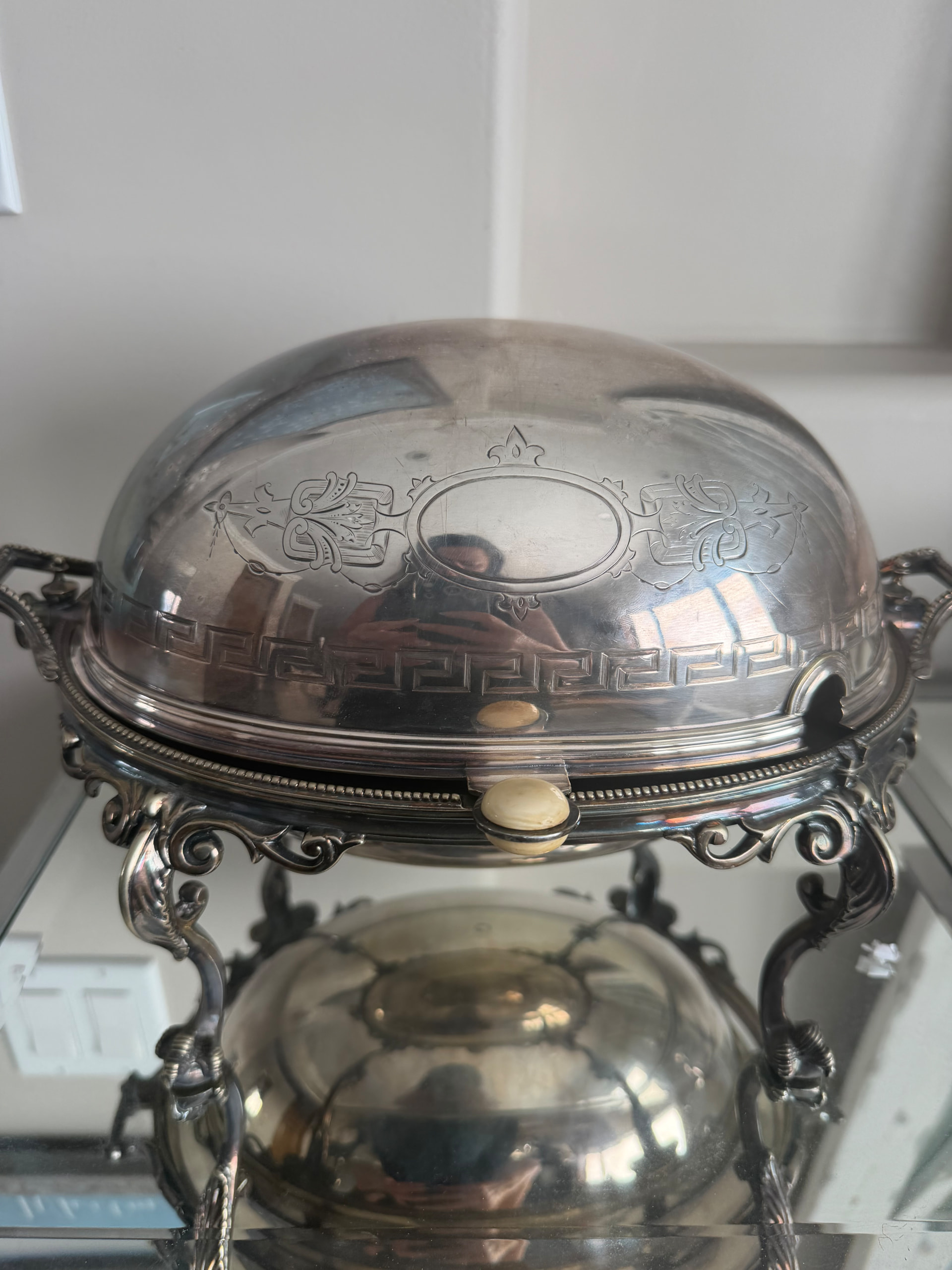
Looking for help identifying this piece and possible worth .
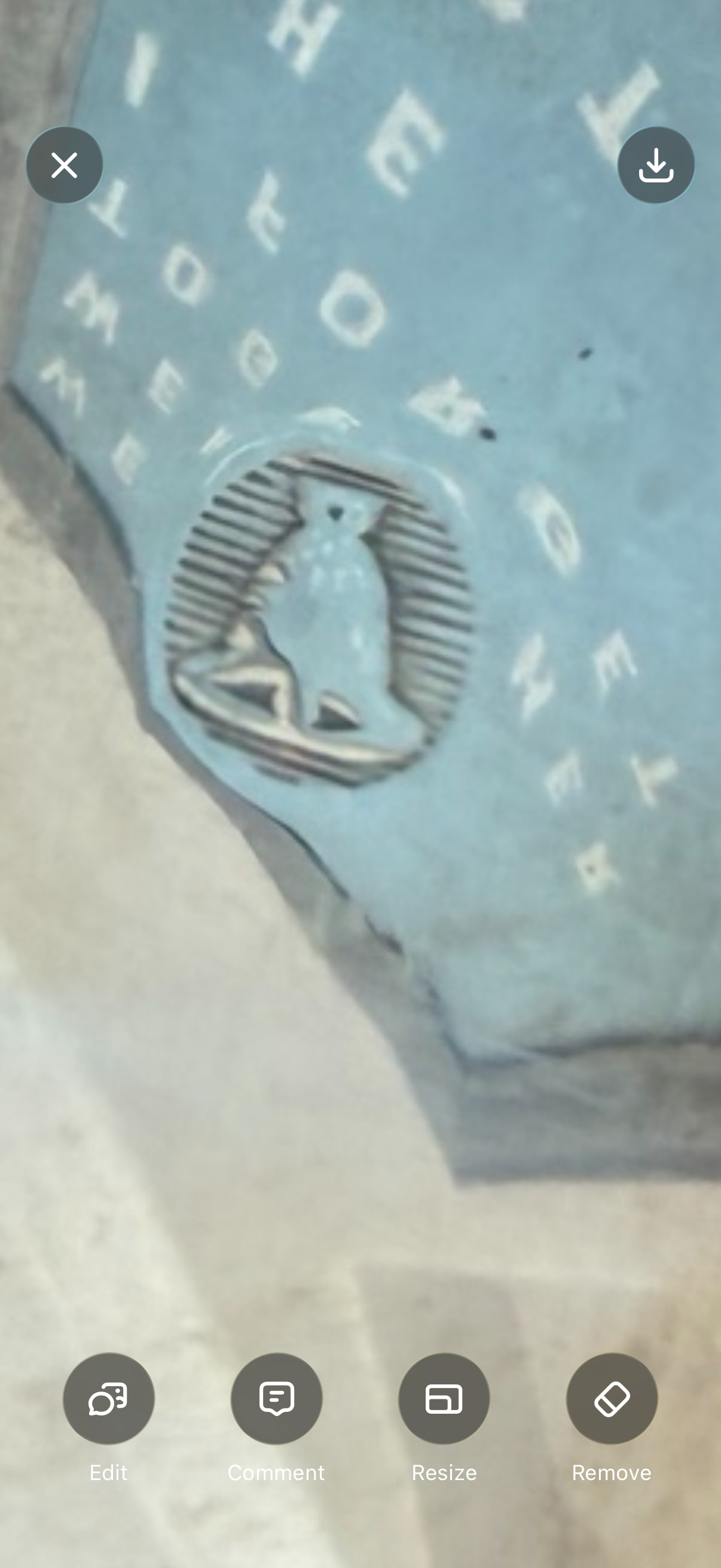
It has bell logo underneath
If that’s the only marking on the piece, it’s not sterling silver. If it were U.K. sterling, it would have proper U.K. hallmarks. If it were American or Canadian sterling, it would say “STERLING.” So, we’re looking at mass-produced silverplate, probably late Victorian. These were produced in the tens or hundreds of thousands.
I haven’t been able to find the mark anywhere, but that’s not unusual.
The value is purely decorative, since there is virtually no precious metal present. I see things like this on eBay and elsewhere with asking prices around $250, but they rarely sell for that. When they actually sell, it’s usually for half that, or less. An example:
That bell trademark has been used by a succession of Sheffield companies on plated goods starting with Roberts, Cadman & Co (c1785) and followed by Roberts, Smith & Co (1844), Smith, Sissons & Co (1848) and W & G Sissons (1858-c1890).
Electroplate started to come in around 1840 so if your chafing dish is older than that it is likely to be Old Sheffield Plate (OSP). OSP is formed by fusing a thin layer of silver to a thicker base layer of copper. OSP can often be detected by careful inspection of exposed edges where the 2 layers may be visible.
MIssing from the dish is the spirit or paraffin burner which would be placed underneath to keep the food warm.
I would advise you to have the dish checked over by an expert who can detect whether the material is OSP or electroplate as this will clearly have an influence on value.
Phil
It may sound childish, but I was the first. Among such greats as Phil, Jeff, and Christopher, being able to shine even for a moment is a real honor.


In 1833 the partners of the firm destined to become Sissons were Samuel Roberts, Evan Smith and William Sissons.
Elkington Bros electroplate licence to the firm was purchased in 1843.
Making this very possibly Old Sheffield Plate which means a sandwich of two sheets of silver fused to copper except on the feet and possibly handles which may use bronze or even nickel silver as base metal for strength.
But yes, take it to an expert and let her or him take a look at it.
We will pay as much or sometimes more for OSP as for modern sterling silver. It depends on four things: condition, maker, desirability and modern use for the particular item.
The condition on this looks standard use, the maker is a three out of five, five this late being Boulton, desirability is a bit how hum and modern usage? Well we have learned a lot about food handling since the 1830’s and it’s going to get a low score on that.
CRWW
When I hear hoofbeats, I think “horse” rather than “zebra.” I suppose that makes me, in the immortal phrase of John Cleese’s vocational guidance counselor, “irrepressibly drab and awful,” but there you have it. Electroplate until proven otherwise. 
I am more open-minded where the trade-marks precede 1840’s.
But the problem is not whether your “rebuttable presumption” approach or my rather more open-minded approach is the best, but the market itself which tends to substitute reaction for judgment, a failure which frequently works to my advantage as buyer.
Wandering around west coast stores yesterday I came across a pair of superb three level Cresswick warmers. They had been in the store for a decade and were clearly susceptible to offer.
By 1825, T. J. & N. Creswick had settled at Paternoster Row and by the 1830s it also had a London address in the Strand. Creswick’s became one of the outstanding Sheffield Plate firms, whose products are well illustrated in Bradbury (1912).
At $400 I left them.A difficult decision.
CRWW
I should I suppose not ignore the whole zebra/'horse thing you raised. I must confess to never having owned a zebra but I have spent a lifetime with horses. After the war we used dray horses to deliver beer to the pubs. My father kept 47 of them in the brewery stables and for me they were always the first place to visit. Later I rode in local races — “point-to points” we called them after the old steeplechases – and sometimes I did okay. Today I still keep horses just west of Toronto although I rarely ride myself any more.
So when I hear hoof beats I think, I hope I have an apple or something to offer. And I think that is the same approach I have to silver. If I can make it better, more respected, more friendly then I will.
CRWW
We can judge the heart of a man by his treatment of animals. — Immanuel Kant.
If you’re going to quote that profoundly difficult man then the whole quote makes more sense in a silver forum:
“We are not rich by what we possess but by what we can do without. He who is cruel to animals becomes hard also in his dealings with men. We can judge the heart of a man by his treatment of animals.”
Kant is difficult for the modern student because, while his opinions are always well-founded, they fit very badly with the quickie ideas or lack of them in the modern TV era.
He is probably most vulnerable on the issue of religions – one in particular— which he felt would, like all religions or dogma, eventually find itself subordinate to a “pure” religion.
This was seen post WWII as being antithetic to that religion. True, if taken literally, but entirely beside the point he was making in “Critique of Pure Reason”.
CRWW
I quoted him in good faith and with noble intentions. I’ve known for a long time that you like to have the last word, remaining silent when you make a mistake. I take life as it comes, living it as beautifully as I can, instead of dissecting everything scientifically and by definition. I leave that to those who don’t care about memories… I once read some wise words: there’s nothing worse than a person educated beyond their intelligence. I suggest focusing on the substance of this forum instead of intellectual scolding and personal attacks. We’ve been through this with poor results.
Dear Bart:
Please accept assurances my interests are limited to silver on this forum. If you can contribute to that I am sure you are welcomed. If you see as part of your mandate to do that a need to make personal comments on other contributors you may trigger a less favourable reaction.
Quoting Sir Arthur Clarke’s comment about education and intelligence in support of your ad hominem attacks may reflect more directly upon your own limitations than any you are attempting to adduce as others.
I did, as it happens spend two years as a graduate student reading Kant. I was rather surprised to have him quoted at me and determined by expansing the quote merely to context it so it might make some sense to anyone who had perhaps spent two years of their life doing something else.
Your comments indicate in at least one case I failed. Not being much for mea culpas I would, except for your comments that that too reps a moral failure in your world, have remained silent on the subject.
CRWW
This is why I stayed out of here for over a year. My, my, what drama!