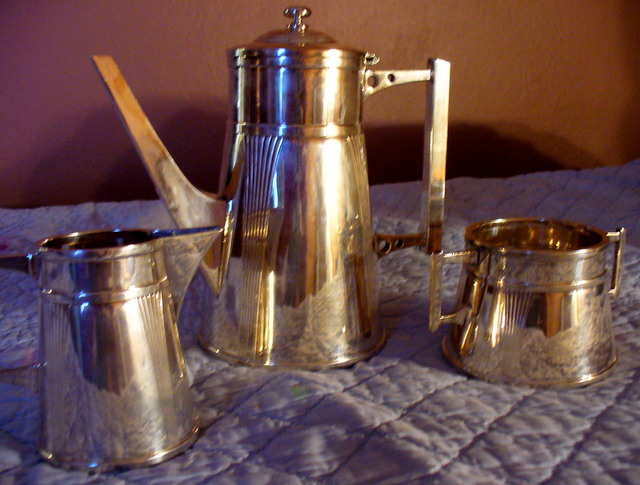
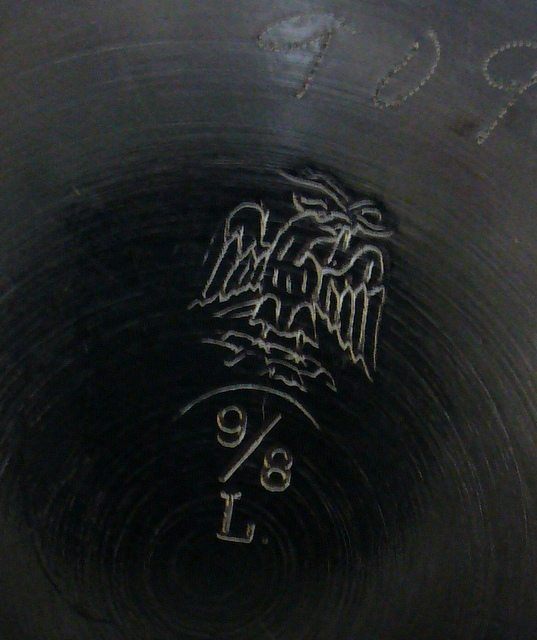
Lots of looking and not much luck. This coffee service is marked only with an eagle facing left with a snake in his beak. This is the same image found on the Mexican flag circa 1900. I’ve seen several references that mention an eagle mark on 19th century Mexican silver, but cannot find an example of the mark. The “9/8 L” mark is a measure - the pot holds 1100ml. I am hoping to get some confirmation of my suppositions.
Correctly called " inspired by William Dresser designs"
Solid silver of .925 or higher.
Made in Mexico circa 1900.
Am I all wet, or does this make sense? Thanks for tal\king a look
So the answer to your questions, thanks to the always thorough research by Bart, is no, not really
I think you are referring to Christopher Dresser?
Here is a fairly useful biography:
We now know the teaset maker’s firm was founded in in 1887 by Philipp Harjes and Hermann Kallmeyer.
In 1890 it was destroyed by a fire and another building erected immediately. In 1896 the complex was expanded in a new building on Waltershäuser Strasse.
In 1899, after the death of Kallmeyer, Harjes became sole proprietor. Kallmeyer & Harjes was one of the most important Gotha companies in the metalworking industry. By 1909 employees reached about 500 workers in 1909.
Some years before Harjes’ death, the property passed into other hands and the firm went in bankrupt in 1938/1939.
The trade mark of the firm was an eagle with spread wings in various combinations here shown with a snake in its beak. The numerics are indeed a volume or capacity mark.
Returning to the design origin:
There is no evidence that Christopher Dresser was directly employed as a designer by Kallmeyer & Harjes.
While some metalware pieces attributed to the “Christopher Dresser style” or sold under his name occasionally appear in listings alongside Kallmeyer & Harjes, the two are generally considered distinct entities.
Dresser was a pioneer of the independent freelance design model. Rather than being a permanent employee, he provided designs to over thirty firms across Great Britain, Ireland, France, and the United States.
His documented professional collaborations included major manufacturers like Minton, Wedgwood, Hukin & Heath, James Dixon & Sons, and his own Linthorpe Art Pottery.
Some antique metalware including tea services from the early 20th century are marketed as “Christopher Dresser style” due to the aesthetics design movement he led, even if it was manufactured by different companies including Kallmeyer & Harjes.
I suppose you have long since disposed to the service so maybe this information will be of interest to the current owner