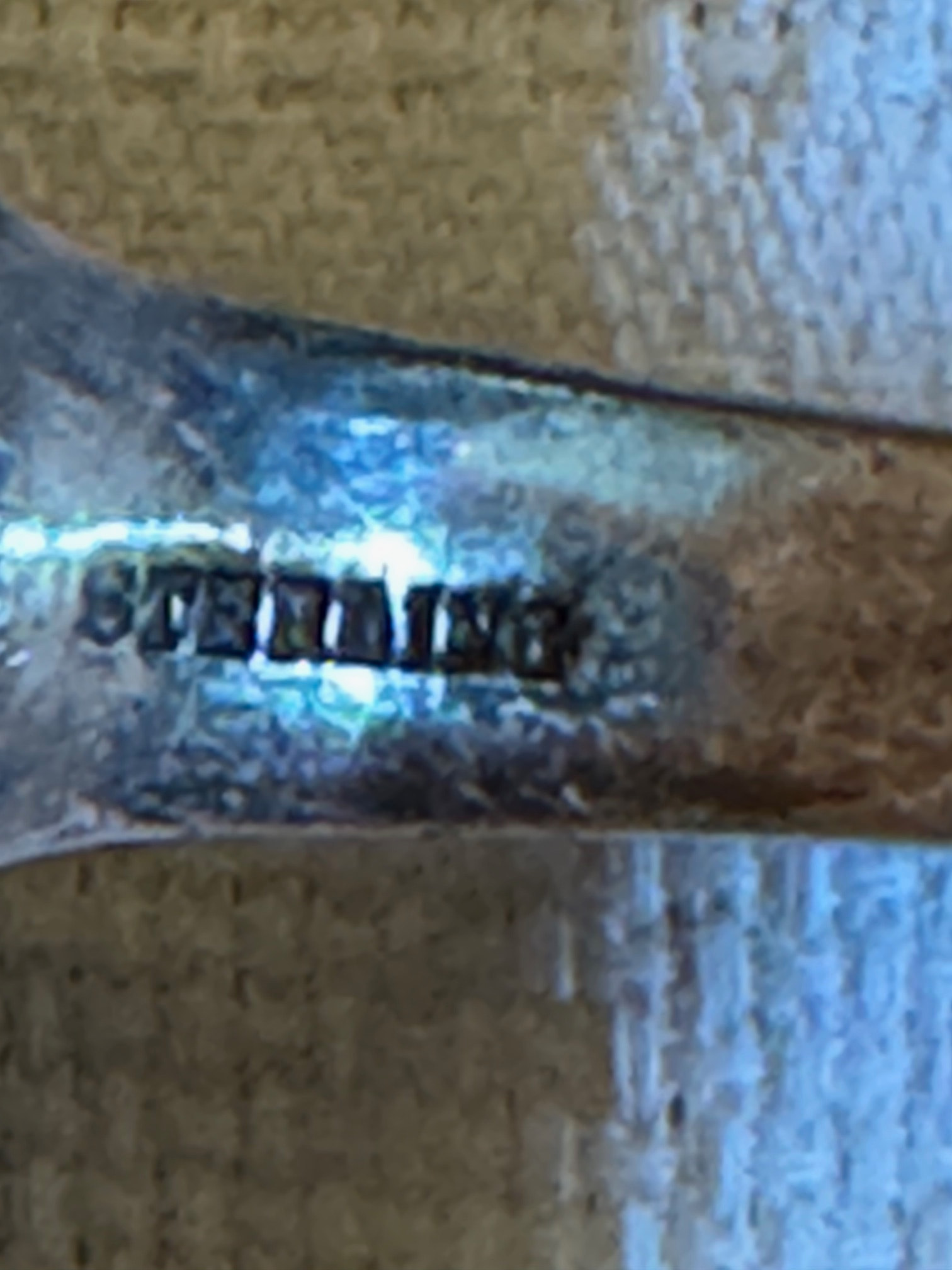
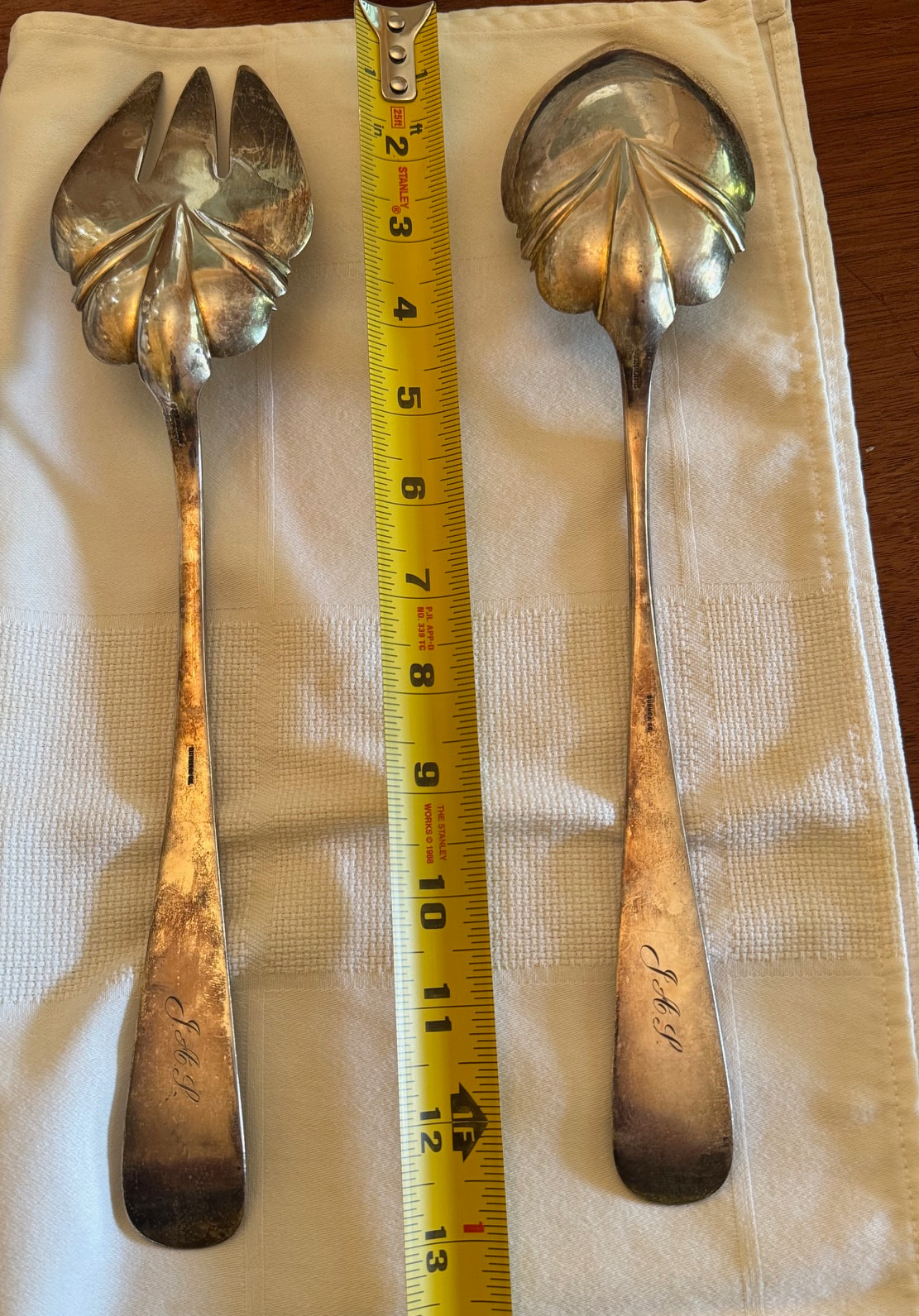
Hello all! I posted on another internet forum that doesn’t seem very active so apologies if you see this post twice. I have inherited some silver and I’m trying to figure the history/makers out. One set has me puzzled, it’s marked Duhme but I can’t see that Duhme made this kind of pattern. I read that Duhme also sold other makers’ silver so hoping for some clarification. These are salad (?) servers, about 13” long. Sorry they are so tarnished, I need to get some silver polish.


1 Like
As you only posted your images on the other forum a few hours ago I feel you are being a little hasty. That other forum is in fact extremely active so try to be patient. No doubt one of our contributors here may also chime in with a response - just give us all time.
1 Like
Honestly, Phil - when I looked at the reply activity on the other forum the were no replies on the last two topics (posted April 30 and May 18) - the last non-admin reply was to a post made on April 25th! So my impression was I had posted on a mostly-dead forum. I tried to delete my post there so there was no duplication but I couldn’t find a way to do so.
1 Like
It looks like a variation on their “Lily” pattern.
Here’s another:
https://www.replacements.com/silver-duhme-co-lily-sterling/c/125106
And one more:
But what do you do on the sales floor with a pair of un-trademarked salad servers? The auctioneer’s standard out are the wonderful words " attributed to".
I once asked a friend of mine, an auctioneers of considerable repute, who had done the attribution in another case.
" Why me of course, dear Boy!" came the response. He died a year later and when the major house catalogues were faced with the same problem a decade later they simply attributed the attribution to the auction house of first instance. I was sad I never got to tell my old friend of his post mortem Bond St. fame.
I thought about heeding Phil’s gentle interdict to wait upon events, or even answer the other place inquiry where you has so recklessly scattered your interrogations, but I do all my chiming on this site although frequently find myself searching the cols of the other.
Did you?
CRWW
1 Like

It doesn’t really look like the Lily pattern - it’s definitely floral and the decoration technique is similar but the flowers on these are large and multi petaled, closer to a daisy?! Definitely not the Tipped!
Sorry, maybe you’re making a joke on the attribution that I don’t understand. The silver mark indicates “Duhme & Co.” so no need to attribute? And I’m not really looking to sell, I’m just trying to get the description right. We have misc silver pieces from various family branches going back to the 1800s and it helps to figure out which family each piece is from if we can date them.
The “other” site appears to be pretty dead, at least on the American Silver forum. No responses on my question yet but I got chided by the moderator for using Imgur for photos… when their tutorial clearly said to do so… and when I pointed that out, my comment got deleted. This site is a lot easier. I guess I’m too used to Reddit where lots of people just chime in.
Yes, I searched initially for Duhme on the site once I deciphered the mark but that’s kind of what sparked my question - in the older post some people mentioned that Duhme would sometimes mark other silversmiths’ work with their mark as they were a retailer as well as a jeweler and silversmith. So I was trying to figure out if this is Duhme-Duhme or retail-Duhme. Hard to tell when the pattern doesn’t look like anything else out there.
2 Likes
LOL. Thanks. (20 characters)
2 Likes
Rarely does one get asked a question which comes with such a complete built-in answer.
Even if we find you another item also stamped by Duhme we are still not going to know if the stamp on that item is Duhme qua retailer or wholesaler or even both unless it happens to come complete with original box and invoice and the paperwork not only differentiates between retailer and manufacturer but specifically attests to the paperwork being specific to the exhibited item.
My original answer stands. Yours is a variation – meaning similar conformation but different in patterning-- on a design it calls “Lucy” and I would call old English handle with a natural theme pattern typical of the turn of the last century.
CRWW
1 Like
That’s a fun rabbit hole! I think the typical Wood and Hughes (that I can see online) has higher relief flowers. These are quite flat and the stippling as part of the handle pattern is also really different. I will look further though. Any reccs for silver pattern books to look for that might be of the right era?
1 Like
Also, probably doesn’t matter but I think this might be a stuffing set or serving set and not a pair of salad servers. The size of the two and the pointed bowl of the spoon was really puzzling me as it’s pretty useless for salad. I ran across several “stuffing spoons” of the same shape.
1 Like
It might. Edward Lear came up with the most satisfactory name for the spoon that’s been turned into a fork in his poem about the romantically inclined Owl and the Pussy Cat.
Stuffing spoons are rarely if ever used to stuffing. They are simply long-handled serving spoons which probably reflect a desire for distance in times when plumbing in servants’ quarters was a rarity.
Sometimes they get called basting spoons which is an even less likely use for them, basting being something you historically did over a split with an iron or wooden ladle or paddle.
Table spoons, on the other hand when they cross the Atlantic, become serving spoons, because Americans were smart enough to realize unless you had a really large mouth they were too big to insert in it point first.
The British invented them for the sole purpose of amusing themselves at the expense of neophyte dinner guests who had to learn they were actually soup spoons and you used them by supping from the side of the bowl.
CRWW
1 Like
Well, we were puzzled how this pair was ever to be used for salad - serving at arm’s length makes much more sense.
1 Like
In the 18th and 19th century long-handled serving spoons were 12-13.5 inches and simply large tablespoons which were nine inches and were large desert spoons (7 to 7.5 inches) which were large teaspoons (five inches) which shrank to demitasse spoons which were 3.5 inches more or less in the 20th century.
Size was important in Georgian Britain. Probably elsewhere too.
You’ve got to go to Ireland to find really odd things being done to spoons, like dividing them in half and calling them draining spoons or slotted spoons.
The New York manufacturers seized on all this ringmarole and the pattern books for the likes of Tiffany are an impossible array of collectibles and new categories of implements for consumables like ice cream and oysters and yes, even salad.
You have presented the panel with what I think is an imposslble-to-solve conundrum because even if you find another pattern the same as yours in another pattern book, it still does not answer the question you pose merely repeats it.
CRWW
1 Like
I thought I’d add what I learned about these in case someone else has the same question and needs some background.
The expert I connected with was pretty sure my set was not Duhme made and it could easily be any one of many manufacturers. The Duhme mark on my pieces was frequently used on silver that was manufactured by silversmiths other than Duhme. Gorham, Whiting and other manufacturers would commonly produce their own pieces and mark them “DUHME & CO” to be retailed by Duhme. The pattern I have is likely 1870s-1880s, it’s part of the Aesthetic Movement designs where asymmetrical nature and Japanese-inspired patterns became popular vs the more symmetrical Victorian designs that preceded them. Large serving pieces like mine would not have necessarily been part of a flatware pattern, many were produced as one- offs. So looking for a matching pattern was a bust but that’s okay with me as I just wanted to know what I could about them.
One of the distinctive features of this era was the popularity of brite/bright-cutting, this is a very fun article on it.
I hope that helps someone!
2 Likes