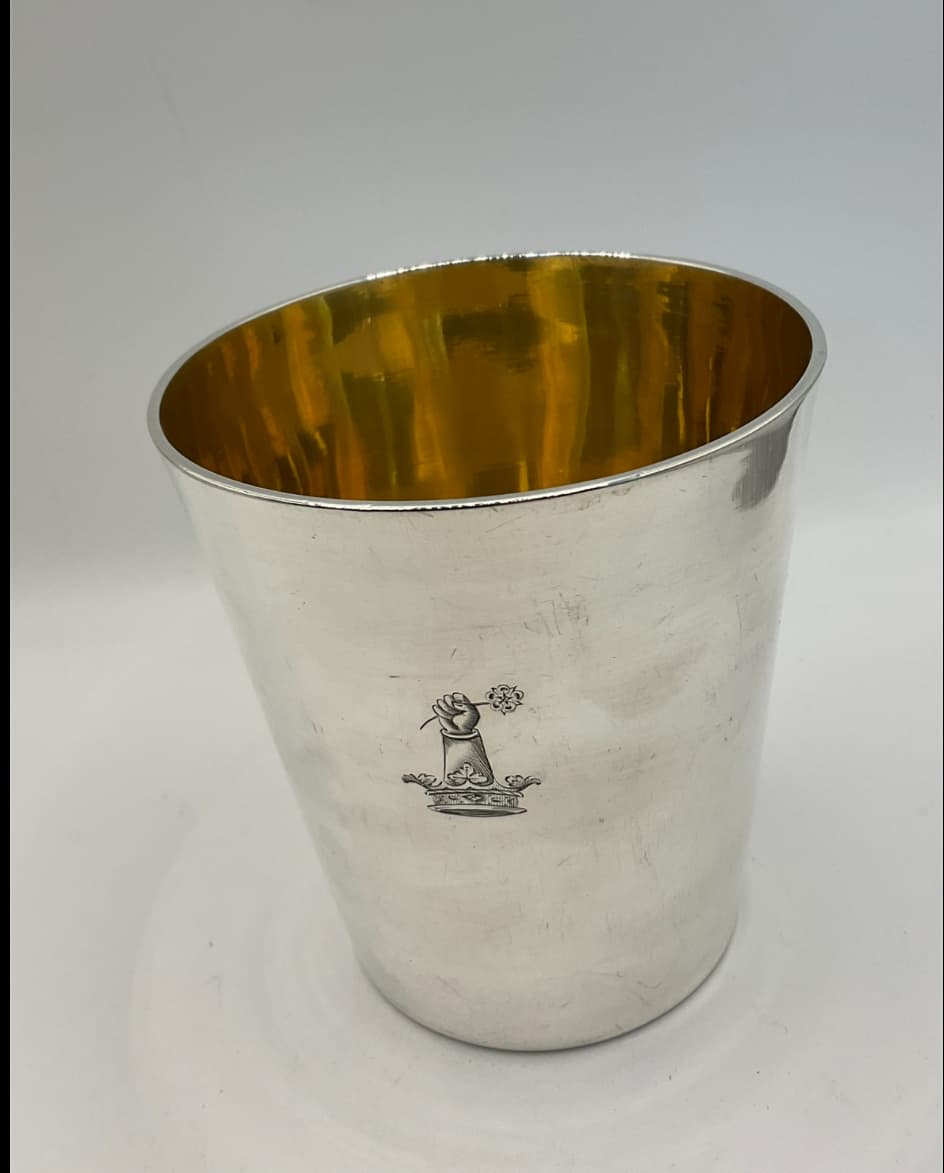
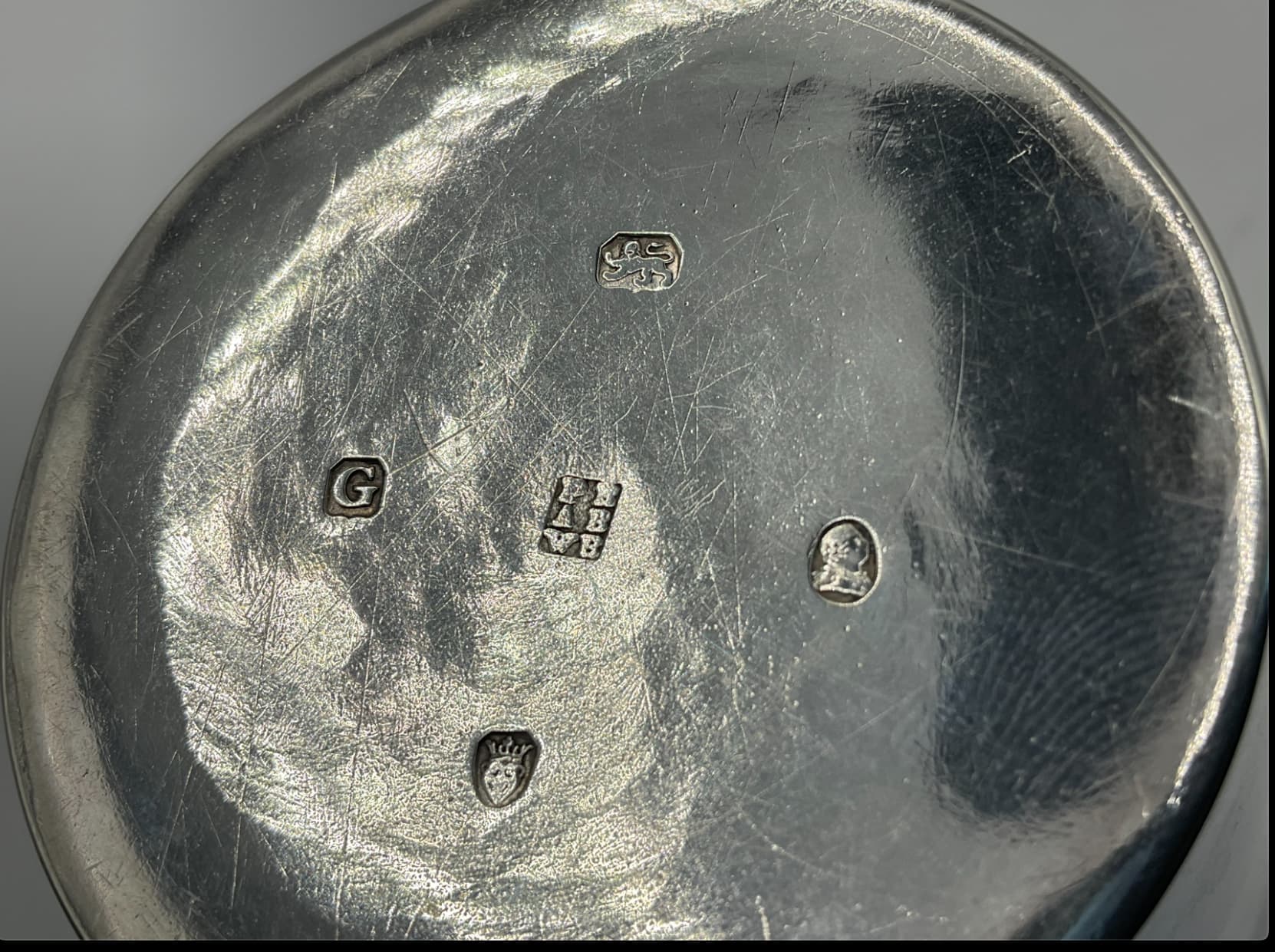
Is anyone familiar with the emblem on this cup. I believe the cup is made by Peter, Ann, and William Bateman but I’m not familiar with the emblem with the crown and an extended arm in a fist grasping the “ Tudor ? “ rose. Thank you for any comments.
1 Like
Hester Bateman and Bateman Family: marks, hallmarks and history 100%
Rose Surname Meaning, Rose Name History, Rose Crests, Coat of Arms & Genealogy : MyFamilySilver.com
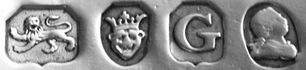 London, 1802.
1 Like
This is an "vambraced’, dexter foreman with a “slipped” rose, no leaves “vert” just a plan stem
A Fairbairn heraldry search directs searchers to Sir Rose Price of Cornwall.
Rose was a slaver. He educated his mulatto chlldren by his 13-year-old wife in the UK
The problem is his “mount”, no, not the child bride but, to use heraldry terms, the ducal crown he claims. I cannot find a link in Burkes Peerage.
You are more patient with these anomalies than I am. Maybe you can sort it.
Price was about to get a huge payday when this cup was being made. "The UK Parliament agreed to recompense slave owners in 1833, as part of the Slavery Abolition Act. The payments were formalised by the Slave Compensation Act 1837.
- Amount: The government allocated £20 million for the compensation, a sum that represented approximately 40% of the UK’s annual budget at the time. This was the largest state-sponsored payout in British history until the 2009 bank bailout.
- Recipients: The money was paid to over 40,000 slave owners as compensation for the “loss of their property” (the enslaved people). Notable recipients included the father of future Prime Minister William Gladstone.
- Funding and Duration: The government took out a loan to cover this massive expense. This debt was finally paid off by British taxpayers in 2015.
- The Enslaved: The Act provided no financial compensation to the formerly enslaved people, who were instead forced to work as unpaid “apprentices” for their former masters for several years after formal emancipation in 1834 (with full freedom granted in 1838).
The National Archives
2 Likes
1 Like
Yep, that’s him. And his purchased baronet title. But you have to push back to find the dukedom – for that is a ducal coronet someone has engraved on the cup. And there isn’t one. Maybe through some female line. Which in the days of primogeniture didn’t count.
I found tin mining and tobacco and slavery and decided I really could care less about him or his fake ancestors or his purchased respectability or enormous wealth
I am however familiar with Worthy Park. They make excellent rum.
2 Likes
Well, if it’s any compensation, he doesn’t appear to have been able to enjoy the giant, ill gotten windfall for long, as he seems to have died twice in 1834. Some guys just don’t get the memo.
1 Like
On the death of his father in 1797, Rose Price inherited a number of plantations on Jamaica,
- Mickleton Penn – which produced sugar and rum, and in 1799 had 34 enslaved people
- Spring Garden – which produced corn, steers, mules, horses and sheep
- Cocoree – 580 acres (230 ha) when inherited, Rose Price made four purchases of 300 acres
- Worthy Park – which grew cane and produced sugar and rum and employed some 50 slaves, even after slavey was abolished in England.
In 1813, Price purchased Trengwainton, near Penzance and lived at Kenegie in nearby Gulval until 1817, while he rebuilt the house and pleasure gardens under the direction of Mr George Brown.
Today the gardens are well worth a visit.. Those whose scruples might worry them if they visited a place once funded by the hard labor of some 500 slaves in another place, should know the Price family had to sell the house and gardens when slavery was abolished.
The 18th century garden created by Price and Brown (no relation to Capability Brown)who invented the natural landscape at places like Stowe to replace the formal gardens copied from the Dutch merchants’ urban homes and gardens) bears little resemblance to the modern gardens created by a profusion of blooms brought in from all over the world in the 19th and 20th century by subsequent owners.
Today’s owners National Trust is under considerable pressure to post acknowledgements of the price paid for the parks creation.
This beaker will have been part of a set of perhaps 12 all fitting inside each other and designed to be picnic ware or for lunches at shooting parties. The drink: a Pimms or a rum concoction. THe myth is cocktails were invented in the roaring 20’s. They were much earlier.
And this beaker or cup is exactly the right vessel.
Ice from lakeside ice houses would have been used too. The ice houses at Trengwainton are located within the extensive grounds of the estate,
Ice houses, including those found on large estates in the 18th and 19th centuries, were built partly or completely underground to provide natural insulation.
They typically feature a deep, often egg-shaped or circular, brick-lined chamber with a domed roof. The one at Trengwainton has a circular pit.The structures were heavily insulated with materials like straw or sawdust to maintain a consistently low temperature, keeping the ice frozen for many months. The Trengwainton structure was found with an extension tunnel packed with clay for better insulation.
CRWW
1 Like