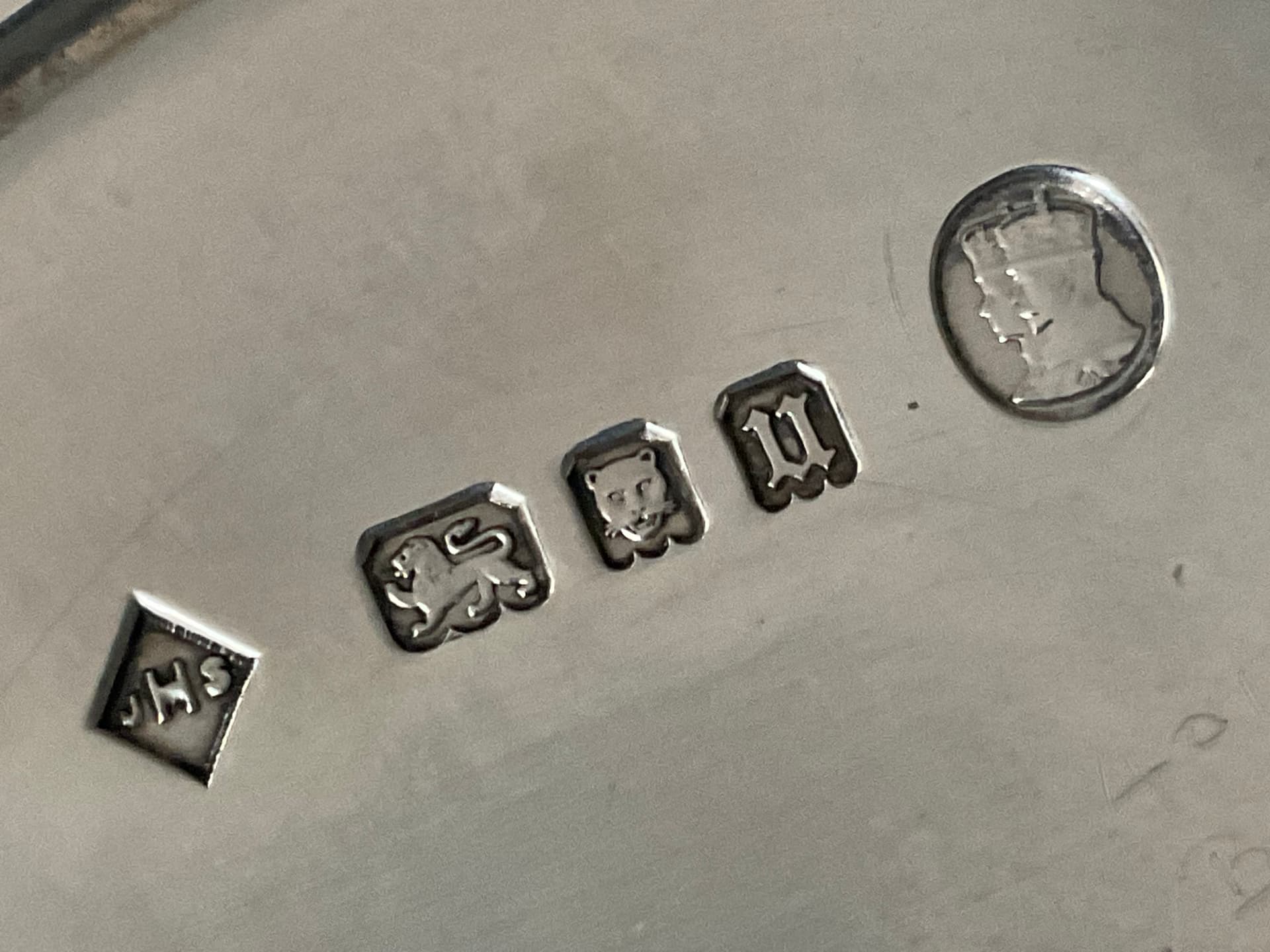
This hallmark appears on a sterling silver cup. I am no familiar with the “ double “ monarch duty mark. Has anyone seen this before? Thank you for your help.
1 Like
George V and Queen Mary, their 1935 Jubilee just a year before his death.
Its’ not actually a duty mark at all but simply part of the Jubilee celebration.
Since then we have seen a number of similar marks for Queen Elizabeth II.
1 Like
| Harman & Co (J S Harman) | 1923..1935. | British and Irish commemorative hallmarks - part 2: an article for ASCAS - Association of Small Collectors of Antique Silver website |
|---|
The King George V and Queen Mary Silver Jubilee celebrated in 1935, adorned items made of precious metals to commemorate the event which could bear this specific commemorative assay mark . This mark was voluntary and was available to silversmiths between 1934 and 1935.
Queen Mary was not a co-monarch like her forebear Queen Mary daughter of King James who ascended the English Throne with Husband William of Orange in 1688 as the protestant alternative to James II and his newly born and Catholic son, but she was extremely well respected as his Queen and consort.
Indeed it was probably she, who by agreeing to abandon the family name – a German name – in WWI saved the British Monarchy. She also invented the " Walkabout" and fought hard against having the deposed Russian Czar Nicholas – a look alike to her husband – from seeking refuge in the UK.
George V was an easy-going, not very bright man who preferred shooting pheasants and collecting stamps to ruling an empire. Mary was the daughter of a minor German royal Duke whose quiet diplomacy and iron will carried her husband, dismissed her son Edward VIII who abdicated, and supported her younger son and his Scottish Wife through WWII.
She died in 1953, just weeks before Elizabeth’s coronation which was delayed by Churchill for political purposes. But a lot of her iron will and diplomacy played out in the reign of Elizabeth II.
CRWW
The listing on Ebay seems to have mis-spelled the maker but this cup created for the Silver Jubilee may be of some interest to you.
George, the naval son of a dissolute father, Edward VII a notorious womanizer, hated the job he got landed with. Despite that he did it rather well, taking an active role in matters his successors as constitutional monarchs, stayed well away from.
In Canada we’re grateful for his diplomacy in the notorious King-Byng affair.This was a 1926 Canadian constitutional crisis where Prime Minister William Lyon Mackenzie King’s minority government faced collapse, and Governor General Lord Byng refused King’s request to dissolve Parliament for an election, instead asking Conservative leader Arthur Meighen to form a government.
This sparked a major debate over the Governor General’s role, ultimately leading to the Balfour Declaration which affirmed Canada’s full autonomy and established the GG as the King’s representative, not Britain’s, solidifying responsible government principles.
The year after this assay mark was last struck, George died. His death was postponed so that it could be announced in the respectable morning Newspapers like the Times of London rather than the less respectable Evening Standard.
Part of trying to keep him alive was reminding him he and his wife were about to visit Bognor. George, who by then was exhausted and was fed up with doctors, palace politicians and probably life, cried " Bugger Bognor" and died.
Perhaps the best recorded last words of any monarch anywhere.
CRWW
1 Like
Because the author of this otherwise somewhat useful synoptic on non-statutory marks left out Ireland, technically correct because he had limited himself to the UK which Ireland had left before creating any purely commemorative marks, and because Ireland continues to use an essentially British-developed system of assay marks on its silver, it is worth reminding ourselves of the key commemorative marks in Dublin starting with the 1973 mark to commemorate its entry into the EU.
This mark is a large Celtic gold necklace, the Glensheen Collar, created using an art of goldsmithing lost to the modern world.
Other commemorative marks are the founding of the Dublin Goldsmith’s Company, the millennium year for the City of Dublin and a stylized M2 mark celebrating the second millennium of the modern calendar in 2000.
For collectors these Eire marks are very sought after especially the EU Collar mark in 1973.
CRWW
1 Like
Thank you for all the information Guildhall
1 Like