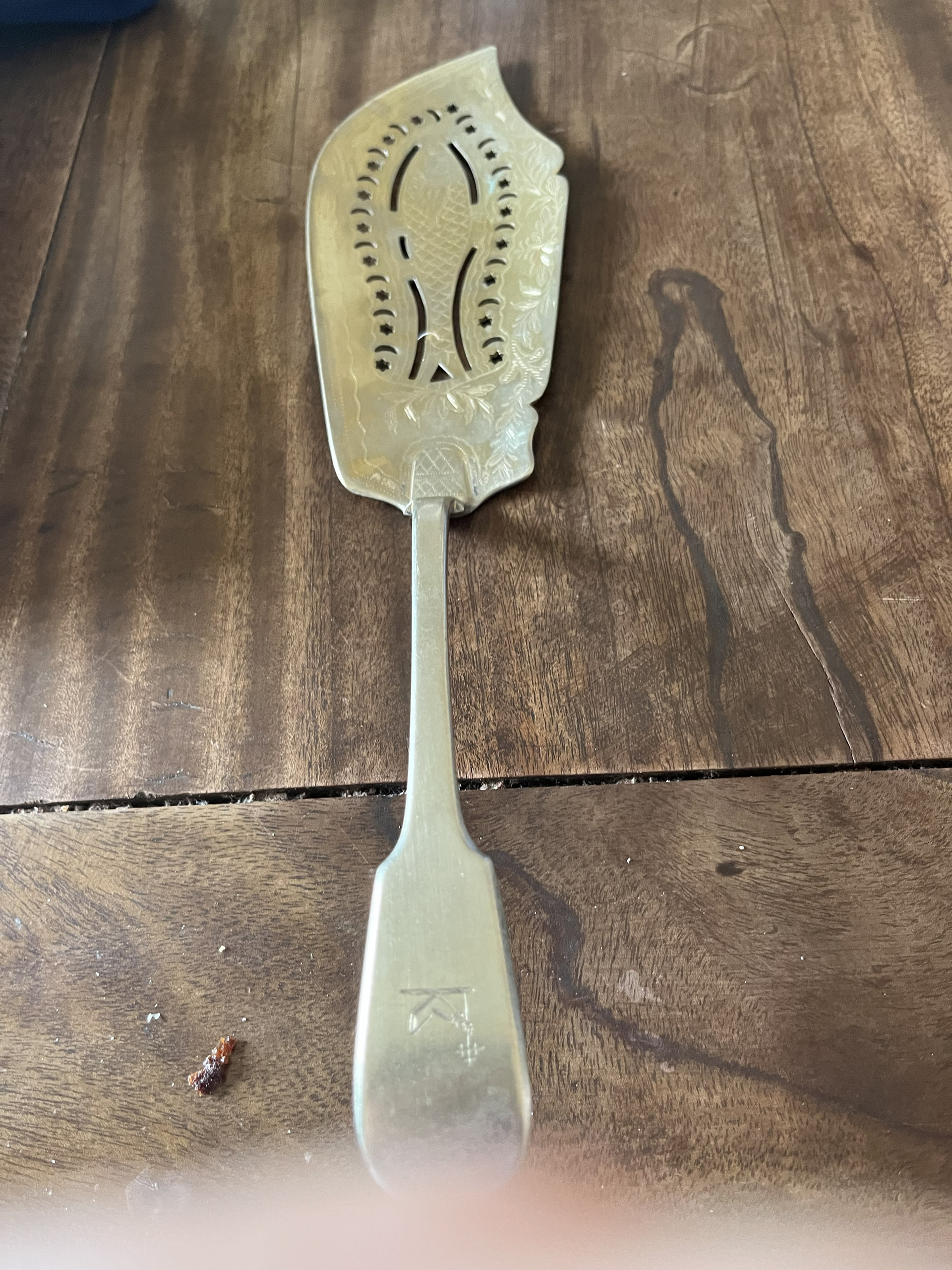
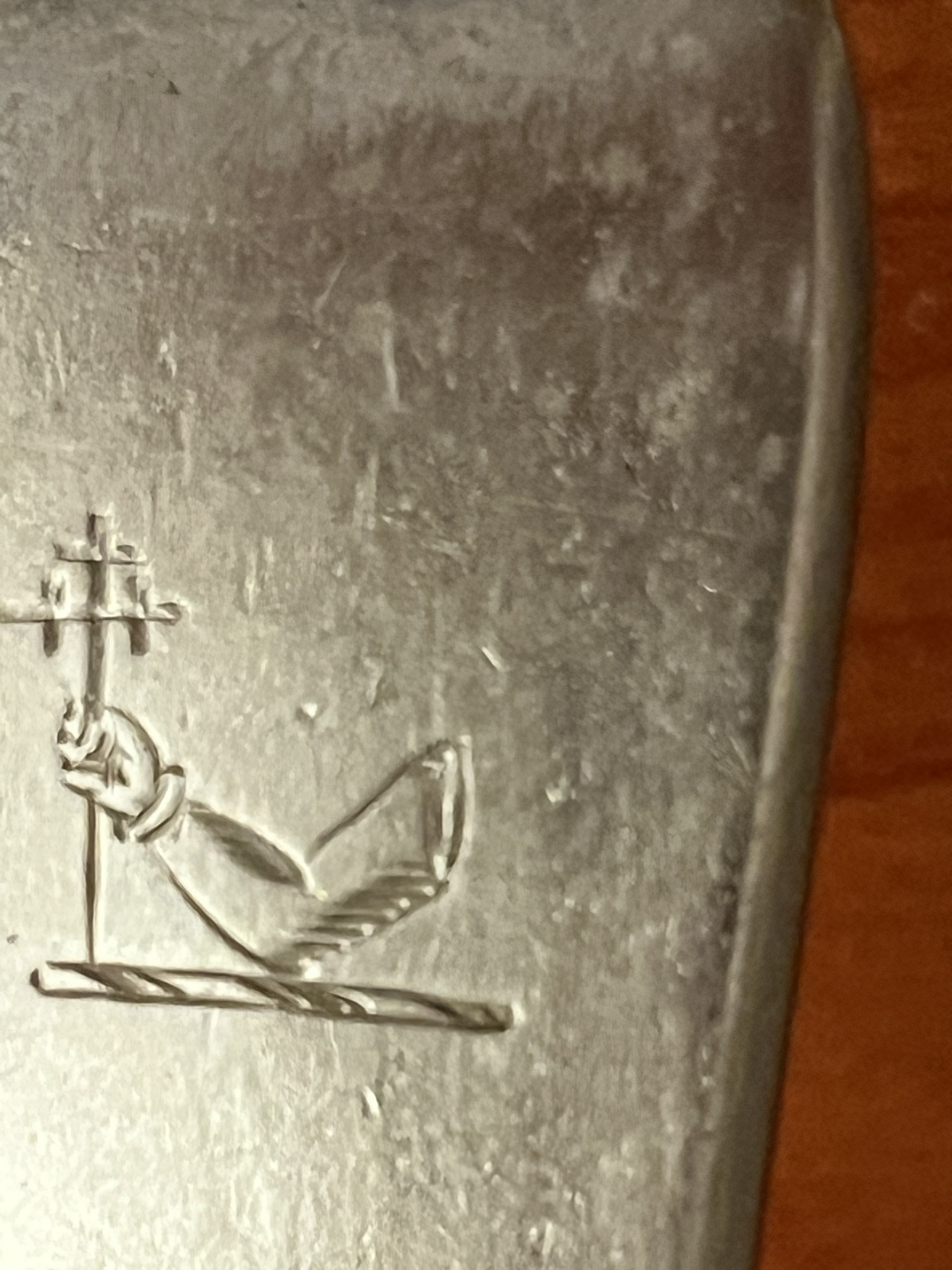
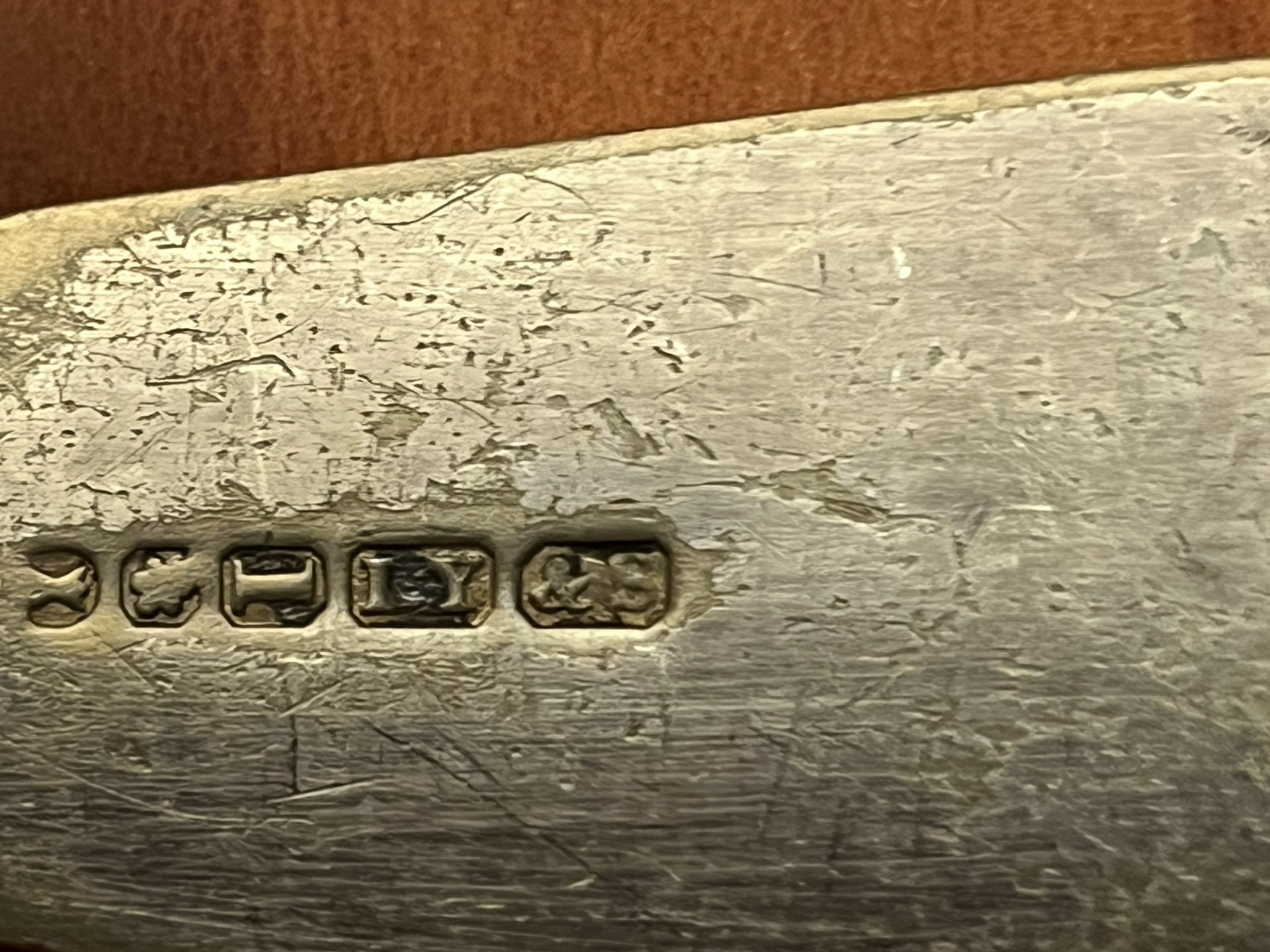
I think this is plate but the item is NOT magnetic. Stylistically its a Victorian fish slice. I believe the crest is the O’Donel family of Newport. Mayo in Ireland. I know where its been since the 1950’s (in Mayo a few miles from Newport) and suspect it has been there since the 1920s The I Y& S could be Israel Yudelman of Sheffield(?). I cannot make any headway on the other three marks.or their meaning. Any help would be appreciated.
One quick note: the “magnet test” is useless. Silver is not magnetic. But neither is copper, or zinc, or nickel silver, or pewter, or even most types of stainless steel. If a magnet sticks to it, that indicates that it’s almost certainly iron, which is almost never used as a base for silverplate.
I agree with the attribution to Yudelman of Sheffield - nothing else really fits.
ETA: Yudelman started business in 1880, but didn’t add his sons until 1909. Closed up in 1925, so that pretty much defines the oldest/newest dates for this slice as 1909-1925.
The other three marks probably have no meaning whatsoever. Makers of electroplate often adorned their pieces with marks intended to fool the customer into thinking they’re hallmarked silver. It’s always been almost completely unregulated.
I think you are right. but this is a Patriarchal Cross with two bars and the O’donel coat of arms has either a cross or a Jerusalem cross (cross with crosses on each arm).
The double arm is supposed to indicate power both temporal and divine. So typically an O’donel who was also a bishop and adopted the variation for his insignia.
The first cross bar was for the words “Jesus of Nazareth King of the Jews” a tutulus ordered by Pilate and the second bar was to support the arms of the crucified
There are three candidates:
- Bishop James Louis O’Donel (1737–1811): Widely known as the “Apostle of Newfoundland.” Born in County Tipperary, Ireland, he became the first Roman Catholic Bishop of St. John’s, Newfoundland. He retired back to Waterford, Ireland, in 1807. You can read his detailed Dictionary of Irish Biography profile for more. [1, 2, 3, 4, 5]
- Cardinal Patrick O’Donnell (1856–1927): Born in County Donegal, he was one of the youngest bishops in the world when consecrated at age 32. He eventually became the Archbishop of Armagh and Primate of All Ireland. [1, 2, 3, 4, 5]
- Bishop Laurence O’Donnell (1777–1855): Born in County Galway, he faithfully served as the Roman Catholic Bishop of Galway through the devastating famine years. [1, 2]
O’Donnell, Ireland, out of a ducal coronet or, a naked arm embowed grasping a dart, aU ppr. In hoc signo vinces. p 417 Fairbairn
Clan Donald’s Cross – Clan Donald Heritage. ile
In summary: the fish slice while not of any intrinsic value is a very useful historical link to a member of the clan prominent in two fields. As you will likely know the O’Donnell kings and Lords of Tyrconnell fiercely defended Gaelic Ireland against English invaders during the Tudor conquests of the late 16th century.
Led by the famous Red Hugh O’Donnell, the clan allied with Hugh O’Neill to fight English forces before their defeat at the Battle of Kinsale in1601, the year James Stuart ascended the British Throne. The defeat of the clans was a direct precursor to the protestant settlement of Ulster by James of Lowland Scots displaced in their homes by “improvements” in farming.
How very much more peaceful if the O’donels had won and the 20th century troubles centred in Belfast and Derry had never happened.
CRWW
@Jeff Tucker. Thank you so much. It never occurred to me that the other marks were just distractors.
@Guildhall. Thanks for all the info but I disagree that it is a patriarchal cross
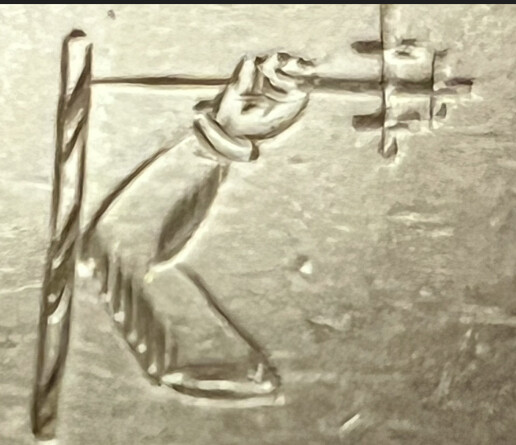
Here’s a different view which makes the down strokes of the Jerusalem cross clearer. Notice also that the main cross tapers to a point,
Here’s the COA of the O’Donel baronets of Newport
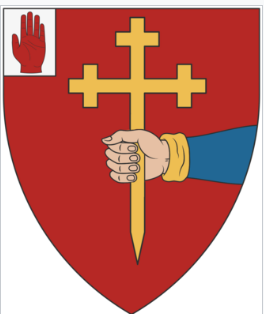
It’s a Jerusalem cross as distinct from the normal cross of the O’Donnells in general and it tapers to a point whereas the more general one has a normal rectangular bottom. The only thing that doesn’t full tally is the arm bent at the elbow. I cannot find the full achievement so maybe the crest has a bent arm as on the silver. The last O’Donel in Newport House died in 1932 and the house was sold in 1945 so presumably, there was a house sale and the fish slice wound up in my house!
What’s more surprising is that someone would go to the trouble and expense to have the family crest engraved on what is, essentially, inexpensive, mass-produced electroplate. Maybe they were trying to bamboozle their guests, just as Yudelman was intent upon planting ideas in the heads of his customers.
It’s a bit like putting fake hood scoops and hood locks on an econobox that would do 0-60 in about two days. 

You may well be right. The tendency inscribing initials on electro plate tended to be accuracy over exact reproduction.
You have the fish slice, now you should go for the house:
https://www.sherryfitz.ie/buy/country-homes/mayo/newport/newport-house-main-street#lg=1&slide=0
Newport House seems to be on the market for one and a half million euros. It’s got 19 bedrooms which may be rather a lot for just yourself unless you decide to rotate through them and only make all of them on the 20th day.
Right now it seems to be configured for a hotel. Looking at the reviews it was a good one but probably better as private residences so it needs to be broken up in to apartments.
Ten units at 800,000 to 1.5 million euros each would work.
All the reference to dexter arms naked grasping a cross crosslet fitched don’t bend. On the other hand the arms of the original O’donel had not one but two arms armoured holding a spear pointing down both bent.
Make a nice crest on the hotel letterhead
CRWW