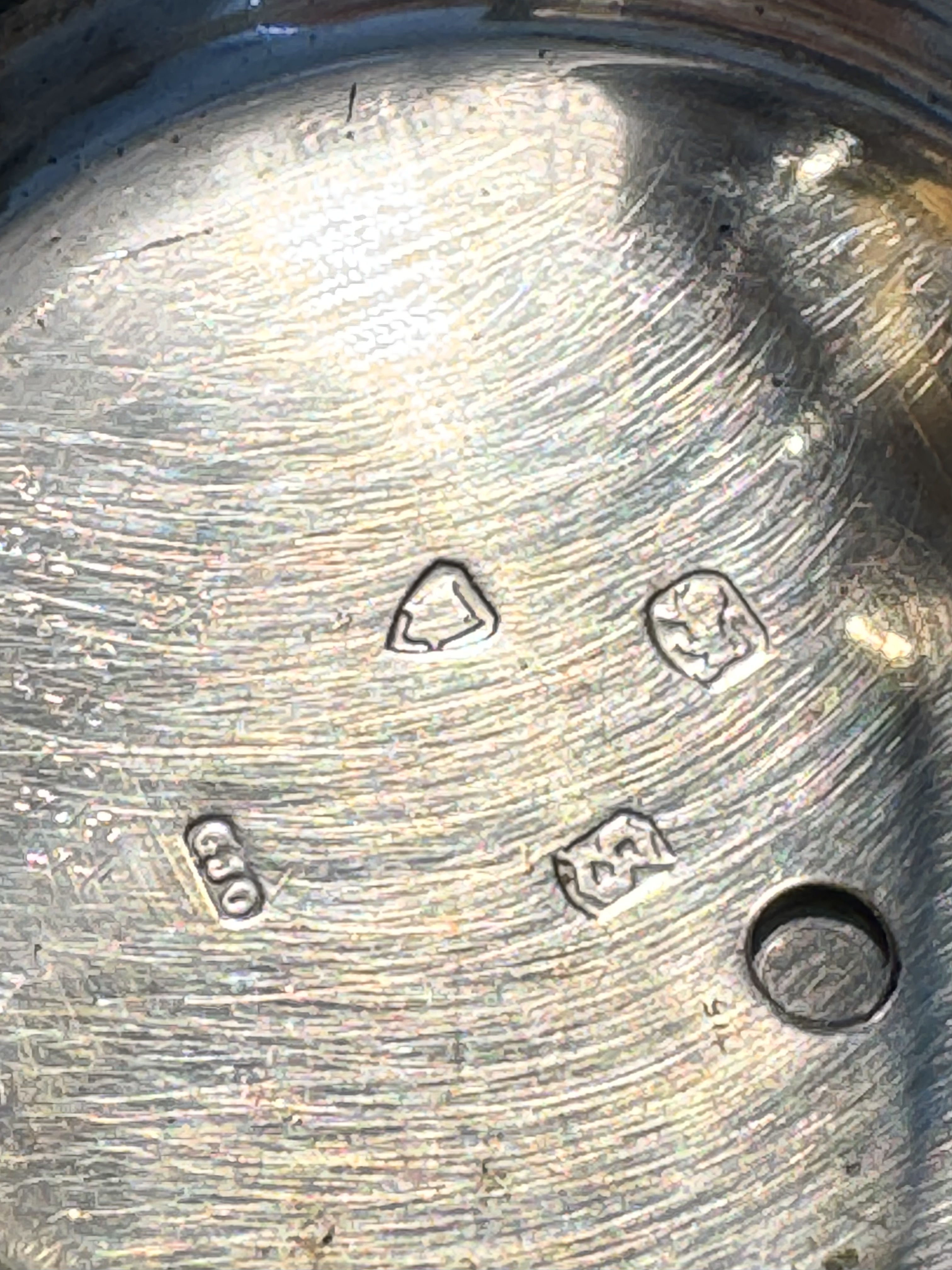
Hi- I’m seeking some assistance please - a lovely silver pocket watch - Roman numeral main face with a smaller second counter in a circle at the bottom of the watch. Marks inside are Lion passant, capital italics S on the right hand side. A shield on the left hand side - worn a little due to polishing I imagine and three letters at the bottom possibly GJO? Thank you
https://www.ebay.co.uk/itm/127094254421
You ask for assistance. But you don’t say with what? Taking clear photos? Take any photos? Restoring old pocket watches? Value if anything above scrap for the silver case?
If the case maker is by George Oliphant or Oram, both were working in London in 1873 (Italics not capital date letter S) then perhaps you want to know if the the watch works is English or Swiss or even French?
Or perhaps the question you want assistance with is should you invest in 19th century pocket watches at all? Only if you know how to make them work again is the general answer.
Or you might be asking what should you pay for them? Scrap for the case and for the probably foreign works? Depends how good of repair it is in? You say its working so sounds like it just needs cleaning and re-lubing?
That will take three to four hours and your local watch maker can give you a quote based on his hourly rate.
Perhaps you are interested in the story of mid-Victorian watchmaking in Europe and the UK and are wondering if you can get some help defining that interest? It’s actually a curious story because, for the first time, time wasn’t a locally-created thing rung out by the village church bell but a national matter which determined if you caught the train or not.
So the mass-produced pocket watch became vital for both railroad operators and their customers and watches, instead of being bulbous luxuries of wealthy men, became basis tools. Sort of the i-phone of the day for early commuters.
Anyway if you are looking at the ebay watch with the fuzzy pictures I have linked here and you have another similar watch and want to unload, you might want to get it working first and then sell it otherwise its little more than scrap only.
To Irishsilver: Piet has used the word “identifying” in his title so that is where he needs assistance. I know it’s really frustrating and annoying when posters can’t be bothered to include pictures…
To Piet: Please include nice clear pictures - they are so much more useful than written descriptions.
1 Like
Quite so. But identifying what? The case-maker? The works? The raison d’etre for the watch itself? Its value? Its fixability?
His question is as fuzzy as the ebay watch pictures by the same case maker and perchance the inspiration for the post in the first place.
As an old Irish hack put it, “The questions asked are always more important than the answers and inevitably define them.”
The question probably should have been not to identify the attributes of the case or the mechanism or even its purpose, but the correct forum within which to post it.
This forum being for silver and that being a timepiece probably manufactured in a Swiss canton and popped into a case sent over by Mancunian maker registered in London, George John Oliphant. A maker identified correctly on you own fine website where answers to even the blurriest question can oft’ be found.
The entire practice, mass produced watches out of the Alps made not by one but by dozens of parts makers, assembled in the UK-supplied case then shipped back to be sold to the emerging middle class, so infuriated the English watch makers special legislation was implemented to protect them.
Didn’t work, but the practice left only the top end watch makers like Dent and Frodsham actually in business in Britain. It was the first trade dispute between Europe and the UK culminating in BREXIT about 150 years later.
To Piet: Don’t worry your honor, your questions will always get treated with the respect you afford them in the posting.
I didn’t know I could post photos - please
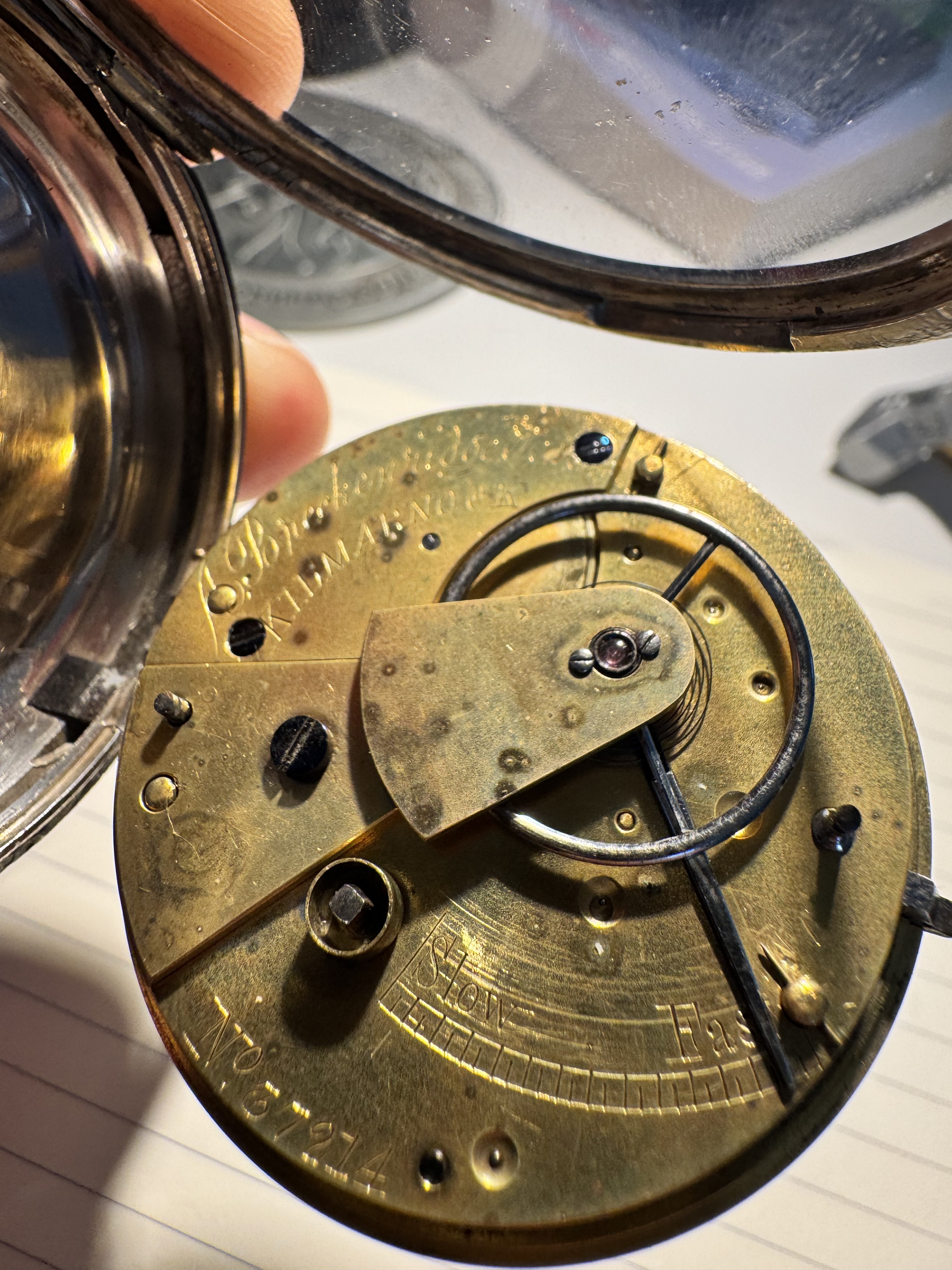
See attached as I’ve now found out some more by opening it up
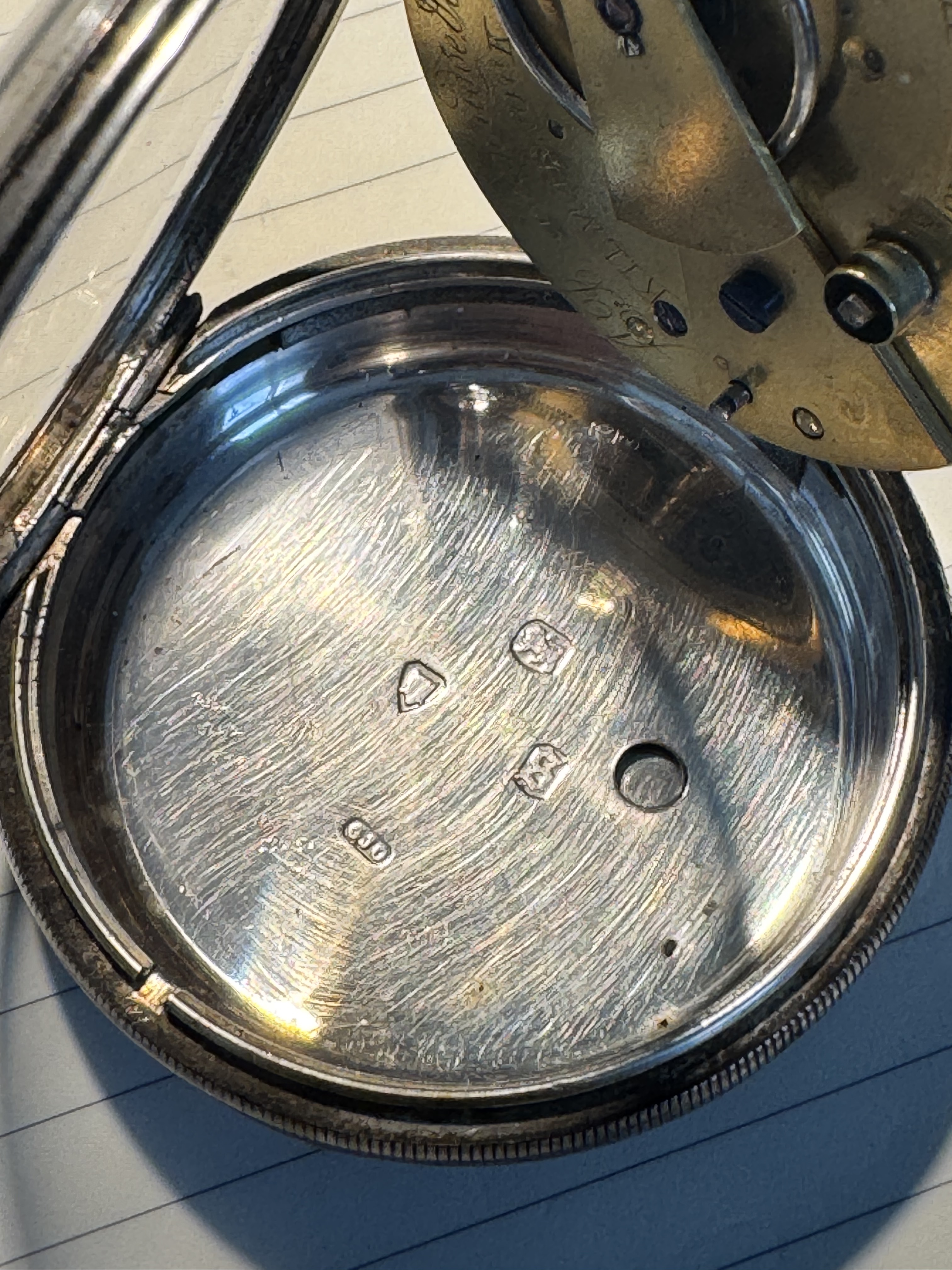
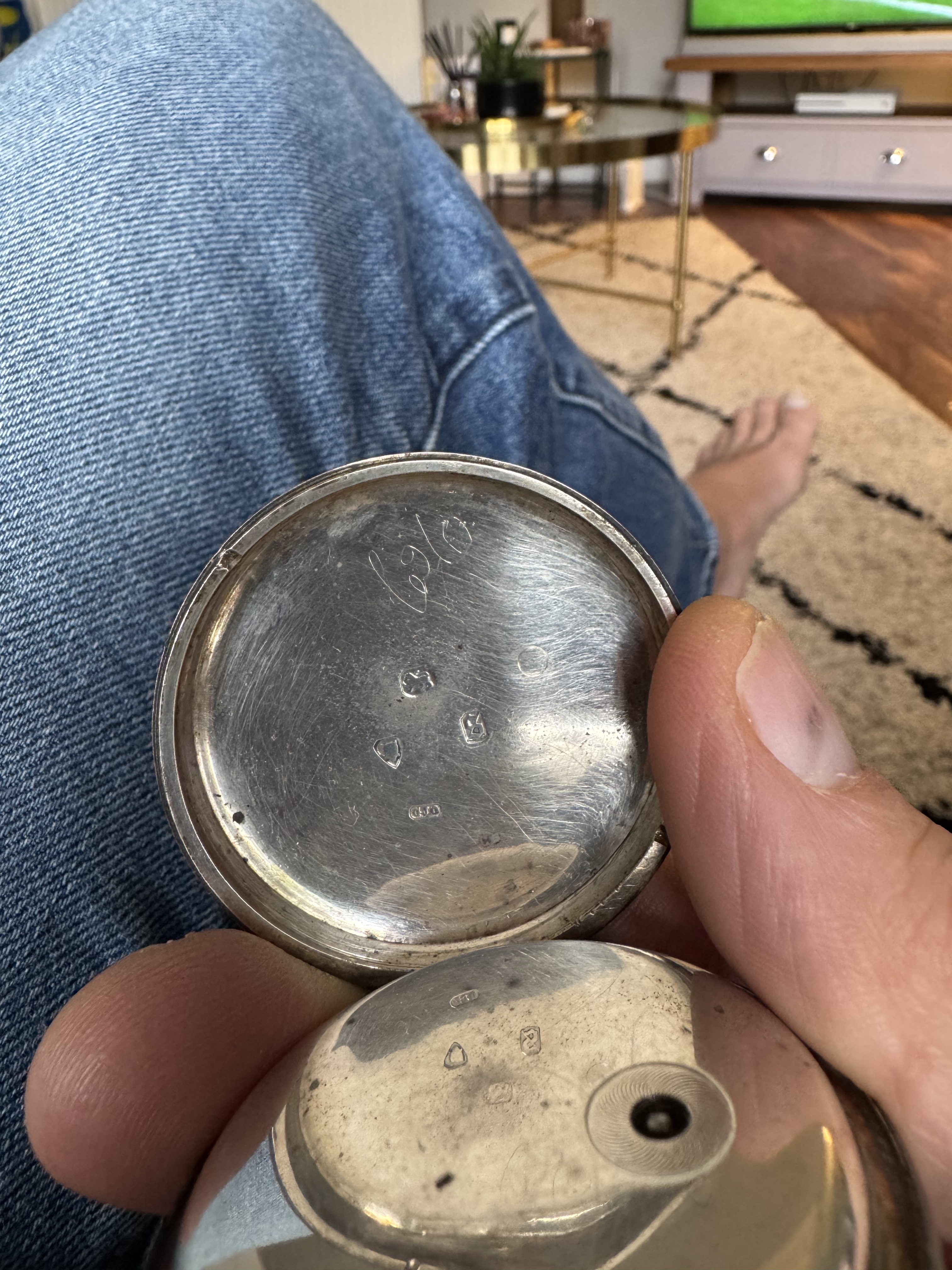
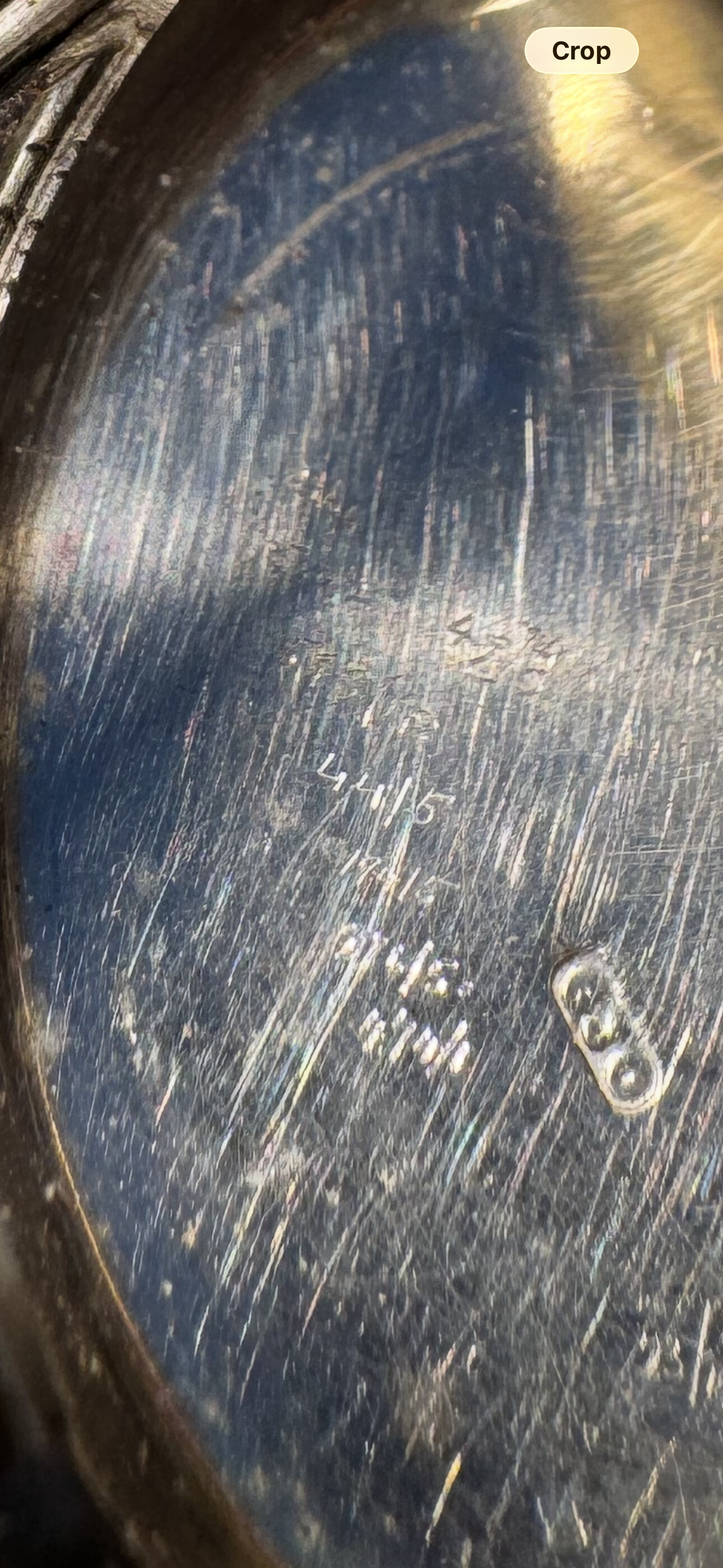
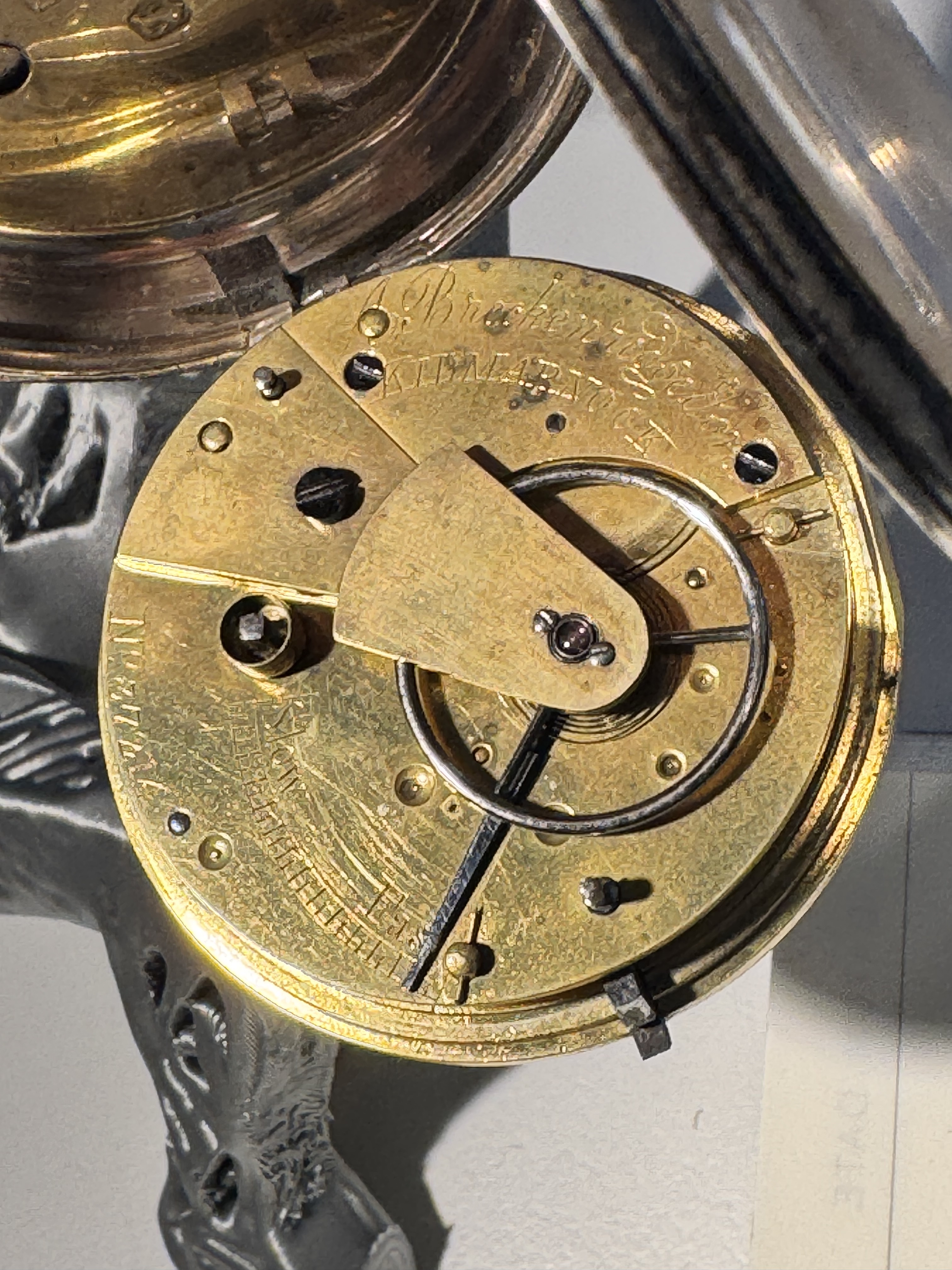
Bloody hell!? I asked an innocent set of questions about my father in laws pocket watch passed Down by his father - I don’t care about eBay or value or selling,
I’m Trying to find out about the history of the little Watch so I know where to take it to, to preserve it and get it going so it lives on. Nothing cryptic about my questions and I didn’t know I could post photos, now done. Maybe reflect and work on being a little friendlier as a group/forum…
Good. Now we can confirm the case date and see the works which are by Alexander Breckenridge & Sons a prominent historic clock and watchmaking firm based in Kilmarnock, Scotland, active from 1799 until the late 19th century.
Breckenridge started his business in Market Lane, Kilmarnock, in 1799. The firm moved to King Street in 1836, officially operating under the name A. Breckenridge & Son. Alexander died in 1848, but the family business continued through his son and later his daughter until around 1898.
The firm is best known for crafting fine Scottish longcase clocks, particularly in the classic keyhole or “Drumhead” design, frequently featuring eight-day weight-driven movements and hand-painted dials.
It also produced signed pocket watches, including this one, bearing its signature on the movement. The watch date is 1873, as we originally deduced before you discovered the ability to post pictures.
So a KIlmarnock keywind works in a London case at a time when UK watch makers were getting scarce. Nice to have.
If you are keeping it, then take it to a local watch maker/ repairer and have him clean and lube it.
Hopefully you won’t get upset again but I have looked more closely at your watch works and it is Swiss imported works stamped with a private label for Breckenridge rather than an English movement.
By the 1870s, Swiss manufacturers were dominating the market with highly accurate, thin, jewel-capped movements like this. Swiss factories purposefully exported these blank movements without branding so that local makers like Breckenridge could finish them, case them in London silver, and retail them under their own trusted family name.
If the movement had featured a chain-driven “fusee” mechanism, or wound counter-clockwise, it would have been an authentic British-made movement. Watchmakers had used to buy raw, unfinished movements from major English watch-manufacturing hubs like Manchester or Coventry. Then the Breckenridge workshop would then have meticulously assembled, tuned, jewelled, adjusted, and finished the movement in Scotland, stamping “A. Breckenridge & Son, Kilmarnock” on the backplate as a mark of their regional quality control and guarantee.
This didn’t happen with this fine timepeice
The movement imported from the Swiss canton and the watch case were married having been made in two different countries. The name was simply added to an already assembled Swiss works.
When this practice started English stamped cases were sent to Switzerland and the works put in them there. This avoided all foreign import duty and left the English horologist at a disadvantage created by not having he assembly line approach to watchmaking and consequential higher wage costs.
By the 1873’s watchmakers like Breckenridge decided if you can’t beat them join them and they brought the Swiss works in themselves.
Now while this private labelling makes the watch less valuable it is still extremely well made-- in fact probably better made than if it were local product-- just not quite as rare.
You say you have no interest in price so I won’t bother you with the cash difference between the two but one is somewhat rare and the other, this one, fairly common or garden.
Kilmarnock apart from being home to a number of very good horologists as well as where Johnny Walker whisky and Clark Shoes started life, was a Scottish rail terminus and indeed where the first steam railway in the country operated. So a good watch might have been very important to its original owner.