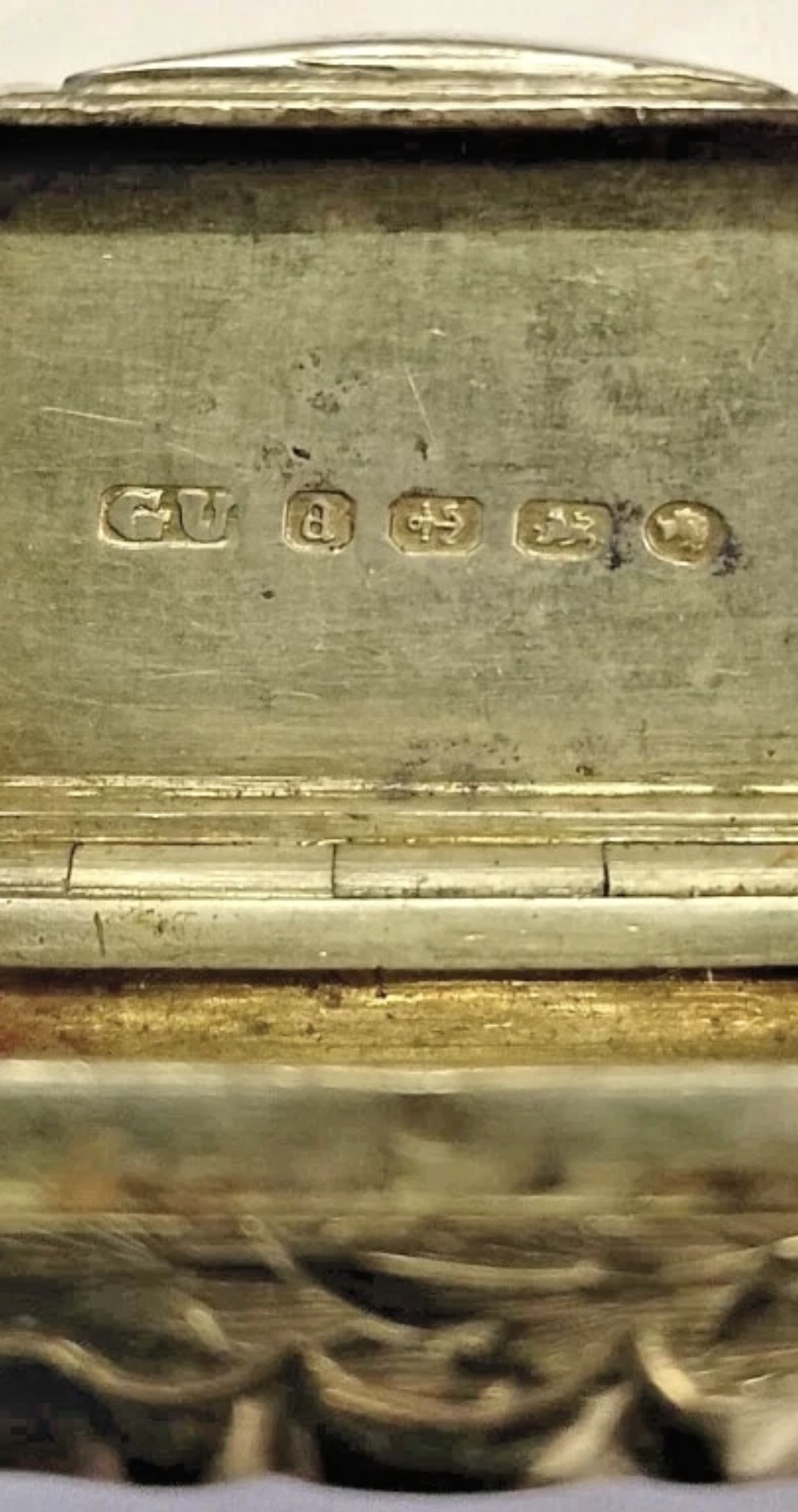
Can anyone help me with the date letter on this Birmingham assayed Vinaigrette box please. I know it’s George Unite and I am presuming it’s from a year of royal significance as a young Queen Victoria is also present on the hallmark. I have looked at ‘a’ and ‘d’ letters but nothing looks the same.
There is no particular significance in the use of the Victoria head mark. It was used from 1837 to 1890 to show that the relevant tax (duty) had been paid. It is therefore called a “duty mark”. The same “young Victoria” head was used throughout that time. The reigning monarch’s head was used as a duty mark from 1784 when the tax was introduced until 1890 when it was repealed.
George Unite and James Hilliard founded the business in 1825 in Birmingham. The partnership was closed before 1845 and the business was continued by George Unite in Birmingham and London until sometime in 1865.
The firm advertised as manufacturer of gold and silver brooches, bracelets, fish carvers, dessert knives and forks, card cases, cake knives, knife fork and spoon, fruit knives, butter knives, pickle forks, caddy shells, sugar scoops and sifters, cups, cigar cases, pens and religious items.
The firm became George Unite & Sons in1865 continuing until his death in 1897.
William Henry Lyde an electroplate manufacturer took over in 1928 and the business became a limited company George Unite Sons & Lyde Ltd
As I suspect you know, George Richard Unite was probably the premier late Victorian silversmith rivalled only by Omar Ramsden who was slightly later and going well into the 20th century.
The problem is further confounded by your exhibited assay mark being in a camfered (cut corner) square whereas in most reference materials on dates the alternatives for a Birmingham 1875 date mark are an oval or a shield:
Your “a” in fact looks more like the 1900 “a” than the1875 “a” which it clearly must be as the Queen’s head as a duty mark was no longer required by the later date and George Unite was dead!
You could send a note to the manager of the website. www.silvermakersmarks.co.uk and suggest he put your configuration in as a third alternative, or since Phil also supervises us on this site he may spot it anyway!
Thanks for the info and video link, I did know about this but it made me remember how lucky we were to not have been born in London in the 1800s. Mind you we wouldn’t have had beautiful Vinaigrettes if this hadn’t have happened
I think parts of London might have been fun. My grandfather was born at 100 Longacre in 1869 and his father half a mile away in 1837. They ran a brewery which has now been replaced with Nelson’s monument and I was lucky to get to read a great deal about his life. His son, my father bought another brewery up north and ran that.
I rather suspect 19th century London was a fairly good place to be if you brewed enough beer!
In fact it was Victoria’s physician Dr Snow who noted people living around the Brewery did not suffer from typhoid and deduced three things: first that the well the brewery used was not leached into from the Fleet River and secondly that the people tended to drink beer or near beer rather than water and thirdly that they did not get sick from Typhoid. From this he concluded it was a water carried not airborne disease. Apparently we brewed half a million barrels a year. Decades later as a young man when I went into the business we were still giving out a half gallon of beer a day to each worker. It was three per cent beer.
My arrival on the maltings floor coincided with Maggie Thatcher decided breweries who owned all the pubs and the production were vertically integrated as we controlled everything. We had to sell one or the other. We sold both. Probably a mistake.
 - - - - - – - - – - - –