Hi! Can anyone help me with this date letter please? I know the baskets were assayed in Birmingham and the makers are the Haseler Brothers, but I am not sure about the date mark. Is it a lower case ‘g’ and if so then is it 1881? I would really appreciate any help. Many thanks!
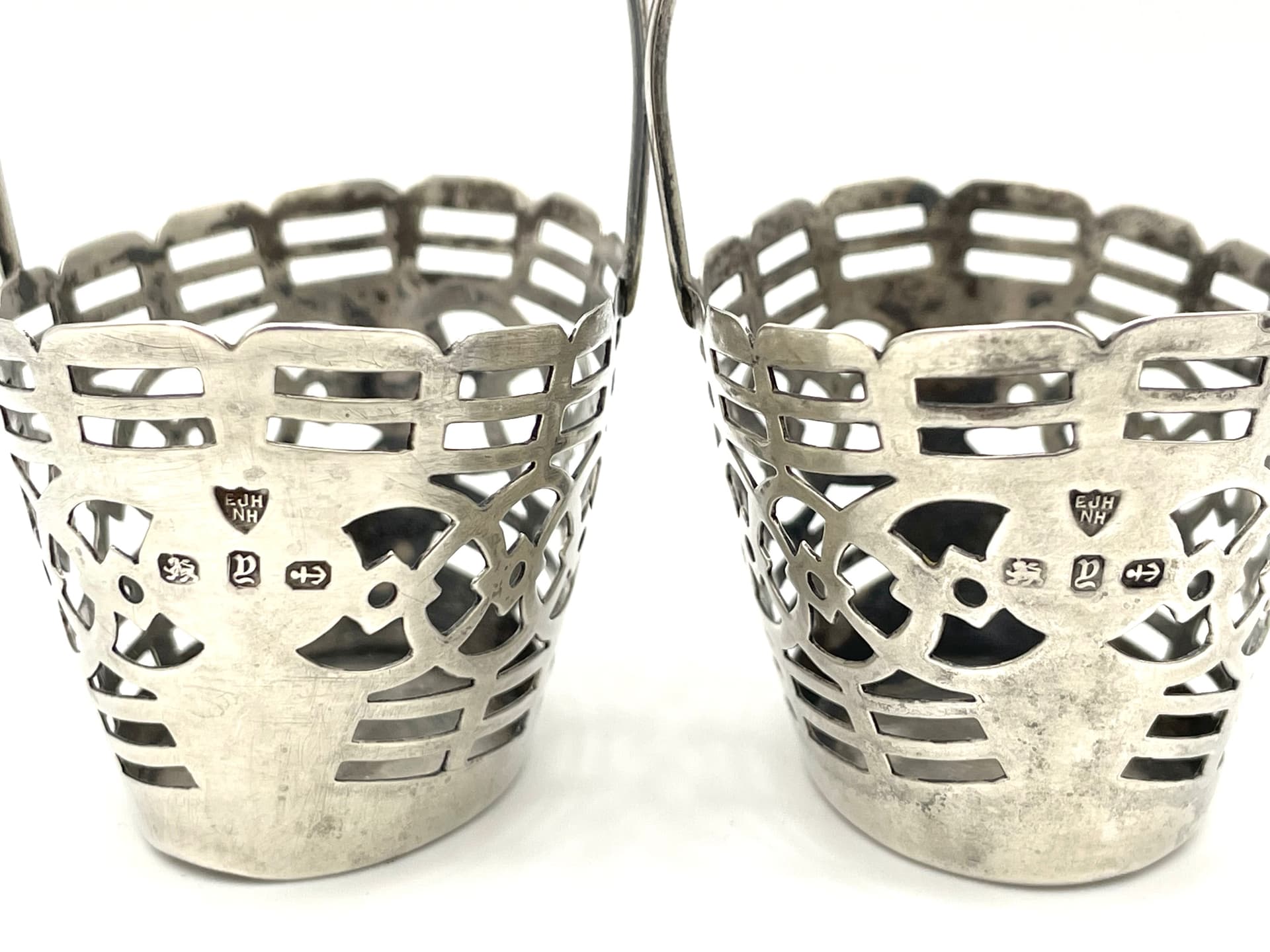
That’s a lowercase “y,” for 1898:
Thank you so much. I find these date letters so tricky.
I always struggle with gothic lettering. The uppercase ones are even tougher to sort out than the lowercase.
Yeah I agree. I’ve been collecting for 18 months now and I’m still learning about dates. There’s just so many to remember.
There’s no reason to remember any of them, when you’ve got an easy-to-use site like this:
Start with the “Hallmark Identification” section to get the date nailed down. Assay city first, then start looking at the letters. If the letter is easy to ID, take a look at all of those. If it’s not, you can view various cycles.
ETA: Then you can turn your attention to the maker - the first link on that page takes you into that section. It’s all very logically laid out, so once you get a feel for it, it’s easy to use.
1 Like
Thank you, this is great. I love the way they group all the date letters in a row together, it’s so much easier to see. This will help a lot.
I have been doing the methodology you suggested and it works if you definitely know what letter it is. It’s just when you don’t. Like when I thought the letter was lower case g and it was a Y. It’s just going to take time I suppose. Thanks
I wasn’t sure what the letter was, either (g? q?). But then I noticed that the Birmingham anchor was lying on its side, with its top to the left. A look at the Birmingham chart showed me that they did that only for the cycle starting in 1875 (it’s lying the other way in the 2000 cycle). Pulling up that cycle (just click on any of the entries in that column) let me scan down the letters, a through z, to find the match.
Oh right, interesting! I did notice the lion in its side but didn’t realise they could face both ways (never noticed that). That’s duly noted 
There are a lot of subtleties like that (and it’s the anchor, not the lion - the lion is always “passant,” with three paws on the ground and one raised, and always facing left), and you start to recognize them. The shape of the outline of the punch is important - sometimes a shield, sometimes a square with chamfered corners, and so on. And some hallmarks have a duty mark, in the person of a monarch. Tough to tell the Georges apart, but Victoria is unmistakable.
Things get a little different with marks for Dublin (harp instead of lion), Edinburgh (thistle instead of lion), and Glasgow (lion “rampant,” on his hind legs), of course. But the overall schema remains the same.