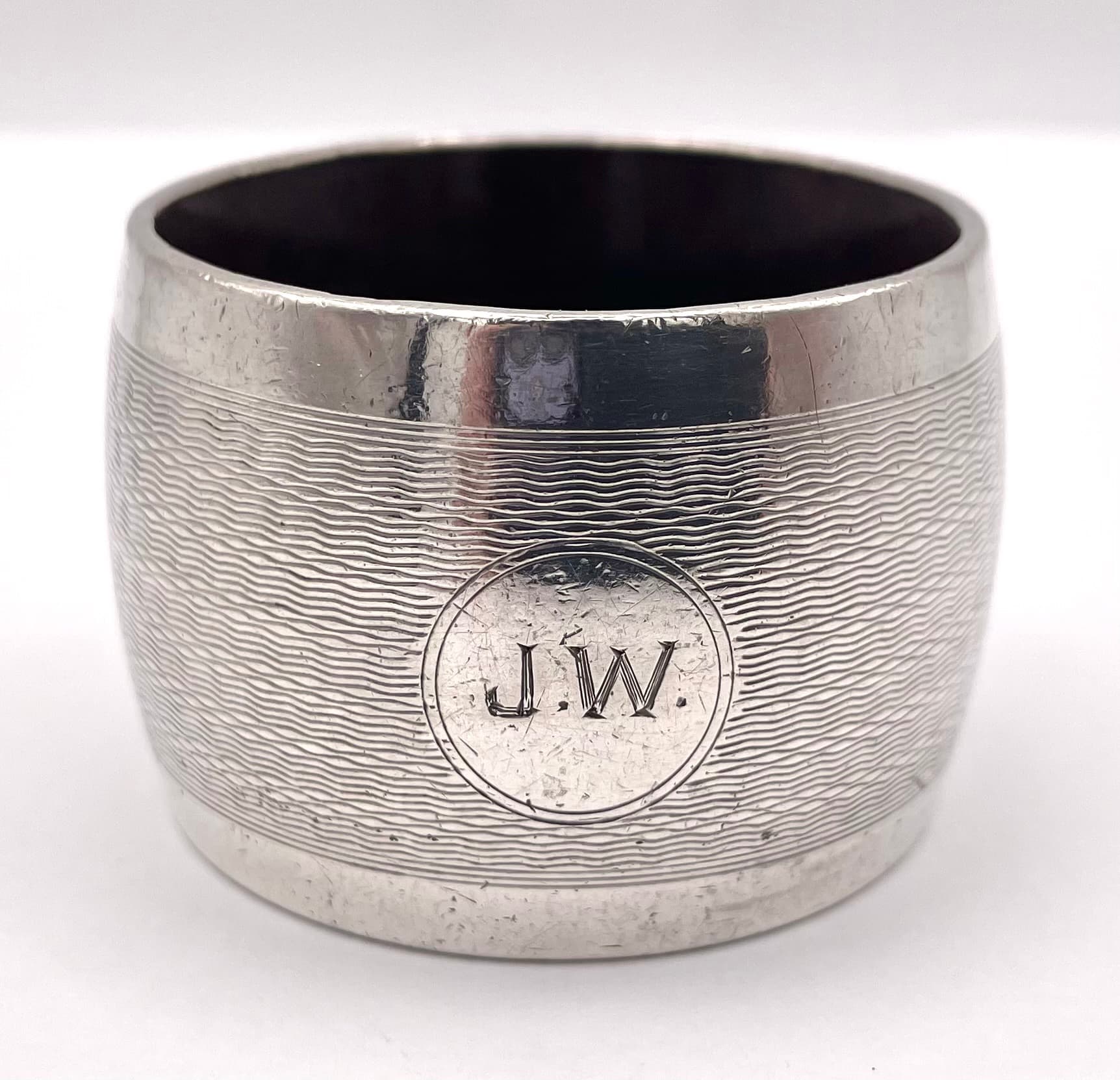
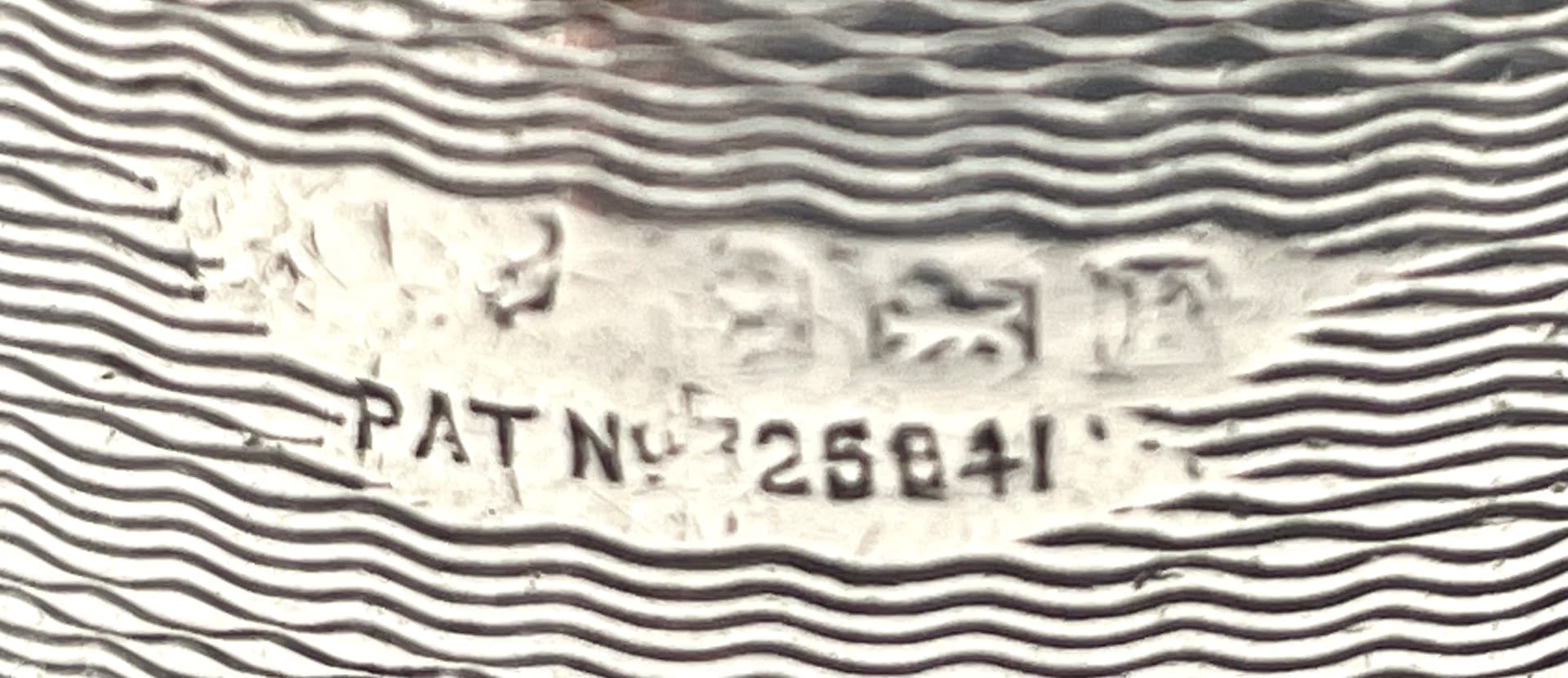
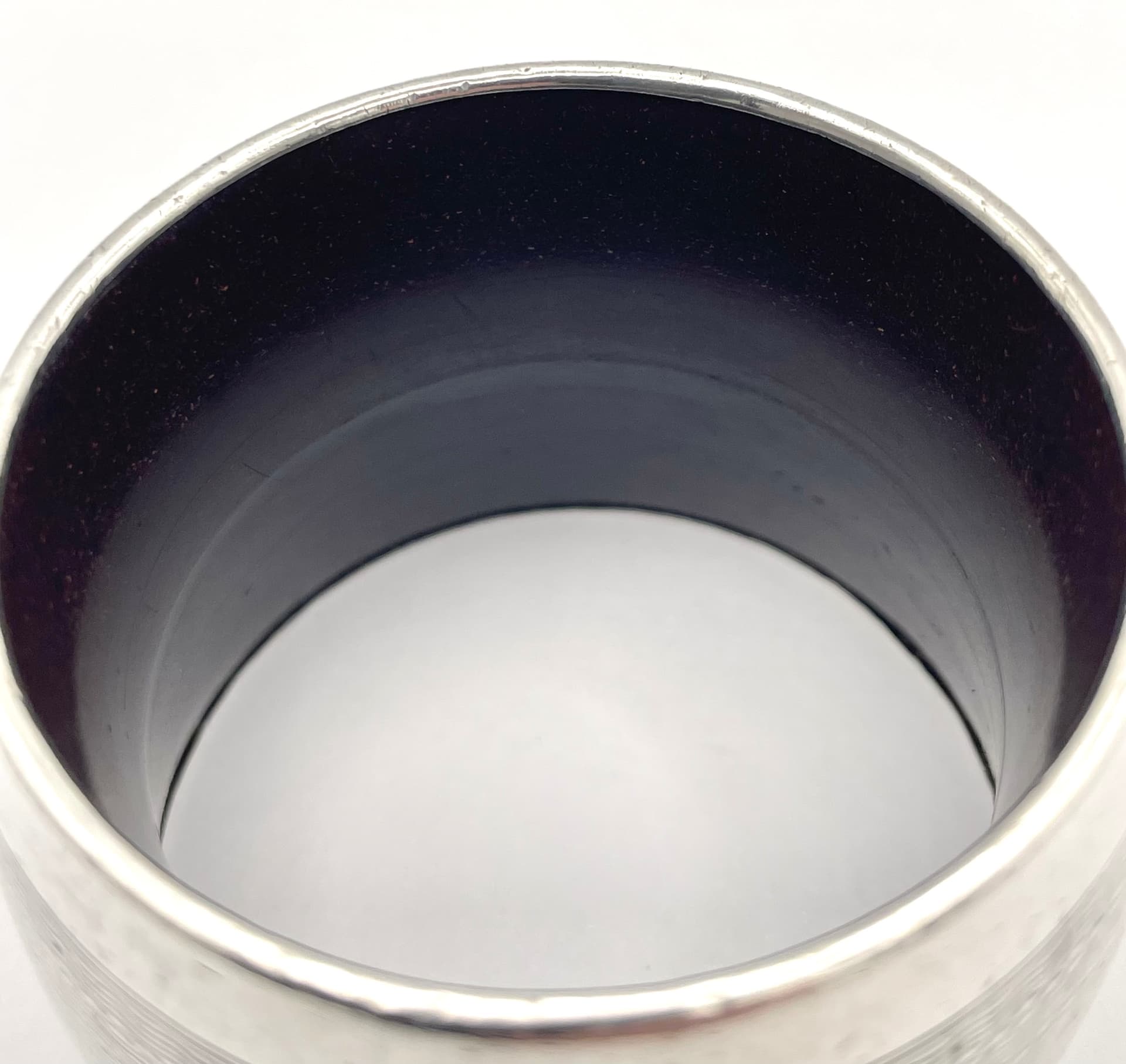
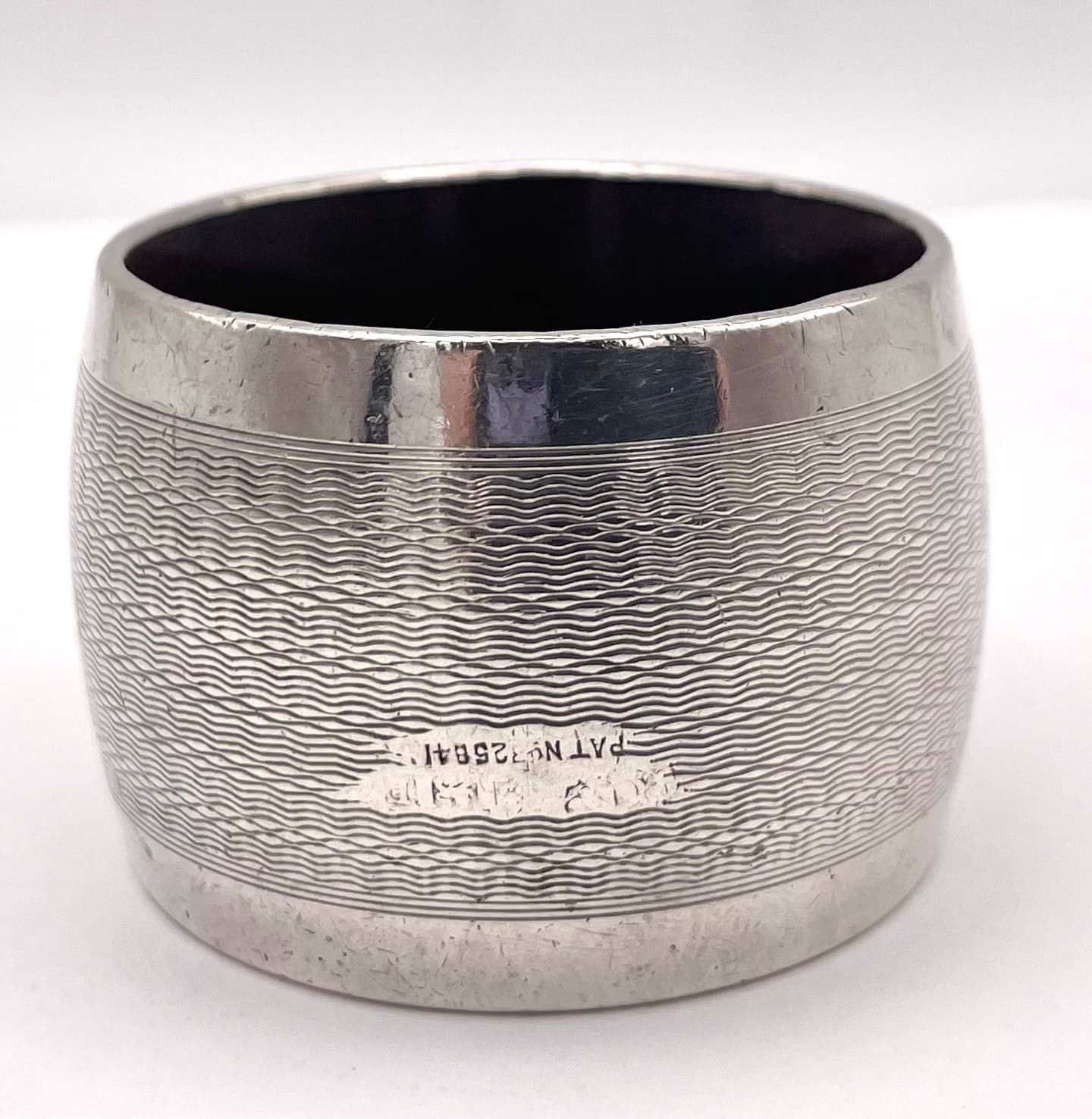
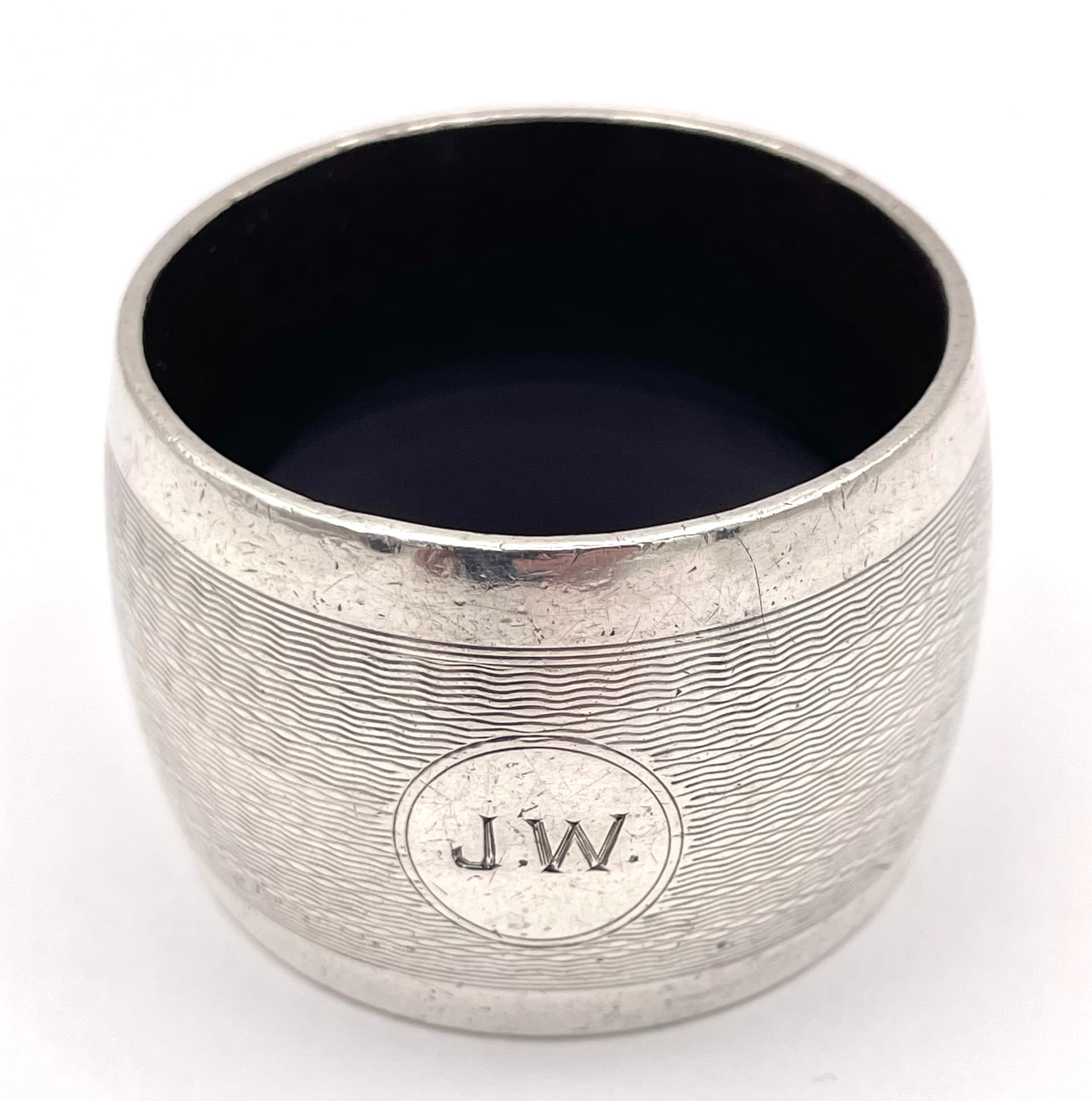
Hi! I’ve got a very unusual napkin ring. The outside is hallmarked silver, but the inside is a mystery. It was sold to me as being Bakelite, but it doesn’t smell at all (Bakelite has a very distinctive smell). It has very rubbed hallmarks where I cannot work out the maker. I also cannot work out the assay office. I think the date letter is an upper case E. Any help would be greatly appreciated, thanks.
Lion passant and date letter E are all that can definitely be determined. I suspect that the E is a Birmingham 1929 date letter but the maker’s mark defeats me.
I’ve just found this one on eBay, again saying it’s made with Bakelite inside. It’s the same Pat number so do you think that it will be the same maker (J Gloster Ltd)? It was assayed in 1930 though.
I think it must be Bakelite as 1929 is exactly in the period that Bakelite was being used beyond commercial applications for costume jewelry and novelties. Probably done (along with the then modish machine turning) to announce a kind of “this is not your father’s napkin ring”. Possibly the silver’s antimicrobial/antiseptic properties neutralized the Bakelite smell? Just a guess, I’m no chemist. I think it’s pretty cool though.
Thanks Paul, great info about the Bakelite. I knew it was the height of Bakelite then, but the fact it had no smell didn’t add up. I never thought about any reaction with silver - could be couldn’t it. Really confused about the quote of my Father though ha ha! Am I missing something?
Haha! Sorry, very much a North Americanism as if to say “this isn’t the old boring thing you think it is, it has a new and hip wrinkle to it” as in “this is not your father’s Cadillac” or “this is not your father’s pint of bitter”.
Joseph Gloster Ltd was the name which sprang into my head when I saw the napkin ring and its hallmark but there isn’t enough left to be sure. Now, if only UK patent numbers were available online rather than only by personal application to the National Records Office……
Yeah it’s frustrating isn’t it. I’ve just put it up for sale saying that the patent number is consistent with Joseph Gloster Ltd, but that Henry Griffith & Sons made these too. So I think I’ve covered myself. Yes it would make life a lot easier the parent number could be traced. Thanks again for your help.
Also struck me that the Bakelite interior might have been a marketing gimmick to save you the trouble of polishing the insides of the napkin ring. I have dozens of napkin rings and polishing the insides is a real PITA (pain in the ass in case that acronym hasn’t crossed the pond either!).
Fair point about the Bakelite. I haven’t actually had any problems cleaning them to be honest, but I’v actually got small hands so my fingers easily fit with a sponge or cloth. I always use Haggerty professional Silver cleaner because it really polishes well and leaves an anti tarnish coating on, which lasts for months before you need to clean again.
Len Gloster’s patent applications for celluloid and tortoiseshell interior on spun and other items are numerous and protected. You can use Base III and Google patent search to pull up what you need without having to actually trouble the Registrar. The problem with it, for those seeking to register as opposed to just search, is the updates are android and sometimes— pace Google – just wrong.
Here is an associated patent application filed in 1923 I have a list of 32 similar patent applications filed by him and if I start command “f” searching no doubt this one will come up.
But in this instance I am offering fishing rather than cooking insights!
“216,419. Gloster, Ltd., J., and Gloster, L. J. Sept. 10. Lined boxes and cases.- Cigar, cigarette and like cases and cigarette boxes made of silver or other metal are provided with linings of tortoiseshell, celluloid or a cellulose or casein compound moulded between dies whilst hot to the form of the case and when cool sprung into position therein, being held in place under an in-turned edge on the case. The linings may be transparent or semi-transparent, and a pattern cut on one or both dies may be reproduced on the surface or surfaces of the lining. Specification 210,313 is referred to.”
The key to this is the US and the Brits have a mutually reciprocal patent treaty respecting each other’s applications going back to the start of things.
CRWW
 so my fingers easily fit with a sponge or cloth. I always use Haggerty professional Silver cleaner because it really polishes well and leaves an anti tarnish coating on, which lasts for months before you need to clean again.