Have been trying every which way to find out what this box was used for.
Claudine, I don’t see a picture.
May we have pictures of your box?
It’s a magic box. You put things in it and they disappear together with the box!
Typically small boxes of silver were made for snuff or holding toiletry or patch items for a lady’s dressing table. Later the Victorians put pills and “vestas” (wax matches) in them.
Many circular or oval antique silver boxes, such as those made by Martin, Hall & Co. around the Edwardian or George V era, featured a slightly pushed-in or concave bottom engineered to sit steadily on a curved vanity tray or pocket curve.
If it ever reappears all will be revealed. Meanwhile it’s like those somewhat larger boxes magicians used to use to make their lady assistants disappear after they had sawn them in half.
I wish I could put a photo, there is no reason for 2 indents on the back of the box causing 2 outdents inside, the box is 7 cm long by 2.5 cm wide and 6 mm thick, silver without a hallmark, it came from my grandfather’s collection in Belgium so bought by him.
I don’t know how to upload a photo on this website.
In the box you are posting text in there is a series of images across the top, the fourth one from the right, which looks like a mountain range with a moon above it, is the picture link to your own photos. Click on it and it will open up your files. Access the picture (s) you want and click on it. It will appear in your dialogue box.
If your pictures are on an i-phone camera and you are using a computer to access this site then email or text the picture to your self, open it up on your computer and drag it to the desktop and thence to the dialogue box.
Make sure the images you wish to show are clear and not blurred. This requires you to take them with the correct magnification and then adjust the camera to sharp focus.
The two indents will likely be repoussé work on silver, which refers to a famous, labor-intensive ancient metalworking technique where malleable silver is hand-hammered and shaped from the reverse side to create intricate, raised designs in low relief on the other. Sort of thing you might see on a French trinket box of dimensions you offer. Useful for your grandfather’s collar and shirt studs or cufflinks if it is decorative work or indents to accommodate a specific item if not.
While your grandfather may well have repurposed the box for collar studs etc, it quite possibly started out as a 19th century pocket snuff box or lozenge/peppermint box which would have been designed to fit discreetly inside a gentleman’s waistcoat pocket.
Back then it might have held a single day’s supply of powdered tobacco or a continental peppermint. Cachou boxes were highly popular everyday luxuries in Belgium, France, and the Netherlands during the 1800’s.
The two indents on the exterior that push through as outdents on the interior might well be chased alignment indicators or structural stoppers. These would have been designed to act as a mechanical friction catch. When you close the lid, it snaps over these internal “out-dents” to create a tight, friction-lock seal vital for a snuff or mint box to keep the contents dry, contain the aroma, and prevent the lid from accidentally opening and spilling.
Finding no hallmark on an antique continental piece is quite common in Belgium before 1942, as hallmarking was not compulsory for small, lightweight domestically-produced silver items.
Since it has no hallmark, it could be a lower purity like .800 or .835 standard rather than the British .925 sterling.
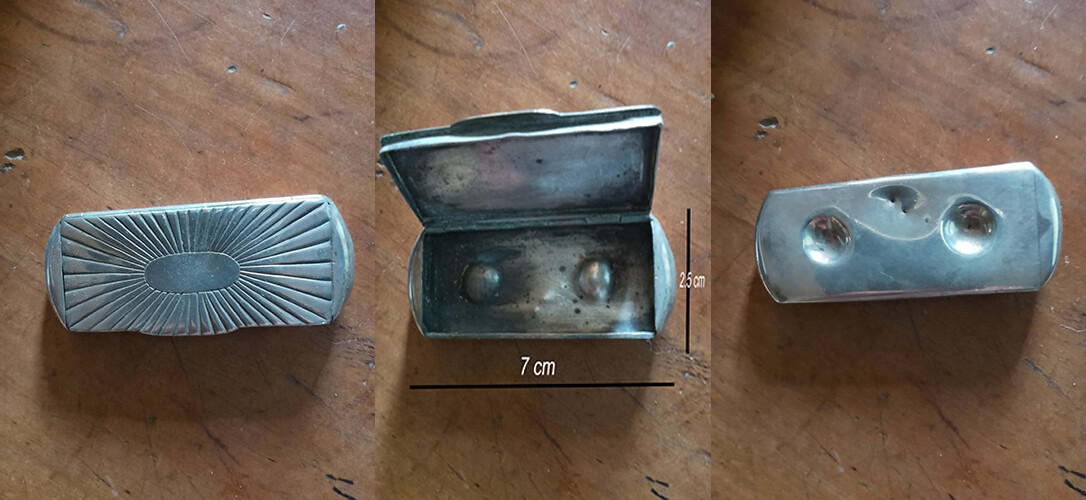
Glilette pocket edition safety razor case. The starburst design for 1904-11. The indents are to store new and used blades. I rather doubt they made the cases out of silver. But a simple test will tell you. There are a number of similar packs on Etsy for sale.
You can probably find an old Gillette Razor to pair with it. Blades, believe it or not are still made, double edged, flat with the circle cut across the cut in the middle.
“Sunburst”.________________________________
Quite so. Although I am told our sun is just the local star so the distinction is without a difference, no?
Continuing the discussion from Id small silver box with indents on base:
No idea what metal it could be, it polishes with silver polish, it isn’t magnetic, have ordered a packet of Gillette razor blades from Aliexpress, I am quite sure you are right and that it is a razor blade box, thank you for your reply to my question.
Probably nickel silver. (copper, zinc and nickel) aka “German silver”. Non-magnetic, zero silver content.
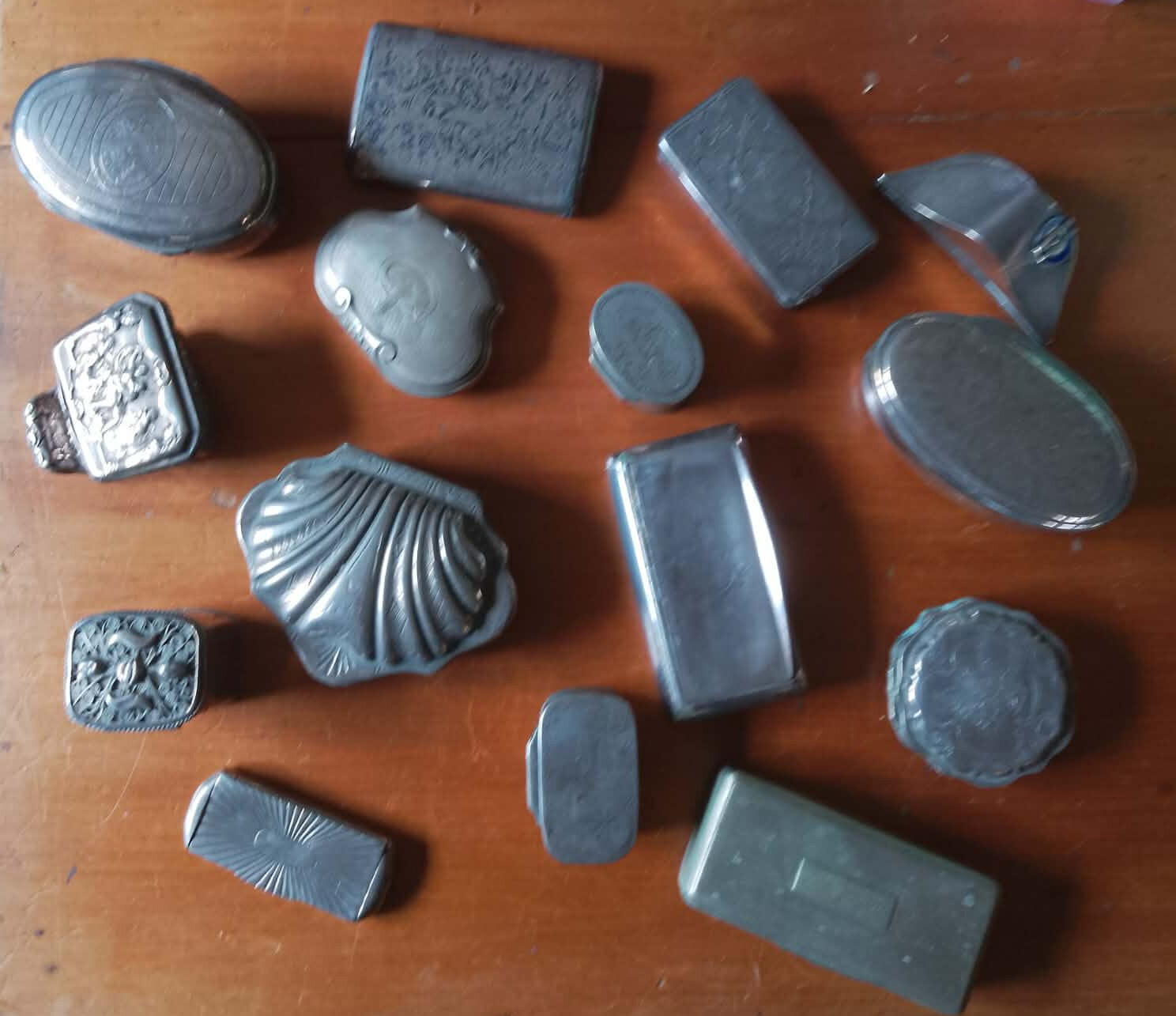
It doesn’t matter what the metal is, it still part of the collection my grandfather had over 100 of these my mother sold some gave many away ( it saved having to buy presents!) here are mine, my favourite is the little purse.
1 Like
Couldn’t agree with you more.
But this is a silver collectors’ forum site which spends great deal of its subscribers’ time distinguishing between marks and form which indicate base metal alloys, such as nickel silver and plated nickel silver on the one hand, and “solid” silver meaning sterling or greater or lesser silver.
Your grandfather had a discerning eye for turn-of-the-century boxes, a mixture of snuff, toilet, etui, cachou, waxed vesta and your favourite, the purse.