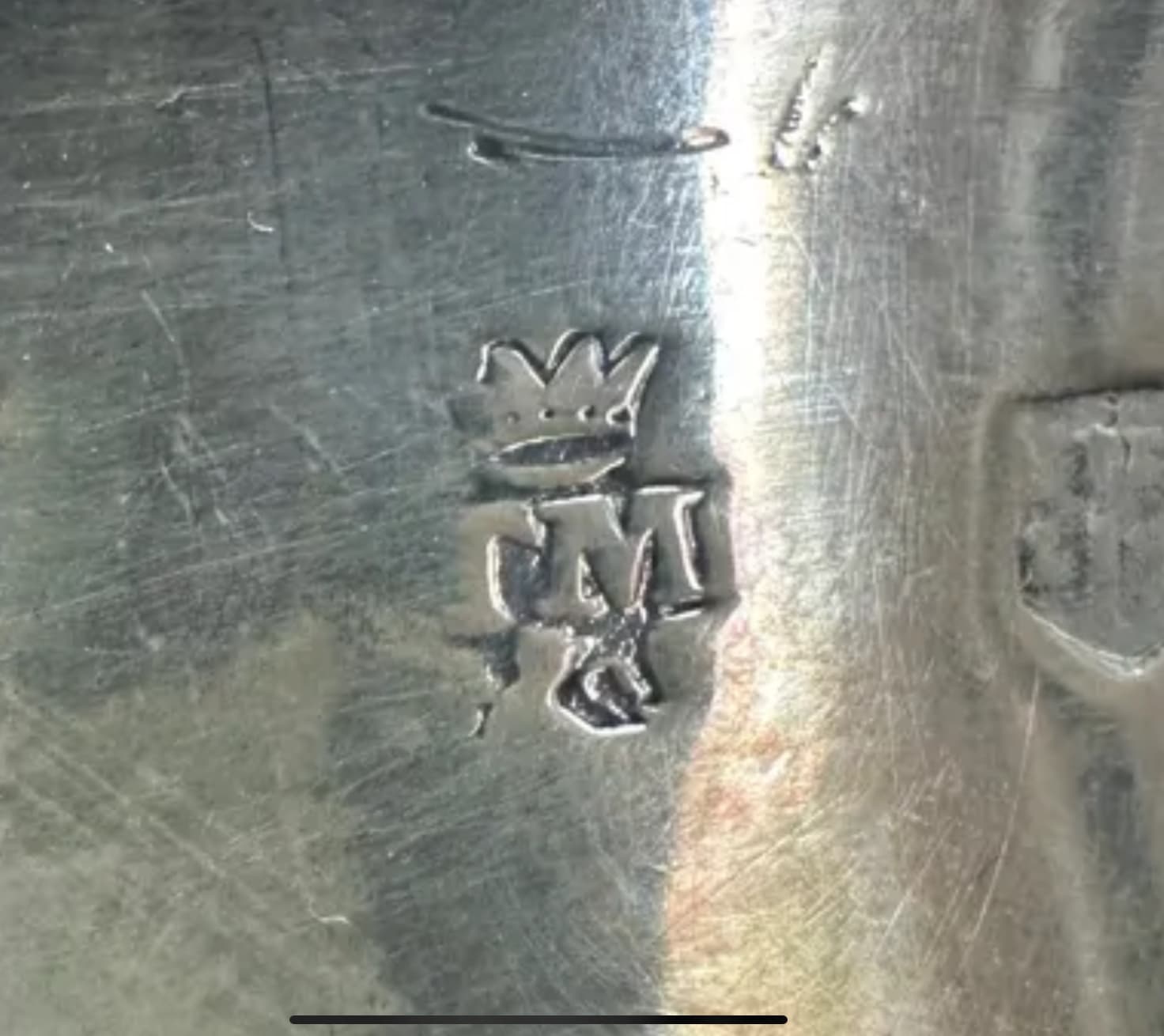
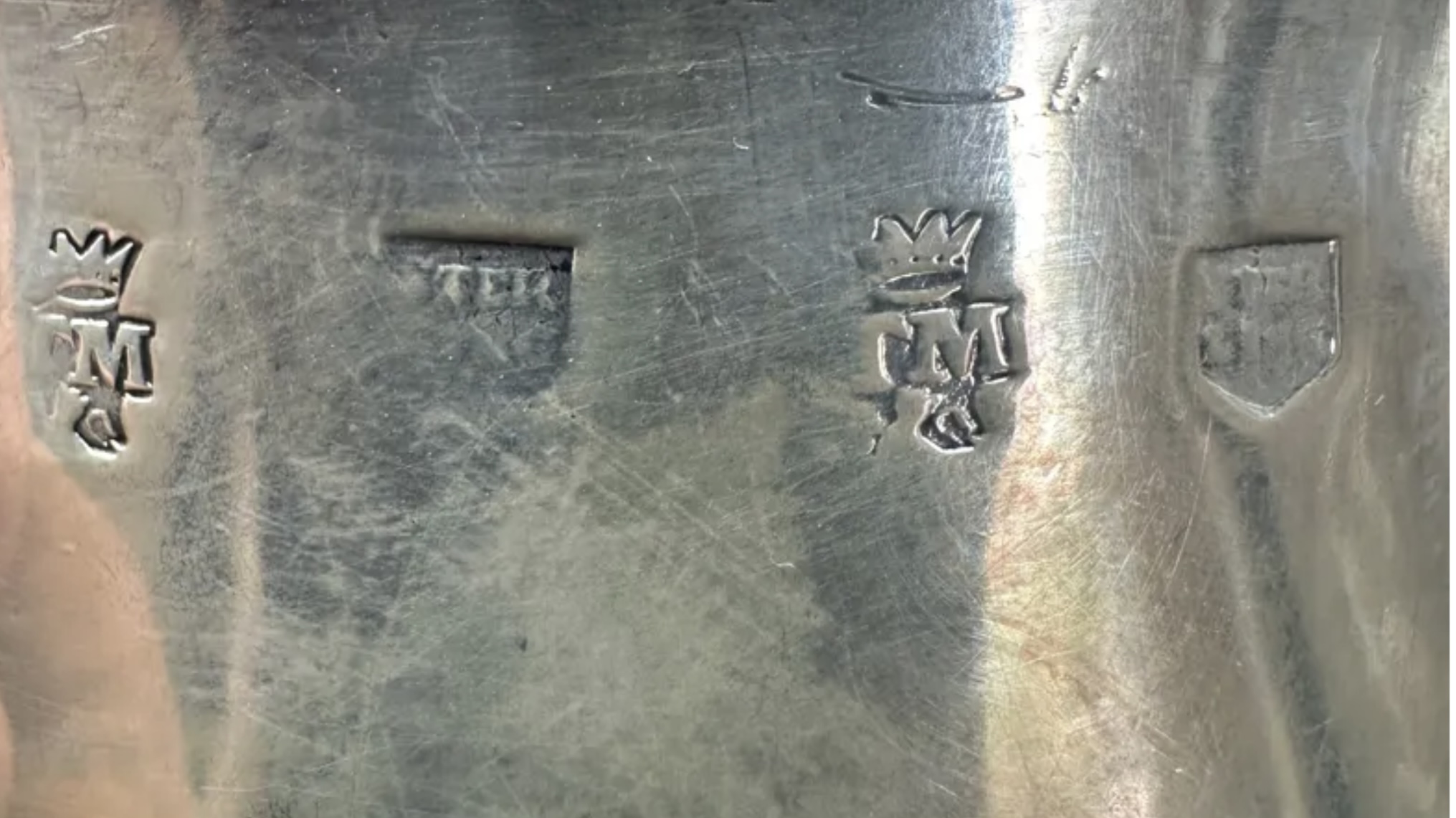
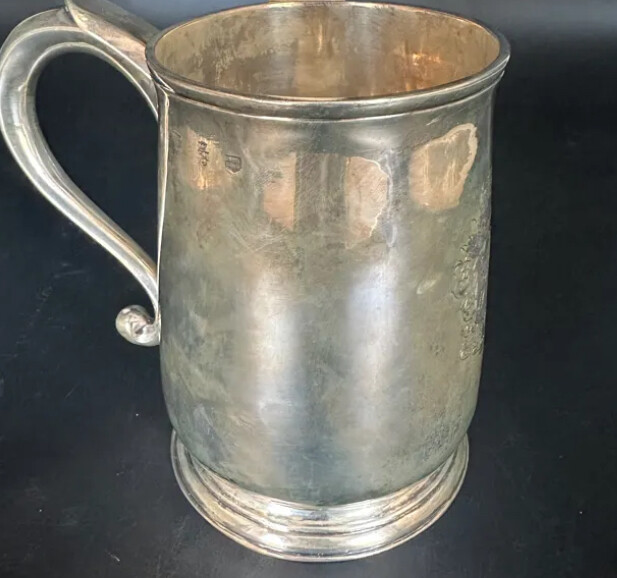
Does anyone recognize these marks? I believe it could be early Irish Provincial silver. It appears on this tankard. The style of crowned initial was used in Ireland on Early to mid 18th Century pieces something with the word sterling . In this case, the word sterling is slit….STER over LING in a shield. Any comments would be appreciated. Thank you.
1 Like
Nothing comes to my mind…
London? Seventeenth century? “Ster” over “ling” could be a clue…
T. Marsh, Chester, circa 1700?
https://www.woolleyandwallis.co.uk/print-lot/?id=415736 “…marked T.M twice and ‘Ster’ over ‘ling’ in a shield shaped punch…”.
1 Like
Jackson illustrates some early Chester marks of which 2 include sterling marks of the same form as on this mug. They are dated to the 1680s. TM is not one of them but I think we can believe Woolley & Wallis’s identification in Bart’s link above as T Marsh.
Ridgway & Priestley’s general Chester book shows a mark of Thomas Marsh, TM in italics, dated c1700.
1 Like
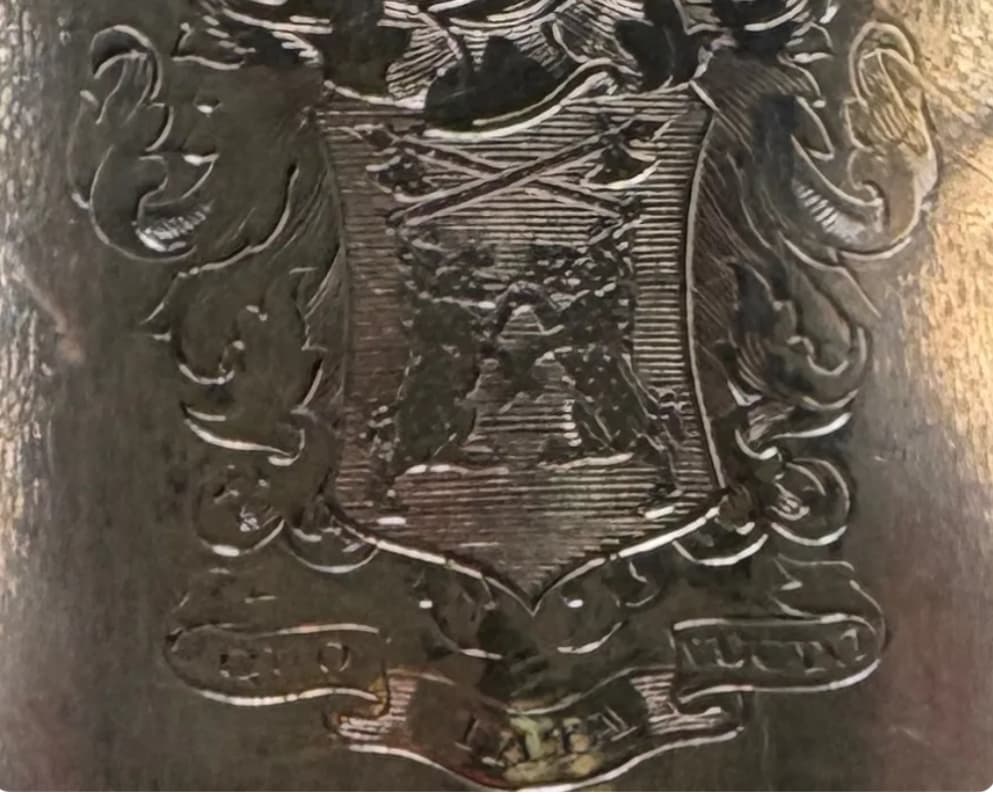
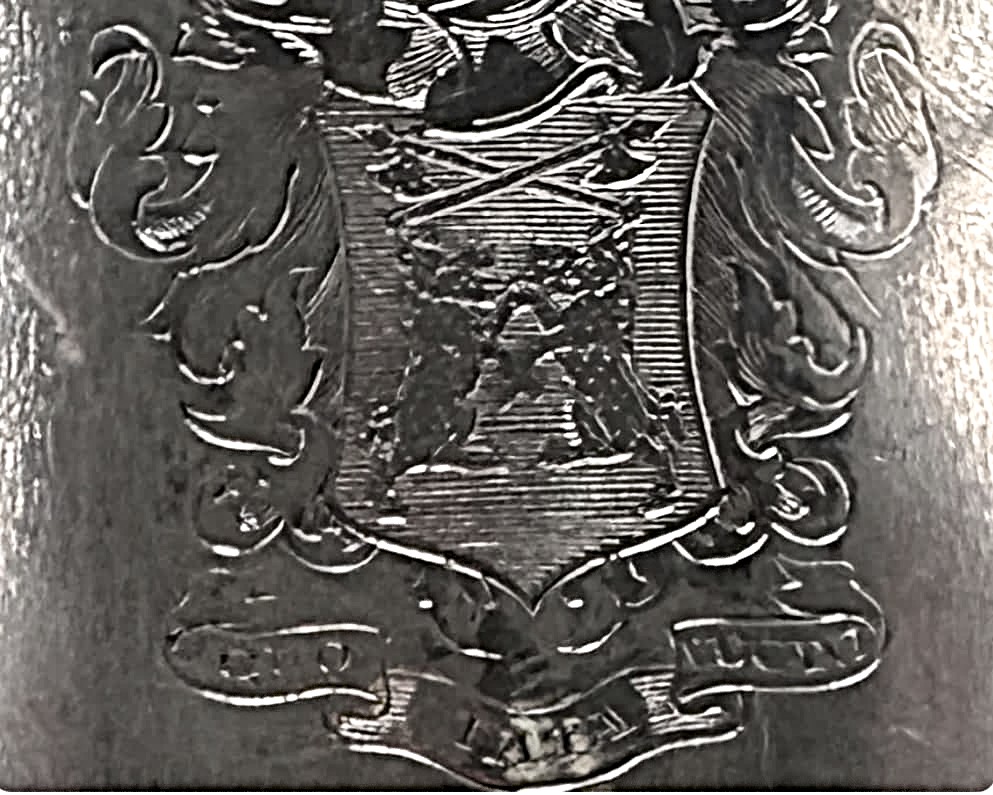
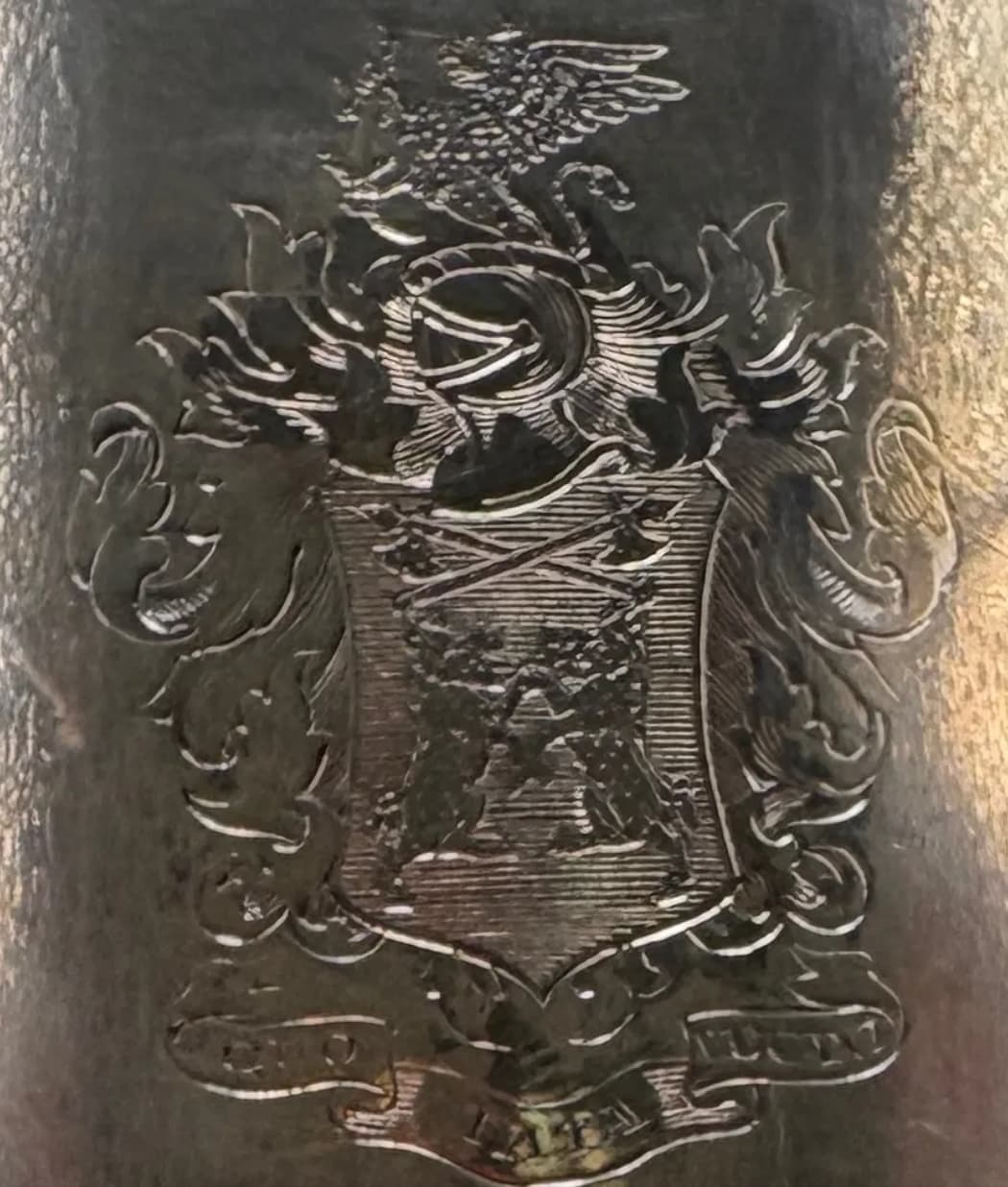
Thank you for sharing your knowledge Bartholomew and silvermakersmarks. This is very helpful. I wanted to add one more picture of the Armorial on the front of the tankard as an added clue.
2 Likes
 .
.Sorry for the poor quality. The piece is not with me at the moment and I have to really on my old pictures. I have this additional image which is properly centered but the details still are not clear. I believe the writing on the bottom is “ Quo Fata Vocant “ if I recall properly which is “Wherever fate calls”
2 Likes
The motto is of the Dudley and D’Isle family and also the regimental emblem of the Northumberland Fusiliers. The odd figure is a porcupine stat. and the other figure is a griffin which is entirely mythical. The listing appears in Fairbairns Heraldry which is on line.
The Dudley family were off shoots of the Northumberland Dukes, the famous Percy family that basically ruled northern England until Richard III lost to the Tudors.
The motto never widely used by the Percy’s was adopted by Dudley.
Exactly which descendant of Robert Earl of Leicester, Queen Elizabeth’s I paramour this belonged to you can work out by looking more carefully at the family tree in 1700.
Chester registry makes sense for this family who estates were in the west midlands and who originated from Worcestershire.
CRWW
2 Likes
De L’Isle and Dudley, Baron (Sidney), of Penshurst, Kent : ( i ) A porcupine statant az., the quills, collar, and chain or. (2) A griffin’s head erased arg., ducally gorged or. Quo fata vocant*."
This branch of the family dies out so you have to search forwarded from Elizabeth’s time and Burke’s is best for that.
Leaving us with:
William Ward, 10th Baron Dudley1 
M, #2770, b. 16 October 1685, d. 20 May 1740
Last Edited=15 Dec 2023
Consanguinity Index=6.27%
William Ward, 10th Baron Dudley was born on 16 October 1685.2 He was the son of Hon. William Ward and Frances Dilke.1 He died on 20 May 1740 at age 54, unmarried.1 He died intestate and his estate was administered on 1 July 1740.3
He succeeded as the 5th Baron Ward of Birmingham, co. Warwick [E., 1644] on 6 September 1731.1 He succeeded as the 10th Baon Dudley [E., 1440] on 6 September 1731.2
The Barony of Dudley devolved on his nephew and heir, General Ferdinando Dudley Lea, while the Barony of Ward passed to his cousin and heir male John Ward, of Sedgeley Park (afterwards Viscount Dudley and Ward.)1
cf. 136.
2 Likes
I’ve already worked hard today. Let others produce.
Thank you for your help Bartholomew
1 Like
Reading back though my notes it may seem a bit of a comedown to start with a cup owned by the descendant of one of the most scurrilous men to have ever lived — he issued hunting licences for killing Irish when he was sent over there as governor by a Queen who decided only England would be her groom— to a Baron of Birmingham especially when you consider Birmingham back in the 1700’s was a Warwickshire town of perhaps 15,000.00
But, as we are seeing with our current crop of royals ,when you get too close to the flame you burn up. Robert’s last hurrah was the famous Tilbury speech by Elizabeth which he stage managed in the teeth of the Armada.
“I have the body of a weak and feeble woman; but I have the heart and stomach of a king, and of a king of England too, and think foul scorn that Parma or Spain, or any prince of Europe, should dare to invade the borders of my realm: to which rather than any dishonour shall grow by me, I myself will take up arms, I myself will be your general, judge, and rewarder of every one of your virtues in the field.”
His son Arthur didn’t help by claiming to be Elizabeth’s son. He wasn’t. And the family suffered that worse than death by execution. They were laughed out of the room.
The owners of the motto didn’t fair much better, the Dukedom dying out only to be revived briefly for one of Charles II many Fitzroy’s without Fitzregina’s. Another was the Duke of Monmouth who rebelled.
So, the cup because of the motto and badge is important. It is not military or mess silver, despite having the motto of a fairly useful regiment. Indeed that regiment was never commanded by any of theDukes of Northumberland and only got the use of the motto in exchange for which it agreed to use the Duke’s nomenclature.
CRWW
2 Likes
Thank you for your help Guildhall
2 Likes
You are most welcome. I went looking around for similar early lower baluster mugs and came up with several all dated around 1720 to 1730. Here’s one coming up for sale in case you decide you wanted a sort of pair. I have three in my own collection.
As you may know, the Britannia silver period was from 1697 to 1720 when it was mandated as the standard for wrought plate in Britain to discourage the melting of silver coins. After complaints, the stronger sterling silver standard was reinstated in 1720, though the Britannia standard remained a voluntary option thereafter.
Jackson points out that Chester silversmiths worked sterling in defiance of this rule which might explain the sterling mark on your mug.
The Chester guild or assay office was shut down by King William until 1700-01 when it reopened.
I looked in vain for other examples of your mug’s TM mark attributed to Marsh and came up crickets. Nobody seems to have it including all three of the writers on Chester Silver Assay two of which are cited by the auctioneer, Woolley quite correctly
So you have managed to peak my curiosity about the mug itself, not just the badge on it. As you may know those convicted of serious hallmarking frauds, such as counterfeiting hallmarks or selling debased plate which sterling back then briefly became, could be sentenced to stand in the pillory. In some cases, the sentence included having their ears nailed to the pillory, with papers above their heads describing their offence.
Now Chester’s a long way from London – three days by coach in the winter – but why risk it?
And why put a Crown on your initials taunting the very man who could have you humiliated in the public square? Fellow Chester silversmith Pemberton thought it was a good idea. But it’s a mystery as to why. Certainly he had no commission from the King to make him anything and nor did Marsh – the usual reason craftsmen included crowns in sponsor marks.
The mug up for sale is a Sterling mug and has a crafted rather than cast handle and the vessel is spun. Something sterling is almost the perfect metal for. So I went to a friend of mine who is both an auctioneer and a silversmith in his own right.
Can you spin the softer Britannia metal and will it come out the same and would a composed rather than cast or single plate handle be more likely and when did the first balusters make their popular appearance?
His answer was yes you can, but at slower speed and a look will tell you the answer as to what happened in the creation of this item and out of what it might have been made.
Anyway you care to say about the provenance of this item which may be 325 years old might help solve the riddle. Its unusual for silversmiths who are well known members of even a local guild to use a different mark with the parliamentary requirement for the initials rather than the first two letters of the surname as needed for Briitannia to use it once on one piece of holloware and then go back to making flatware and using the italic initials. It costs good money to make two dyes to perform the same task even if one only appears on flatware.
Finally I went back to where I had started – with the badly abraded barely discernible crest and looked at the wear on that and the lack of wear on the side-marked guild and sponsor marks. Then I went to Wax Antiques in search of other side-marked mugs or cans and found one which is also bottom marked. That too raised alarm bells – the wedding alarm bells that occur when 19th century Victorians have married bits of silver to meet the demands of the collectors they invented.
Simple rule: the majority of mugs of the period are bottom marked. Yours isn’t. Why not? Other rounded vessels like chocolate pots got side-marked, but mugs, not so much.
Because the problem with side-marking is it is polished sometimes weekly and soon – within a few decades sometimes it has worn away. Just like the crest. Does that entitle me to wonder if the hallmarks are later than the crest? Not really. Not on its own. The engraving may have always been light and the guild marks stamped heavily even showing on the inside of the metal as slight very slight protuberances.
And that, based only on photos and without testing for silver standard, is as far as I can go. Is it enough to raise some questions about origin? Perhaps.
On the other hand, who knows. Mr Marsh the flatware maker may have been so delighted to get commission for holloware from a West Midland noble that he decided s new dye or punch that he would only ever use once was just the ticket. The guild may have punched the sterling mark on sterling tankard with enough heft to counter three centuries or more ofbutler polishing week in week out and Mr Marsh like Mr Pemberton may have thought sticking the King’s crown on his highly illegal mug would mitigate royal wrath at this breach of the Hallmark legislation. All perfectly possible as individual anomalies. Add them all up and throw in the unlikelihood of early baluster starting in an obscure west midland guild rather than London and you start to think a bit.
1 Like