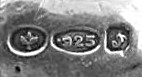
Can anyone help me to identify and value the attached donkey, which I have had for approx 40 years?
I would be most grateful for any information you could provide me with.
Many Thanks,
Beggar 
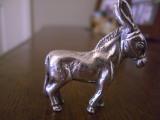
Can anyone help me to identify and value the attached donkey, which I have had for approx 40 years?
I would be most grateful for any information you could provide me with.
Many Thanks,
Beggar
Can you provide a better picture of the hallmarks please??
Thanks for your prompt reply, please find attached a zoomed in version of previous.
The first two marks are quite clear, I haven’t a clue what the third is though?
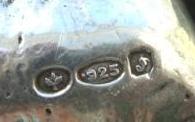
The center “925” mark tells us its not English. The style says Mexican or South American. I’ll check some of my books and look for a match.
Thanks for joining us here on silver-collector.
Uncle Vic
Hi Uncle Vic,
did you have any joy matching the other marks yet ?
Beggar 
Sorry, I did not have any luck on them…actually to be honest I forgot to look until now, thanks for reminding me. I’m retired and got busy doing nothing… Still no luck. American sterling almost always has the word “sterling” on it along with the name or the mark of the maker. In about 1970 there was an obscure treaty between many north, central, and south american countries that standardized the use of the mark “.925” to represent what we know as “sterling silver”…i.e., that the metal is an alloy of 92.5% silver and the rest is another metal, such as copper, to make the soft silver more durable. The “925” today is seldom used on American sterling items other than jewelry, the word “sterling” is the norm. In Mexican and other Central American countries the “.925” is in common use since (and before) the 1970 treaty. Most South American silver comes from the west coast of that continent, places like Peru and Bolivia and a lot of it I’ve seen is actually .950 silver, or 95% pure vs. the sterling standard of 92.5%.
I have some books that show a lot of Mexican marks and your donkey is not among them. Sorry for the long response, but my gut tells me its from Mexico, probaly one of the less known Taxco makers.
Regards,
Uncle Vic
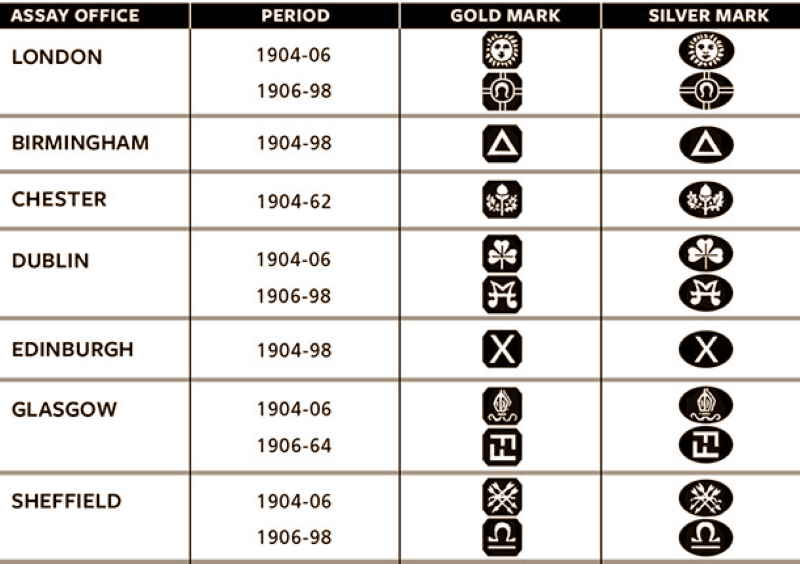
So this is a sterling silver donkey assayed in Chester, UK in 1909 (Third mark is a letter I in script) Imported from Hanau, Germany .
Missing is “BM” for Berthold Muller, the importer, and the maker’s mark “N”. See below. Two similar donkeys are showing up for sale currently in ETSY.
Berthold Mueller distributed B Neresheimer & Sohne, Hanau silver. His firm changed its name in 1915 and was listed as wholesale silversmiths and jewellers, antique reproduction in silver, ivories, miniatures, enamels, and so forth.
Neresheimer offered a wide range of highly decorative objects like tankards, coconut and nautilus cups, and other “sideboard pieces” and was famous for producing high-quality antique reproductions and ornamental figural pieces, including animals like this donkey.
The company was founded in 1890 by August and Ludwig Neresheimer and Jean Schlingloff.
Neresheimer often used pseudo-hallmarks designed to resemble old, authentic master marks from the 17th or 18th centuries. However, their pieces generally feature a characteristic “N” maker’s mark (often with a crown or within a shield) and were frequently imported into the UK by Müller.
Similar pieces, such as cow-form creamers or small animal figures have sold at auction in the $500–$2,000 range, depending on size, complexity, and weight.
When the inquiry about this donkey was first made back in 2007 neither the importer’s mark nor the maker’s mark was shown. It is unlikely it didn’t feature on the item as without it the Chester assay office would not have been able to complete its work under the law as it then stood. However mistakes do happen.
CRWW