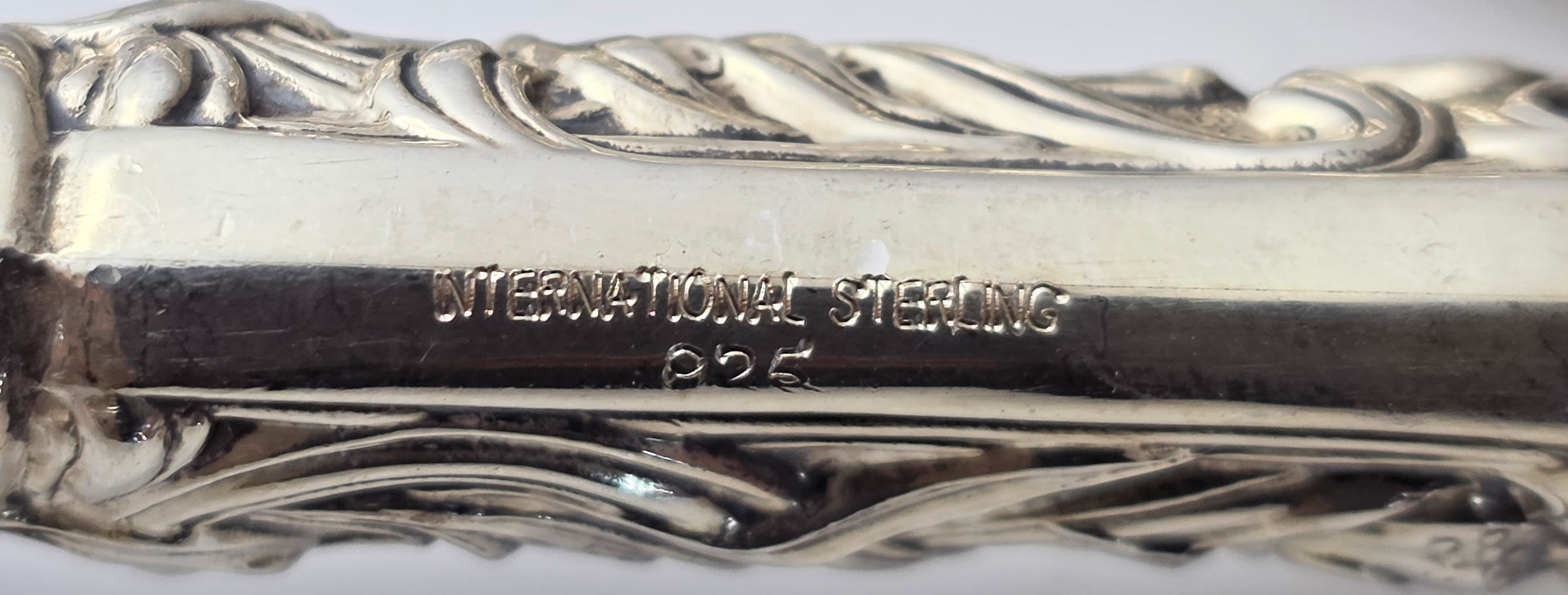
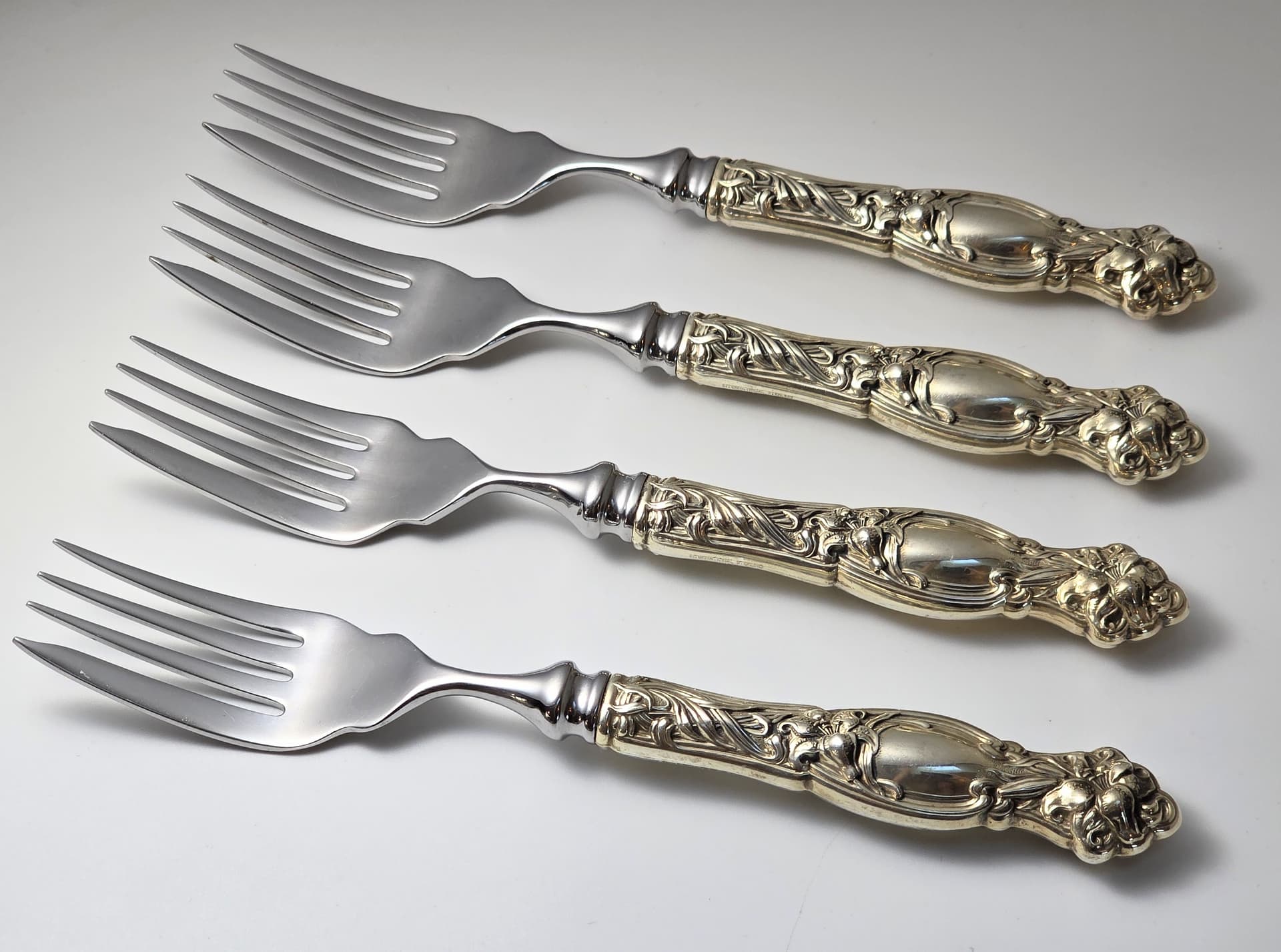
Hello! I’ve obtained these four forks. I recognized the Frontenac pattern but it appears someone combined stainless fork tops with Frontenac sterling silver hollow knife handles. The handles are marked INTERNATIONAL STERLING .925. However, it looks odd.
Can anyone tell me what the story might be on these?
International Sterling’s “Frontenac” pattern is a classic, Art Nouveau-style sterling silver flatware set, known for its detailed design featuring lily flowers and flowing leaves down the handles, introduced in 1903, and available in various complete or partial sets for 12 people, often including numerous forks, spoons, and serving pieces.
International Sterling introduced the Frontenac sterling silver pattern in 1903. The pattern was originally designed by Simpson, Hall & Miller of Wallingford CT and Montreal one of the smaller companies that was consolidated to form the International Silver Company in 1898.
The pattern was in continuous production until 1974.
A quick look at old catalogues still available does not show use of stainless steel tops on filled sterling handles so it may have been done as a special order. There is not enough wear on the handles to indicate the tines would have needed replacing, Nor are we used to seeing stainless steel tine replacement on sterling fish or fruit knife/fork handles-- although clearly it has occurred here.
I take it no knives were included. Again with fish knives, stainless steel blades, which would be useful for meat knives used for cutting, would be pointless since fish knives are deliberately blunt.
While the top and bottom are a fairly good fit, the double shank at the join, one on the steel and another on the silver handle, is not something that would have been designed so indication of later modification.
Your sterling handles would have likely started out with silver plate blades and your stainless steel tines would have graced French ivory (Celluloid) handles.
On the other hand, here is another International Sterling fish fork with exactly the same configuration of steel tines and silver handle. (Different pattern). Unlike yours where there is a double shank, it has a single shank limited to the steel tines. So now I am less certain of my earlier comment about later modification. I will have to concede this quite possibly was, as I initially suggested, a special or limited order for the Frontenac pattern.
And here is the fish knife with a stainless steel blade. Again quite pointless as fish knives are blunt to allow flake separation rather than cutting and should be silver or silver plate.
I suppose if you are going to make steel blades for fish knives you may as well make steel tines to go with them. But I am not sure I see why either is a good idea.
It appears, in the Joan of Arc pattern, International used the stuffed handles for both. So it is possible they did the same thing for the Frontenac pattern knives and forks despite the fact it created a double shank on the Frontenac pattern – a clear mis-alignment.
It’s either a special order made by the company or some after-market jeweller jury-rigged the forks in question presumably together with two more forks and six knives. But if that is what happened where did the jeweller who did the work get the International stainless steel tines (and blades) without destroying another International set in a different pattern?
Maybe it started getting too expensive to manufacture the solid sterling version as fish services got less popular so they did a cheaper version using stainless forks and blades on regular knife handles and retired the solid sterling version of the fork across most of their pattern lines?

 That is just fine. thanks so much for your help on this!