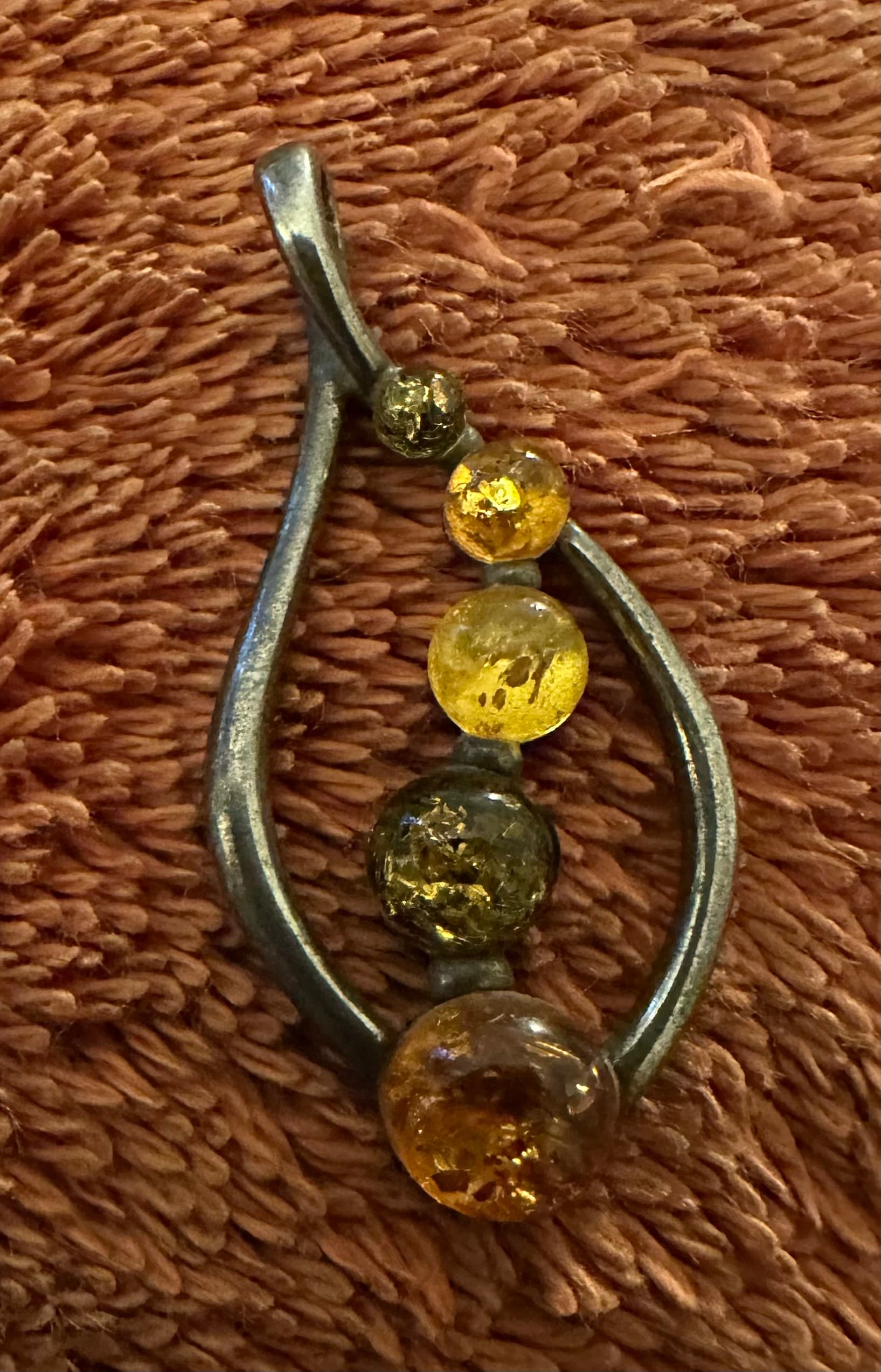
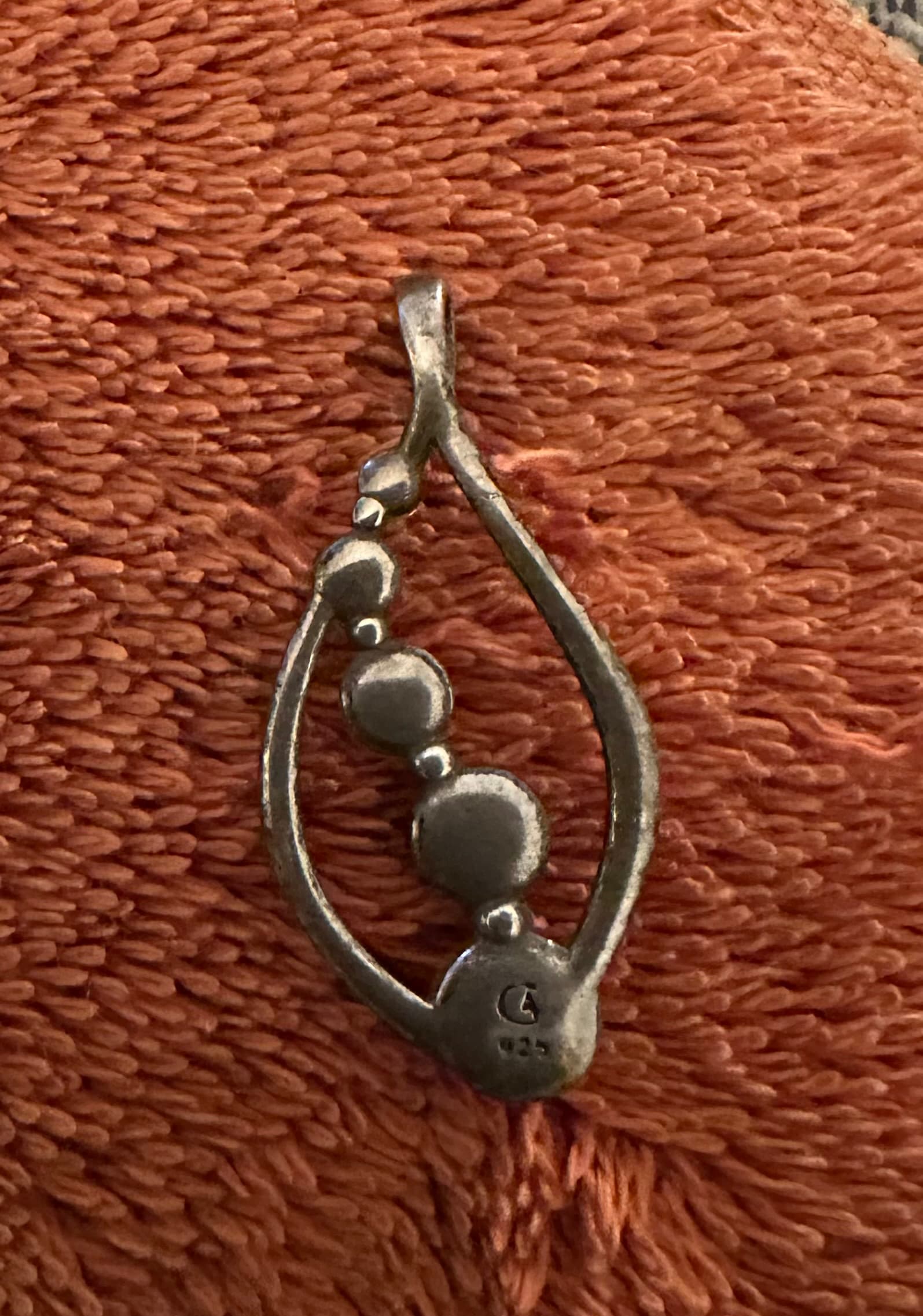
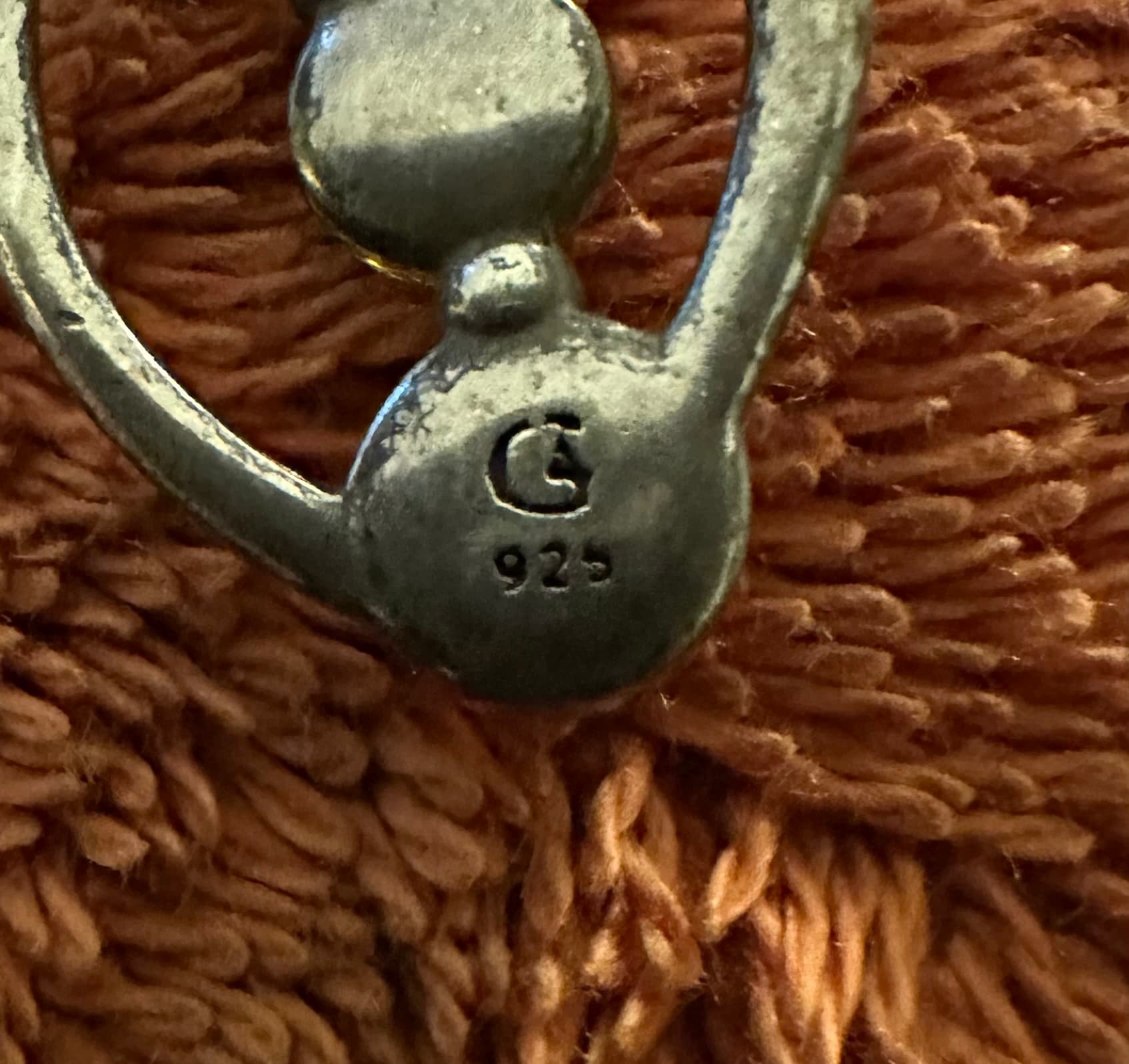
Hi folks I was wondering if this tear drop pendant set with 5 types of Baltic amber is a George Jensen piece please. The size is 4cm approx. The reverse is stamped G 925. I have attached the pictures

Thanks
Sean
Hi folks I was wondering if this tear drop pendant set with 5 types of Baltic amber is a George Jensen piece please. The size is 4cm approx. The reverse is stamped G 925. I have attached the pictures
Thanks
Sean
Here’s a list of Jensen trademarks. A simple G does not seem to be among them.
Your sterling silver loup contains a series of Baltic amber examples.
CRWW
Thanks but I am not able to open the list. It could well be similar to the one that I have. Part of my thinking is the colour of the silver work itself which has a Scandinavian look to it along with the G. Thanks Sean
Guildhall’s link has lost a “j”. Try this: Georg Jensen Hallmarks — Jensensilver.com
Hi there thanks for the list it is the one I already have. What draws me to the possibility is the oxidised view of the pendant. I will keep hunting
There are a number of Europeans countries it could come from but, because it is Baltic amber and in the same triple nugget configuration as another Swedish maker, that is the best bet short of a positive match. Oxygen and oxidization being a common problem for silver everywhere.
It’s a very nice piece and I am sure we all wish you well in your hunt. If you come across a definitive match off-internet, I think we have probably exhausted the www., do let us know and thank you again for asking.
CRWW
Thanks very much for your help and the Swedish trail may well be the route to go down. Your help and knowledge has been appreciated
I have found it I believe. It is probably Polish made in Gdansk which was a region for making these Freeform pieces using Amber which is very prevalent in all its forms in that region. Thanks again folks for your help
I am from Poland. 


I am advised Gdańsk is recognized as the “World Capital of Amber,” with a rich tradition of producing high-quality, natural Baltic amber jewelry, particularly in 925 sterling silver.There are numerous boutiques and workshops, especially along the historic Mariacka Street.
The Amber Museum, I am told, repays a visit to understand the history of the “Gold of the North,” It is in Foregate Complex of Długa Street. I have not been there but from its web it looks interesting.
Can you tell us a little more about freedom pieces as distinct from the routine production of the city? I presume this had to do with celebrating the city most famous recent political figure, Lech Wałęsa a Polish statesman and Nobel Peace Prize laureate who served as the president of Poland between 1990 and 1995.
I didn’t see anything on your fine item which would link directly to the dockyards strikes he led or other activities of that 1980 era. Can you tell us what to look for?
I suppose we should be remembering the iconic red-lettered Solidarnośc logo in solidaryca script, the Gate No. 2 of the Lenin Shipyard or even the Three Crosses Monument to the Fallen Shipyard Workers of 1970. Other key symbols the world became aware of as we watched events unfold included white-and-red flags, portraits of Pope John Paul II, and the “21 Demands”.
I found this article on resistor broaches particularly interesting but wasn’t sure anything illustrated there reflected in your fine item:
"A goldsmith, Mariusz Pajączkowski, made several dozen resistor pins framed in silver in the 1980s. The first one he ever made was returned to him 23 years later by the person who wore it. It’s a small object—but full of meaning and memory. Today it is in the jewelry collection of the largest Polish collector of contemporary Polish goldsmithing art—Maria Magdalena Kwiatkiewicz.
“In other works, Pajączkowski also used symbols of national resistance to express opposition to Communist rule. He created versions of the Fighting Poland anchor—a symbol used by the Polish underground—made from silver spoons, and he used Polish coins with the national eagle emblem.”
CRWW
Presuming the teardrop is for lost freedom and the death of those seeking to regain it in 1970 and 1980 and presuming the “G” on your item stands for Gdansk, I have found a short list of possible makers:
Do you suppose the absence of a maker or designer mark is because the shops doing the selling wanted their sales material to be the surviving trademark? This was a discussion the Irish retailers and goldsmiths had in the late 18th and 19th century and the net result was both marked their items, often the same items.
CRWW
A secret collaborator and traitor. I refer you to the historical works of Professor Cenckiewicz.
Well, it’s your country so I bow to your knowledge. I presume you are referencing to “Wałęsa the Man with the Briefcase” a book by Sławomir Cenckiewicz written, so the author told the world, because of “a general deficit of ignorance” about Walesa by which I presume he meant a general deficit of understanding.
I lack your facility with the language and found the translation difficult to understand.
My recollection is there was a lawsuit framed in libel and the two sides settled. No apology was issued but it was conceded that some of the aspersions were not well documented and withdrawn.
The book was written as a counterpoint to the film *Wałęsa. Man of Hope from 2013.
Libel isn’t something I know a great deal about, and Polish law’s of libel even less, but I do know those who pursue libel suits usually end up regretting it no matter how virtuous the remedy sought. I suppose Oscar Wilde and Jeff Archer as two prime English examples of that.
This is probably not the forum to pursue the matter in, but it would be very interesting to learn more about your views. Today your country is poised to takeover from Germany as the most successful in Europe a role it once had and lost while relying, twice, on empty promises from other Western European powers. Walesa is seen as the architect of that opportunity by many.
CRWW