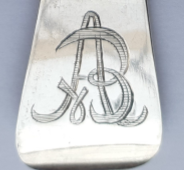
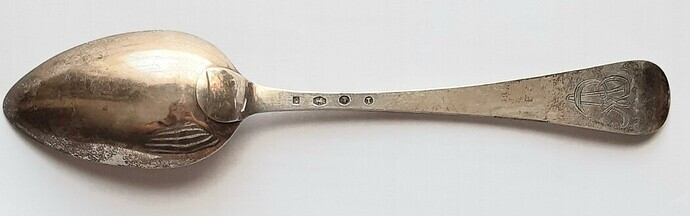
Good day, friends. I have here a Dutch tablespoon made in 1853 by silversmith Volkert Brouwer, upon which the initials A and B, with a symbol in between them looking like a stylized ampersand, has been engraved. Please see pic. Being of the Hanoverian pattern, the spoon is traditionally laid upside down on the table, so that the engraved initials can be viewed by the guest.
Would you support me in assuming that this monograph represents a wedding gift, and secondly that the A refers to the bridegroom’s first name and the B to that of the bride? As in (say) Anne & Barry. I suppose further that this tablespoon (which in the Netherlands might have served as a porridge spoon) could be one of a set of six or twelve spoons, all engraved the same. Or maybe a whole service, had money not been an obstacle!
Or perhaps I’m on the wrong track? Please advise, friends.
AB intertwined is most likely a single name monogram rather than a couple.
Silver for weddings until the 20th century bowed to the concept that women’s rights were submerged in the male when they married. Until the Married Women’s Property Act in most common law countries females lost all property rights even to separate dower rights
I am not an expert on Dutch matrimonial law in the 19th century and earlier so would concede the floor to anyone who might be more precise.
But, if I might make general comment, you might want to show the entire spoon and the marks upon it to get a more broad-based response.
CRWW
PS The exception to this rule is West Country silver where two sets of initials often appear on Exeter registered silver.
I also realise I have ducked the question which is, would the Dutch have used an ampersand to conjoin two initials belonging to a married couple?
I find its use, remember it is the combined letters “e” and “t” mostly for business in the Lowlands. So perhaps not.
Also the part of the letters you draw our attention to would be a rather poorly drawn ampersand, sort of upside down and incomplete!
So “no” based on form and general use added to, I have now looked it up, and
“…married women in the Netherlands gained separate legal rights, including the ability to control their own property and finances, when the Act abolishing the legal incapacity of married women took effect on January 1, 1957.”
Thanks for coming in on this, Chris. I must agree that the funny symbol between the two initials in no way fits the ‘ampersand’ bill. But might it not be a stylized ‘plus’ sign? That would serve to connect the two initials into a marriage bond, if you would permit my imagination getting the better of me!
Whether the bridegroom is at left and the bride at right, or the other way round, is unclear to me.
At the moment I cannot see any other reason for putting that little sign between the initials, other than the marriage connection. Please help!
Good day, friends. This is all I could reliably find regarding that mark in between the A and B on the spoon.
The (Reminder Ribbon) symbolizes support, awareness, and remembrance for various causes, acting like a physical awareness ribbon, often yellow (for hope, troops, or suicide prevention) or other colors specific to diseases (like pink for breast cancer or purple for epilepsy/Alzheimer’s). It signifies solidarity, encouraging action, and is used to show support for people affected by health issues, missing persons (POW/MIA), or social campaigns.
It resembles the engraved mark exactly, but that does not really help, does it? Perhaps Guildhall’s last comment is closer to the truth?
If we abandon your ampersand explanation and try for remembrance day ribbon instead – -very Tom Jones “Tie a Yellow Ribbon Round the Old Oak Tree”, The Sands, Las Vegas, 1972-- then it must for something we are remembering in space as the ribbon ends in the monogram are defying gravity. And, as far as we know, nobody had got into space in the mid 19th century, in fact it wasn’t until that wretched dog got sent up in 1957 by the Russians that anything living exceeded the Kármán line. The Germans sent a rocket up in 1944.
And if the upside down, gravity-defying remembrance ribbon isn’t part of the B we are left with an A and something that looks like an inverted script E.
So if that was what was commemorating a wedding for say Andy and upside down Eileen – then the Dutch engraver was following some fairly advant garde, one might almost say kinky, instructions.
Mind you, having wandered through the De Wallen district of Amsterdam, this might actually be the explanation.
CRWW
PS: The Dutch get massive kudoes for liberalizing attitudes toward the window trade but it was Napoleon, when he conquered the lowlands, who insisted it be legalized for the safety of his troops.
Thank you, Chris and Jools. Well, I suppose this is the topic slowly grinding to a halt. It’s as if we can’t get to say goodbye. (Probably not a bad thing, hey?) All I can add is that the maker of this spoon is probably also the engraver of the AB monograph (unless he employed other engravers as well). I can say this because he is said to have qualified as silversmith and engraver.
My original purpose was to accurately determine the maker of this spoon (for which see my previous topic “Lovely Dutch Table Spoon” if you like). I’m happy to say that goal has been achieved. It is Volkert Brouwer, of Kampen. And this after I frustratingly could not be helped by the source “THE NETHERLANDS SILVER MAKER’S MARKS (a selection of marks of Dutch silver manufacturers from 1814 to present days)”. I have found ample published evidence that the maker’s mark on my spoon is identical to one of the marks registered by this Volkert Brouwer.
Better than today. The mob had pretty well left but the corporate America hadn’t drained all the fun out of it.
Food and drinks were free and hotel rooms comped regularly. So that left time and cash for the black jack tables and the delightful young ladies who supplied the drinks.
One day, while staying in the Sands, which sits where the Venetian now straddles, I got bored and called up the concierge.
“I wonder”, I asked, " if I could borrow a horse?"
“Certainly, Sir. What color would you like?”
The color of the animal seemed the least important thing about its suitability for trail riding and I decided a trip down to the desk might facilitate the acquisition.
I introduced myself.
“I am the guy looking for a horse,” I started out.
“Oh yes, I remember, You want blond or brunette?” Came the cheerful response.
That was the Strip in 1972.
The last person I told this story to asked me if I ever got in the saddle?
The answer is I borrowed a jeep to visit the Hoover Dam!
CRWW
 (Reminder Ribbon) symbolizes support, awareness, and remembrance for various causes, acting like a physical awareness ribbon, often yellow (for hope, troops, or suicide prevention) or other colors specific to diseases (like pink for breast cancer or purple for epilepsy/Alzheimer’s). It signifies solidarity, encouraging action, and is used to show support for people affected by health issues, missing persons (POW/MIA), or social campaigns.