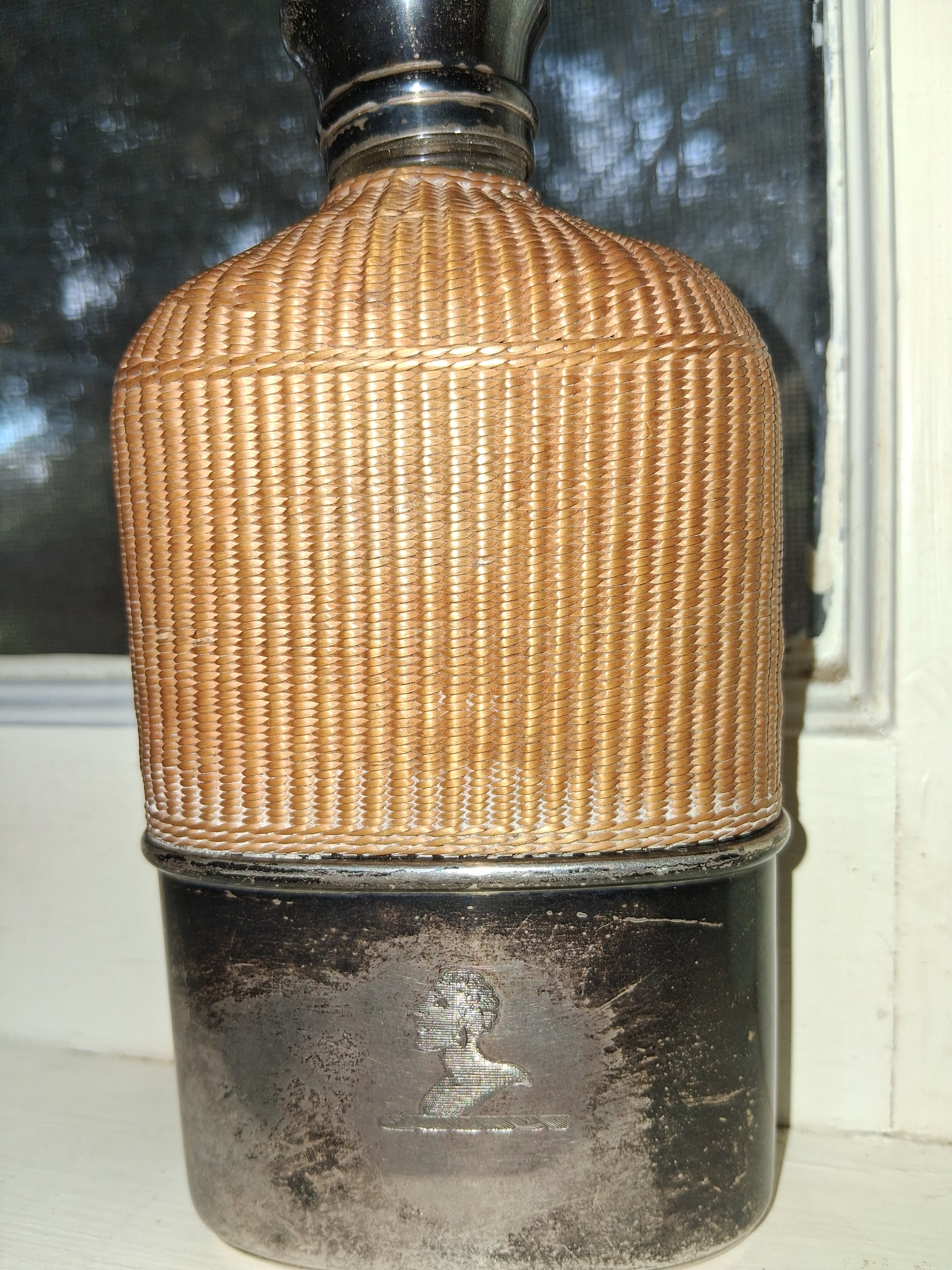
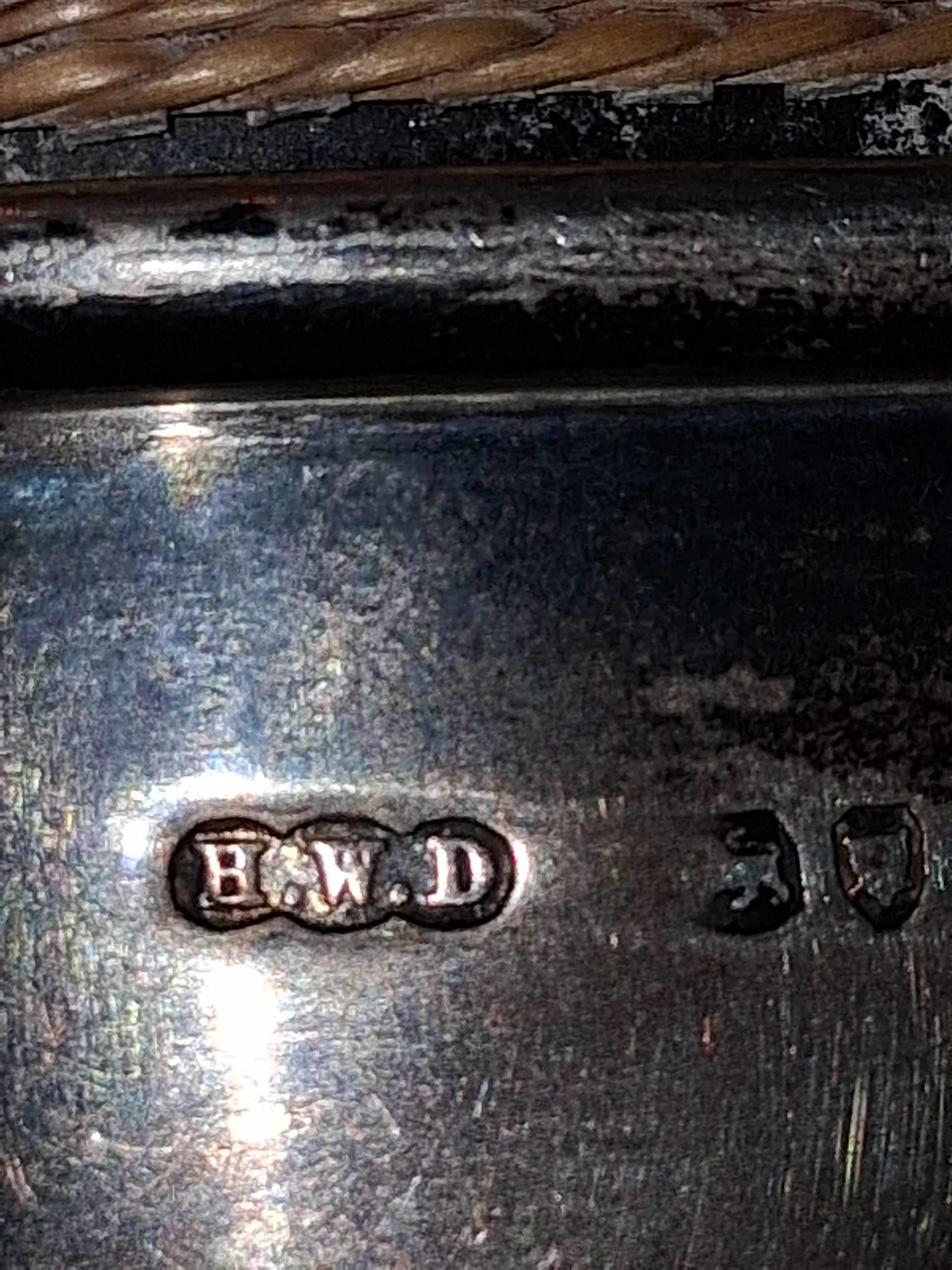
Victorian Silver & Glass Hip Flask, Rattan Grip by Henry William Dee London 1869.
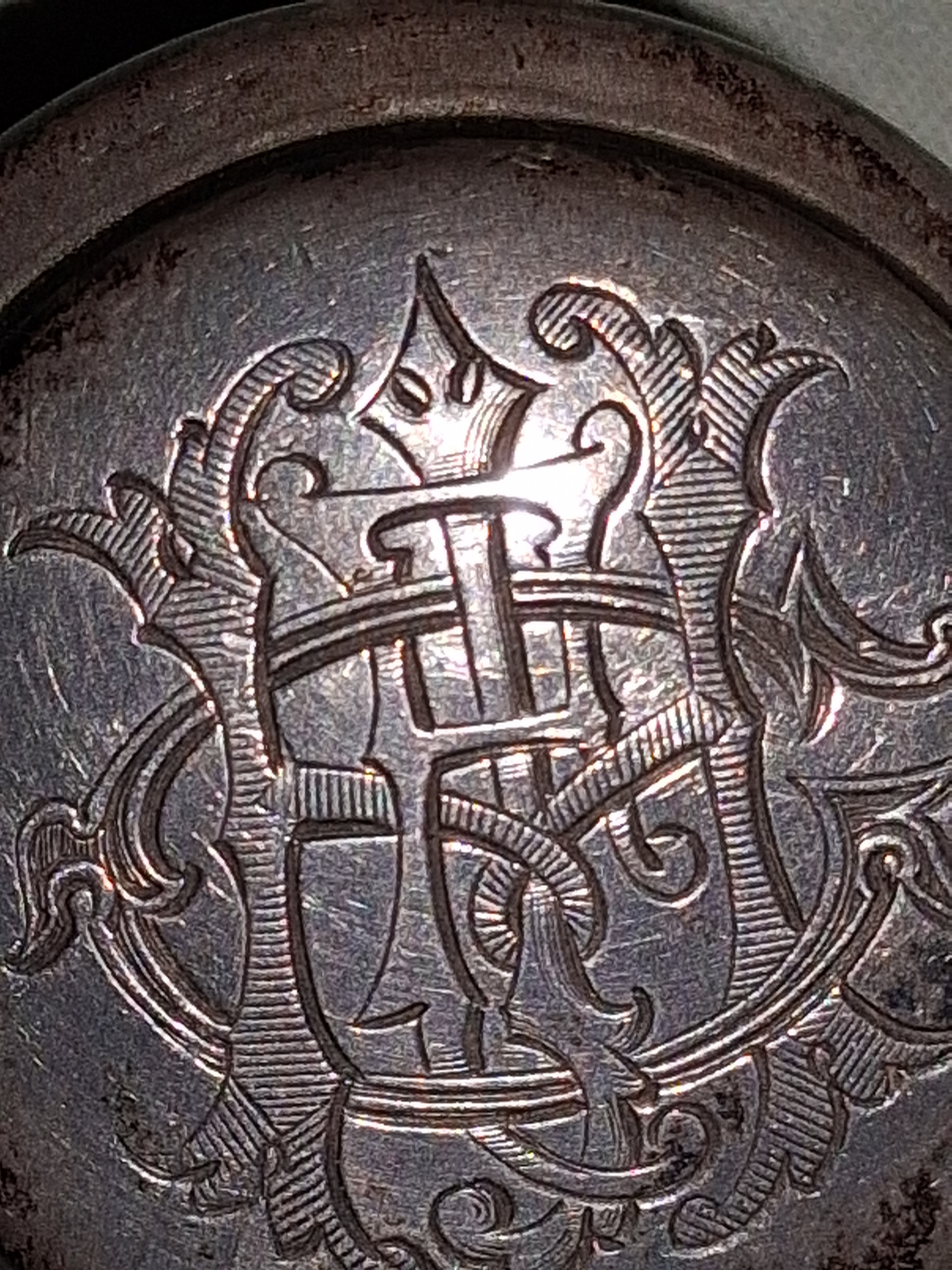
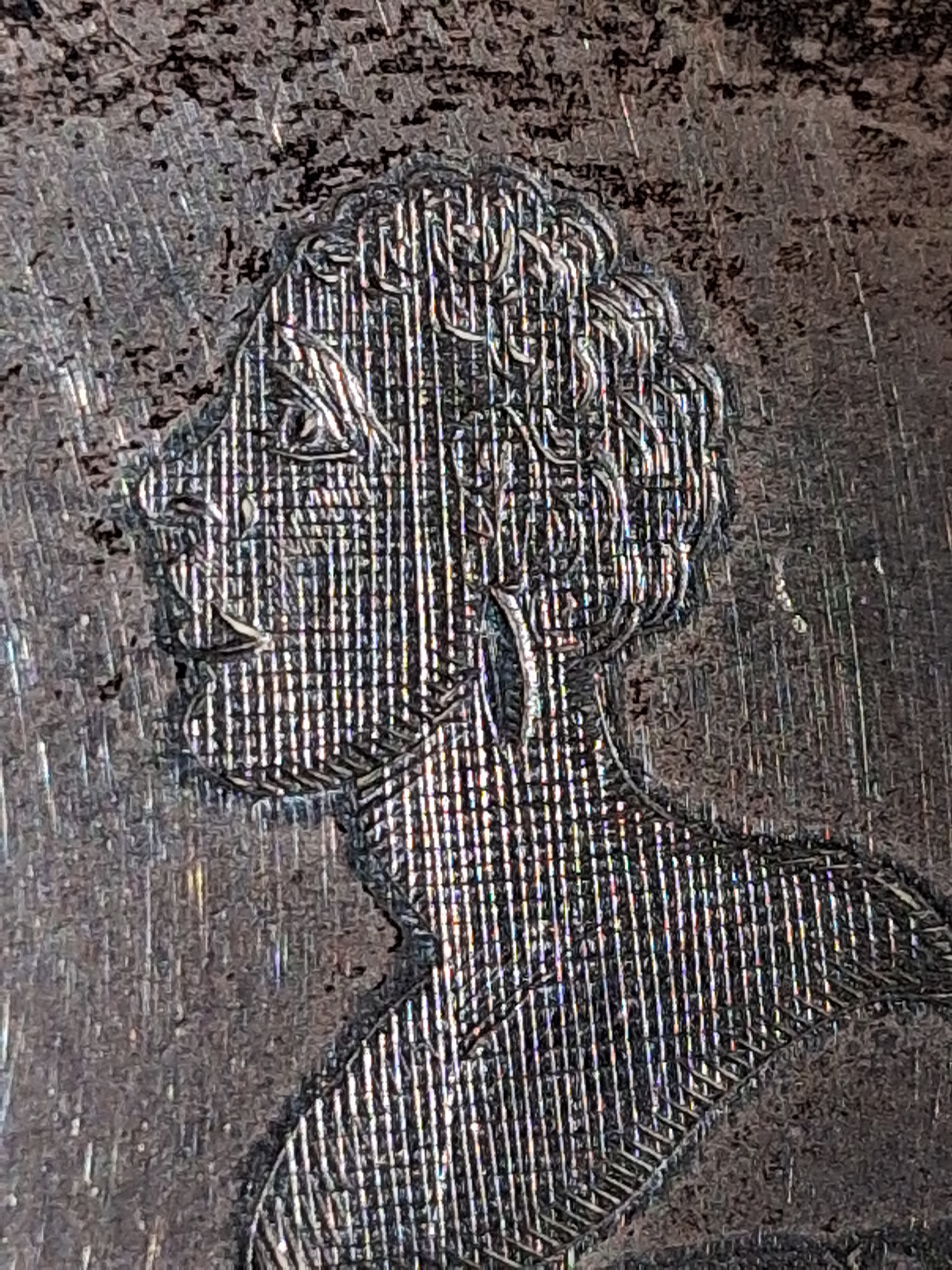
It looks to me that there is a female Moors head engraved on the flask. I think it is being used as part of an armorial device. There are stylized initials engraved on the cap. I have three main questions.
Do you think it is a Moors head?
Can anyone decipher the initials and are there any ideas about rho the flask mY have been made for?
Do you think it is unique? No one I have talked to has ever seen a Moors head etched into a Sterling Victorian flask?
You are entirely correct. The human head couped at the shoulders is part of an armorial
device.
Here are just three of the 491 distinct family heraldry shields and crests which feature slaves owned by the family working in sugar canes in the Caribbean or elsewhere.
*“O’Conry, a blackamoor’s head in profile couped at the shoulders sa., and bound *
*round the temples with a ribbon arg.” *
"Andrews, Bart., of Denton, Northamp., a blackamoor’s head in profile, couped at shoulders, wreathed about the temples, all ppr. 192. 13 "
“Borthwick, John, Esquire, of Heriot, Midlothian, a blackamoor’s head in profile couped. Qui conducit.”
If the initials and the heraldic head are related and you can figure out what the letters in the written initials are I can probably find you the family that owned this flask and this unfortunate human.
I have no idea how much you have read about the slave trade, and I don’t want to shock you in any way, but you have in your possession one of the most unpleasant, I dare say repulsive, aspects of English Colonial history.
What may help you grasp the horror of the business is the way the National Trust is attempting to deal with its slave trade legacy. You may like to go on their website and review their material for content on the matter.
The final insult to humanity occurred when Britain abolished slavery and the government paid £20 million (approx. $16bn–$21bn today) in compensation to slave owners, not the enslaved, for the loss of “property”. This 1833/1837 compensation represented 40% of the Treasury’s annual budget, with loans for this payout only fully repaid by the UK government in 2015.
Another way of looking at it if the most successful businesses Britain ever engaged in were the slave trade and the cotton industry.
Here’s a website setting out the present Royal Family’s ownership of the Royal African Company formed specifically to ship slaves to British-owned plantations.
Yet another way of looking at it, is the UK lost the wealthiest colony it ever had because of the Stamp Act, a duty of 4% imposed on good imported from what is now the US which did not apply to competing goods coming in from the slave plantation Caribbean islands owned by the British including William IV the present King’s five times great uncle.
( Full disclosure my family owned four Manchester cotton mills and employed thousands of operatives in little better than slave conditions in the nineteenth century. This industry collapsed with the US abolished the slave trade and the supply of cheap short fibre cotton dried up).
Gaitskill’s Novel “North South” tells a great deal about that industry just as Harriet Beecher Stowe lowered the curtain on the Slave trade with her literary work.
I hope this has answered some of your questions. I must confess the fact that nobody you have talked to has even seen blackamoors depicted on heraldic devices which appear not only on silver but on college or university windows, in garden statutes and of course literature, makes me think that the burial oft his horrid business continues in your country.
In the US and Canada we have a harder time burying it as 20% of the US population is descended from the trade goods owned by the other 80%. Canada abolished the trade when the rest of the British Empire did. The US took another half century and a civil war to follow.
You asked about the sex of the picture. Itis either female or a young boy. probably employed as a household slave rather than a field hand and almost certainly incorporated in the family heraldry because of the wealth she or he represents and may well have been sexually involved with the master or mistress. You may recall Thomas Jefferson actually married his slave and they had several children.
Thank you for your submission and the reminder to all of us where so much of our wealth and that of our respective countries was founded.
Victorian Silver & Glass Hip Flask, Rattan Grip by Henry William Dee London 1869.
It looks to me that there is a female Moors head engraved on the flask. I think it is being used as part of an armorial device. There are stylized initials engraved on the cap. I have three main questions.
Do you think it is a Moors head?
Can anyone decipher the initials and are there any ideas about rho the flask mY have been made for?
Do you think it is unique? No one I have talked to has ever seen a Moors head etched into a Sterling Victorian flask?
Hi Anon, I hope it is not too late to ask you for help determining who may have commissioned this flask. I was in contact with a Professor Kaplan at NYU and he confirmed that he thought it was a Blackamoor from an armorial crest. He is an expert in African images in western art.
We are pretty sure the initials are H, C, I, and A. H is the largest and most imposing letter, around which all the other letters are entwined, so we think this might very well be the Hurlock family from, maybe the Devon branch. C is the next largest letter followed by I and A. Do you think you could determine who this might have been commissioned by? If we can make a few reasonable guesses there is a Silversmiths guild in London that has said they may be able to find records of the flask. They are basically a very old Guild that maintains records for British silversmiths and especially London silversmiths.
They seemed more than happy to help were interested in seeing if they can find anymore examples of Victorian Sterling etched with a Blackamoor. Here is a link to more and better pictures especially if the cap with engraved initials
I hope you can help. If you want to email me directly my email is [email protected]. I live on the Cape Fear in North Carolina. Let me know if you have any questions.
Thank you, Robert