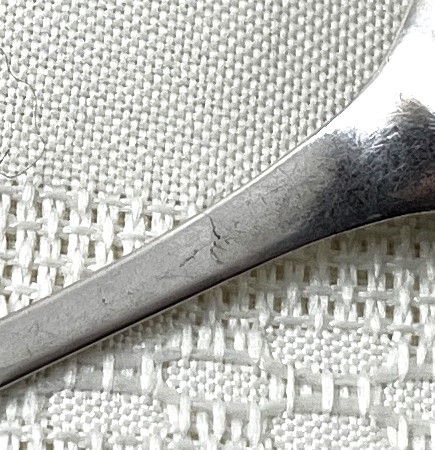
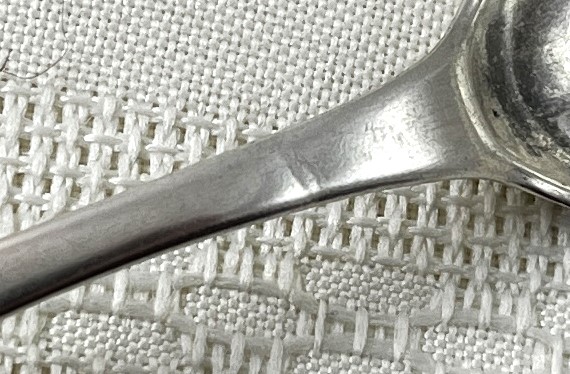
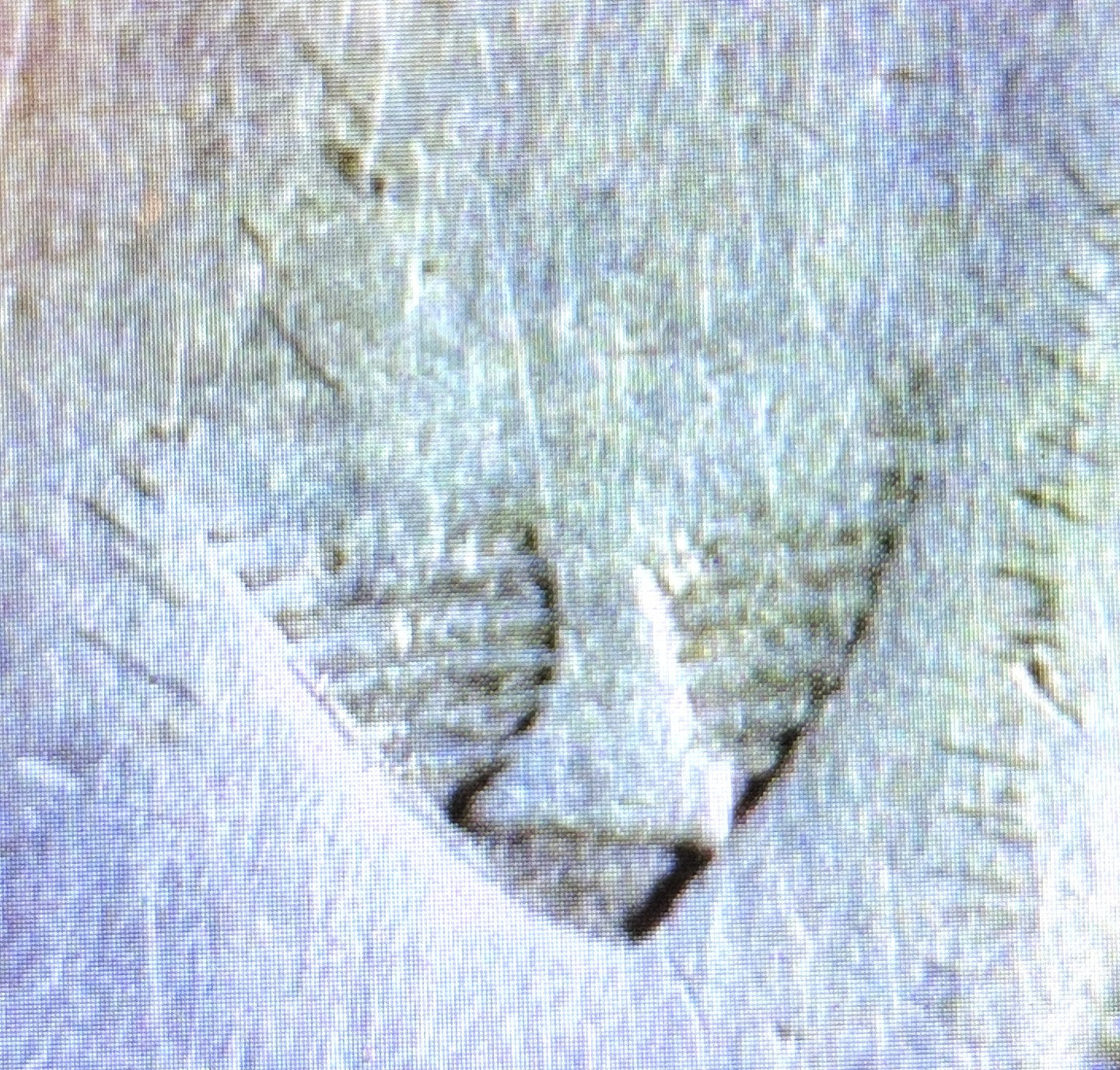
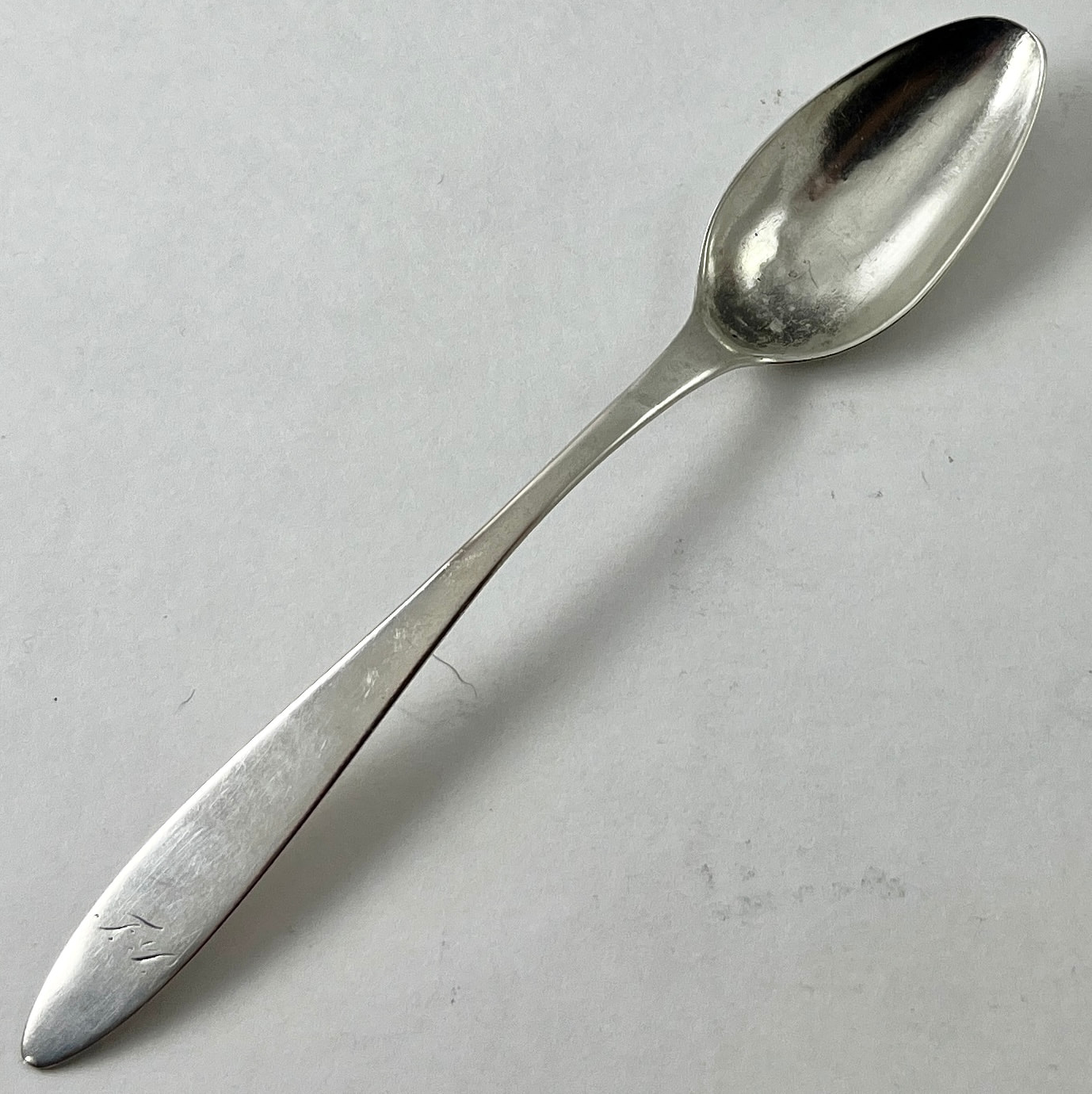
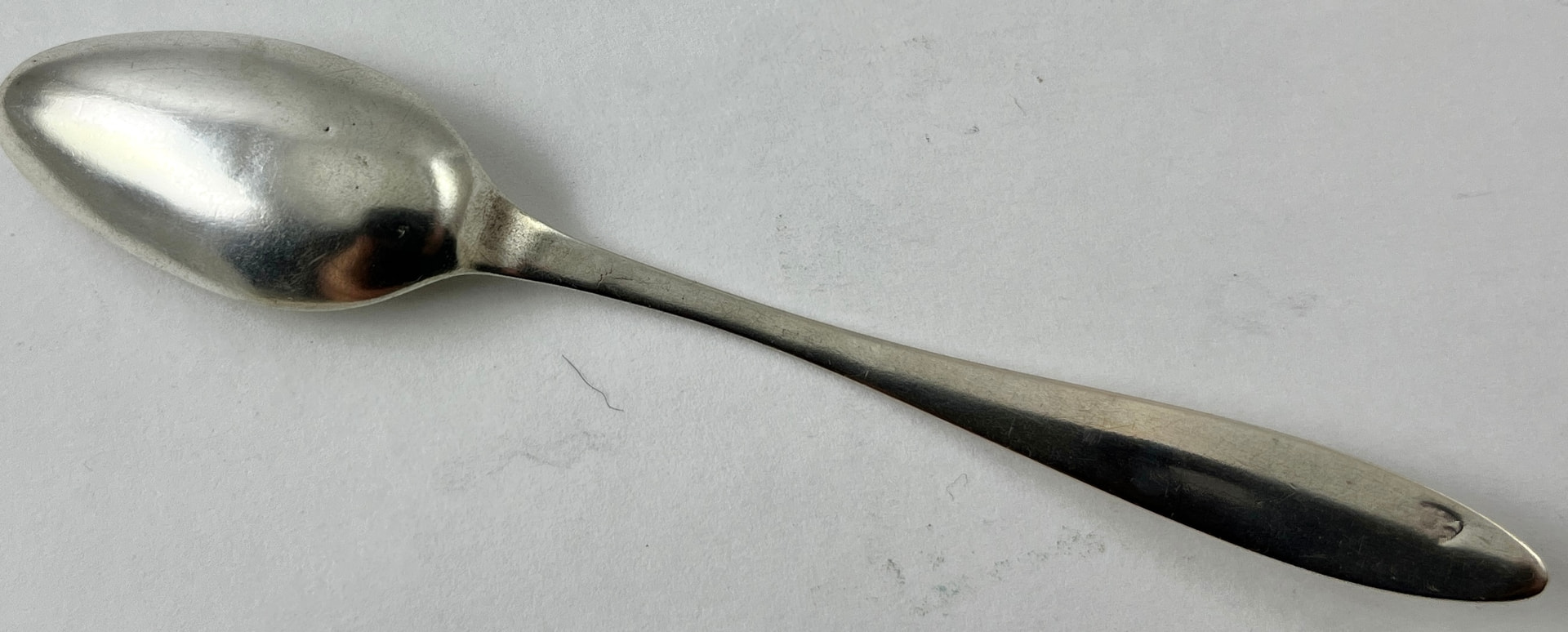
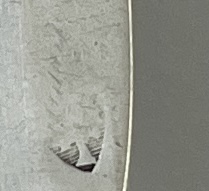
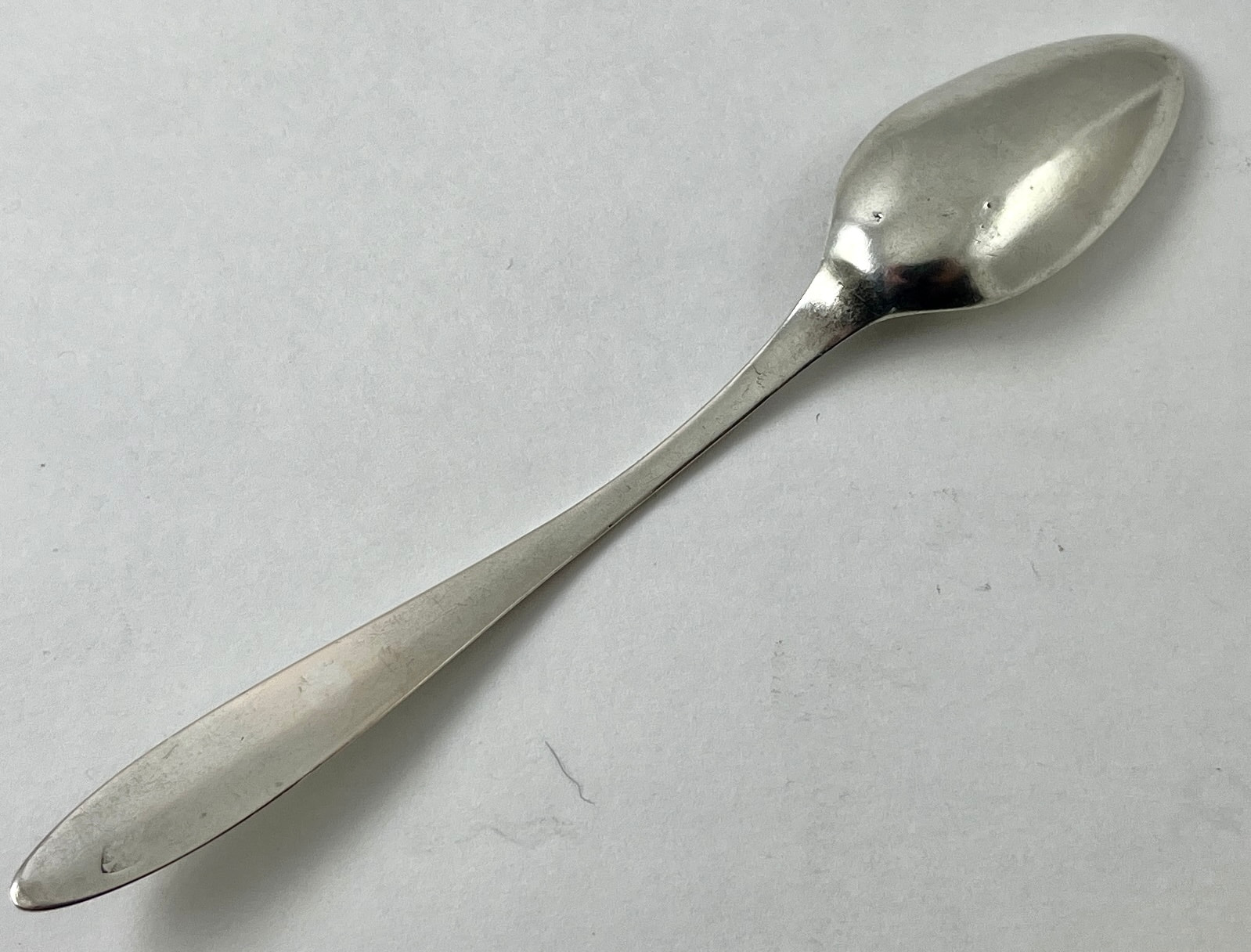
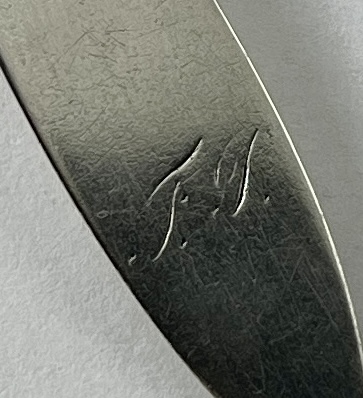
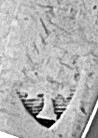
This 5-5/8" spoon (10 grams) has confounded me for years, so I am trying once again to identify it. It acid tests to solid silver and has the look and feel of it as well. It has just one partial mark on the reverse of the handle – a possible shield with horizontal lines and what appears to be a tree. I discovered through online searches that the horizontal lines sometimes signify the color blue. There is a monogram on the front terminal end of the handle. The piece appears to have been two parts connected – see the seams just a bit down the handle from the bowl. Any help would be greatly appreciated.
Regards,
Dave
1 Like
Too little information to identify anything. Definitely the letter “T,” perhaps with a crown above it or the maker’s initials, which would indicate France…
Can’t help with the mark, but the seam looks to me more like a repair. Perhaps Uri Geller used it in his act.
1 Like


Well, Google AI (everyone take a grain of salt now, maybe the whole salt shaker), believes that the seam is actually where the silversmith turned the spoon from hammering the handle the long way to hammering the bowl area in the other direction. This apparently causes a mark such as the one on this spoon – hammering the thicker handle and then the thinner bowl. ChatGPT tells me it is almost certainly French. I have been through every American coin silver maker’s marks on three different websites, as well as through my Rainwater “Encyclopedia of American Silver Manufacturers”. I have also been through sites with French pre-revolution marks. All with no luck.
Possible. But remember that AI doesn’t “believe” anything. It’s just reporting that someone else out there on the interwebs believes that. This, of course, is the danger of AI. Any fallacy, if it’s “out there,” get reported as truth.
I rather like your little spoon. Ten grams isn’t much to work with and I think we might start with its use which would likely to serve spices or salt in smaller quantities. Which dates it later than about 1780.
It’s a cast spoon and it looks as if the casting had flaw which, as Jeff says, points to a repair. The repair looks like a strengthening repair not an outright break repair and may have been done by the original caster.
Its Celtic point design doesn’t mean its Scots but certainly makes it compatible with that country.
The italics initials will be the owners.
The mark on the back is more definitive . Wavy lines do indeed often point to azure or blue in heraldic crests. Although, again, it doesn’t rule out other colours for the shield.
It’s a leafed and uprooted (erased) oak tree on a blue shield background and, given the position of the mark on the spoon handle may relate to the owner’s family rather than the maker.
A complete absence of makers marks is not uncommon on Scottish provincial spoons and points to a regional silversmith making a cutlery set for a private or direct order with no retailer interposed. And no British taxman levying charges of sixpence in the pound sterling to pay for trying to hold on to the 13 Colonies and failing.
Fairbairn on Heraldry lists 132 families whose crests might include an erased leafed oak tree on a shield which might be blue. Half of them are Scots.
Generally azure background refers to the sea or, in Scotland, possibly a loch.
So you’re looking for a family with this crest, quite probably with a marine connection but not necessarily a geographic marine connection. The head of the house might be first sea lord, for instance, or just a sailor.
So why a set of initials and a heraldic crest? Likely the crest arrived first and is there simply as means of keeping tabs on domestic silver. Remember servants back then got a free ride to the antipodes for acquiring silver without paying for it.
I wonder if you wouldn’t mind saying where, what part of the world you acquired it? Because the other silversmiths making this sort of spoon were southern colonial smiths working in the Carolinas. No or minimal makers marks as they likely lived in the same community as the buyer. Many were Scots in origin so continued to favor the Celtic point.
You mention you had it tested for silver. You didn’t say if it tested .900 (coin) or .925 (sterling) or something else completely, which would tell us much about origin.
There is little point in running a scan for Scots crests until you are clear it is UK origin.
Silver content and point of acquisition may point the way.
CRWW
I compared the mystery spoon directly against known sterling (.925) and known coin silver (.900) using the same GTE silver testing reagent. The mystery spoon’s reaction closely matched the known coin silver control and differed from the sterling control. While I realize an acid test is not a laboratory assay, the comparative result is consistent with the spoon being a lower-fineness silver alloy than sterling. As for where I purchased this, all I can tell you is that it was purchased in an online auction from somewhere in the United States. Anything beyond that would be impossible to say – I acquired this years ago.
1 Like
That being the case it is probably not Scottish. It may be American. But apparently someone here has done a search of colonial silversmiths and come up crickets.
It is also being suggested it is European but I think I prefer southern colonial America. But this maybe is just because I know a little about US colonial silver and nothing much about European material unless it is Dutch which this probably isn’t
It also means the heraldry search is likely to be less fruitful and increases the chance the badge with the oak tree is maker rather than owner.
So the task is to search out again a colonial makers badge with an uprooted (eradicated) oak tree with leaves (vert) against an azure ( blue) background.
And if that comes up nothing then some family with that badge whose talents and fortunes were exported to the southern US.
That search promises to be more time consuming than a 10 gram spice spoon deserves so I will leave it to others more talented than I at that sort of thing.
But thank you for posting and giving us all something to puzzle over.
CRWW
Thank you so much for the information!
David
1 Like