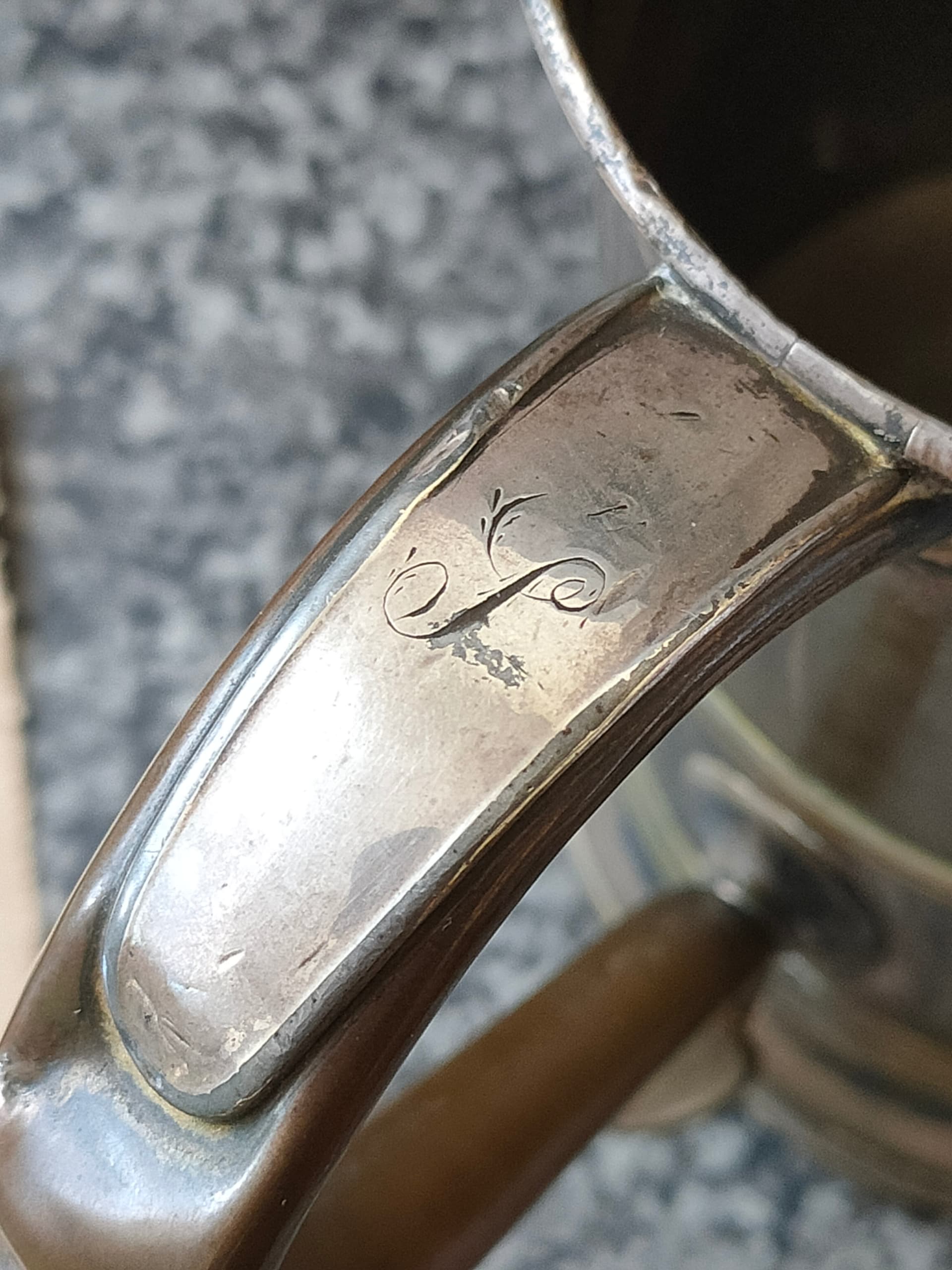
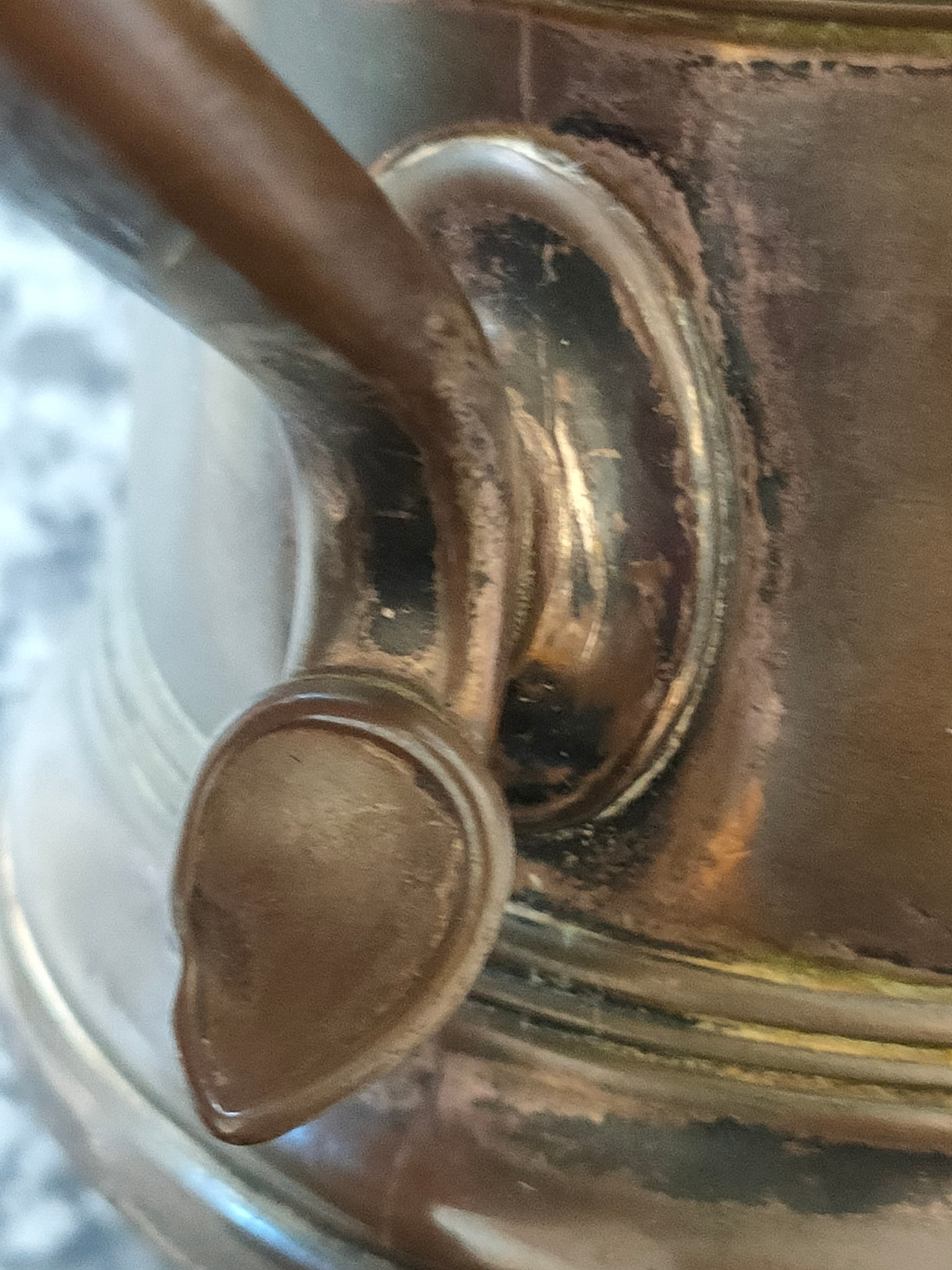
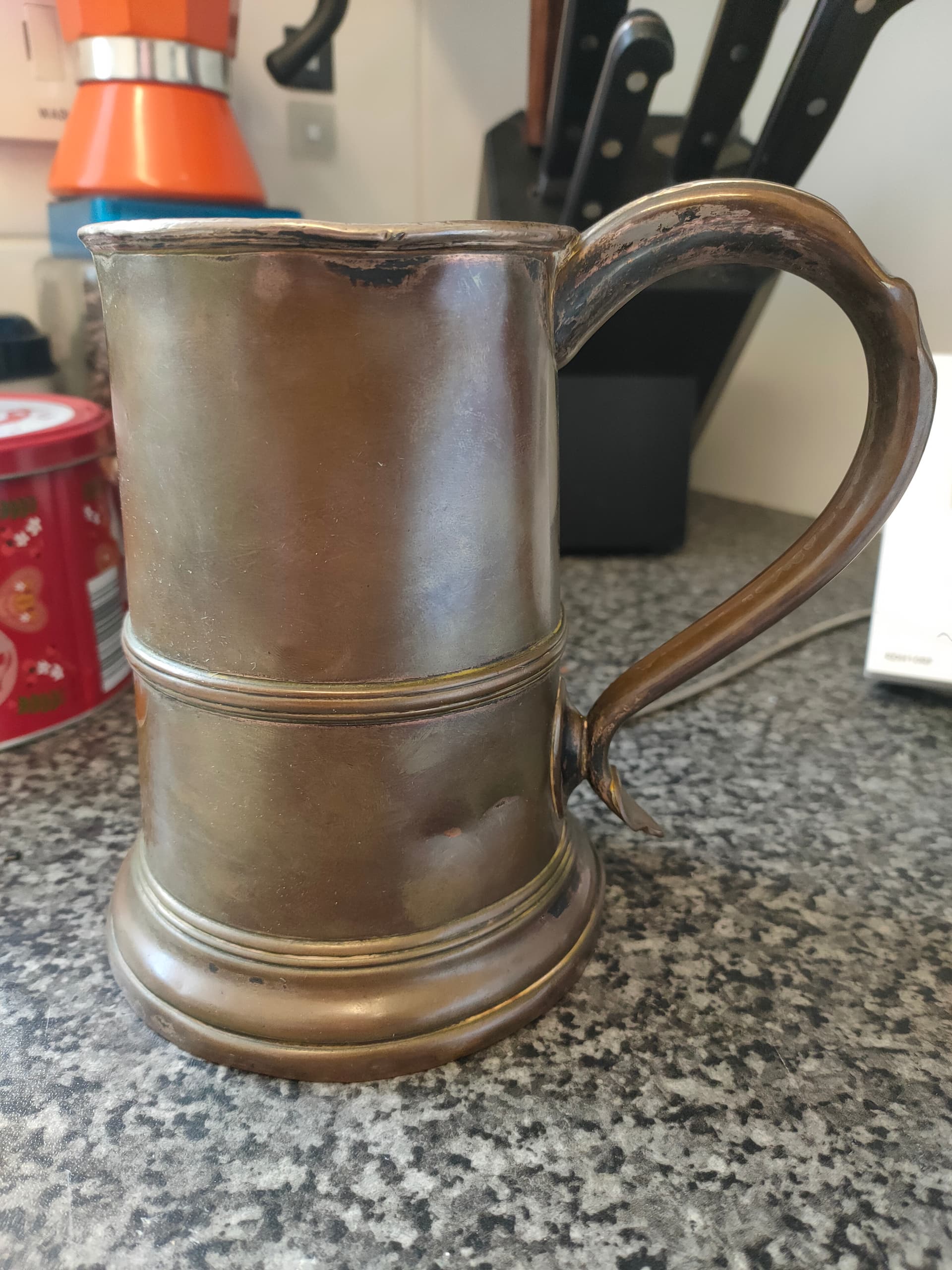
I’ve had this tankard since the dawn of time and believe it’s c1700s !!!, I can see that it was once silver plated and has what I believe a solid silver thumb rest at the top of the handle even though it doesn’t have a hallmark  . There are no marks whatsoever to the tankard anywhere apart from an initial to the thumb rest, would this be normal Not to mark such items ??. Any input would be appreciated, thank you


1 Like
Antiques Atlas - A Late 18th Century Sheffield Plate Quart Tankard as980a474 / 1578N
Georgian, George III, Old Sheffield Plate Tankard. N. Smith & Co. Shef – Bassetlaw Silver & Antiques
1 Like
 thank you for that Bart, it looks amazing both with it’s plating and without
1 Like
U welcome, Alan! 
 __-__—–__-
1 Like
Every time I look at my tankard I envision some old fisherman entering a tavern after a Hard days work sitting in front of a fire on an old oak Settle and warming his ale with a red hot poker 
1 Like
Drinking any drink from such a unique mug is pure pleasure. At home, I sometimes pour beer into an old German mug. It’s so heavy that it’s difficult to get drunk. 

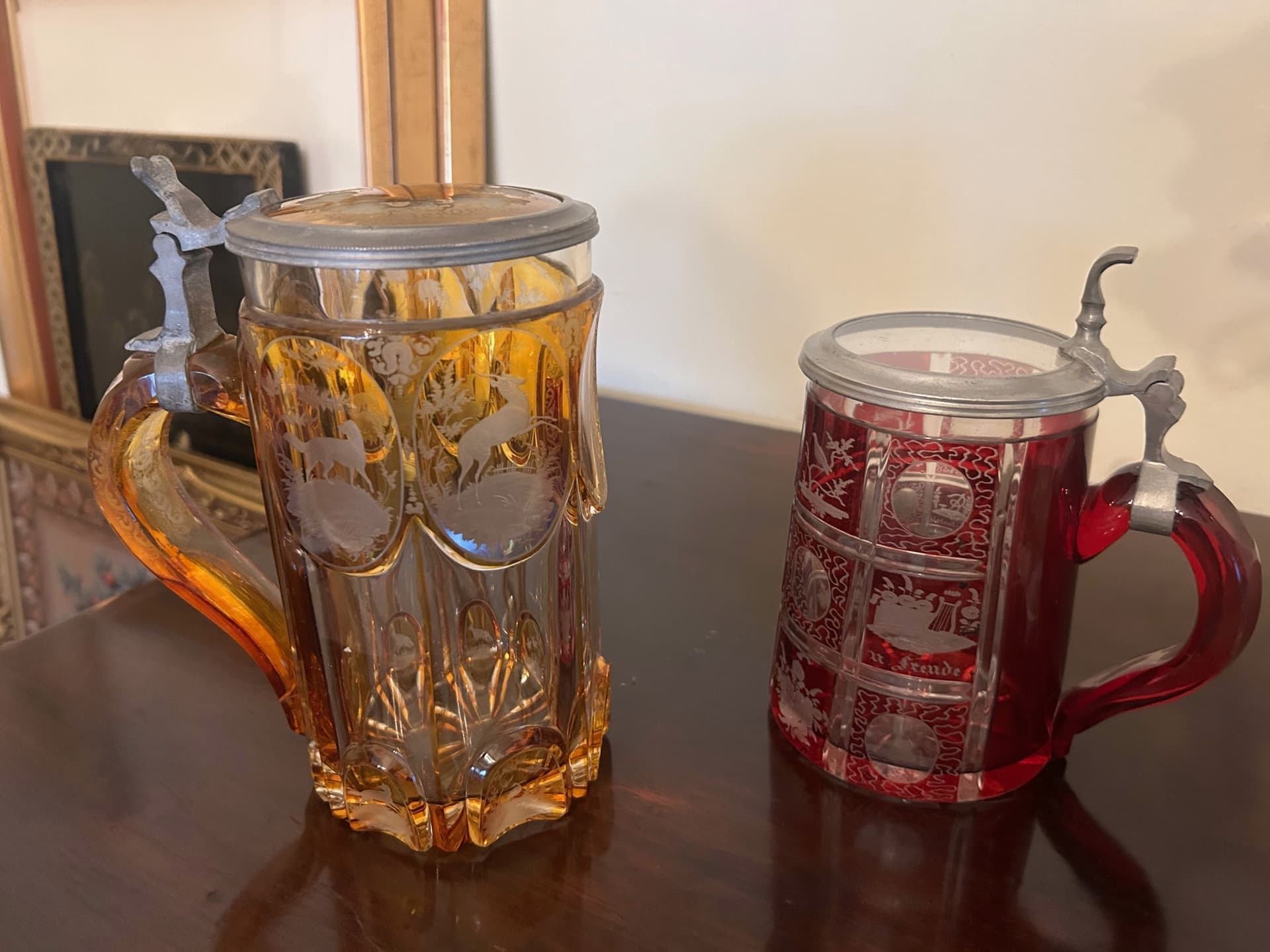
These two glass beasts will be arriving soon… 
1 Like
They’re beautiful Bart
1 Like
Sheffield Plated, as opposed to electroplated items routinely had solid silver inserts for trays and handle inserts for tankards designed to take an initial engraving or badge. This is an 18th century mug probably made around 1770. Its lack of marking is also evidence of it being true to period. The reeded hoop around the straight-sided mug is typical of that date range.
Other than taking out a couple of dents, the collectors say do nothing and don’t electroplate it as you will decrease its collection value.
Some of the earlier mugs, one’s made from 1745 for perhaps a decade were only one silver sheet of silver on the outside and left as raw copper on the interior or underside.
Again, this appears to be a true sandwich indicated the later date.
Happy drinking!
CRWW
1 Like
Looking at the inside of the tankard there appears to be some kind of what I believe to be / or like to think of as an Ale Froth stain probably or possibly accumulated after a Hot Poker was added to warm the Ale !!!  .
.
Also, I’d like to know that would the copper on the inside leach into the liquid and cause any kind of ailments ???
1 Like
Short answer is both copper and silver leach into fermented liquors. Which is why the Victorians gold plated the insides of mugs.
Actually I was wondering if the dark mark might be the same sort of darkening you find to a teapot from the tannin. But I didn’t want to suggest someone had been drinking tea out of your family mug.
Also, because of the staining it is difficult to see what you have or have left on the interior.
My initial thought was this was a single sheet mug indicating a really early date.
If it were my mug I would clean the insides of the dark stain. I hesitate to give cleaning advice on an item I cannot examine in case I get it wrong, but generally start with the least invasive, least abrasive and keep going until your stain responds. Or take it to your friend neighborbood silver chap and have him/her deal with it.
CRWW
1 Like
Oh and all this brandishing red hot pokers around is very overrated. It was done not to warm alcoholic drink, especially mead, but to burn off the alcohol before it was given children. Remember most well water in towns carried disease. Which is why the Brits bought so much tea from China. Not for its taste but the fact it was boiled. Although they didn’t know that, until Doc Snow took time out from delivering Queen Victoria’s nine babies to figure out the water not the air was the problem.
So the survivors drank tea or alcohol. Which meant people that didn’t succumb to cholera etc, which meant soon everybody drank tea or booze.
Red hot pokers were tricky thing to handle in English history. Both Kings Edward II and William II fell foul of them. Very uncomfortable one would imagine.
CRWW
1 Like
To be honest I never gave it a thought that the inner may be plated as it is black and not visibly copper !!!. I’ll give it a gentle polish when I get home and see if there’s some difference and let yous know  .
.
Every time I think of Edward and William receiving the Royal Poker I cross my legs and Cringe 
1 Like
If I may be permitted to suggest, I don’t think your black “patina” needs polishing so much as removing. How you remove it depends on what it is. White vinegar is generally helpful and benign. Failing that water, washing soda and sea salt generally work. After that fails there’s a few other household chemicals I use if I am in hurry but until you know what the surface inside is don’t go there.
Yes, being king used to be a high-hazard, short-term job. Most got killed in battle or from really bad leading edge surgery.
The poker cure for bad monarchy worked well as you could still stick the body on display afterwards and pretend it was all just anno domine.
You will recall Richard III was so badly chopped up after losing his all three of his horses at Bosworth they had to stick him in a pub parking lot near Leicester and cover him with asphalt.
Today the problem is monarchs live too long and are loved too much. Victoria hit her “best buy” date 40 years before her death. He son Edward obligingly gluttoned himself to death. His second eldest son, the eldest was gaga, died with the immortal words " Bugger Bognor" on his lips. His second son George VI (Albert) was hooked on Players cigarets and died nice and early enabling daughter Elizabeth to live and reign longer than any monarch ever had. Which created the problem of her ageing flower-smelling and talking child. Charles III is savvy enough to keep most of his latter day weirdness under wraps but his sons and brothers don’t seem to have the same facility.
CRWW
1 Like
I forgot to respond to your the medical question about leaching copper and silver. Silver is an antiseptic. Medics used to use it for all sorts of things both in liquid and solid form before antibiotics came along. I had an great-uncle with a silver plate in his head from a war wound. He claimed with the right atmospherics he could get Radio Luxemboug.
Copper too has beneficial effect, supposedly as an antidote to rheumatoid arthritis. My grandfather’s game keeper used to tell everybody how well copper bracelets worked but now I think back on it, it was probably hinting at wanting the rising damp in his basement-less cottage fixed. No Lady Chatterley for him, although that might have worked too.
Beer used to be brewed as wort (pronounced wert) in copper kettles and fermented in copper-lined fermenting tuns. That was my first job at the brewery, cleaning them. It quite put me off brewing. Today it’s all stainless steel.
Both my grandfather and great grandfather drank copper-brewed and fermented beer rather than anything else and both made the century in a time when 57 and 70 was a good age.
CRWW
1 Like
How old are those Steins may I ask !!!
1 Like
For now, both mugs are in Melbourne, at my father’s house. Their appearance suggests they are Bohemian glassware, dating from around 1860.
1 Like
Wow , they’re beautiful and look to be in immaculate condition 
1 Like
My father, due to his education (Warsaw Academy of Fine Arts) and passion for beautiful and aesthetic objects, also possesses an incredible talent for finding curiosities. He always surrounded himself with opulence…
1 Like