2 Likes
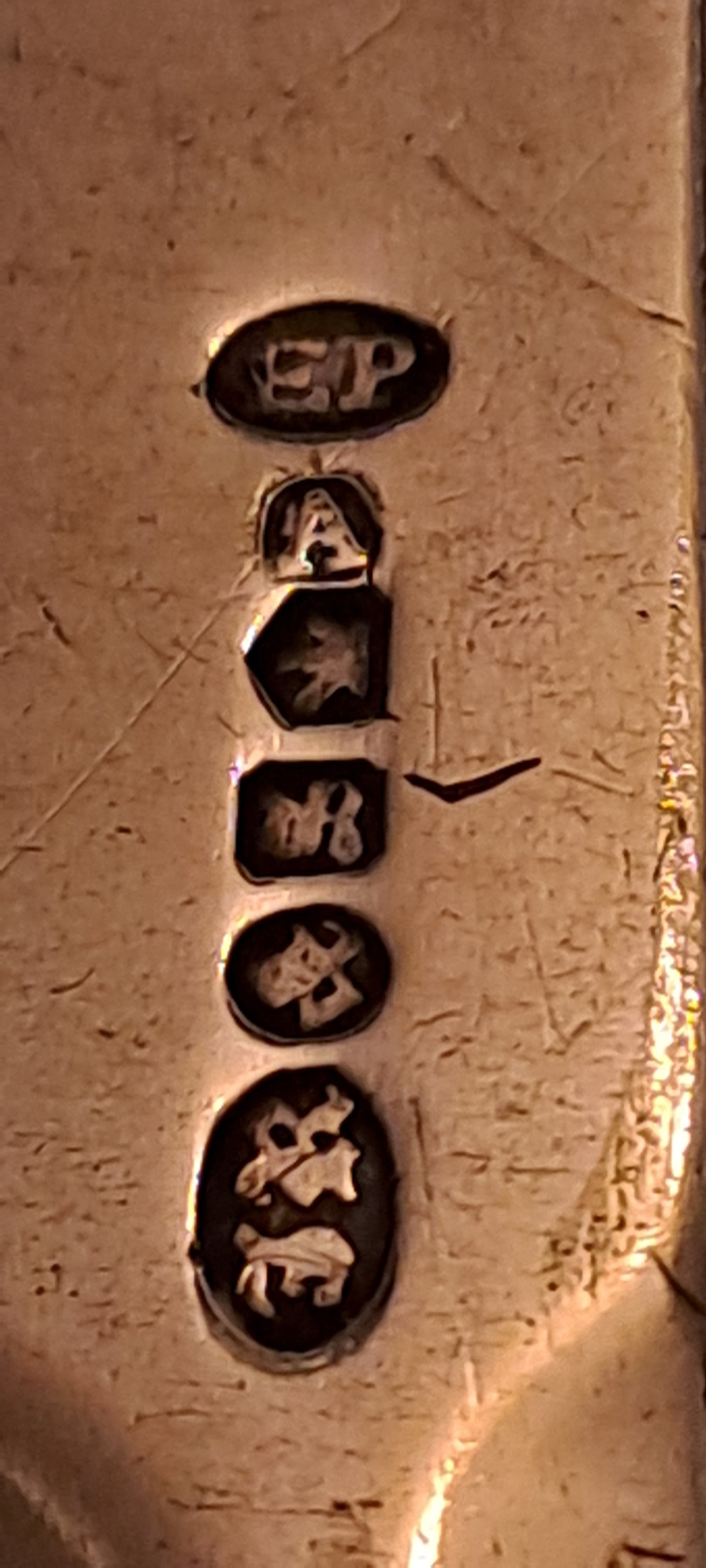
Your paper knife is made by John Round & Sons (A EP ) probably sometime before 1874. The EP stands for Electro Plate and the A is the first quality.
Here’s a brief history of the company:
And an advert:

CRWW
1 Like


John Round & Son, Tudor Works, Sheffield
I have been looking for another paperknife made by John Round & Son and haven’t had any luck. Which has made me very curious as to what yours looks like.
I was able to find one modelled as a sword with cross guard and pommel terminal, hallmarked John Round & Son Ltd (Joseph Ridge), Sheffield 1913, length measures 8 inches (20.5 cm), but your mark looks like its on a flat fiddle handle and quite different
CRWW
1 Like
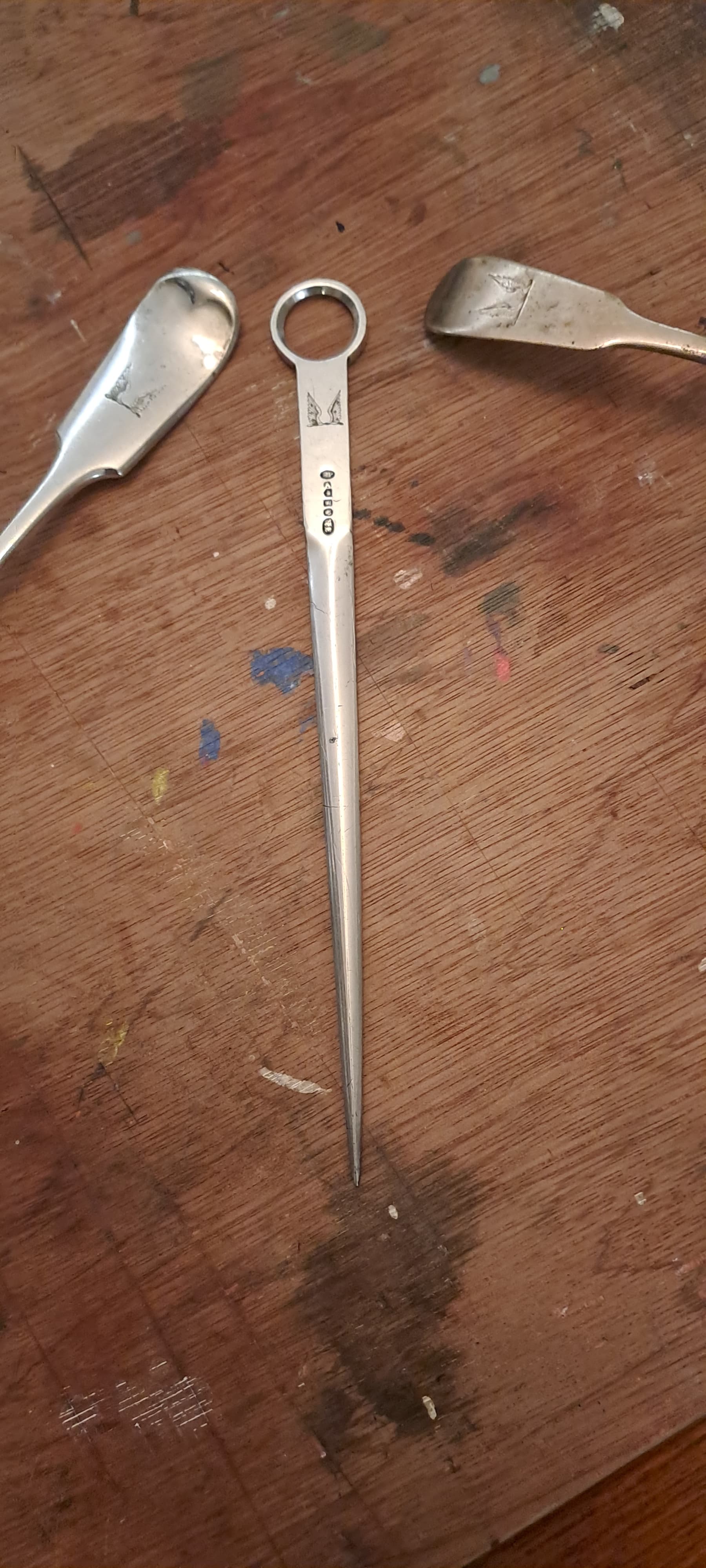
Hope this is helpful. I think all of the silver I have. Or a lot of it has been embellished with a family crest. So that’s not part of the original design.bAs you can see from the ladle and fork, i’ve posted with it -those are from different makers, and it’s on the electropated as well as the sterling stuff.
1 Like
Thank you. So your paper knife is actually a meat skewer!. They used to make them in sized bundles of 10. They were used to secure the joints or game birds for carving in the dining room. and they hung on a hook next to the stove.
Because they were usually damaged. by the carving knives often wielded by footmen or even a well-oiled host, electroplate would have been a very unsatisfactory material. And indeed your example appears little used.
I can tell you about the family crest too but will not do so on a public forum unless I have your specific permission. You’re listed in both Fairbairns Heraldry and Burkes Peerage.
CRWW
2 Likes
Oh, name and shame my ancestors.If you would like, I have no problem with that. I don’t mind even if they were hanged for treason.
But I suspect either there were greens or fishers or kingsleys.
2 Likes
Your photo shows three items, a plain fiddle pattern Victorian dinner fork, the meat skewer and an old English-style sauce ladle each decorated with a family crest consisting of a pair of eagle’s wings conjoined.
None of the families you mentioned use a pair of wings as a crest or any part of a crest of heraldic badge.
On the other hand the Blows, the Moens and the Rennie families all do. And the Moens are the ones with Eagle’s wings the other two are just conjoined wings. Lorimer, Melville and Spencer also use a conjoined eagle’s wing but usually attached to another animal.
If you’re related to Spencer or Melville your ancestors married into the aristocracy. The Blows, Moens and Rennies are all Scots as at the Melvilles.
CRWW
2 Likes
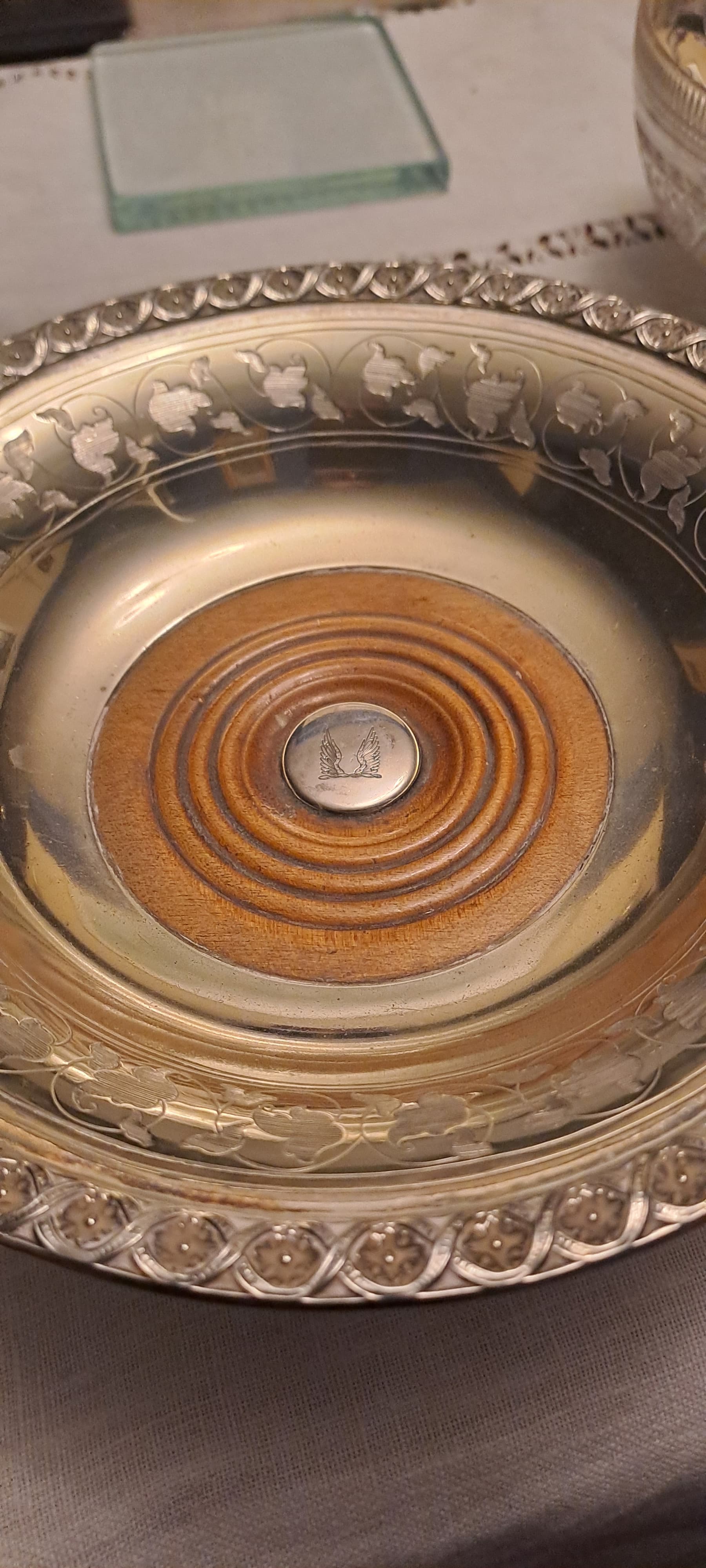
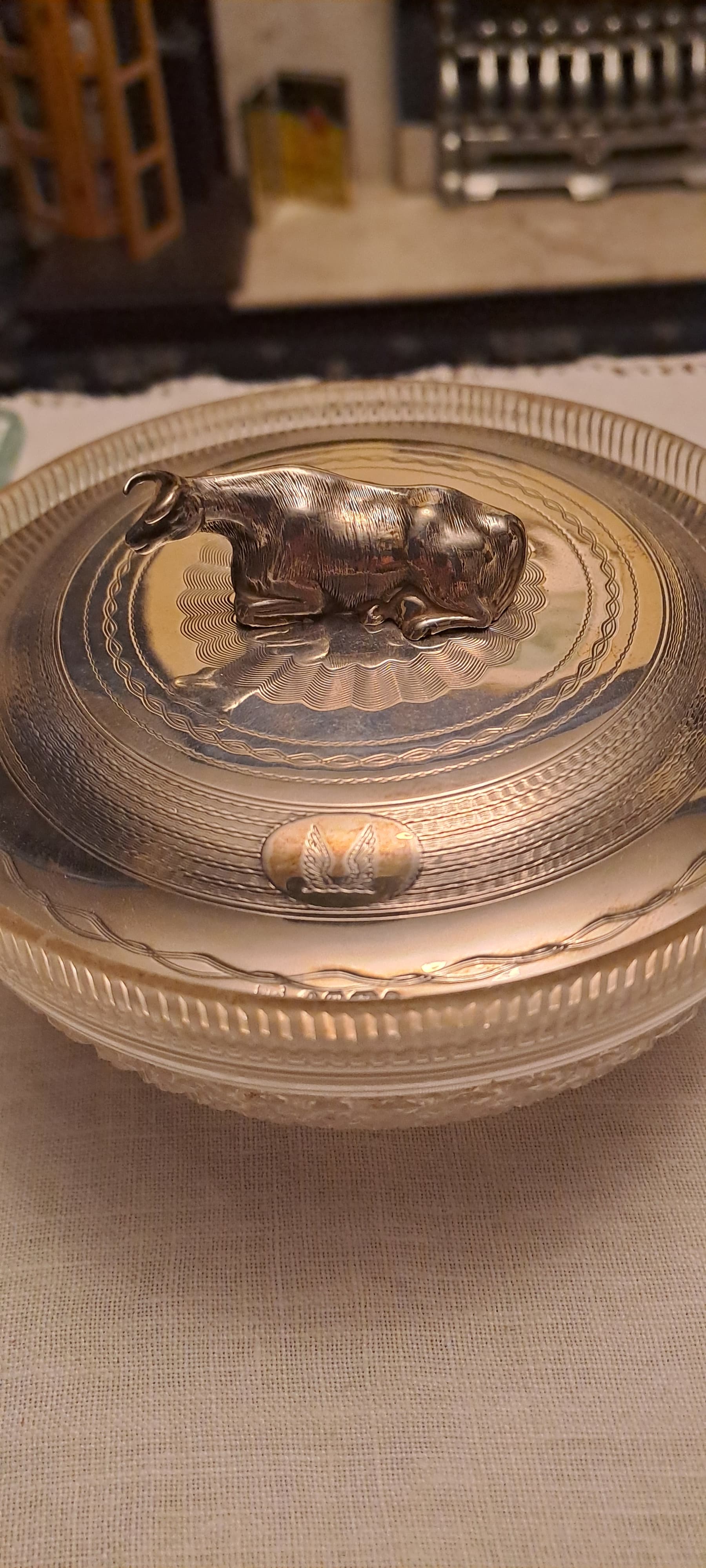
The names are not familiar. There’s always the possibility, a relative bought all of this silver at a sale as a job lot. It’s everywhere. Such as on this, what I think is a wine coaster and possibly a cream or butter bowl ( guessing by the glorious little cow on top of it)
1 Like
Ah. That’s a clearer mark.
So either someone bought the Clay’s silver or you have inherited.
This appears to be the crest.
The family estate in Monmouthshire was sold and the house is now a ruin. So the apparent shortage of money may indicate someone on your family purchased the family silver.
CRWW
1 Like
Here’s the complete list of Clays in the UK
Clay, Claye, and Cley, Derbysh., two wings
expanded arg., semee of trefoils slipped
sa. 109. 1 1
Clay, Henry, Esquire, M.A., J.P., D.L.,
of Piercefield Park, Chepstow, Mon-
mouthsh., in front of two wings arg.,
semee of trefoils slipped sa., a mount
vert, and thereon two estoiles gu.
Clarior virtus honoribus. 292. 1 1
Clay of Ford Manor, Surrey, and Arthur
J. Clay, Esquire, of Holly Bush, Staffs,
same crest and motto.
And here is the will of A J Clay on p 33
CRWW
1 Like
Thanks very much. Monmouthshire makes more sense. My father’s family were from South Wales He was born in ferndale. And my grandfather was a manager of the Mardy Pit after serving in the Royal Engineers.
1 Like
The most famous Mardy Pit manager was Dick Davies but I am not sure he spent time in the Royal Engineers. His would have been seen as an essential service in war time
Mine managers were well compensated being provided with full staff and a free company house
So he would have been in the market for silver and the Clay silver probably came up for auction in the inter-regnum period.
As you can see the Clays made their money working for Bass Charrington of Burton-on-Trent. It’s difficult to go broke as a Burton brewer in the 1930’s but those families distracted into armed forces service often did. Lloyd George’s income tax didn’t help either.
CRWW
2 Likes
Thanks for all of that. Apparently my aunty in Yorkshire has done some family research knows of a connection with the Clays in the 1800’s - I am waiting to find out what it was. It could be a marriage.
2 Likes
Yes there’s a family tree up on Ancestry.com and another in Heritage for the Clays so all you’ve really got to do is slot in your own ancestor and you will see how it all fits together.
Since you now have the name and the silver or a bit of it, you may as well have the estate too.
Someone needs to go tidy up that property and either rebuild or tear down the house.
CRWW
1 Like