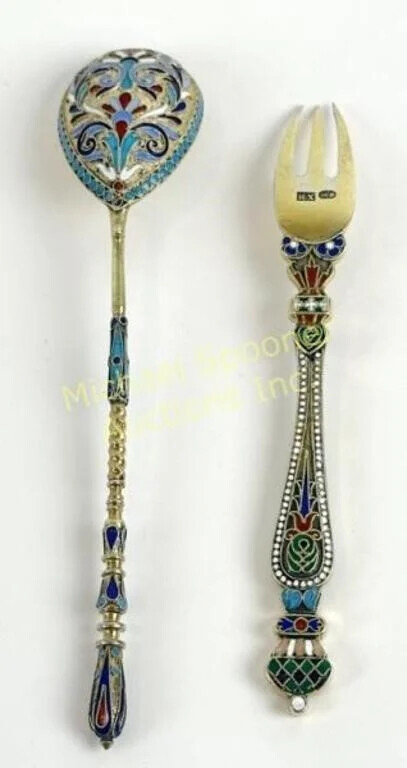
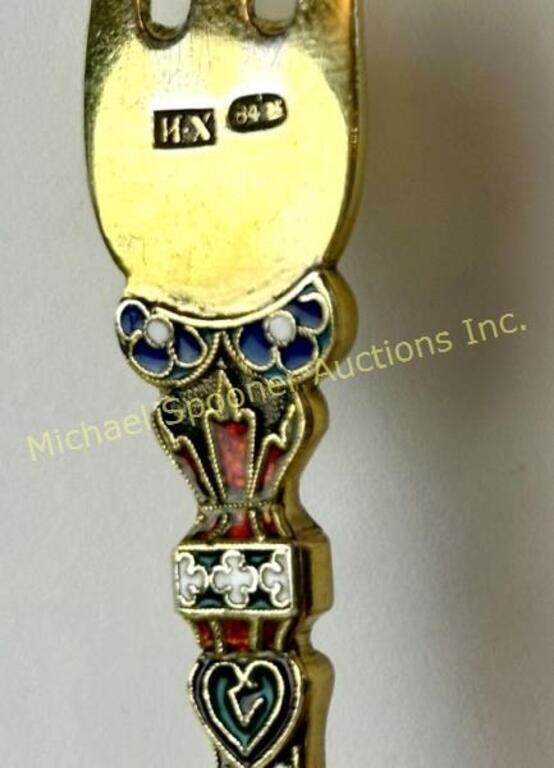
The makers mark is the 10th and the 23rd letter of the cyrillic alphabet and the combined standard and city mark mean it was assayed in Moscow sometimes after 1881 by Ivan Khlebnikov’s factory (his mark) and before 1900 so, yes pre-revolutionary and that is George of Lydda,Turkey being. beastly to dragons or rescuing women from them.
Here’s a blurb about Ivan and his Moscow factory employing 200 people published by Pushkins:
But back to your Ottawa Auction House spoon of Spooner galleries, these cloisinee spoons are often not marked. You can see why.
Several prominent makers crafted exceptional cloisonné enamel pieces in Russia, with Faberge, Pavel Ovchinnikov usually heading the list followed by Feodor Rückert and your fork maker, Ivan Khlebnikov.
Here’s a Creamer also by Khlebnokov listed on ebay:
At the risk of trying the patience of the editors of this splendid forum I wonder if I might be allowed to return to the question of spoons, specifically yours, not having a marks as it appears to concern you a little?
First off fake Imperial Russian spoons that have been exposed as such, are all larger spoons. I guess the amount of cash to be earned from running up a fake small spoon is negligible.
Secondly a lot of spoons came out of the factories with no marks, according to Spoon Planet.:
The Russian assay masters and the systems they used and the marks made are covered extensively elsewhere, so pointless to repeat it here.
But the key thing to remember is the Russian assay system was not designed to guide and enlighten the masses and needful of government control over an otherwise unruly democratic capitalist system because it was a closed loop system unlike the English system.
Tax was something the peasants were there to pay not the enamelled spoon users and the assay master and the factory owners worked hand in glove, both serving the same master, Russia’s elite a tiny minority who bought their gear in good faith. A breach of that faith might not get you a free trip to Tasmania on HMS Really Bad Hulk and an opportunity to learn to speak “Strine”* but it would close you down economically.
I don’t see st George or a dragon. Am i missing something? All i see is the back of a beautifully enamelled spoon that looks more like something i saw after dropping acid and listening to dark side of the moon.
The spoon is unmarked so far as we can see from the photo. The two items go nicely together but we have no way of knowing they both have the same manufactory. The only marks are on the fork.
Very little pre-revolutionary silver, which you expressed an interest in, survived and the bits that did tend to be smaller and more highly crafted So it is worth reminding oneself that enamelled work while fun is not typical of 19th century Russian silver.
Here’s an earlier ladle by the same maker, note the silver markings on it.
Also true is a high percentage of what has survived is in museums rather than the hands of private collectors.
The story of the Russian royal family’s children being protected from bullets deflected by the shear quantity of jewellery sown into their clothing may be apocryphal but Victoria, BC, where a number of Russian emigre families settled after 1917, still sees a significant amount of Russian silver plate (as distinct from plated) and jewellery showing up in stores and auctions.