Can anyone identify this hallmark?
1 Like
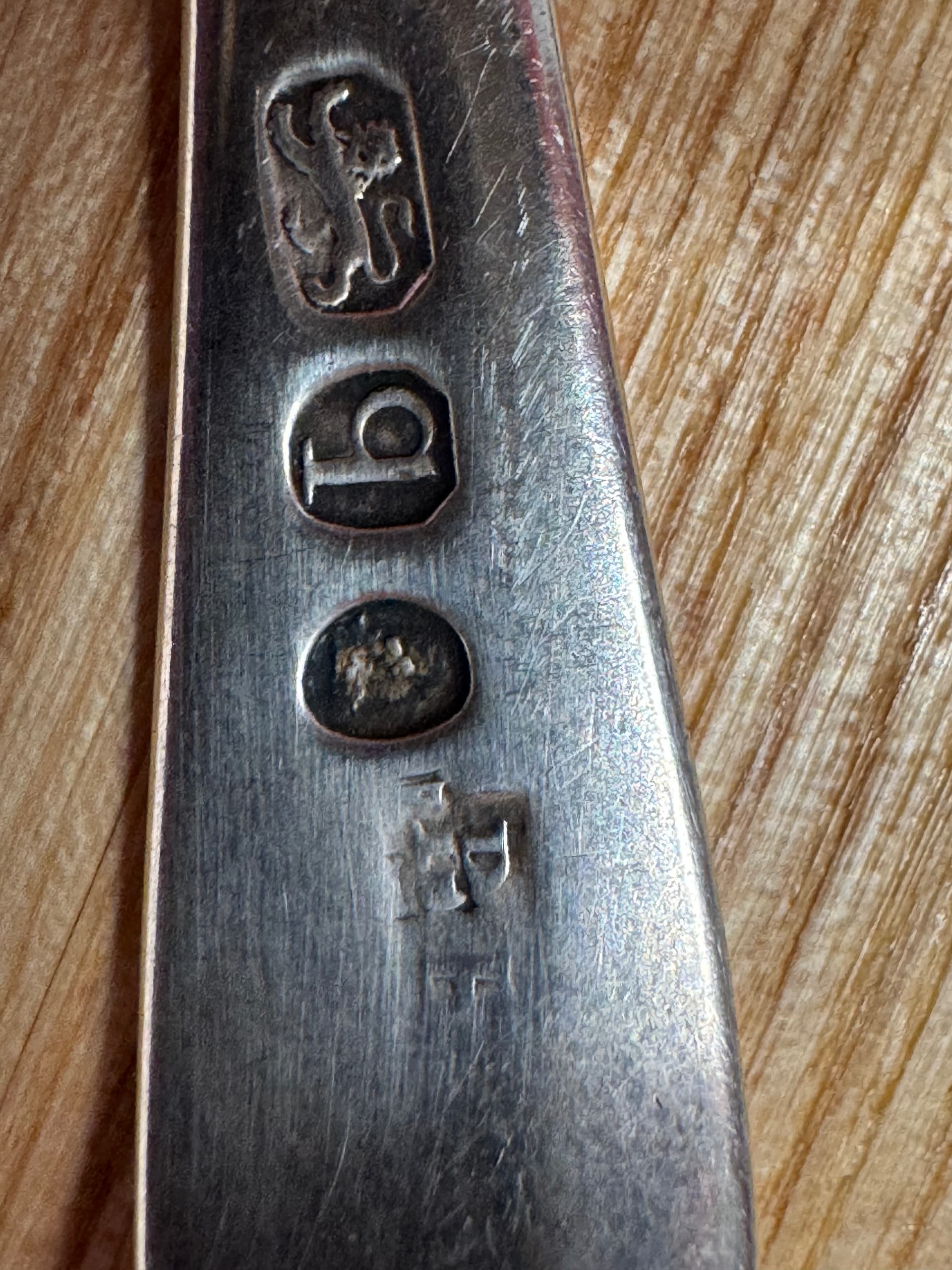
The Hallmark is for Robert Hennell II, London, 1831. The date letter and the sterling lion are clear the duty mark for William IV is scrambled and the sponsor’s mark has been mutilated possibly by an overstamp. The spoon will have come with a salt cellar for which the Hennells were famous.
"Robert trained under his uncle and the engraver John Houle before gaining his freedom in 1785. Initially working as an engraver, he entered his first maker’s mark in 1808 and became one of the most prolific silversmiths of the Regency era. His work was characterized by refined craftsmanship, featuring intricate engraving and fine piercing. The firm’s output during this period included high-quality domestic silver such as salts, cruet sets, and tea and coffee services.
'By 1817, the business was operating from 3 Lancaster Court, Strand, a key location for London’s silversmithing trade. Under Hennell’s leadership, the firm thrived, producing elegant and functional silverware for an increasingly affluent clientele.
'Robert retired in 1833, passing the firm to the next generation. The Hennell family remained active in the silver trade throughout the 19th and early 20th centuries. Today, the legacy of Hennell Ltd continues under the name Frazer & Haws and Hennells, still based in London’s Bond Street, maintaining its historical connection to fine silver craftsmanship" (Source, Puskins Antiques Ltd.)
2 Likes
Here’s a pair of salts to go with your spoon made by RH II six years earlier and typical of the time of Victoria’s uncle.
Your spoon(s) are (is) plain old English in style It is possible the salt pot(s) were plainer cauldron than these using blanks the family will have held onto from much earlier in its illustrious history.
CRWW
1 Like
With respect to my colleague, Guildhall, I believe that this is the earlier q of 1791. I base this on 3 points: no town mark, shape of date letter punch, duty mark appears to be George III rather than George IV (William IV’s head didn’t appear as duty mark until 1834). This means that we must rule out Richard Hennel II as the maker. I suggest it may be Richard Evans of Shrewsbury:

Phil
1 Like
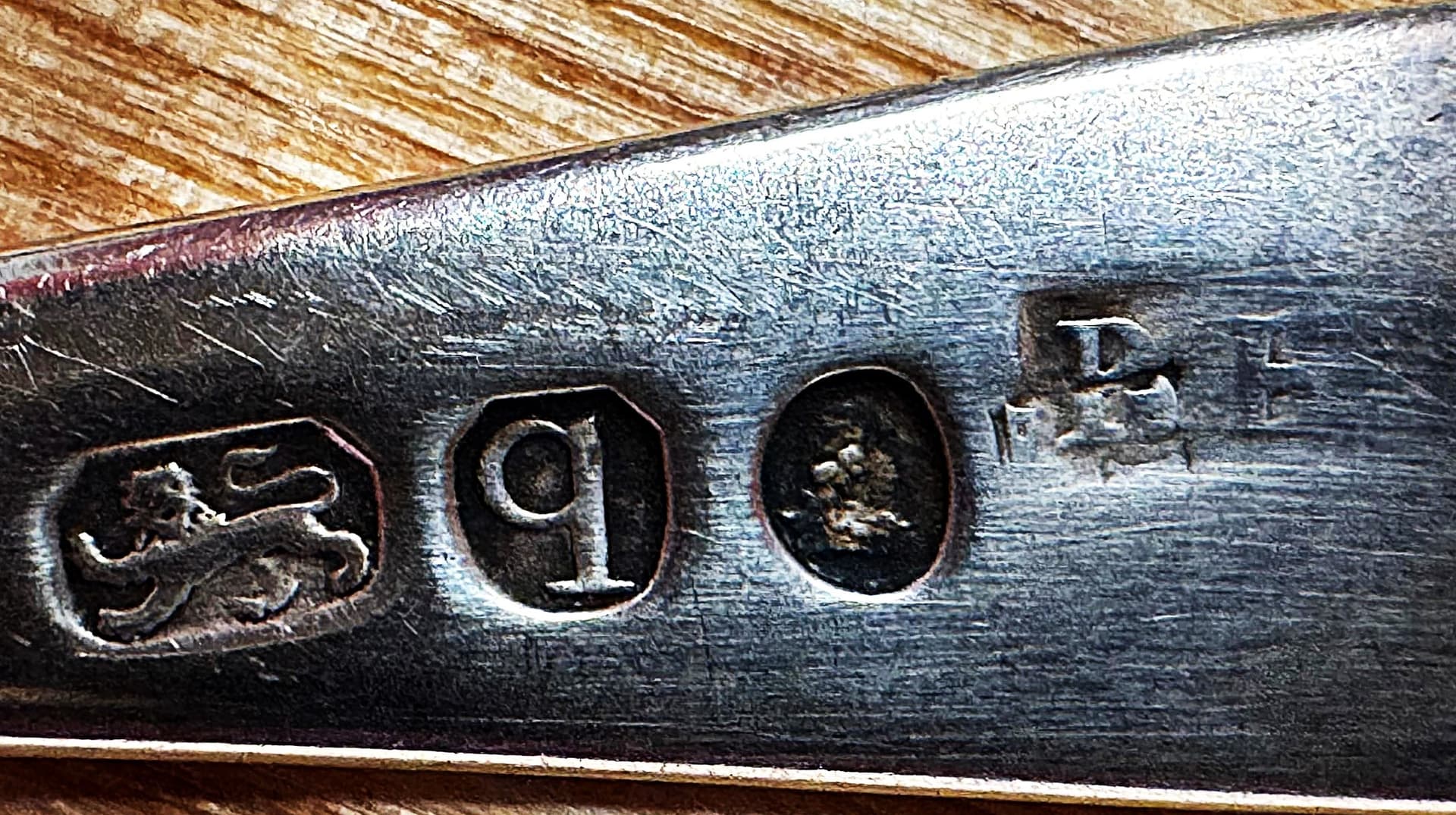
The most persuasive argument in favor of the provincial silversmith from the West Midlands, is the style of spoon, old English. Hennell II in 1830’s would have been heavier silver if period. I had decided the customer must have stipulated for the older plainer style possibly to match some pre-existing material in his cupboard. The duty mark as to content is indeterminate and indeterminable. As to the date letter I had looked at both and preferred the earlier one based on shape but found the worn “q” unhelpful.
While we are agreed upon. the R, I had great difficulty ruling out an H as the second letter or ruling in an E as an alternative, plausible as it might be.
I also had difficulty with the distortion of the RH/RE. Couldn’t really see why anybody would bother over stamping a 12 gram item for resale although it did happen mostly for Channel Island purposes. Still don’t.
One thing this discussion does demonstrate rather well is the necessity of those seeking opinion on date and maker providing a picture of the entire item as well as a clear shot of the marks.
Even with that evidence it may not be possible but it become infinitely more probable an answer can be hatched.
As always I am grateful to Phil for his expertise and knowledge which is extremely valuable in a forum such as this.
CRWW
2 Likes
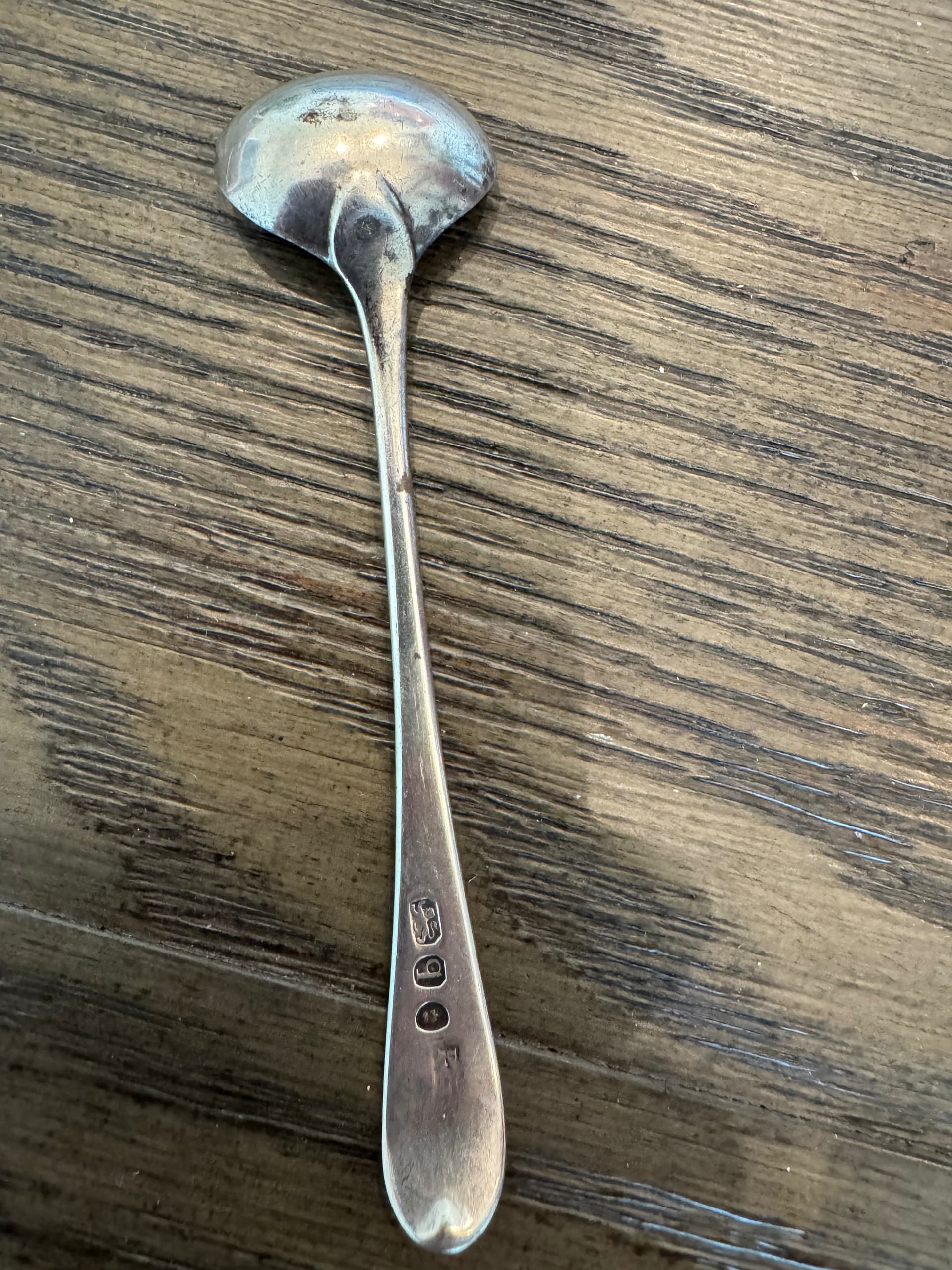
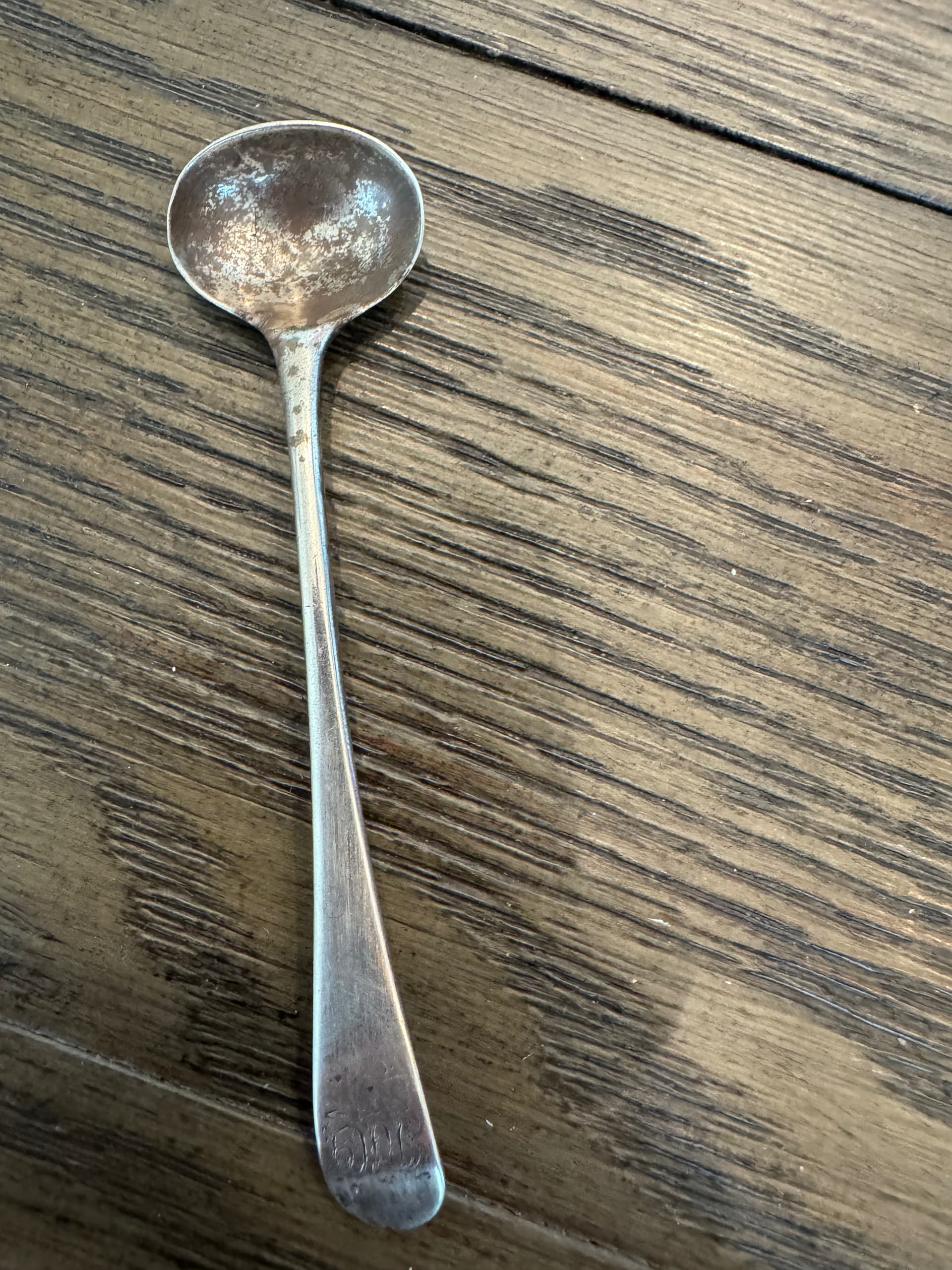
Thank you. That is indeed an Evans spoon once owned by someone most of whose guests using the spoon to scoop salt were right-handed. See the wear on the left hand side of the bowl. The salt corrosion of the bowl which was once gilt should be attended to. Salt is a great enemy of silver. I use very fine 000 wire wool and “silvo” or other liquid polish. Removal of all the corroded metal will leave you with a matt finish It can be brought back to a gloss using “silvo” and a polish rag. I prefer to do this to buffing although that is also an option. Do not treat the uncorroded handle the same way, For that a simple polish is enough keeping as little rubbing on the already abraided marks to absolute minimum. You can then re-gilt it if you wish, but that will need you to take it to a silversmith or someone else with the ability to coat the bowl, both sides with a microscopic layer of gold. This is designed to resist the corrosion of salt but as you can see it is not fool proof.
Evans will not have electroplated his spoon bowl but used the lost mercury method that involved coating an object with a gold-mercury amalgam and then heating it to evaporate the mercury, leaving behind a thin layer of gold. This method, also known as fire-gilding, is now almost never used because the mercury off-gas is lethal and probably accounted for the often very short lives working silversmiths suffered from. So don’t try it.
CRWW
Given that Georgian salt spoons in pristine condition usually sell for something in the mid-two figures, you have to ask yourself just how much time and effort you want to expend to restore this one.
You can’t restore it. All you can do is remove the corrosion and give it bit of a polish. That costs nothing, presuming you have a bottle of polish on hand. Re-gilting has got more expensive as gold prices rise. Do a batch dip and you are probably putting about $4 worth of gold on the bowl. Labor charges will vary but they shouldn’t be much as the entire process takes less than half a minute.
But having said all that if you want to make a living out of collecting salt spoons you are likely to need to get used to thin gruel.
However, despite its London Assay, this is a Shropshire or West Midlands spoon manufactured in Shrewsbury and that gives it a certain cachet.
One of the royal mints used to be in Shrewsbury, run under the auspices of the Talbot family. History buffs will recall, Charles II, having lost the Battle of Worcester and needing to evade the Scots, fled north and found sanctuary in an oak tree at Boscobel.
He didn’t come north to climb trees but for silver and gold coinage the mint produced. Also the families there there were, and two still are, profoundly catholic. Charles was out of luck on the coinage stash which is actually supposed to be hidden on land just south of the Dartmouth Estate. There’s a title exemption registered for it. The mint was located in what is now the Prince Rupert Hotel. Today there is rather a good restaurant there,
The Evans family, famous then for silversmithing, later for watch production like many Marches or border families are Welsh not English and to this day you can get brisk discussion going in towns along the Welsh border about who is entitled to what heritage.
Where there are mints there is both gold and silver some of it mined locally since pre Roman times. And where there is precious metal there are families fashioning it. The Evans are the last survivors of an Anglo-Welsh craft more or less completely extinguished by the county which now sees Iron Bridge as its most important town and monument.
CRWW
I cannot find an address for Richard Evans in Shrewsbury. I did however confirm he was “…recorded as a Shrewsbury maker, registering his mark on May 3rd as a small-worker and admitted to the Company of Mercers, Goldsmiths etc. of Shrewsbury in 1780. He was a Burgess of the town that same year.”
Streets then were called for the businesses they were in. Shrewsbury has a Bear (baiting) Steps, A Butchers’ Row even a Grope Lane originally called something even more anatomical. Silversmiths tended to locate near church yards. Perhaps for security reasons.
https://www.silversugartongs.com/Features/RE.htm
This sugar tong site shows Evans overstriking Bateman marks. Does this explain why he registered in London rather than the nearer Birmingham office which opened for business in 1773?
If your salt is an overstrike, and there is a bit of the mark which doesn’t fit and threw me off in the first place, that gets me off the hook for not recognizing Shropshire work from the marks alone but doesn’t assist the view that the item has importance for not being made in London.
CRWW