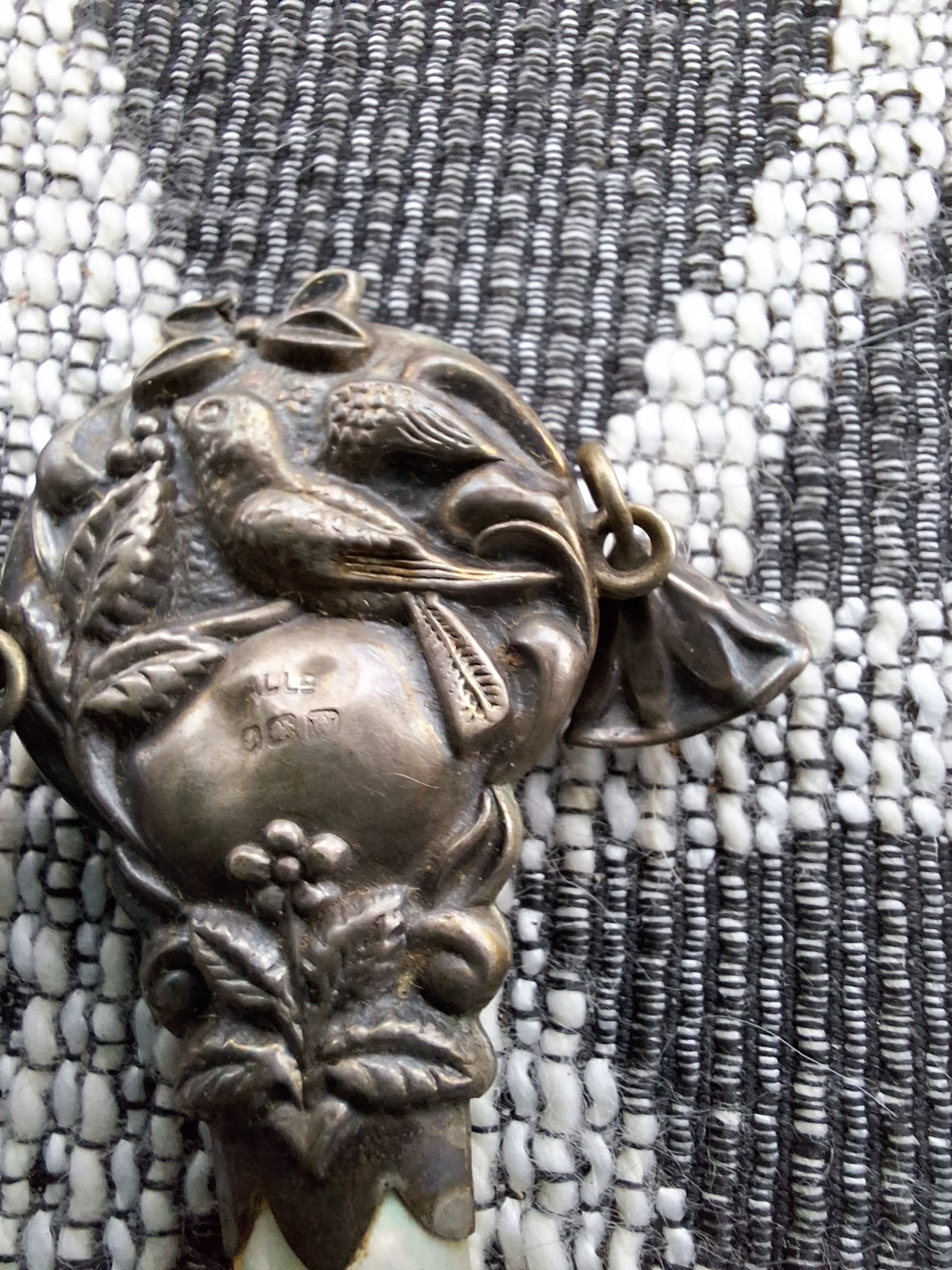
Your rattle has a Birmingham sterling silver hallmark with the date letter w for 1921. The maker’s mark is that of Adie & Lovekin Ltd. The character that you have read as an E is an underlined superscript D, LD being an abbreviation of Limited (Ltd).
1 Like
Here’s another rattle about the same vintage:
Adie & Lovekin Ltd made silver items during the late Victorian, Edwardian, and Art Nouveau era. The varying items included babies rattles, bookmarks nurses’ buckles, peppers and salts, button hooks and pin cushions. Their speciality being animal-shaped pin cushions such as swans, elephants, pigs, and even camels.
The company was incorporated in 1889 by Alfred Lovekin (1844-1912) and James Adie (1840-1913).
The firm began business circa 1863 as Adie & Lovekin, and originally had its base in Hockley, Birmingham. They also had a factory in Regent Street. In 1894 the partners commissioned Mansell & Mansell to design a new factory at 23 Frederick Street, Birmingham which later became known as ‘Trafalgar Works’.
They entered various hallmarks at the Birmingham Assay Office from 1879 to 1906 and the Chester Assay Office in1883 and 1909. They ceased trading in the late 1920s.
What’s interesting is in this pre- plastic era, what they decided was great to stick in a newborn’s mouth, often dipped in laudanum. Mother-of-pearl, coral and citrine all seemed to work for them. Glass too.
Celluloid was invented for knives handles as fake ivory and there are plenty of bone and ivory teethers – now all sold as bone so as not to get caught in CITES rules.
Celuloid was invented by AmericanJohn Wesley Hyatt in the late 1860s, becoming the first commercially successful plastic, created by combining camphor with nitrocellulose to create a moldable, durable material that could imitate ivory and tortoiseshell.
Here’s a celluloid rattle. But no silver maker seems keen to use it for infant tooth formation.
I wonder if what Churchill was deriding as “honest British Teeth”, owes much to these peculiar soothers?
CRWW
Despite some authors presenting Adie & Lovekin as the predecessors of Adie Brothers, we are unable to confirm a link either by sanguinity or business between the two eponymous firms.
They were separate manufacturing businesses albiet both located on Frederick St, one at 23 and the other at 45.
Adie Brothers was established in 1879 by brothers Percy James Adie and Hubert William Adie. They became a limited company in 1906, taking over other firms at the time.
They were well known for their high-quality vanity cases and hand mirrors, often adorned with guilloché enamel, and recognized for their distinctive Art Deco styling in the 1930s.
Their diverse range also included sterling silver tea and coffee services, condiment sets, cigarette cases, and presentation cups.
Their premises were located at Frederick Street and 1 Northampton Street, Birmingham.
The company became part of British Silverware in the late 1960s and closed in 1968.
CRWW
\
Thank you for the information