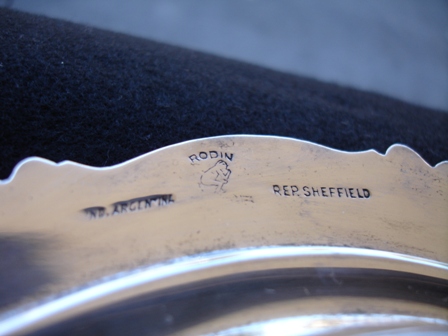
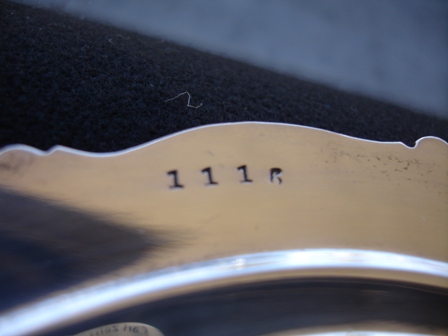
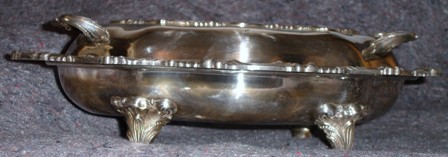
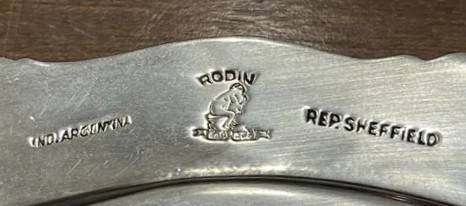
The questions you asked is are they worth anything? And am I wasting my employer’s time trying to find out?
I really can’t answer the second question as I don’t know what business your employer is in or what you are supposed to do for him or her.
But if he or she is an antique dealer he will likely already know even the very best electro-plate has little or no market today and that is not about to change.
Electroplate contains, to all intents and purposes, zero silver – a few microns in thickness and, unlike sterling or even .800 silver, no substantive base or melt base value.
Silver plate, like collector’s china, glass display cabinets even elaborate sideboards and dining room table sets – stuff we were all told to buy even collect and preserve as an investment from the1950’s to the 1980’s— turns out to be a terrible investment. Some of it having negative value – which means you have to pay someone to come haul it away.
This change from display to strict utiity came about 20 years ago driven by three factors; more expensive housing so less formal area decorated to impress rather than house you and your guest, a desire to be different from the post-war generation that sought to impress by display and the cost of freight and storage.
I just hauled four bankers boxes of electroplate —top class quality stuff which people paid serious coin for in the 1920’s and 1930’s— to the Goodwill store and followed it with a truck load of “brown furniture”, Victoria stuff beautifully made but completely useless to the modern two-bedroom and a den condo crowd.
Now draw a sharp distinction between electroplate which was mass produced after 1840 and close plate which was produced from the third quarter of the 18th century into the second quarter of the 19th. That material, especially if it is by someone like Mathew Boulton, has a value sometimes as great a solid silver value.
If your employer is in the antiques business he should instruct you on how to tell the difference between electroplate and close plate and send you round the Goodwill store to pick out the latter.
I was explaining all this to a couple who were downsizing and wanted to sell their stuff which didn’t fit in the new apartment: electroplate, collector china, Victorian and Edwardian furniture and even beautiful cut glass which won’t do well in a dishwasher.
They gave me a list and priced it to reflect what had been paid plus a bit for inflation. I explained the problem.
“I guess we collected the wrong stuff” they said. I told then, no they had collected what conventional wisdom thought was right – the problem was everybody else did too and today one Georgian worn-at-the-edges teaspoon is worth more than the most sparkly, carefully stored, little used electro-plate entree dish.