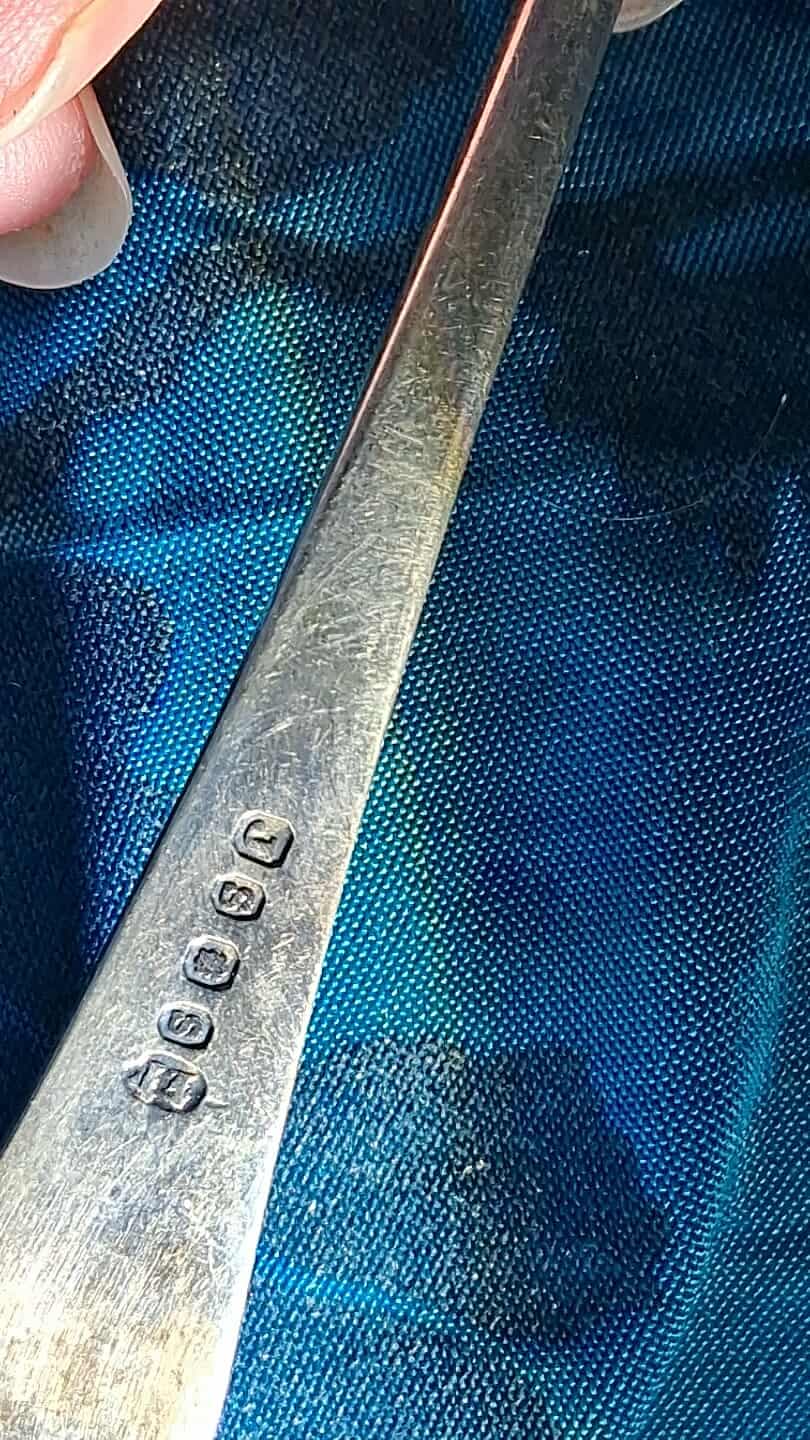
Hello,
Spoon set. Can anyone tell the markings. I am having a hard time.
Thanks
These are silverplate - the EP mark stands for “electroplate.”
The maker is probably John Sanderson & Son, Sheffield:
Michael, come on… You are feeding the drones…
oh boy. But I see it now. The first one is “EP”
I couldnt read it for the life of me at first. Perhaps I need some reader glasses.
U need googles…  Just like they all do.
McPherson Brothers were silversmiths and cutlers from Glasgow, known for producing high-quality silver plate and cutlery . So anytime you see a box of theirs, chances are the contents are plate. Very good plate and sought after in its day.
The firm was founded around 1881, first its business at 134 Trongate St in the old mercantile area of Glasgow.
George McPherson, one of the brothers, was a registered silversmith. There is another George MacPherson silversmith trained in Glasgow who became an important Mississippi silversmith operating in Nantchez from 1843- 1871. Probably no relation.
Meanwhile the Glasgow company acquired another establishment on Argyle Street, then as now a major retail area, this premises previously occupied by Reid & Sons, Silversmiths of Newcastle.
The brothers sold a wide range of goods from their two Glasgow locations, including plate cutlery, tradesmen’s tools, fishing tackle, guns, and revolvers through to the 1940s.
CRWW
awesome. Thanks for the info. appreciate it.
The operative phrase being, “in its day.” Today, they struggle. A current listing:
ETA: I’m consistently amazed at the number of eBay sellers who won’t spend five minutes with a bottle of silver polish to make their offerings more attractive. Sterling and good silverplate, unless they’ve been neglected for decades, can be brought back fairly easily. They’re robbing themselves.
regarding value. What do you or others think are the main drivers. Of course Maker. But what else beyond that. I can’t seem to find out how any of this stuff prices.
For sterling pieces, the weight is the first thing on the list, since silver has a melt value, regardless of what it’s been shaped into, regardless of how old it is, and regardless of whether anyone collects the object in question. The value goes up from there, based on more subjective characteristics
But electroplate is purely decorative. It contains virtually no precious metal. It’s worth something only if someone else thinks it’s attractive. Most silverplate sells for very little. There are certainly exceptions, usually involving large, showy pieces. But flatware isn’t in that category.
What it is. When it was made. By whom. For whom. Quality and quantity (gross weight). Who is selling it and how effective their sales effort is. Not necessarily in that order.
Silver is an international trade commodity but once it is fashioned its sales are always locally driven. I live in a country where demand for Canadian silver is very limited. First because there isn’t any market. Secondly what there is is either religious (always a Debbie downer in sales) or it an ersatz copy of UK stuff mostly flatware or it mass produced 19th and 20th century stuff turned out for the then insatiable demand for tea sets and flatware.
I live next to a country, the US which pay astronomically high prices for colonial silver especially if it can somehow be linked to Revere, and favours Southern silver, even unmarked over Northern which is almost always better made of better silver and bigger.
Silver prices are also driven by trends. The Russian silver trend is over. Thank whatever they have over there today instead of god, the Chinese silver market has never developed and the Persian and Middle Eastern market has so little quality product that it seems to die for lack of gas.
That leaves mostly Europe and that rather large island just west of Dogger Bank.
I have been buying and selling western silver for more decades than I like to be reminded about. I used to see what I called floaters. Items I bought privately decades ago, which were bought by other dealers from me who sold to other dealers who resold to yet more dealers and turned up in trendy S. Kensington stores decades latter never having had private owner or been used for purpose but with another nought stuck on the price.
Don’t see that any more since the general price collapse.
Today seeing a different trend. People who should use silver (they can afford it, it might make them pause and think about what they are doing at the dining table or elsewhere and they might enjoy it) simply haven’t the time to bother with it. So the entire middle class market is, like the middle class, itself MIA.
CRWW
Thanks to you both.
It seems to me that people, in general, have lost touch with acquiring long lasting items (silver, gold, art) and instead want a shiny new house with cheap materials. Perhaps with inflation rearing its ugly head again the middle class (if they still exist) will start looking. I watched a Quebec auction for art the other day and it was quite well bid and vibrant. Very curious how the younger generation is viewing this. I have a bias that the younger generation mostly thinking about bitcoin, cypto, but curious if they will return to real things. Thats who the next buyers will be….