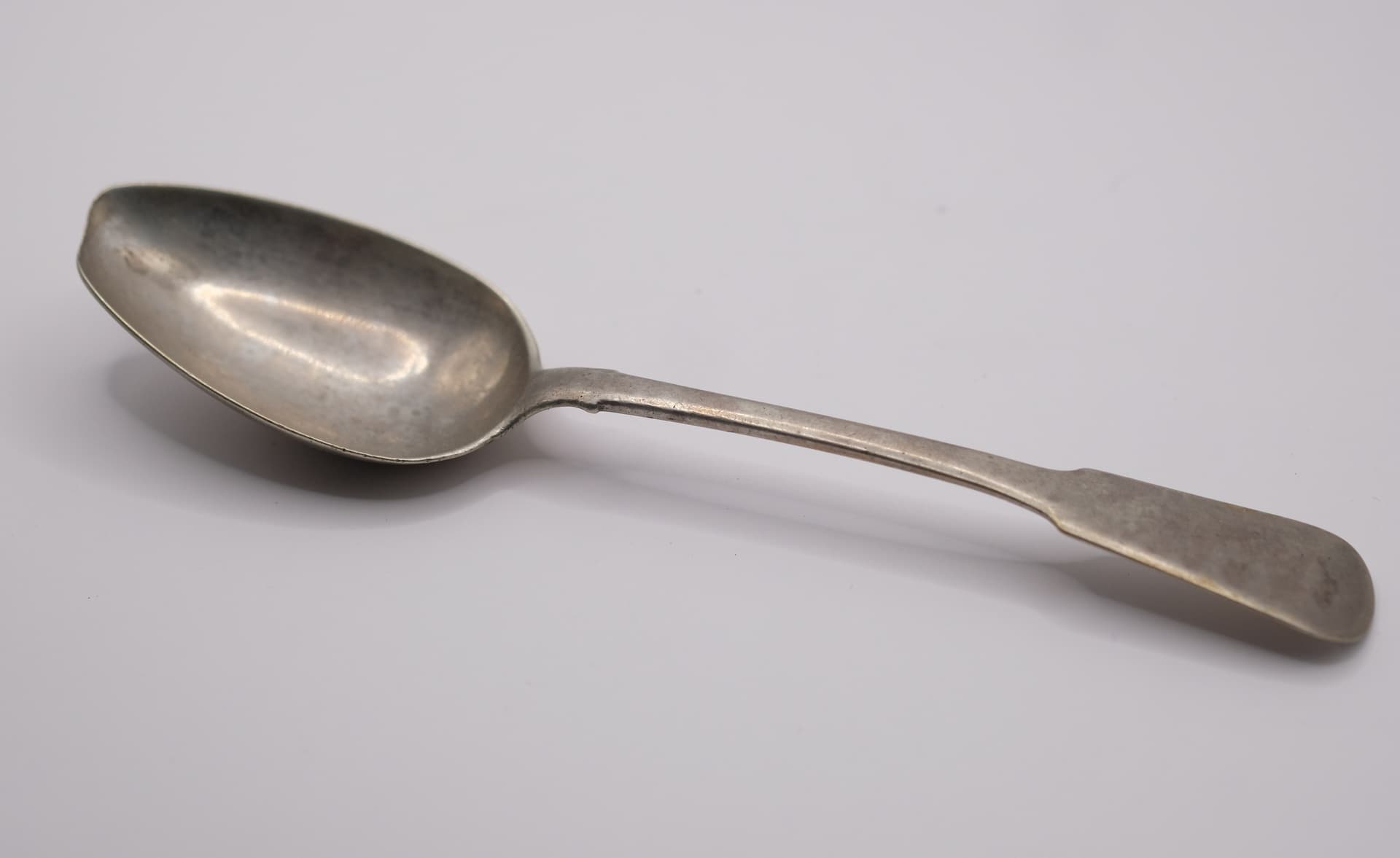
Spoon Identification, please

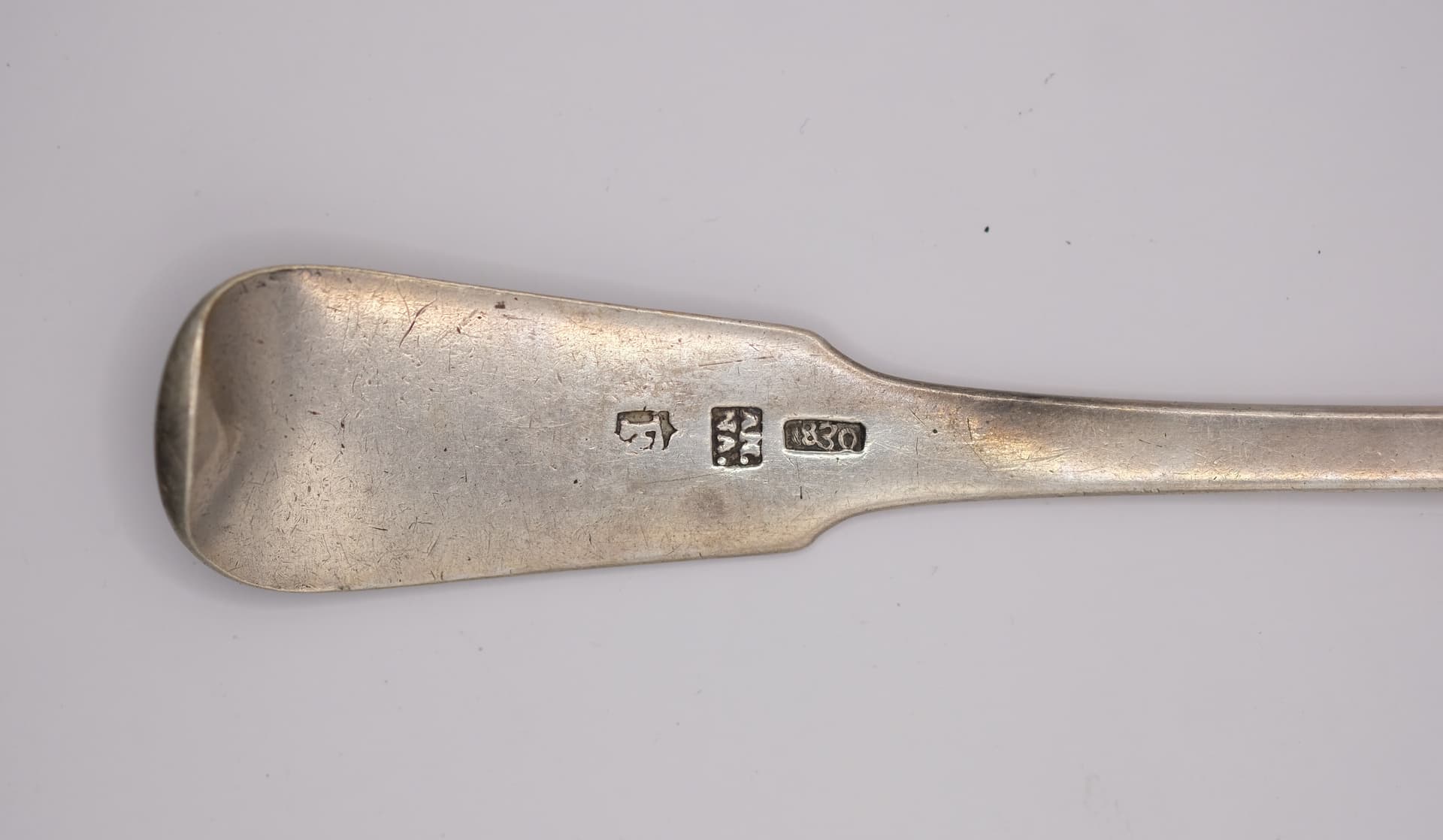
Can anyone interpret these hallmarks on this spoon? I first thought the number was 1830, then perhaps 830 (silver grade), then maybe I’m back to 1830!?

My Mum recalls an Alexander Dick spoon (significant maker for Australians) owned by her aunt, which isn’t accounted for now but this can’t be it from the marks but likely came via the same great aunt of mine.

Thanks in advance.

2 Likes

ANDREA NAUDI.

Andrea Naudi was granted his warrant in 1805.

He is likely to the same Andrea Naudi that served as a Lieutenant in the Mdina Rabat Dingli battilion during the uprising against the French in 1798.

1 Like

Always good to see some Maltese silver. Naudi worked under the sponsorship of the governor of Malta for whom he made an outlandishly large silver mirror which came up for sale recently.

He was also the man who ended up creating the silver town mark for Canongate.

All of which is great but doesn’t get us any further on Antipodean silver. There is no on-line list which is anything near comprehensive and the modern guild concentrates, not surprisingly on modern guild members.

J B Hawkins wrote a two vol treatise on 19th century silver in Australia which I have. It is quite useful or would be if it was in Toronto where I am.

Alexander Dick a free Scot who went to Australia to set up business got flogged for his pains, was pardoned (which I am sure made all the difference) and is probably the most prolific of smiths down there back then.

So now we know who AN is but who was NA? Soon as I get back to the west coast I’ll look it up. Or lend my copy to whoever wants to set up the online site of "Strine Smiths.

CRWW

2 Likes

ANdrea NAudi? ——-:nerd_face:——–

Alexander Dick (1799-1843), silversmith, was born in Edinburgh on 17 July 1799, youngest of seven children of John Dick, wright, and his wife Janet, née Wilson. He was possibly related to an Edinburgh silversmith with the firms Dick & Robertson or Dick & McPherson. Alexander arrived as a free settler in Sydney from Leith on 16 October 1824 in the Portland. At first he may have worked for James Robertson, who had come from Scotland in 1822, but by April 1826 Dick was advertising his already-established business at 104 Pitt Street. He married Charlotte, daughter of Abraham Hutchinson, on 2 June at the Scots Church.

Business prospered, the 1828 census showing that he employed two silversmiths, two jewellers and a servant girl. He soon moved to new premises at 6 Williams Place, George Street, where he employed up to six other craftsmen. In January 1829, smarting from a flogging of twenty-five lashes instigated by Dick, his assigned convict Alexander Robertson accused him of receiving twelve silver dessertspoons stolen from the home of Alexander McLeay, the colonial secretary. Charged with receiving stolen goods, Dick was tried on 26 May, found guilty and sentenced to seven years imprisonment on Norfolk Island. The merchant Samuel Terry, watchmaker James Robertson and engraver Samuel Clayton were among those who testified to his good character. Forty leading citizens, including a reluctant McLeay, signed a memorial to Governor Darling on behalf of Mrs Dick. On 1 February 1833 Governor Bourke pardoned Dick, stating that ‘some favourable circumstances have been represented to me on his behalf’.

The pardon described Dick: ‘Height 5 ft 7 ins [170 cm]—Complexion fair ruddy and a little pock pitted—Hair sandy brown—Eyes grey—Remarks less a front tooth in Upper Jaw, Mole right side of Chin, Nose broad and broken’. Returning to Sydney, he resumed business. He was praised as the maker of the eighty-four ounce (2381 g) silver Sydney Subscription Cup (now lost), ornamented with a gold horse finial and gold horse-heads, for a race-meeting in 1834. That year, the Polish explorer John Lhotsky claimed to have found the first gold in Australia on the Monaro Plains and took it to Dick, who heated the samples in a crucible and poured out a small button of molten gold.

In February 1835 and October 1836 Dick advertised for more craftsmen, moving in February 1837 to bigger premises in the most fashionable area, opposite the barracks gate on the eastern side of George Street. The Charlotte, arriving in January 1840, brought from Scotland sixteen bounty immigrants sponsored by Dick, including two jewellers, a silversmith-clockmaker and a watchmaker. He bought land, built The Hermitage at Vaucluse and went on family picnics around the harbour. He and Charlotte had four sons and four daughters.

His works were spare, Classical Revival in style, and derivative, often with elaborate and florid embossed scenes. Extant silver pieces include communion plate for the Scots Church, Sydney; a dog collar presented in 1834 to the publican Michael Farrell’s dog Tiger for killing twenty rats in two minutes two seconds; the forty-four-ounce (1247 g) bell-shaped Cavan Challenge Cup won by Lieutenant Waddy’s horse Frederick at the Yass plains races in 1836; a foundation trowel for the Royal Exchange, Sydney, 1840; the Anniversary Day Regatta Cup 1840 (held by the Art Gallery of South Australia); tankards, pap boats, christening mugs and many pieces of cutlery. The 1835 silver snuff box (held by the Powerhouse Museum, Sydney) presented to Captain T. B. Daniel, with a crudely-embossed view of Sydney Harbour, emu, kangaroo and Aborigine under a palm tree, has been attributed to his workman Joseph Forrester. Imported clocks, watches, plate and jewellery rather than his local manufactures, however, were the backbone of his business.

Dick announced in the Australian in August 1841 that he intended to retire due to ill health; in September he lost two sons from scarlet fever. His firm continued to trade until his death, after a long illness, on 15 February 1843 at his George Street residence; he was buried in the Presbyterian section of the Devonshire Street cemetery and left an estate of nearly £9000. His wife and six children survived him. In 1846 his widow sold up and in 1848 married her neighbour Francis Ellard, the music-shop-owner, singer and composer, with her eldest son Alexander (1827-1867) as witness.

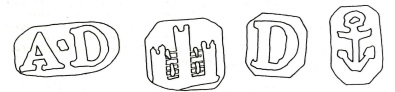
Dick

ADick

January1979_No_1.pdf

1 Like

Yes I read all that. Didn’t think of the na/an explanation for the missing partner. Thank you.

Nobody has commented on the condition of the spoon. The fact it is worn away at the tip in such a thorough way doesn’t seem to surprise anyone.

I am going to presume it is a table spoon, perhaps some eight and a half to nine inches in length more or less rather than dessert or teaspoon. ( I’ve had another look I think it is a dessert spoon.)

Then I am going to presume whoever used it in Australia or where ever else it ended up didn’t use it to delicately suck turtle soup accompanied by a glass of Madera out of it’s side as one might provided with such an implement at a dinner or luncheon party.

Next I am going to assume it was owned by someone right-handed who owned one or more earthenware bowls or pots in which right handed stirring caused the spoon point to disappear.

Faced with such depredations on a common-or-garden, UK-produced spoon of similar date I would have the bowl reshaped professionally so as to restore it to ordinary utility.

But somehow the grind epitomizes its colonial origin and use and seems part of its history.

I see spoons of this type and vintage in good nick from both Australia and Malta routinely fetch US$500 to £500 at auction.

Would Forum members pay more or less for one with this deformity – or wear?

CRWW

2 Likes

Sorry for the delay in replying. Yesterday was full of a medical thing (all clear).

Malta is a surprise! There is no family connection to there AFAIK. My mother’s side is well documented, my father’s not so but it’s more Ukrainian, Scottish and English in general terms.

The spoon is a tablespoon, I guess, perhaps 18-20 cm long (I don’t have it with me and it would have been useful to include a scale!).

My great aunt was delightfully eccentric and probably did use this for scraping a pot or three if it was hers. She treated the Dick spoon as she would a bit of worn EPNS or steel reputedly! It disappeared along with other items near or at the end of her life it seems.

I can only imagine the wear reduces the value, although it seems Maltese silver is of interest.

Interesting to read more about Dick. I was of the misapprehension he was a transported convict, not became one when he was here! Same base sentence of 7 years. My earliest ancestors arrived in 1794, 6 years after colonisation, so probably knew him. In fact, John Jamieson worked as convict overseer at the Norfolk Island penal settlement where Dick was sent, but before then.

I’m light years from an expert but don’t see them as anything special other than he is the most celebrated silversmith in the colony of New South Wales.

Checking some sales, I regret it isn’t a Dick! A tablespoon on ebay is at $10 000 (or offer). One sold at auction in 2023 for $3200. It’s all but identical in style to this one. A presentation three-piece tea set sold at Tennants auction house in the UK for £42 000.

2 Likes