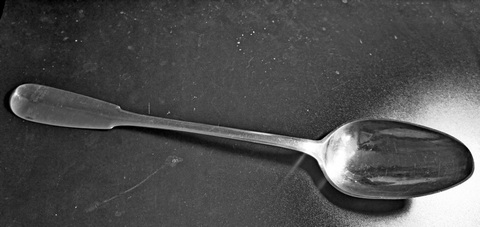
Hi, have a large sterling spoon 34cm/150Grams and cant identify the marks, not the G83 either…wondered if it rings a bell with anyones experience and knowledge, Photos are spoon, marks from one angle, same marks photographed from other side of spoon… thanks!..in advance for any clue, Tom
PS: my best shot: William Grundy (seems like a “WG” maker’s mark in 3rd photo…?) Script Mark, “P” 1750 date mark, Lion Passant?..don’t see it… Leopards Head, faint but there…just a speculating guesstimate as I find it hard to discern the marks…“G83”?, no idea…no doubt very old marks (very old spoon), but, what are they?
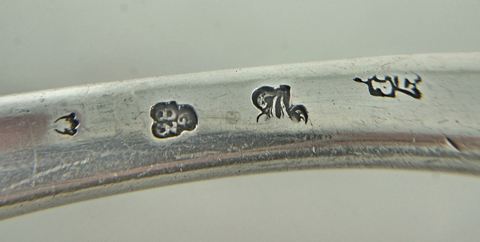
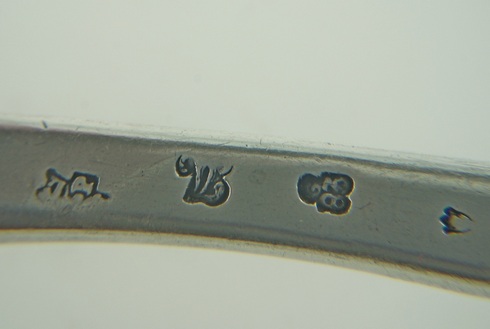
It looks a bit like a Hanau mark but it’s not one I recognise. The 83 could indicate ,830 standard silver. It is certainly not a British mark so can’t be William Grundy. I suggest that what you are seeing as WG is a script “A”.
thank you… something to look into on a different path to what I was following
I think it’s made in France. 
This spoon is a useful reminder to collectors of European silver that while the English didn’t use fiddle pattern until late in the 18th century, it was a design copied from the French silversmiths who had adopted it at a much earlier date, some 75 years earlier by most accounts.
Authentic French silver from the Ancien Régime was rigorously hallmarked during the reign of King Louis XV. Genuine pieces like this are typically struck with a set of four distinct stamps: a maker’s mark, a charge mark (tax), a discharge mark (tax release), and a guild/date letter mark.
The maker’s mark or Poinçon d’Orfèvre is the personal signature stamp of the silversmith. By law during this era, it featured the smith’s initials and a symbol, with a crowned fleur-de-lys and two “grains” at the top.
The charge mark, Poinçon de Charge or tax stamp was applied at the beginning of crafting.
The specific mark corresponds to when the item was declared to the tax authorities. For Paris silver made around this time, a notable charge mark in use was the crowned scripted “A” with a slipped or top sided crown used between 1726 and 1732 shown here.
The discharge mark or Poinçon de Décharge. is tax release mark stamped by the assay master once the tax was paid, often placed near the rim, spout, or underside. The discharge mark shown here is a crowned goose. It’s very worn.
The final mark is the jurande or date letter. The official guild mark, which usually incorporated a letter of the alphabet to denote the exact year the item was assayed. These marks were variable and differed between Paris and regional assay offices across the country.
The spoon looks as if it has wear patterns consistent with nearly 300 years of use by right handed diners.
Someone who works with French 18th century silver will be able to identify the partly rubbed maker’s mark. search will involve cross reference between makers registering between 1726 and 1732 and having a second initial after a pointele.
It’s a wonderful find.
CRWW
1 Like