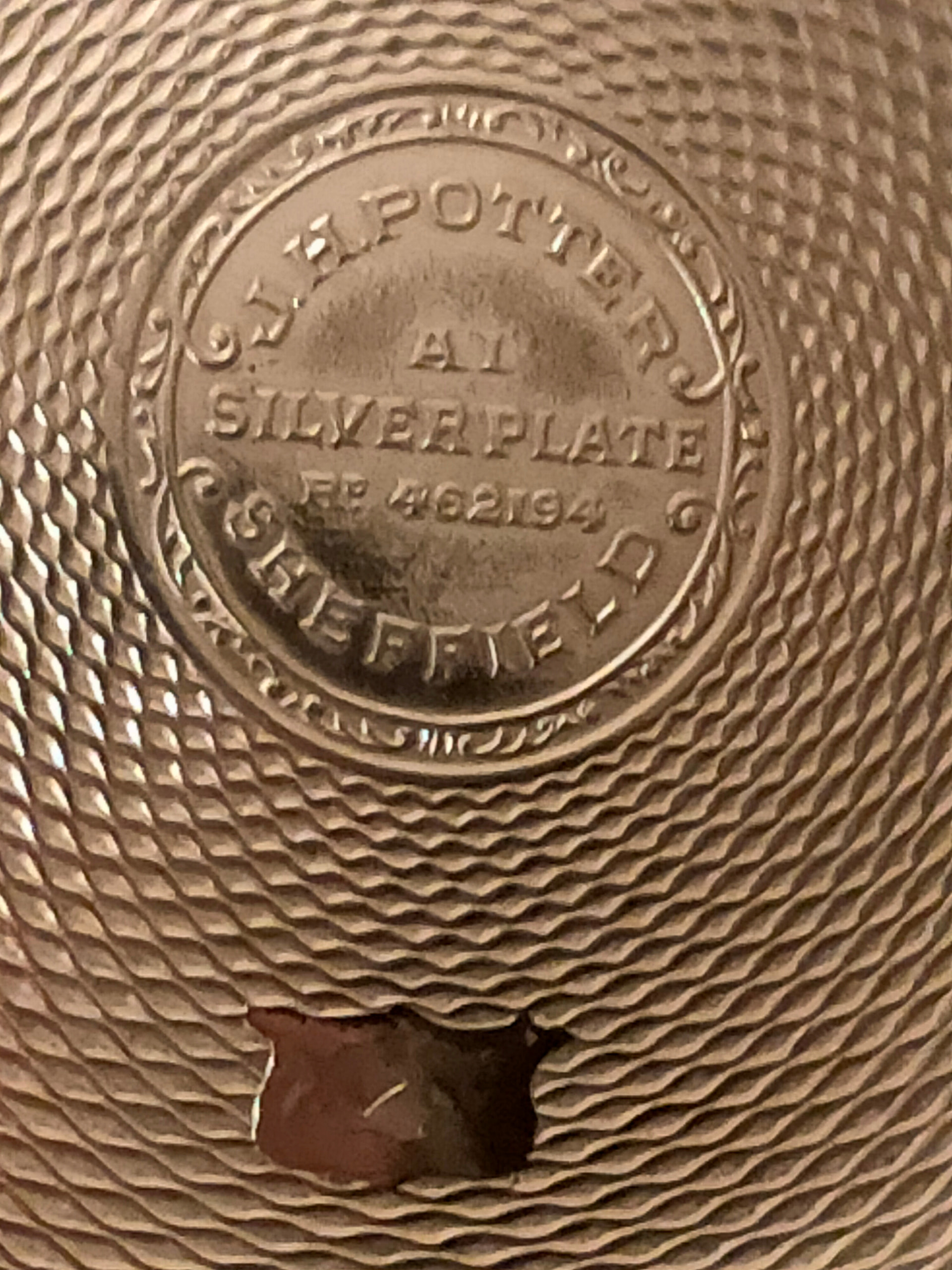
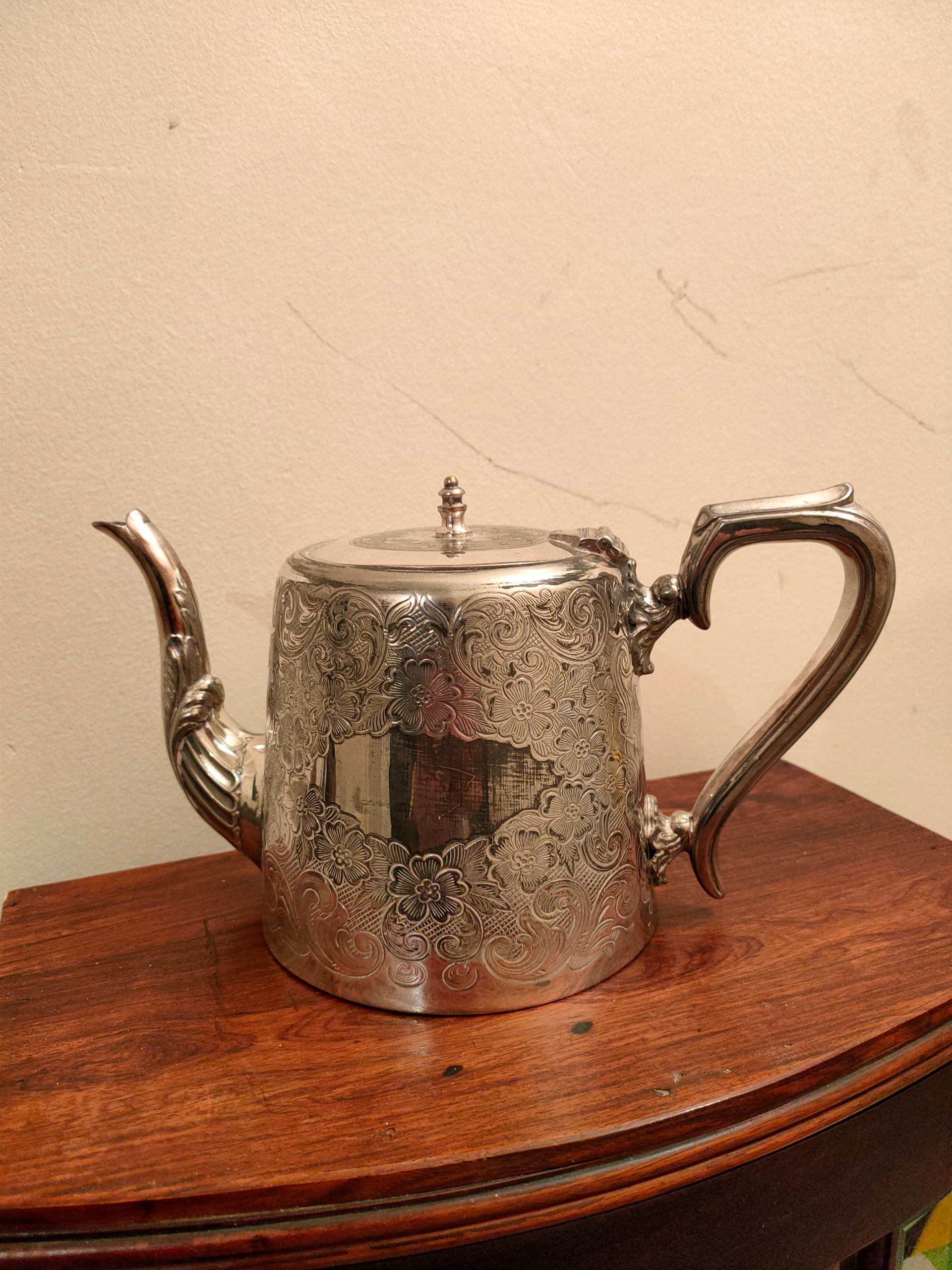
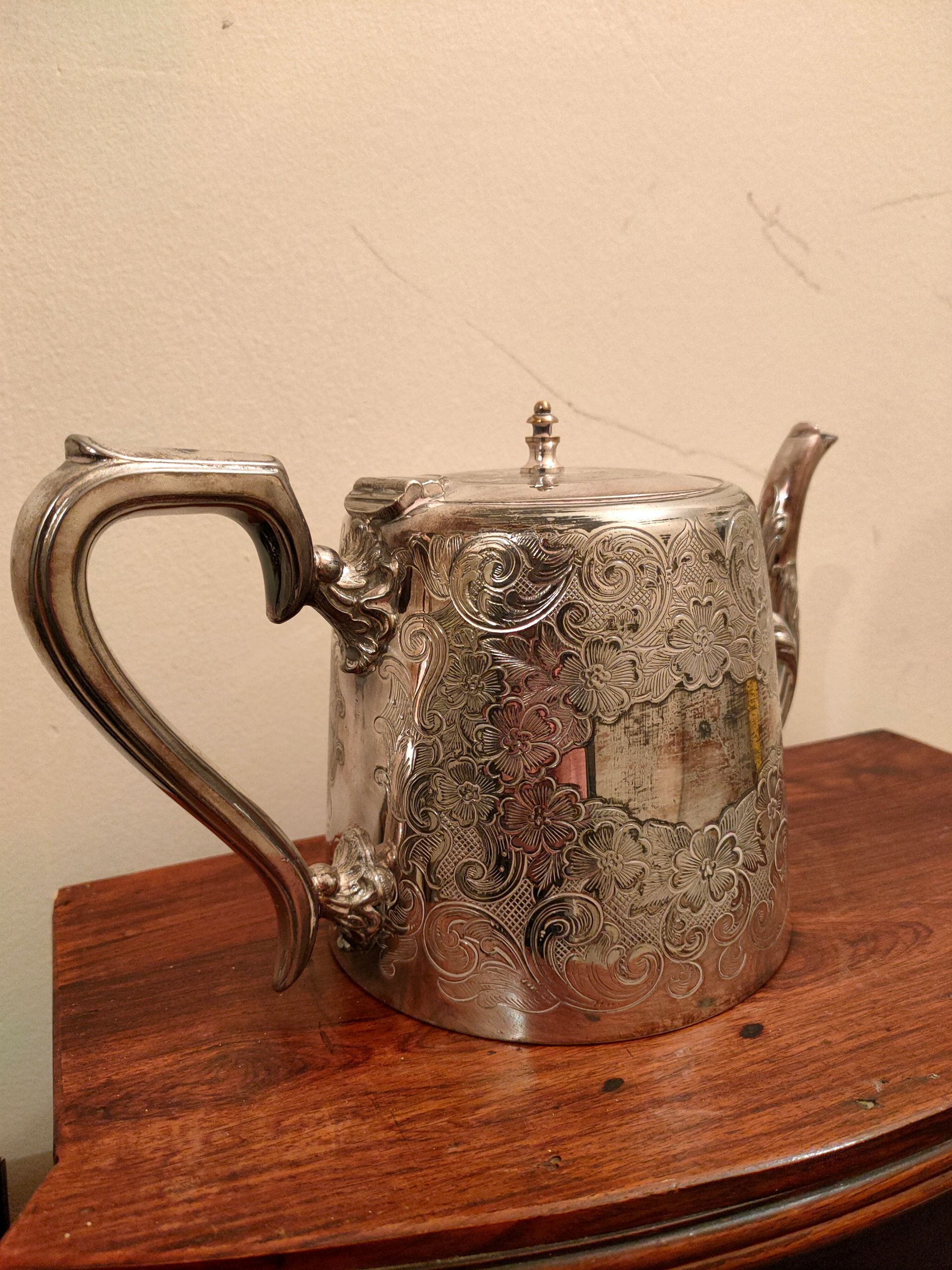
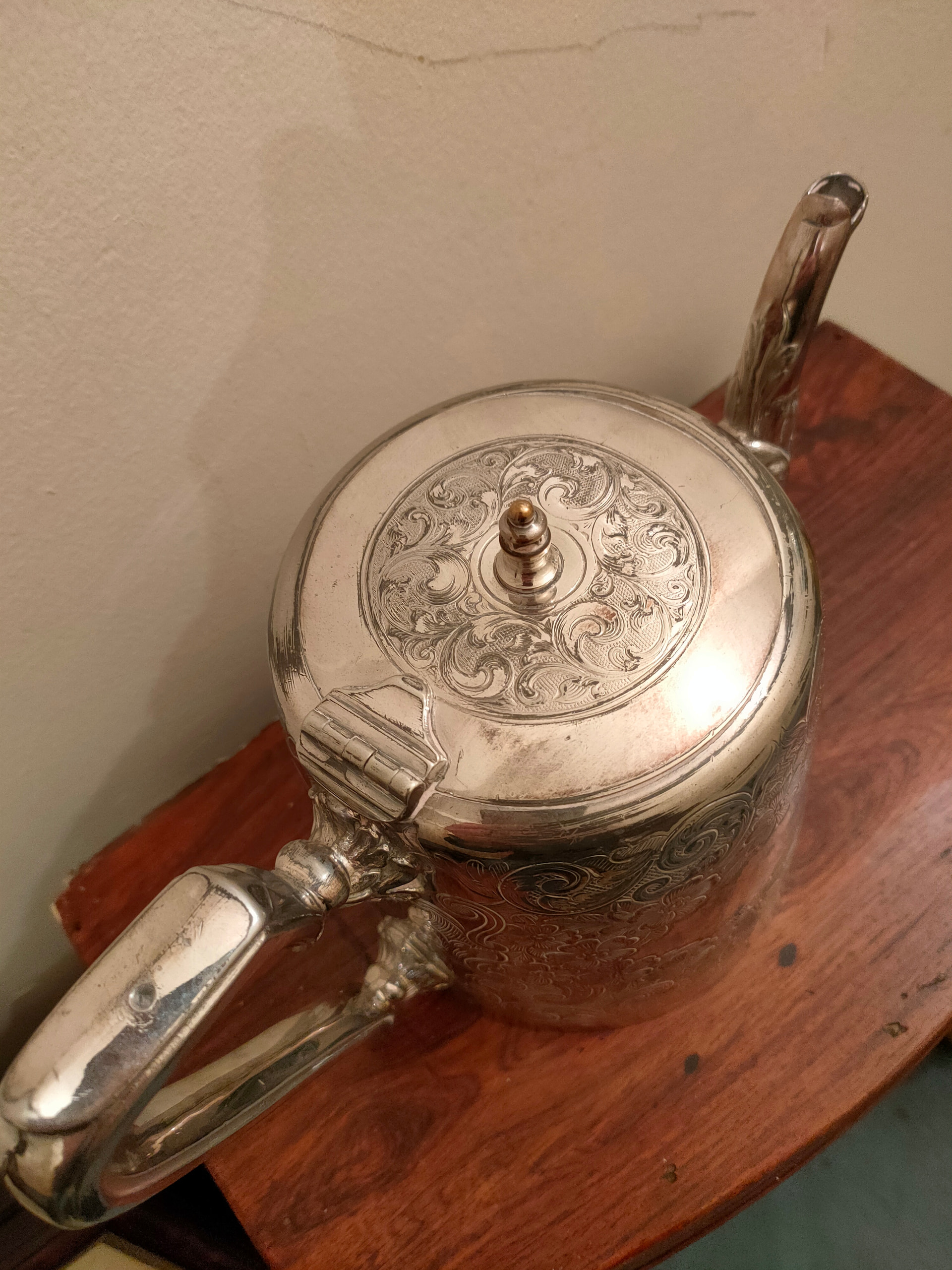
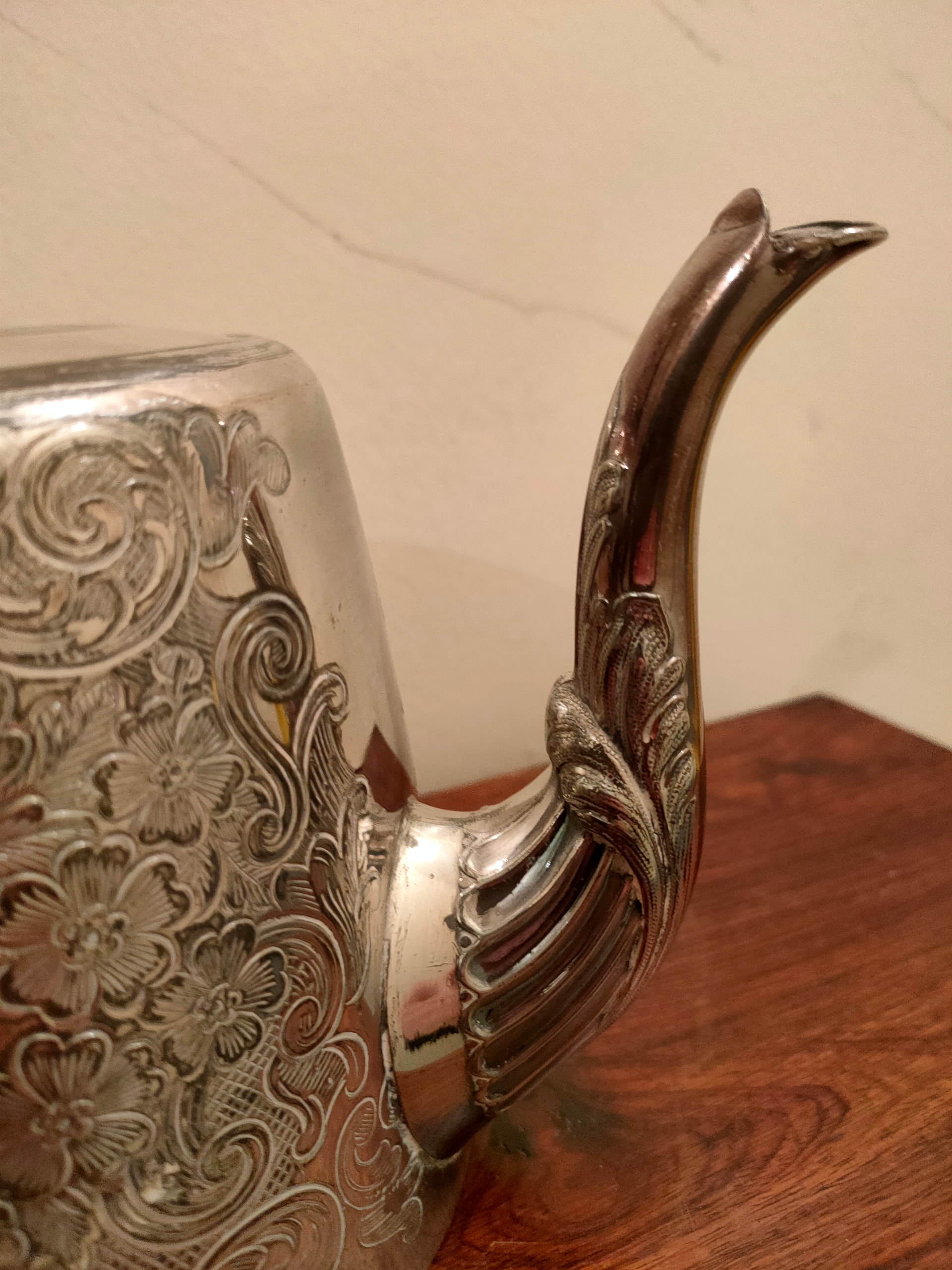
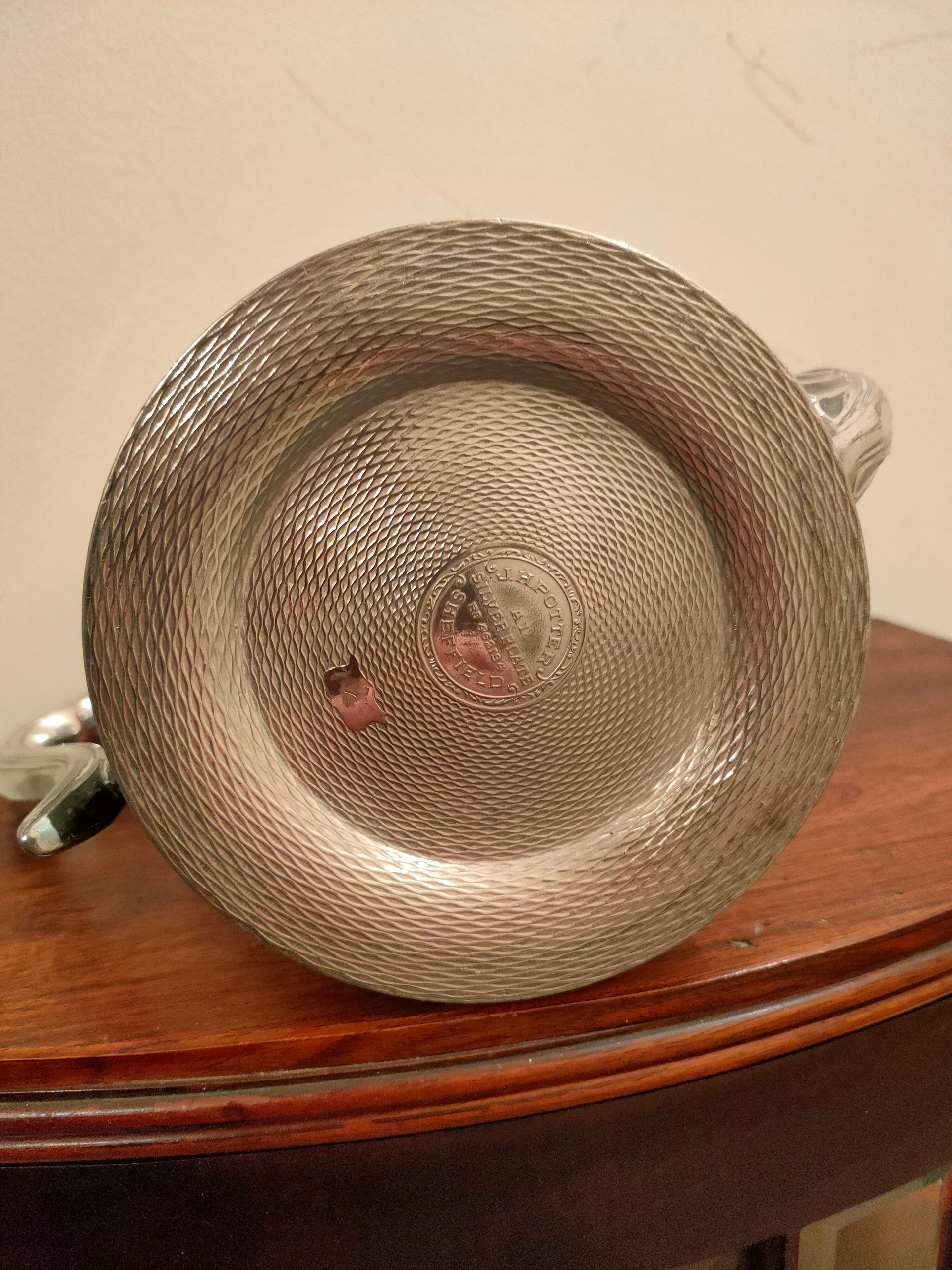
Bought this Plated set with tray and just thought with the base of this pot being Ornate I was wondering if it’s a teapot or for Hot water only !!!  .
.
1 Like
It certainly looks like a teapot to me. Hot water jugs tend to be taller with a close-coupled pouring hole / spout.
1 Like
Thank you Phil, I edged on teapot too. Only bought it as I got the milk, sugar, and tray too and it is virtually clean, I have a lady who buys or trades . Have a pleasant day 
1 Like
1 Like
I love reading about the treasures we bring to light, whether it be their fabrication history or their use during ownership. Thank you for that Bart, very much appreciated
1 Like
Man is a unique creature; capable of being both incredibly stupid and incredibly brilliant at the same time.
I dare say that in the past we used more layers of grey matter, and the evidence is still there today.
1 Like
A very simple way of deciding if it is designed for steeping tea leaves is to look inside at the entry to the spout and see if there is a serrated cover to keep leaves out of the spout.
Only works on Geo. III and later teapots. Earlier pots with straight spouts used mote spoon to poke stray leaves out of the spout
There are. five basic possibilities with every closed spouted vessel for hot water or drink:
Teapot
Chocolate Pot
Coffee Pot
Hot water jug
Biggin
The teapot, which yours is is fairly simple.
The Chocolate pot tends to be earlier than coffee pots, had a stirrer in the lid and a spout lower down the body than coffee pot.
A coffee pot lacks a stirrer in the lid and generally has the spout higher
A hot water jug is a coffee pot in a UK tea set, in case the set is sold stateside and used by the English to renew water in the teapot and
A biggin is a two-compartment device for brewing coffee.
CRWW
1 Like
Hi, I agree that it looks like a Teapot to me. However this can be verified by looking at the inside of the pot at the bottom of the spout. If there is a strainer to hold back most of the ‘then’ tea leaves, it is definitely a teapot. There were no strainers in water pots. Hope that clears things up
Liz
1 Like
So not only tempests are found in teapots.
There’s an excellent early George II, melon-shaped teapot coming up for sale at auction next week.
It of course has the straight spout and no internal filter, although it is very definitively a teapot and modelled as a direct copy of the clay tea pots of the Qin Dynasty.
We are used to seeing Regency revivals of the melon-shaped pot often executed by the likes of Paul Storr or the Barnards, but those came 100 years later and today fetch $US4,000 to $US8,000.
CRWW
1 Like
Also coming up for sale, this time in Ireland, is a fine example of a once indispensable tea time container I had omitted to list; the hot water storage system to allow the hostess or her Butler to replenish teapots without retreat to the kitchens then often in the basements.
The Irish auctioneer calls it a samovar which, strictly speaking, was used in Eastern Europe and Russia for brewing tea not storing hot water.
Inside this globe would have been, and probably still is, a sleeve into which a very hot, not red-hot but oven-hot iron “pig” rather the shape of a grandfather’s clock weight would have been placed with the entire device upside down and then base and legs then bayonetted on before being turned back upright and water poured into the top.
The hot water jug, which magically become a coffee pot for tea-adverse Americans if it was shipped or manufactured across the Atlantic, replaced these magnificent silver creations whose volume of silver dictates the price today, lacking a modern use.
CRWW
1 Like
I remember many years ago, repurposing a silver gravy argyle I owned for serving and keeping my coffee warm. Finding new uses for pieces that are no longer in common use for their original purpose can feel quite rewarding.
1 Like
Indeed. Toast racks becoming filing systems for personal letters and sugar tongs hanging in the gents washroom downstairs come immediately to mind.
I applaud new uses so long as the successor doesn’t commission his silversmith to alter the item to accommodate the new use.
I note, for instance, perfectly respectable pairs of wine bottle sliders get legs attached by their new post-revolutionary US masters and to this day I don’t know why.
They cease to be useful as sliders as the centre of gravity is too high and they have no value as sweet meat dishes because the wood base interfere with cleaning.
CRWW
1 Like
What would sugar tongs in a gents bathroom be for? Toilet paper holder? Nose hair plucker? Finger nail tool for cleaning? I’m at a loss, and as I have loads of them and use cubed sugar rarely I’d be interested in a subsidiary use
I had set up the answer to your question in an earlier post. Your very sensible inquiry has reminded me of two things: Don’t repeat material twice and if you do, don’t presume anybody read it the first time.
Also don’t say things like, Paul if you really are at a loss, then you’d never find a use for a pair of sugar tongs hanging on a string next to a urinal.
But that was the essence of the joke first time around. I had, true story, given a pair to a young friend of mine who had married and used various wedding presents including the tongs to set up her house.
Like you, she couldn’t figure out a use for them so found a piece of blue ribbon and hung them in the gent’s loo.
CRWW
I recall the earlier post, and didn’t get the joke then either. Perhaps I was trying to parse it too much. I suppose what I find most amusing is that young newlyweds have a separate gent’s loo in their house. I would therefore speculate that the sugar tongs weren’t the only things she had no idea what to do with.