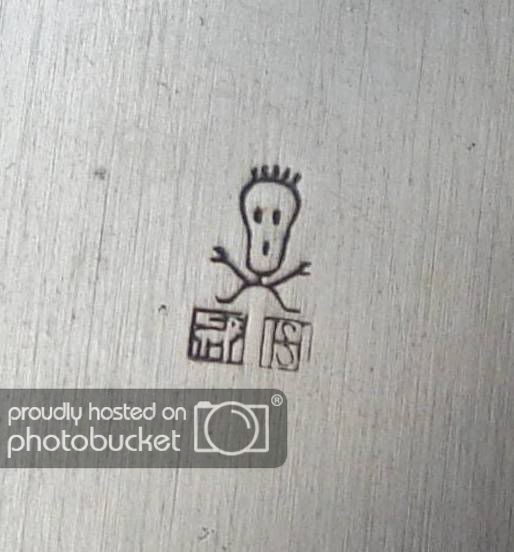
Hi everyone, and thanks for helping out folks like me. I have looked and looked but I can’t find this mark. Even posted it on another forum without any luck. Any and all help very much appreciated.
Todd
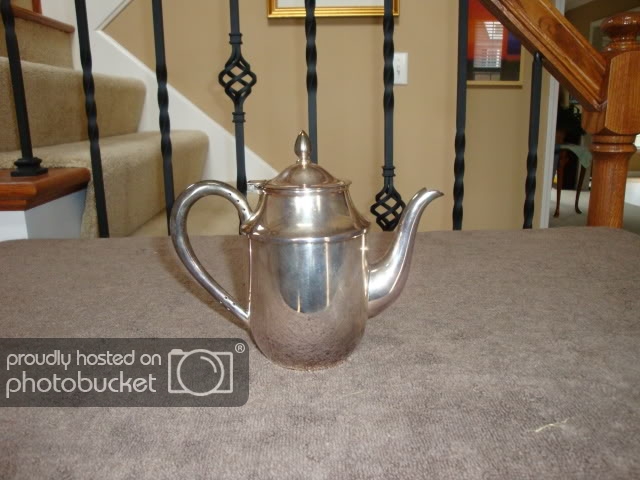
Hi everyone, and thanks for helping out folks like me. I have looked and looked but I can’t find this mark. Even posted it on another forum without any luck. Any and all help very much appreciated.
Todd
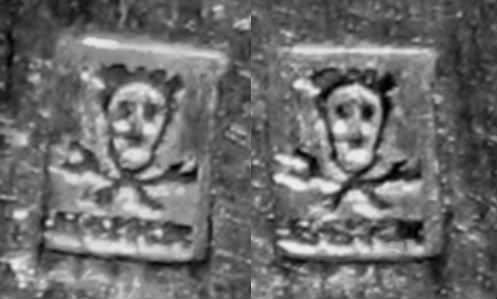
I have seen a similar mark before.
Always thought it was French silverplate, but could not find who used it.
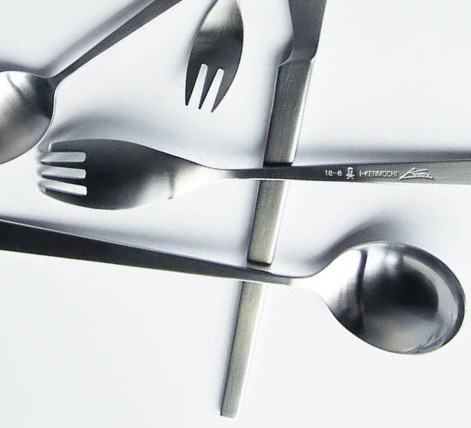
Isamu Kenmochi, Japan.
Your teapot is made by Sato Shoji Co. Ltd, of Japan This is its logo " Martian"
It appears on the company website:
It is the sixth largest Japanese steel and other non-ferrous metal manufacturer celebrated 90 years of growth, according to its website which, while acknowledging the munchin-like figure as its mascot does not tell the story of its adoption.
Looking at your picture it might be nickel silver.
CRWW
Someone has now posted a bunch of stainless steel cutlery designed by Sori Yanagi which does not shed much light on your teapot’s age, style or design except that neither of them are designed by famed Japanese furniture designer, Isamu Kenmochi.
When I first saw your teapot I was not even sure that’s what it was. Typically Japanese teapots are squat, rounded and made of clay or porcelain which does not, unlike metal, convey heat through to the handle.
When tea was first imported and European silversmiths started making pots, they mimicked the Chinese clay teapot, as did the Japanese, and only later followed then contemporary design for vessel made for other liquids including wine, creating the evolution of the classic Georgian teapot, currently a bit of a glut on the market. Blame teabags.
The Europeans solved the heat-into-the-handle problem by using ivory or bone insulators or fruitwood or ebony handles. Your pot addresses the same problem with a series of three holes punch in the handle at its upper extremity and base.
It would be interesting to know how effective that is.
It would also be interesting to know, since the spout is at the bottom where tea leaves would collect and potentially block access, if there is a serrated cover at the spout entrance to counteract this problem.
The spout blockage problem was solved by Queen Anne and Georgian teapot makers with the invention of a mote spoon which could be poked down what started out as a straight spout affixed to the bottom of the rounded, squat pot. That only worked so long as the spout stayed straight. When it curved, as yours does, the serrated screen was needed and used.
Your item, designed for the Japanese metallurgical manufacturer, borrows much from the European “biggin” pot — a two-level two-compartment vessel for coffee brewing – but lacks the double compartment.
That and the acorn lid handle or finial, again borrowed from European pot makers of an earlier era, points toward a mid 20th century dating. I am hoping, since you only asked about the mark and not the designer or date of manufacture, that you already have some thoughts on both and can comment yourself.
CRWW