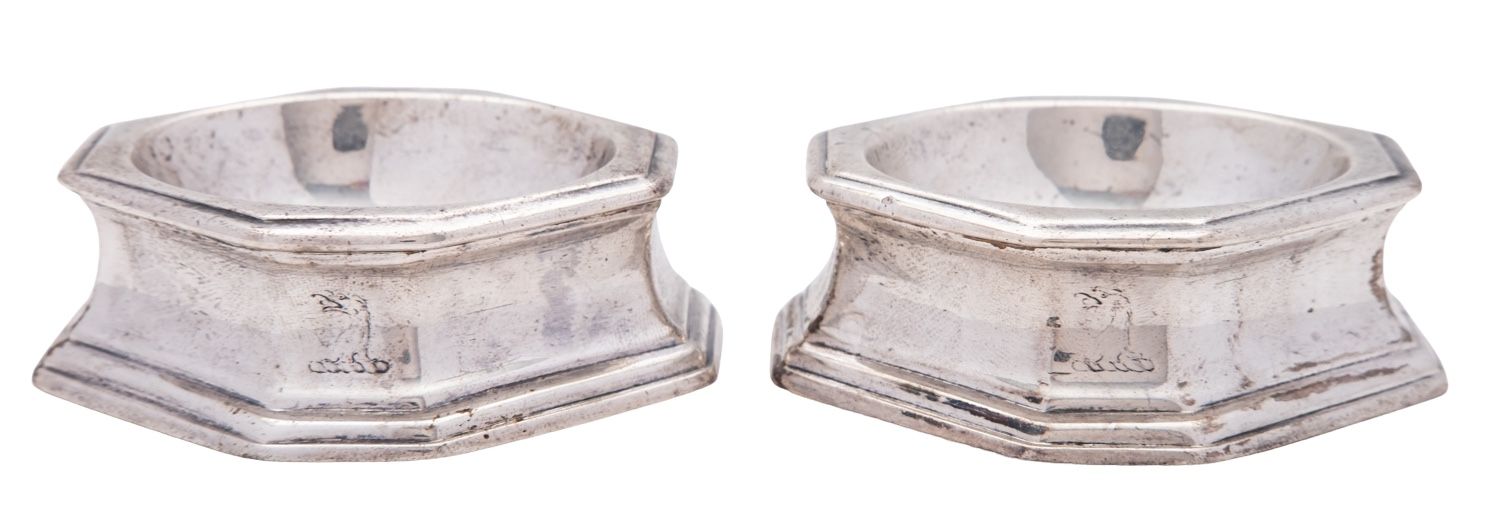
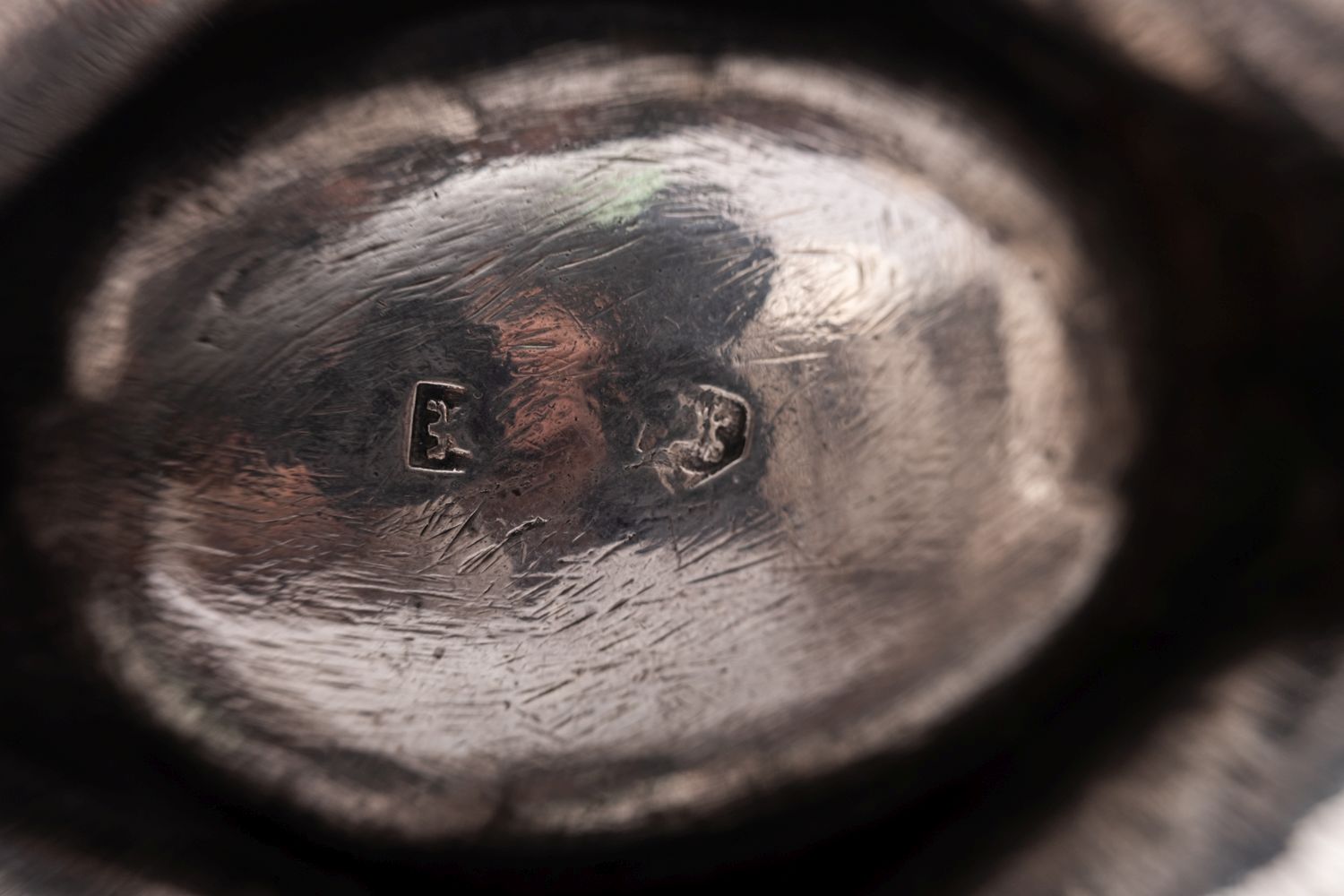
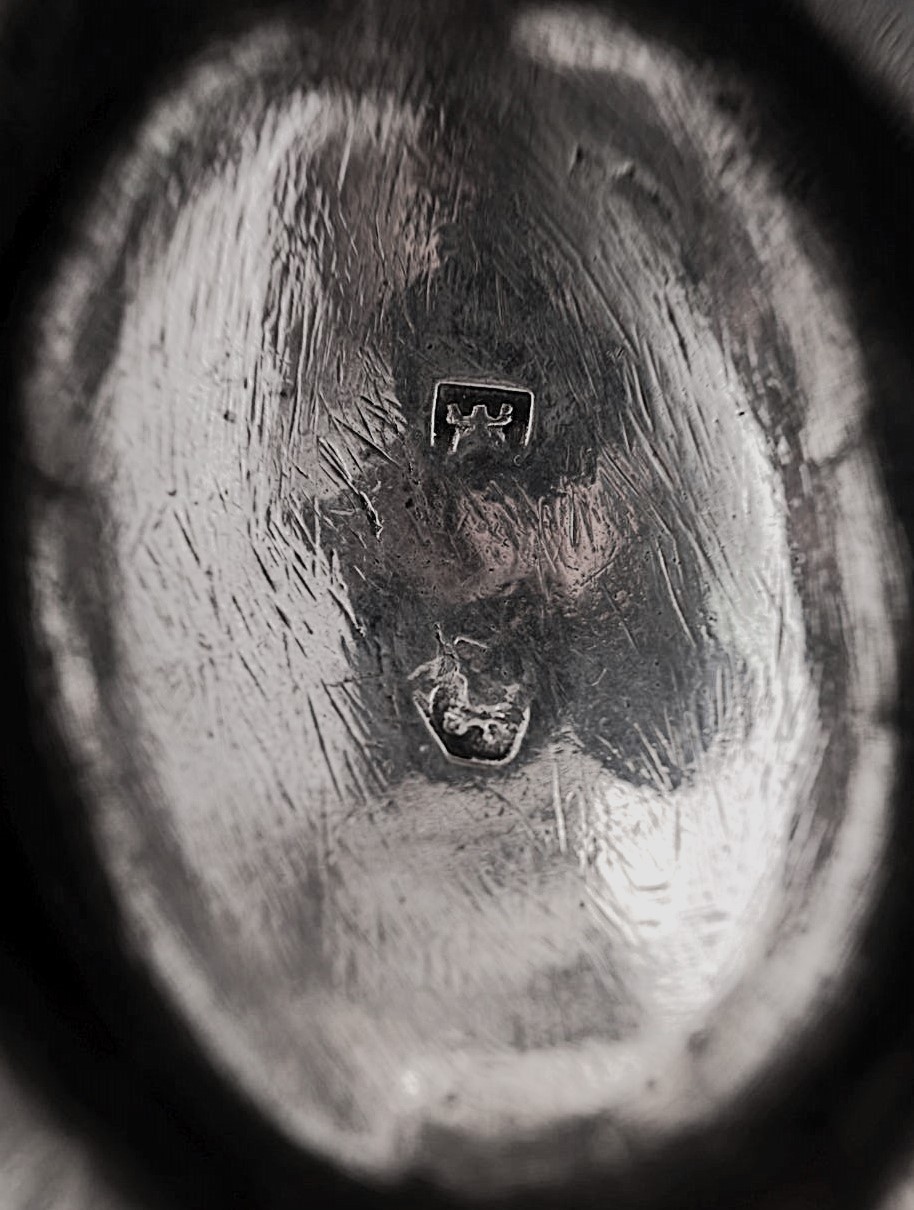
I was wondering if anybody recognises these marks on a pair of trencher salts, one of the marks could be a stag’s head.
1 Like
Do both items have equally faint signatures?
1 Like
Unfortunately yes, the one shown being the clearer of the two.
1 Like
After several hours of searching, my eyes are failing me… My only guess is that they’re from the 18th century.
2 Likes
Appreciate your efforts Bart, many thanks.
1 Like
If that’s the top of a crowned leopard then its clean rectangular shape puts it sometime after 1728 and before 1735. If the marks most often back then in put in five-sided shields are date letters then this one might well be what a Roman “T” looks like after you have fed your budgerigar off it’s punch mark for a year.
If the most prolific maker of octagonal trenchers was still Gundry Rood then his heart-shaped mark might show up on an XRF test but isn’t visible to the naked eye, at least not mine. The Met has a set and it might show you theirs if you… well you know.
If that’s an engraving of a couped or otherwise detached head of bird of prey, either an eagle or a sparrow hawk, then Fairbairn’s Heraldry has almost as many of them attributed to almost as many families as he does dead fishes and 113 fit the time frame. One might be prepared to go through them and ask them who made this surviving two of a set of probably eight or 12 salts but, since they are all rubbed out by time and elbow grease like the marks, I shan’t trouble.
CRWW
2 Likes
Pure assumption based on limited number of people still making these about to become very dated salts.
The only thing I am sort of sure about is the date range and that’s based entirely on one mark which may not even be a crowned leopard.
The trencher salt, intended for placement at each diner’s trencher, or plate, was first used at English and American tables during the early eighteenth century. Its modest scale followed the majestic spool-shaped salts of the late seventeenth century that were traditionally placed near the head of the household and whose size alone commanded respect for the rare commodity they contained. Hence the term " above the salt" .
By 1734 trenchers were already dated. Edward Wood whose workshop used to make them had switched to the-three legged cauldron salt which remained in fashion right up until some one figured out the addition of magnesium carbonate made granules of salt flow like water and shakers replaced dippers.
Spoons for salt – reference a discussion here earlier —were not much used until Regency or Victorian times when silver smiths were running out of table items with which to “load the groaning board”.
CRWW
2 Likes