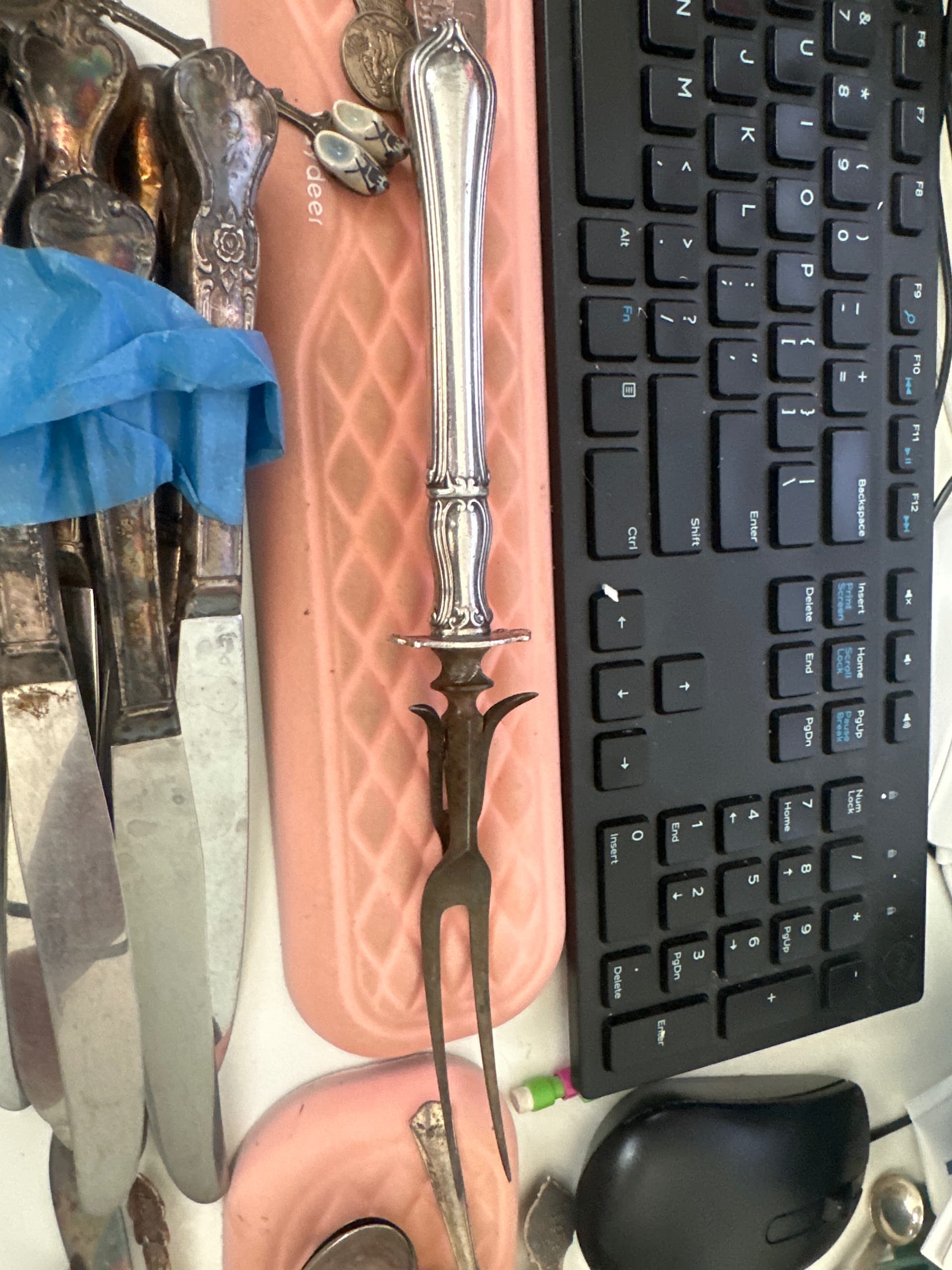
Hi again. I am trying to figure out the maker/pattern in this meat carving fork. My mom passed away and we are sorting soooo much! Thank you

1 Like
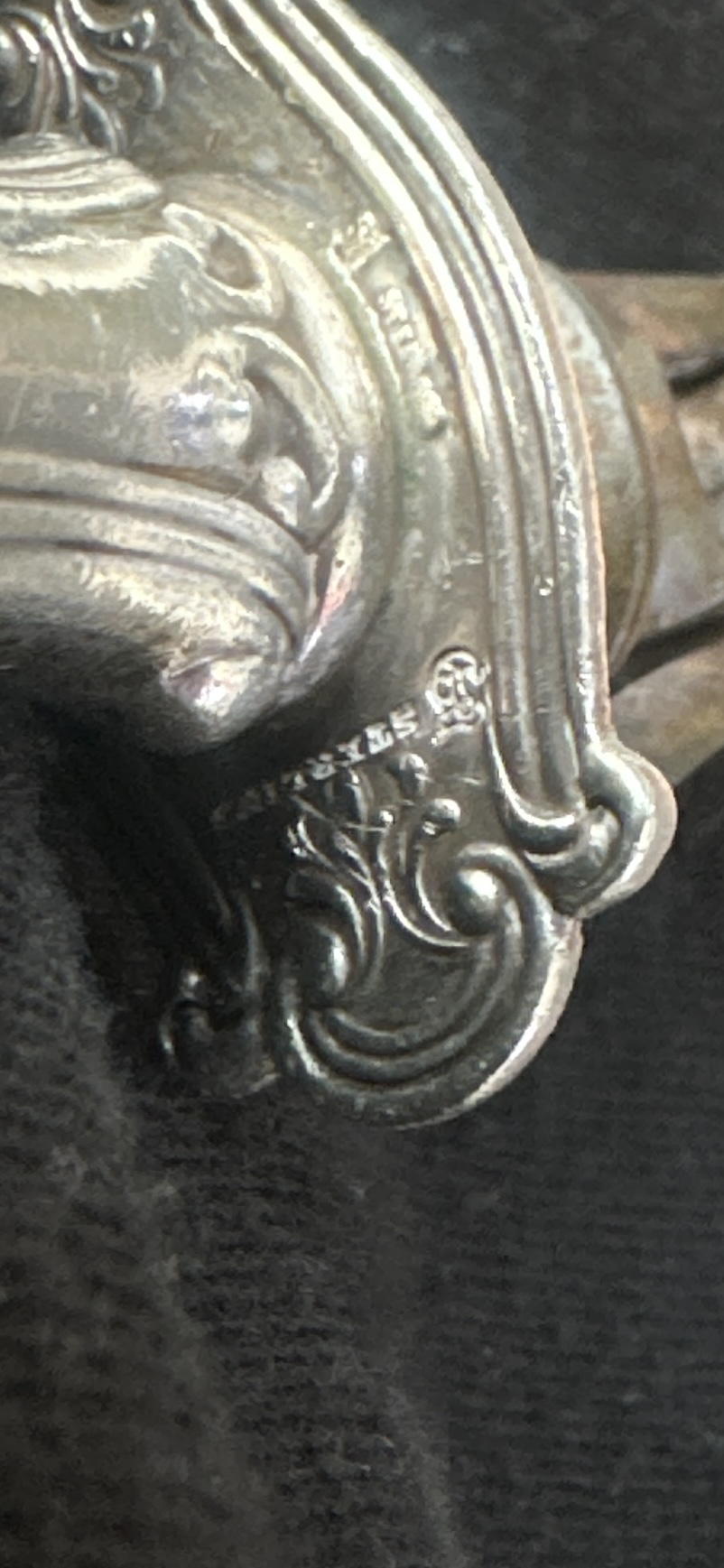
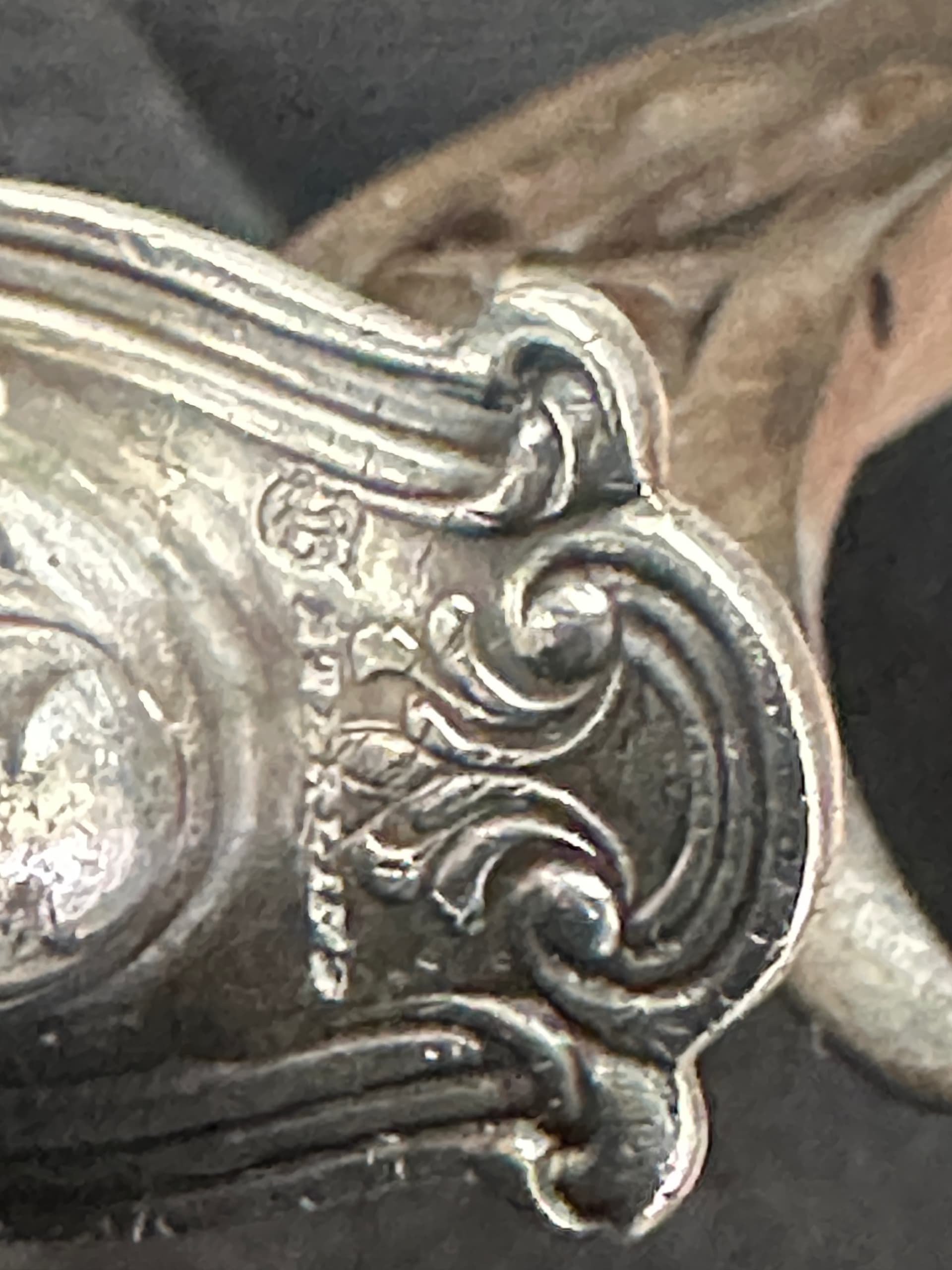
Early steel-pronged, sterling-handled carving fork with an antler-horned knife guard as part of the base metal casting and another sterling knife guard on the Georgian-style handle marked “Sterling” with an elaborate I, J or possibly T in the form of a trade mark. It maybe a cast, solid silver handle or pitch-stuffed, cannot tell but likely the latter; probably assembled in the US late 1890s. to WWI. If you have a knife and steel (sharpener) to go with it very saleable.
CRWW
2 Likes
The mark appears to be that of Towle Silversmiths of Newburyport, Mass. Scroll down in the link to find it.
4 Likes
That would, given it is the correct maker for the steel fork as well as the silver handle, confirm the post 1890’s date for the entire fork based on this material by Towle before it was taken over. This entry suggests after 1923:
https://www.etsy.com/ca/listing/897931211/3pc-towle-dorleans-sterling-silver-fork?gpla=1&gao=1&
What’s different about this item from the standard carving set is the double guard, one built into the cast steel and the other by the silversmith. It’s as is two halves of two separate implements have been put together.
The survival of the fork, which often out lasts the knife but rarely the steel sharpener, would tend to confirm the “marriage”.
CRW
1 Like
Went searching for a possible manufacturer of a carbon steel antler guard set of tines or prongs for a 1923 fork handle and came up crickets.
By this time substantially all steel sold for this sort of implement had switched to stainless as the carbon steel rusted easily, as this has.
The marriage of an older set of tines to a 1920 et seq. handle means the interior is likely pitch as it would have been easy to heat the handle and contents and substitute the older tines. Why replace a stainless steel tine set with a carbon steel set is less clear. Maybe they liked the old antler guard.
My thought is the tines, celebrating the stag , are European where venison was considered with greater reverence on the table than in the Americas, I suppose because for hundreds of years killing it was a capital offence over there.
Stainless steel was invented by Harry Brearley, a British metallurgist, in 1913. He discovered it accidentally while trying to find a more erosion-resistant steel for gun barrels and created it by adding chromium to iron.
CRWW
1 Like
Would a silversmith make such a thing in solid silver?
Why?