Two tally marks (circa 1782) signify anything unusual?

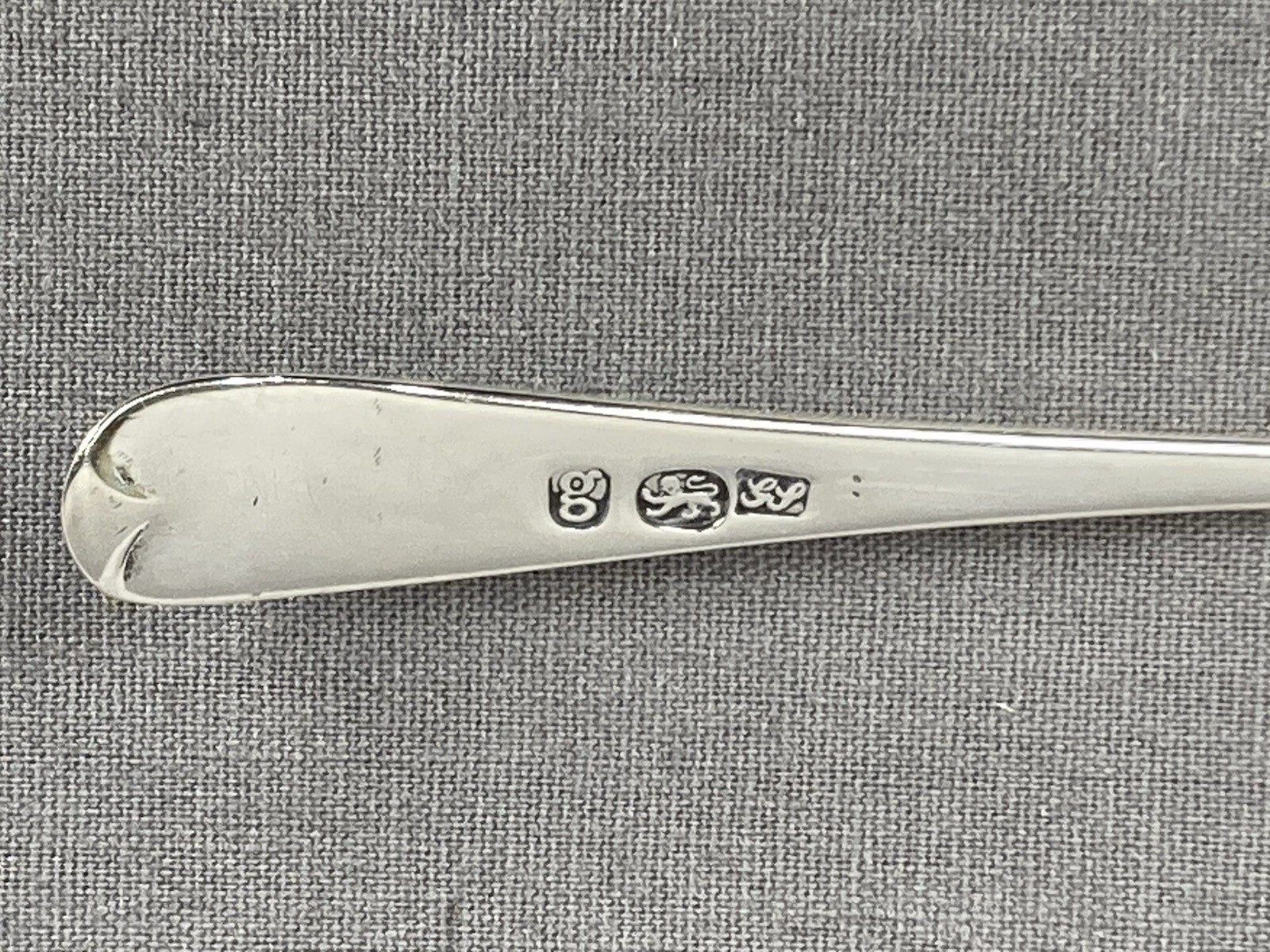
I have an 18th-century spoon (apparently demitasse?) with two small dots near the hallmarks. My research has shown me an image of one dot used as a tally so I guess two dots is a variation of that; maybe the silversmith had more than one apprentice? Just wondering . . . here’s a photo:
---- Image deleted by moderator at OP’s request for copyright reasons ----
(The original picture shows a London hallmark with lower case g for 1782 and maker’s mark GS (italics) of George Smith III. To the right of the hallmark are 2 small punched dots aligned vertically.)

Thank you.

1 Like

The dots are very likely tally marks (aka journeymen’s marks). We see such marks in many different forms so there is no particular significance in either one or two dots.

2 Likes

George Smith (III)? :thinking:

2 Likes

The tally marks on your George Smith III 1782 demi-tasse spoon provided us all with a trigger for great depth of scholarship on journeyman marks, especially the work of David McKinley.

The marks of men skilled in their craft, often having worked for the same shop in the same workroom for their entire life make a very simple point for me. The emphasis we put on sponsors marks is largely a function of their relative ease to trace since they are recorded by the various city guilds in the UK and Ireland but bears only incidental and indirect reference to the quality of the craft shown in any individual piece.

The most extreme example is Paul Storr who between 1807 and 1819 lent his PS mark to identify substantially all silver coming from Rundell, Bridge and Rundell, the largest and most prestigious firm of silversmiths in London early 19th century; a firm so big it took charge of the largest coal mine in Canada and employed some 1,000 outworkers and journeymen in its silver production in England.

Storr ran their four workshops in Soho and supervised the work coming in from contract or outworkers scattered throughout England.

It meant he had very little or no time to pursue his craft and indeed that is the reason given for his retirement from a very lucrative arrangement.

Someone in this forum suggested an attempt to trace these unsung tallyman and try and determine who they had worked for, when and what they specialized in, if indeed they did. A truly Herculean task, probably impossible.

I find the great benefit to collectors today is using the tally marks to identify or help identify sponsor marks that have, through wear or over-stamping, been obliterated.

Elsewhere in this forum I refer to an Elizabeth Eaton fish knife which has been over stamped by a Channel Island maker. We were able to trace Ms Eaton’s mark from the distinctive Z tally mark which also appeared on the over stamped item and pair them.

CRWW

3 Likes

Probably George Smith II London Arrows Crest Sterling Silver Spoon C. 1782 | eBay :wink:
Silver investment- refineries- world message - #9 by almostmacleod :clap:

2 Likes

Hi Bart:

Thank you as always for proof reading my post.

I am reliant upon the scholarship of silver makers marks in this matter. If you think Mr Osborn is incorrect you might, perhaps, take it up with him.

I note the ebay seller’s attribution of its spoon made in the same year to Geo. Smith II is both tentative and, so far as I can tell, incorrect.

CRWW

3 Likes

Dear Christopher, I read all the information carefully, especially yours—filled with rich content and history. I would never dare question your opinions. Although I did have the final say a few times (and rightly so!). This forum is full of unique personalities!

3 Likes

Opinions, I was once informed by a young women whom I admired for candour, are like a…holes. Everybody has them and they are quite useful but should not be over emphasized.

I collect silver not because I care about bullion, I can go down into my basement and dig down into an old largely mined out silver vein which once supplied the entire of Britain with enough of that to fight two world wars, but because of what the artifacts made from the metal tell me about their former makers, owners and users.

Those facts, often as difficult to unearth as the Cobalt silver initially proved to be , and sometimes possessing the same subtle allure under a grubby exterior coat, provide a lens through which to look at shared history and may even encourage us to avoid repeating it.

Perhaps I should send Trump some pieces. Unfortunately he shares the same curse that burdened King Midas and possesses no River Pactolus to wash it away.

On a practical note, if you think www.silvermakersmarks.co.uk confuses one George Smith for another and there are lots to choose from, and you can provide a prima facie case, the website’s owners will be grateful and ,if the mark is from your own collection, likely give you credit for it. If you scroll down their page I sent you with the George Smiths and their marks arrayed, you will note there is another GS with a generous attribution to our company.

That GS was an Edwardian retailer primarily known for co-founded the BADA. Apart from the four entree dishes marked by him I have never seen the mark on anything else. I picked them up in a garage sale in Santa Monica years ago.

CRWW

3 Likes

I think we’ve correctly deciphered the initials “GS.” Don’t even mention Trump, because the mere thought of that vile creature makes me sick.


1 Like

“We” must have, by George!

CRWW

1 Like


This is Gaza. Towards consideration of the definition of the lesser evil.

Can we keep our focus on silver please.

1 Like

Sorry, Phil. I know political topics are frowned upon here, but I couldn’t let this go without comment…

Clausewitz defined war as “politics by other means” and silver is inextricably linked to that endeavour starting with Persia’s Darius II who mined 250 tonnes of the metal in what is now Turkey, to Alexander of Athens who built such a pretty bank vault for his silver visitors still thinks it is a temple, to Crassus who funded the politics between Caesar and Pompeii which eventually created quite a good Globe Theatre play, to the Rothchild’s who funded both sides in the Napoleonic wars to my country in the last century which funded two wars the Brits engaged in to preserve colonial power or democracy depending on your preference for tall tales.

For collectors wars are inevitably going to make your hoard more valuable so long as you resist the patriotic cries to melt it down into The King’s Shilling.

So as collectors should we be in favour of politics by other means or against it? On the one hand it increases the price/demand for the metal and temporarily makes us all feel rather wealthy, on the other hand, as is happening right now, enormous amounts of collectable silver of historic interest is bunged into blast furnaces and emerges as something else, usually coin or security for same.

England today owes its vast collection of 18th and 19th century of silver to an absence of civil war since the 17th century and a willingness to develop colonial capability to acquire it. The British have always been remarkably democratic when it comes to its collection. They really don’t mind who controls the resource, they are perfectly content to relieve them of the responsibility of distributing the proceeds. The Spaniards have special reason to be grateful to them starting back in Elizabethan times with the licensed privateers like Hawkins, Drake and Raleigh.

There was a time when the British Isles had its own gold, silver and tin mines. The Romans didn’t invade this country to sit on the beach at Bognor Regis, or build walls to defend against the intractable Celt as the Emperor Hadrian was forced to, but for minerals.

This early trend saw all manner of folk including a rather famous Jewish prophet’s uncle Joseph of Arimathea arriving to trade metals. His visit was immortalized by Blake in that seminal hymn “Jerusalem” with the line. “And did those feet in ancient time walk upon England’s mountains green”

Joseph wasn’t here to help Milton or Blake write lyrics, he was here for tin and silver which the Romans needed to pay and arm soldiers to make political advances without too much back-chat.

Today silver is again a weapon of war. An essential ingredient in the solder that cements computer parts for Tomahawk Missiles or allows the creation of cellphones off which drones to harry the enemy are controlled.

Here in my hometown former owners, the Teme-Augama Anishnabai, ran out of lead bullets to fire into the Catholics whose Jesuit priests were leading the invasion of their homeland and resorted to silver to make musket bullets.

As soon as the medics started digging silver out of the combatants they suggested a cease fire to discuss this new weapon of actual belligerence. That discussion continues to this day and is now called indigenous land claims, a vital ingredient in the defence against the US seeking to control Canadian fresh water. We control 25% of it globally and the US has to keep growing veggies in the Imperial Valley to feed us all.

In summary, politics is not just the silver lining for political man, it is the essence of it without which we would inhabit a very different world. Various empires have tried other metals and ores but they never really caught on.The Pacific Coast lot, today we call them Haida up here, tried scallop shells. The Ancient Egyptians came up with Lapis Lazuli, which was really only rare because it came from Afghanistan and the religious leaders back then were tricky to deal with. Gold is also much prized. There are streets around the Bank of England which allow you to walk or drive over hundreds of tons of the stuff tucked away in bank vaults below you on behalf of various client countries.

But somehow silver has remained the arbiter of financing “politics by other means”. It’s expensive enough you can give a soldier a coin or a purse of coins and he feels he has got something with which to buy a drink or the affections of an obliging female and cheap enough you can afford enough soldiers to make a political difference.

The perfect compromise metal.

CRWW

Keyword “Rothchild.” And that’s about it.