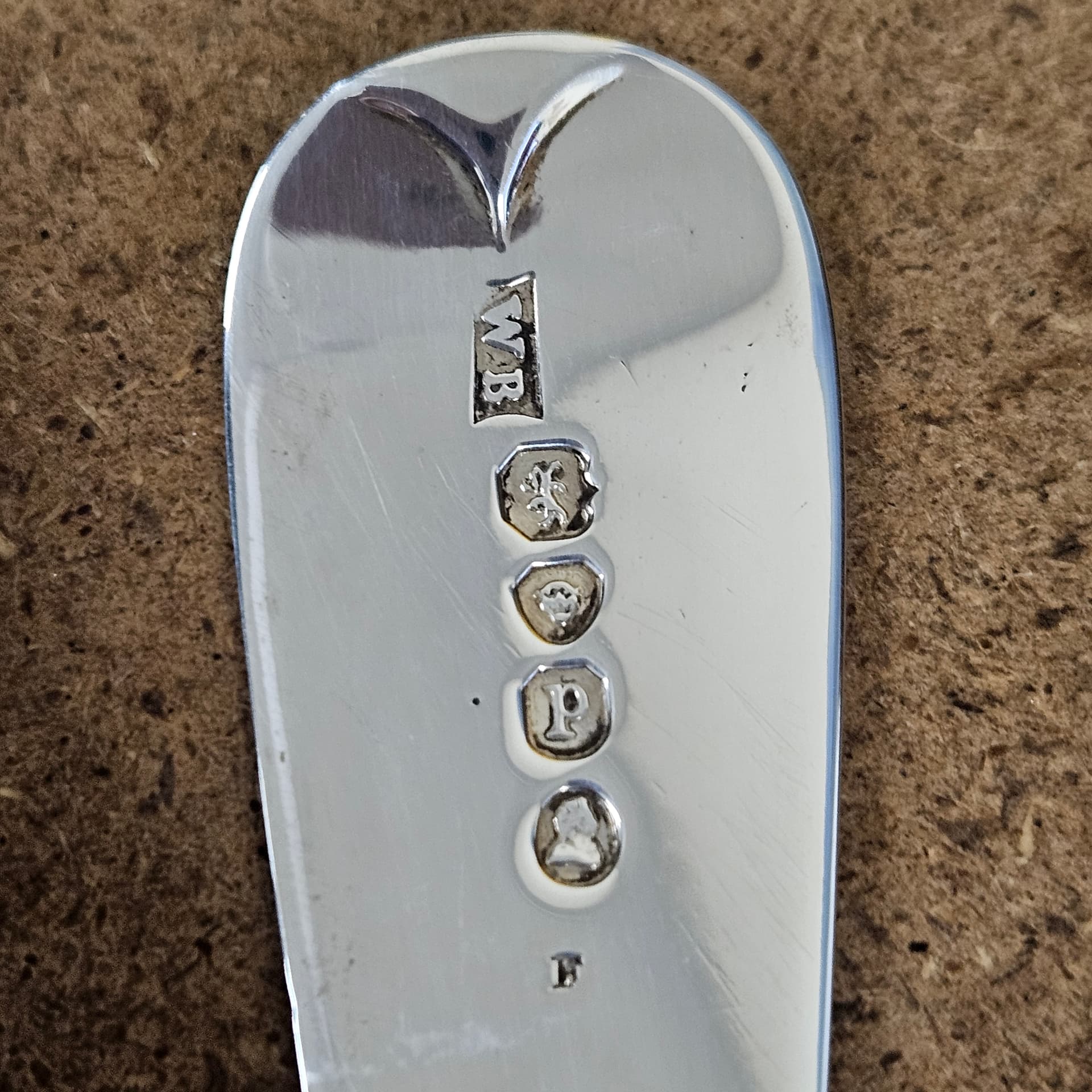
I volunteer at my local Oxfam shop in Exeter. We’ve had a silver spoon donated, which is in superb condition. I thought the maker’s initials (WB) indicate William Bennett, but when I do an internet search for William Bennett and look at hallmarks on items for sale/sold, the maker’s mark is often WB, with a dot between the two letters, so now I’m unsure. Any help would be much appreciated.
A second question is the date letter (P) - 1810?
A third question (thanks for your patience!!) is what does the “F” mean?
Thanks in advance. I want to list the item on the Oxfam online shop, but, of course, I wnat the information to be as accurate as possible.
This WB is William Bateman II, son of William Bateman I, and the date letter p (lower case) is 1830/31. We can be sure of that because of the uncrowned leopard’s head which was introduced in 1821. The F is a journeyman’s mark, the private mark of the workman actually responsible for the piece, applied so that he would be paid for his work.
William Bateman II was the grandson of one of the better known female silversmiths. Hester Bateman. Hester took over when her husband died and left her his silversmith tools.
Her key to success was she was an early adapter of the sheet metal silver produced by the Birmingham roller mills of Matthew Boulton and James Watt.
This allowed her to produce silver more inexpensively than her competitors as she was using less silver.
Back then it was usual for wives to take over their husbands business upon their death and it was equally usual for husbands in the silver business to die young, often from inhaling mercury given off during the gilding process. They had usually run the books while their spouse lived so they simply carried on after death.
Charles Solomon’s death was attributed to mercury inhalation. A problem which didn’t go away even when electro-plating of gold was possible because people preferred the soft light color it created to the harsh more even gild process.
The other advantage Hester had was her six children and then grandchildren which carried her otherwise modest Bunhill workshop well into the 19th century.
This was a time of war and war means taxes and the Bateman’s were masters at tax avoidance – not evasion but quasi-legal avoidance. For instance William used to ship his silver to the Channel Islands which has a lower tax rate than if it stayed in England and was sold directly to the customer.
From 1784 a monarch’s head appears on all British silver showing duty paid at sixpence in the pound sterling. William shipped his stuff to the Islands of Jersey or Guernsey where it was only a penny halfpenny in the pound. Of course it had to get back to the customer but that’s what that rugged Cornish coast was useful for.
A separate mark, known as the duty drawback mark , was briefly used from December 1784 to July 1785. This mark, a standing figure of Britannia holding a spear and shield, indicated that duty would be refunded because the item was intended for export. It proved very unpopular because the silver which returned to the customer had the mark showing it wasn’t supposed to be in the country.
Elsewhere on this site I show a Bateman ladle which had the sovereign’s head struck off it. I asked if it was struck at the port of embarkment probably London or upon arrival in New York where I acquired it. So far no answer to that.
So William the grandson of Hester the matriarch of a family of smiths who not only invented making commercial silver from sheets rather than ingots, but also used family to protect their business and came up with important tax regimes which, while they don’t still exist, set the City of London on a course in direct collision with Westminster and managed to turn that collision into collusion.
It is perfectly possible that Hester never actually made anything bearing her sponsor mark. And this may be a comment with general applicability to other diamond widows Traditionally the widows mark was her initial in a diamond. Hester didn’t use this punch shape,
The key book on female silversmiths is “Women Silversmiths, 1685-1845” by Jennifer F. Goldsborough and Philippa Glanville published by the National Museum of Women in the Arts] (Women Silversmiths, 1685-1845 – NMWA Shop) (NMWA) and Thames & Hudson, exploring Britain/Ireland’s hidden history of women creating silver, featuring figures like Hester Bateman, Louisa Courtauld and Anne Tanqueray with a significant appendix listing hundreds of these craftswomen.
Thank you for all this useful information. I owned a Hester Bateman creamer many years ago. It was very elegant, but the metal was thin; really thin. It was a nice piece despite that.
Her designs were very often avant garde. None of the histories about her or other women folk in the metal banging business tell us who the Bateman designer(s) was/were. It may even have been her. Perhaps that’s what she did. In which case, if she sketched out any designs for your sugar bowl or creamers or anything else, they would be worth a fortune.
Years ago I asked a rather famous Australian silversmith to design something as a wedding present. In due course I got the hand-drawn and painted images of the design, but the party had decided not to use it. I sent him a cheque for his design work and thought nothing more of it. A few days later I got a very hostile note demanding I return the graphic work he had done and undertake not to have made any copies. I told him I couldn’ t undertake that as they had already been faxed to a third party who had actually vetoed the design.
I realized from all that, for this silversmith, the design was the value not the metal created in image of it.