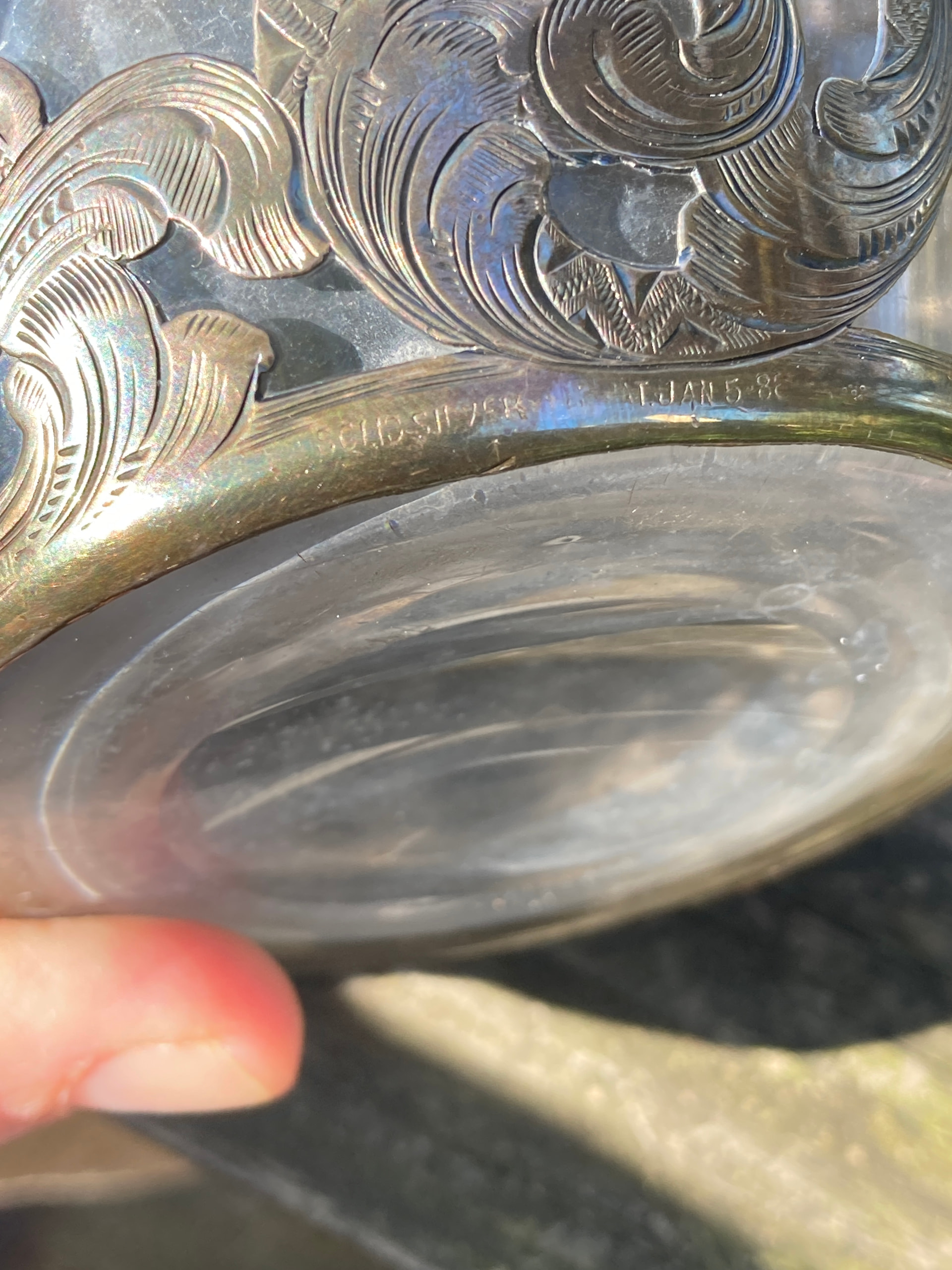
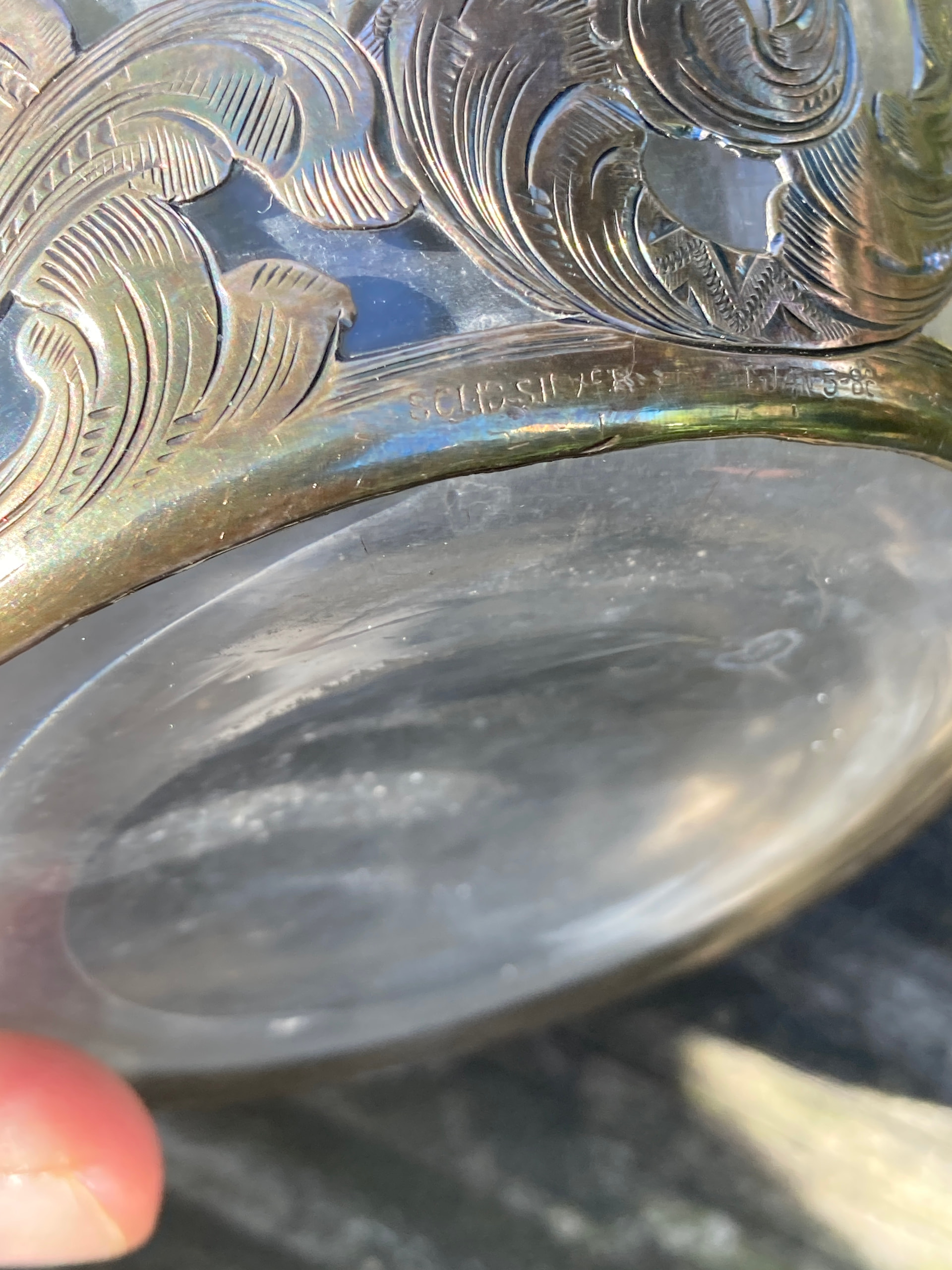
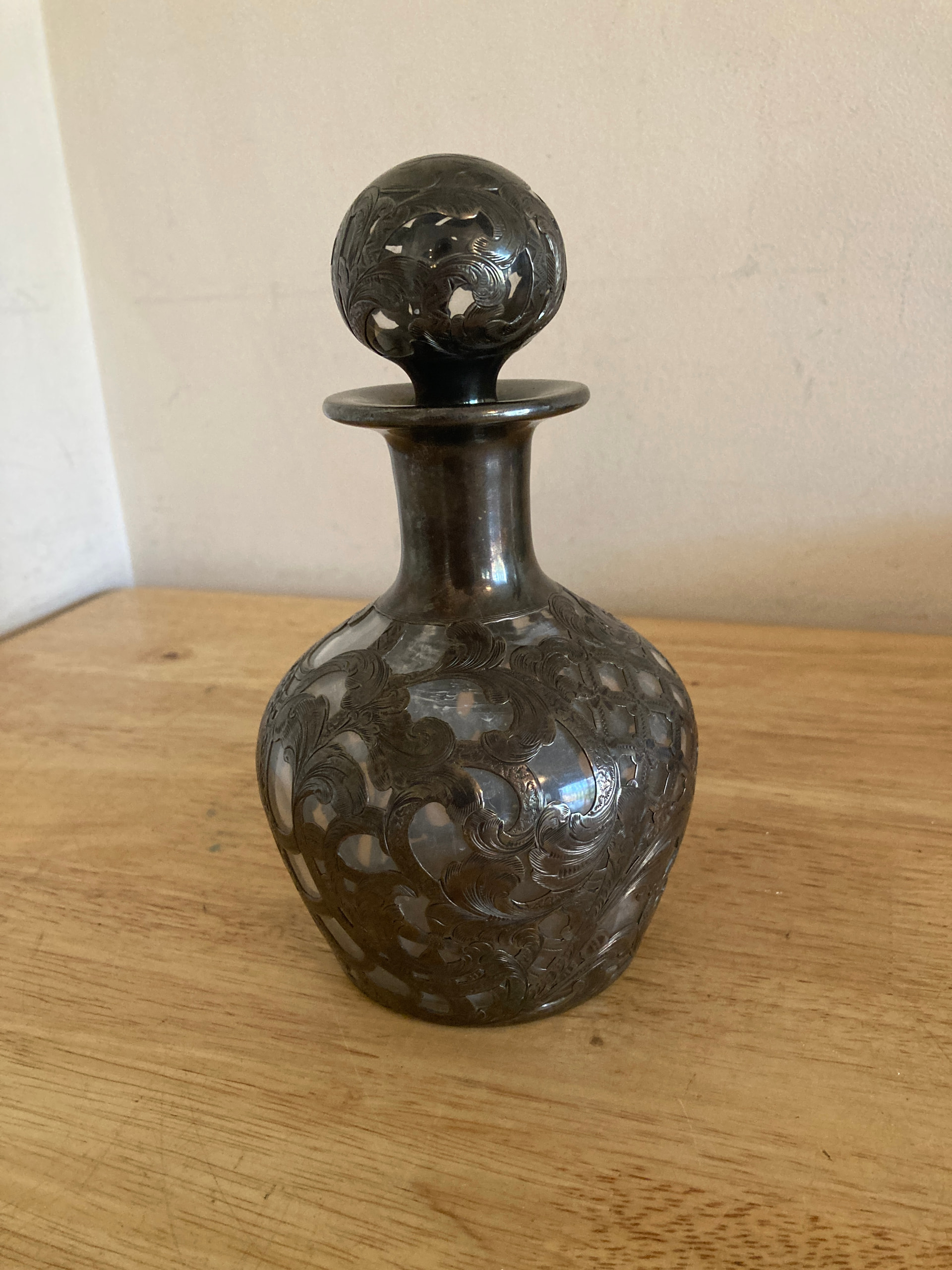
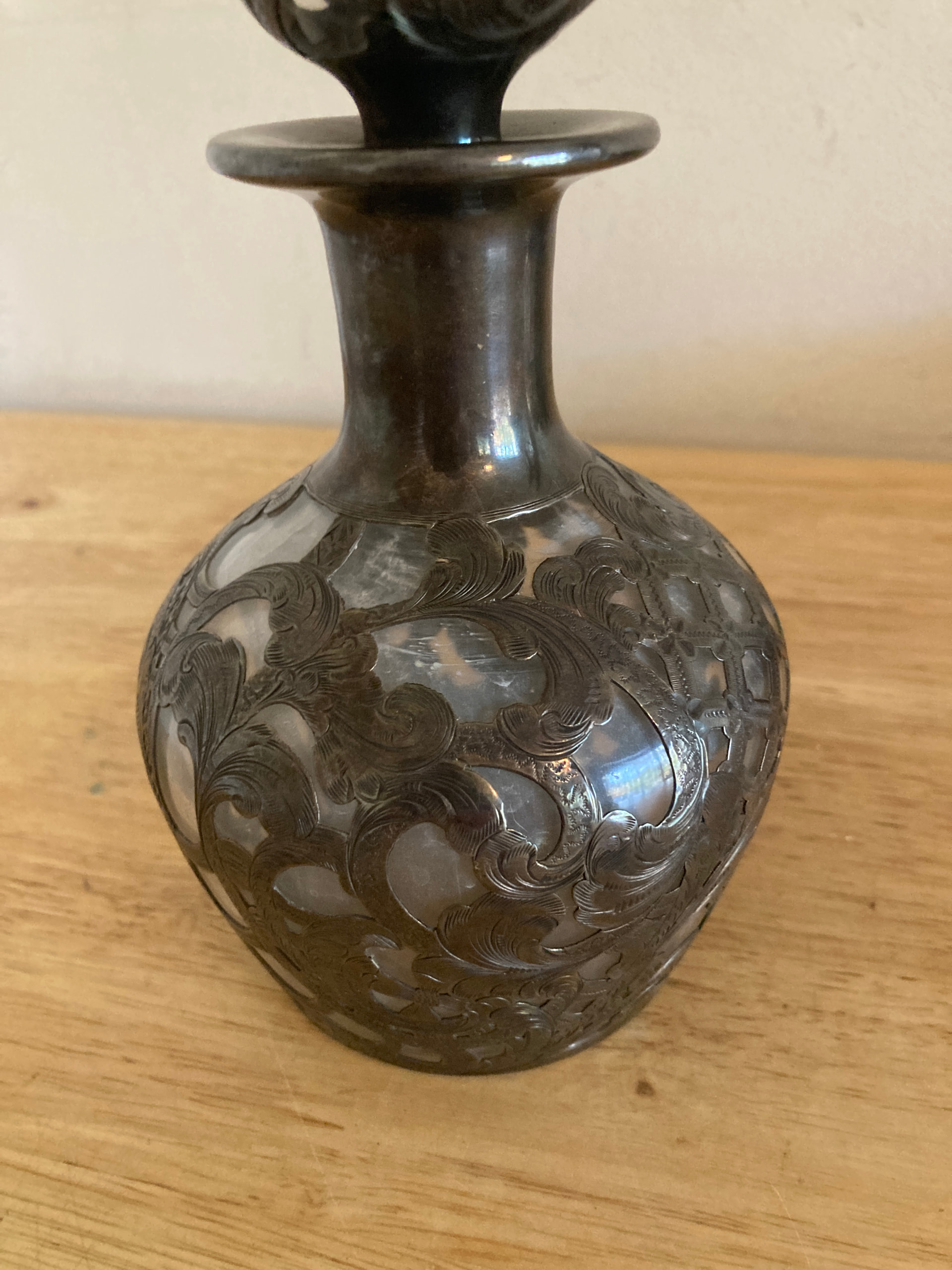
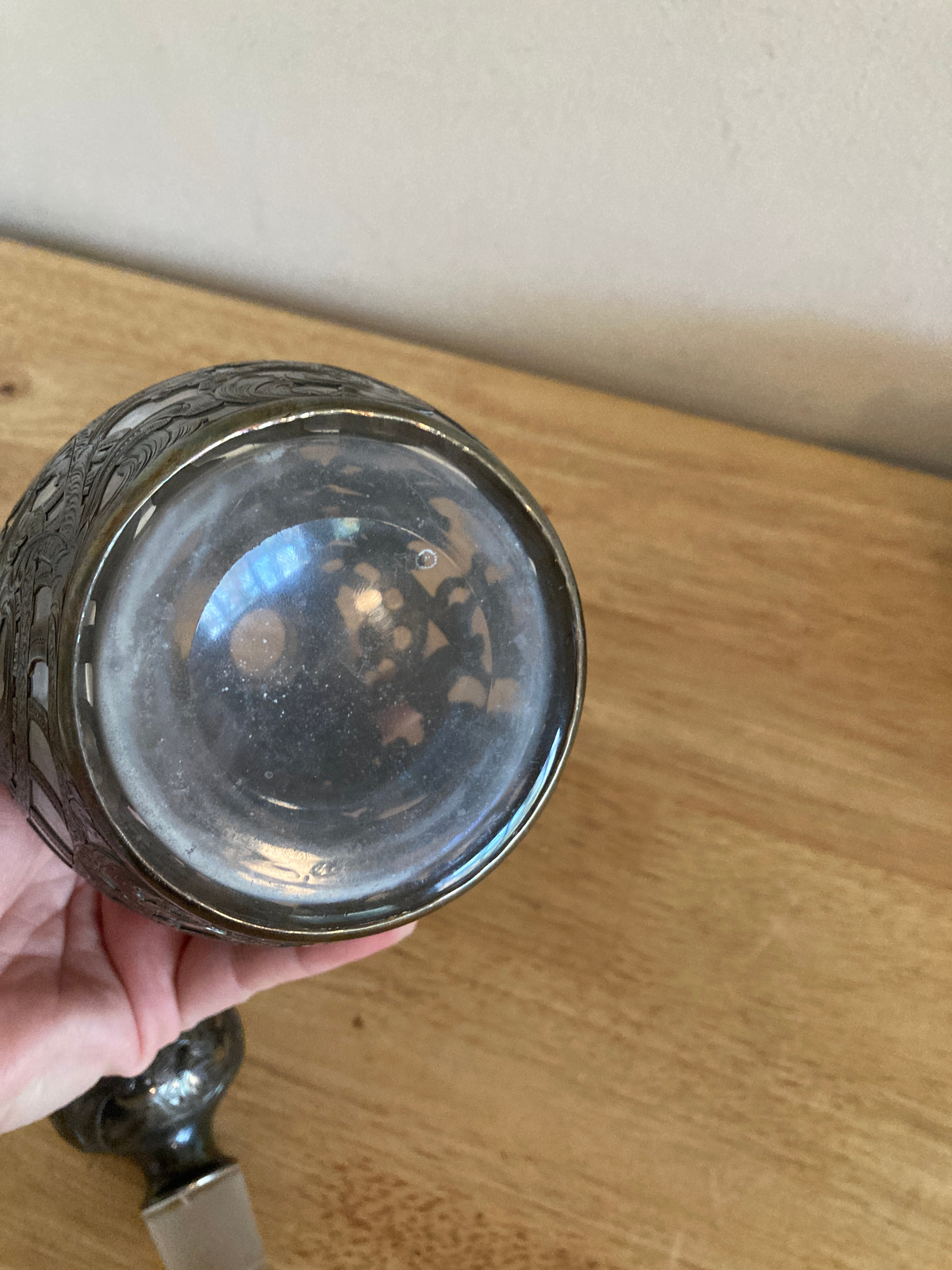
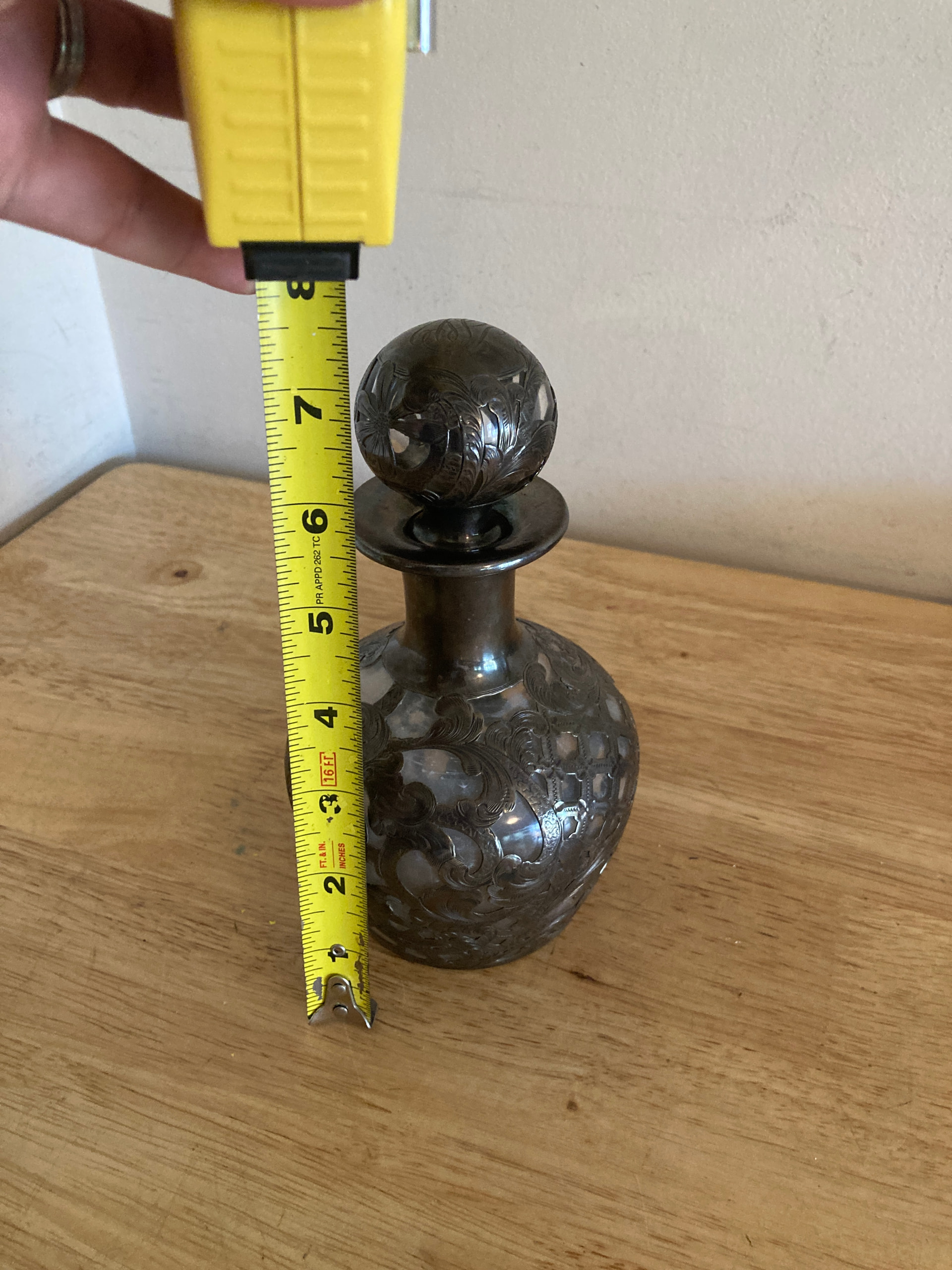
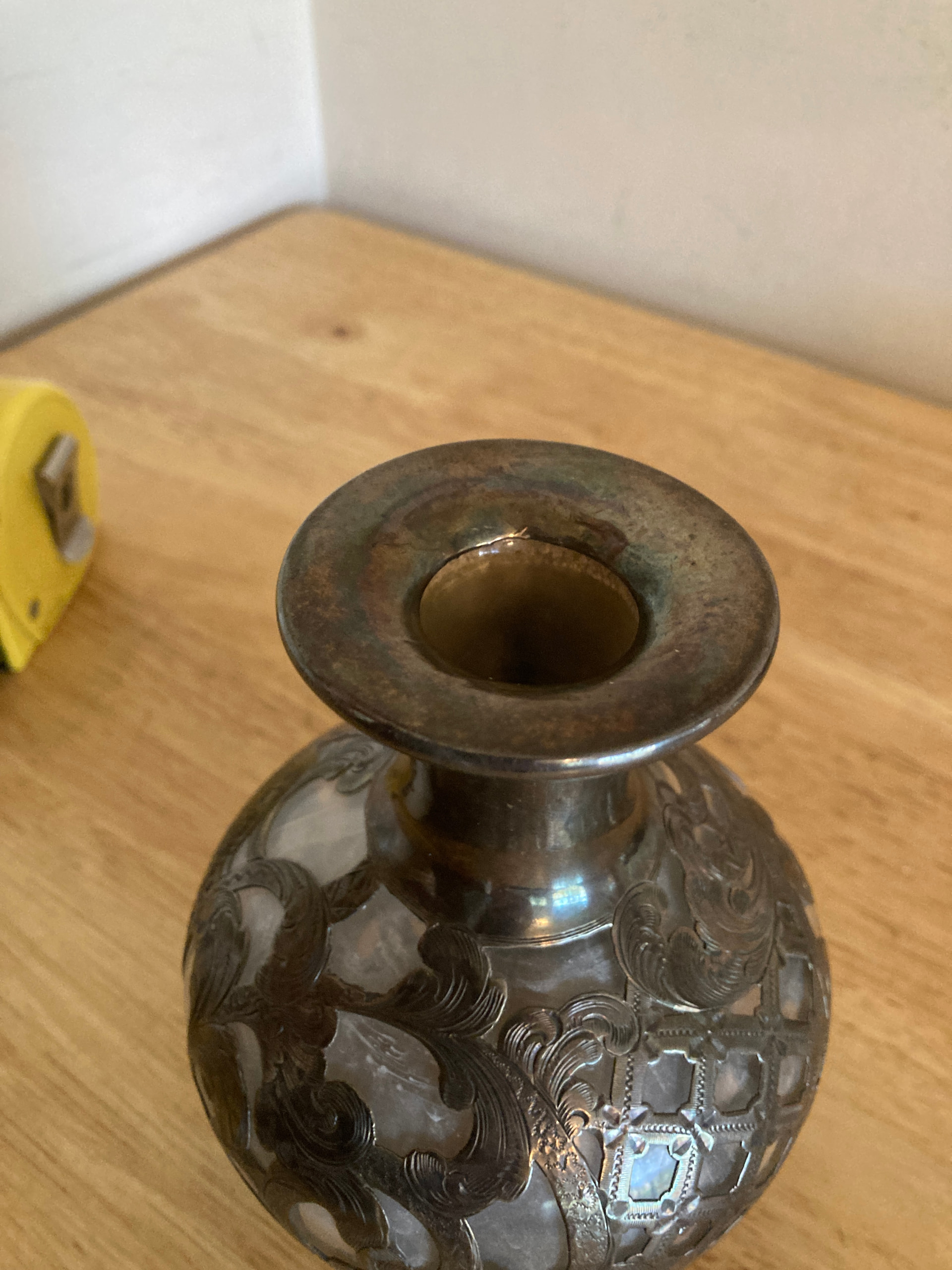
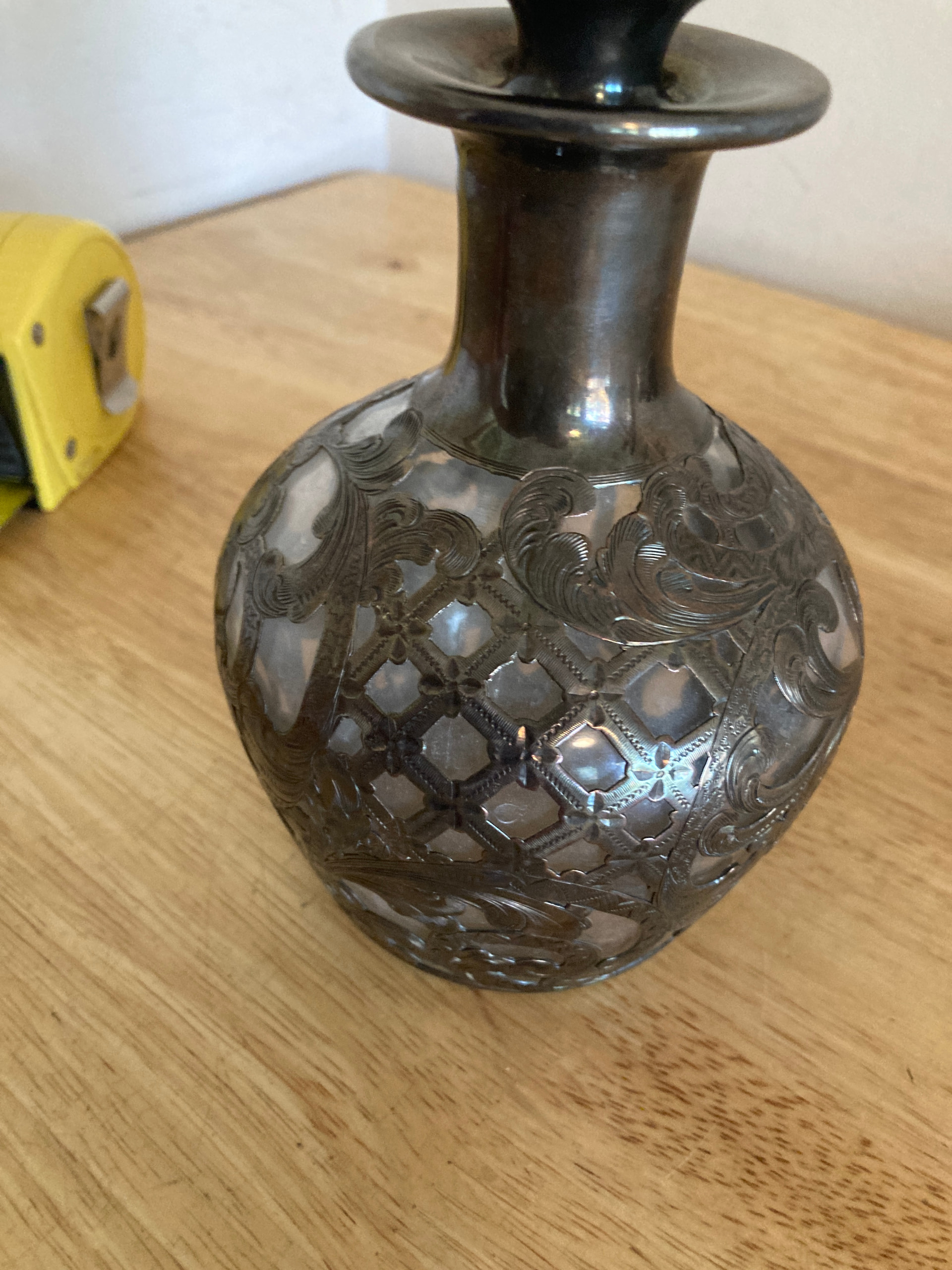
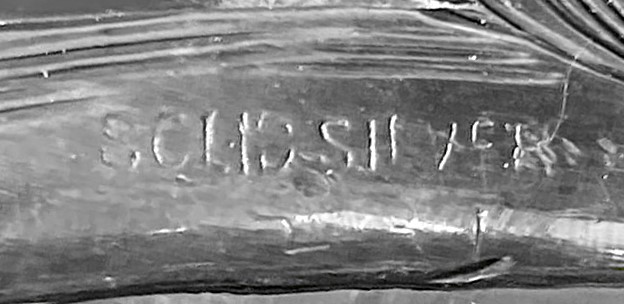
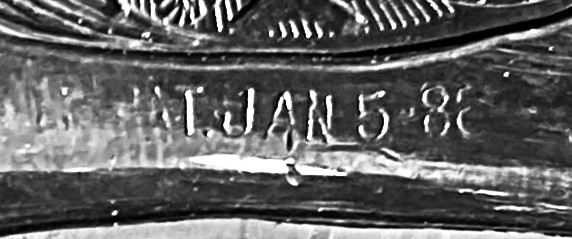
I’ve done extensive research on my own, but can not figure out who the maker of this art nouveau silver overlay on glass decanter is. On the very bottom of the decanter it says T. Jan 5-8c I think. and to the left it’s stamped solid silver. Trying to figure out who the maker is and which country it was made in. I thought it might have been La Pierre sterling company, but their makers mark is pretty distinct. I looked for other marks on the bottle, but the one on the bottom is the only one I could find. Thanks!

2 Likes
Thank you for the info.
2 Likes
This is just a request if you want me to help you.
1 Like
Thank you. I appreciate it.
So the wordage is “SOLID SILVER. PAT(ent) JAN (uary) 5, (18) 86.”
Both Alvin Manufacturing of Rhode Island and Gorham made these flasks and bottles. Alvin obtained a patent Jan 5 1886 for a process using .999, literally solid silver to adhere to the glass in these swirling pattens. But whereas Gorham stamped items it produced with the name of its company and used sterling silver, Alvin often simply referred to the process patent application date and sometimes also to the patent for the individual designs of bottle or flask.
The company’s patent process referred to here was for depositing pure silver on metallic and non-metallic surfaces, often used for electro-deposit goods on crystal glass as in this case.
In addition the firm held numerous design patents, including those for the “Easter Lily” (1907) and “Brides Bouquet” (1908).
While founded in RI, the company moved to Irvington, New Jersey, to meet demand, later becoming part of Gorham in 1928.
If you do accede to my colleague’s suggestion you clean the bottle up, unless you actually know how to clean pure or .999 silver on glass may I urge resort to a professional. Bart was seeking to make the marks more legible, which is perfectly legitimate suggestion, but please don’t. Either leave it as has happened for the better part of 125 years or clean the entire flask. ( I think it is a bit small for a decanter)
2 Likes
In another forum there is a fairly complete description of the process of electro-plating glass and then employing designers to create the cutaway patterns. Here is the link for those wanting to delve deeper:
CRWW
1 Like
While the process patent remained fairly bullet proof, when it cam to the various design patents the patent registry office was criticized for being downright lax in its issuance of a patent to Alvin which Whiting claimed, correctly I think, infringed one of theirs.
Whiting Mfg. Co. v. Alvin Silver Co., 283 F. 75, 80 (2d Cir. 1922);
Those of us who think design patents and their protection in the early 20th century is interesting, and I will confess our numbers dwindle, the different approach taken by the fiercely competitive Rhode Island company and say Elkingtons of Birmingham England is worth noting.
Whereas the Elkington Brothers recognized its 1839 patent for “…an improved method of Gilding Copper, Brass, &c.” registered in the US under 741A should soon be challenged and then infringed, granted licences to operate under it to half a dozen Sheffield firms and became both wealthy and well known for it, Alvin Manufacturing on the other hand was swallowed by Gorhams!
CRWW
2 Likes
Fascinating stuff. But how did Gorham use sterling silver? you can’t electroplate with an alloy. What was their process? To stamp it out in pieces and then enrobe the glass and glue it?
2 Likes
Good question. But, and I am no metallurgist, apparently you can use some alloys to plate.
But the problem, as I understand it, is not that Alvin used .999 silver – there could be no property in that – but getting something thicker than a couple of microns to adhere to anything including glass.
I think the best thing to do is to buy a non Alvin piece and see exactly how their competitors did it. I am looking for one cheap enough that if I break it trying to figure out the answer, I can get my cash back when I take the debris down to the smelter!
What we do know is Gorhams found the answer to your question difficult enough that by 1928 they bought the company and, presumably, with it the entitlement to patents.
The other thing I didn’t touch on is why there is no trade mark on this flask/ bottle/ decanter. The usual answer is because it is part of a dressing table set and came encased with boxes, powder puffs, brushes and other essential accoutrements for the Edwardian lady’s boudoir and the mark would have been liberally available on other items.
Remembering that this was a time when household grew their own lavenders and distilled their own rose petals, I think seven inch bottles might have been used to store either. I asked a friend of mine expert in these matters what a seven inch bottle of ample girth might find itself employed for in the boudoir and got a rather ribald answer which I won’t burden you with.
CRWW
1 Like
Haha! No wonder with all the men out Empire building!
2 Likes