
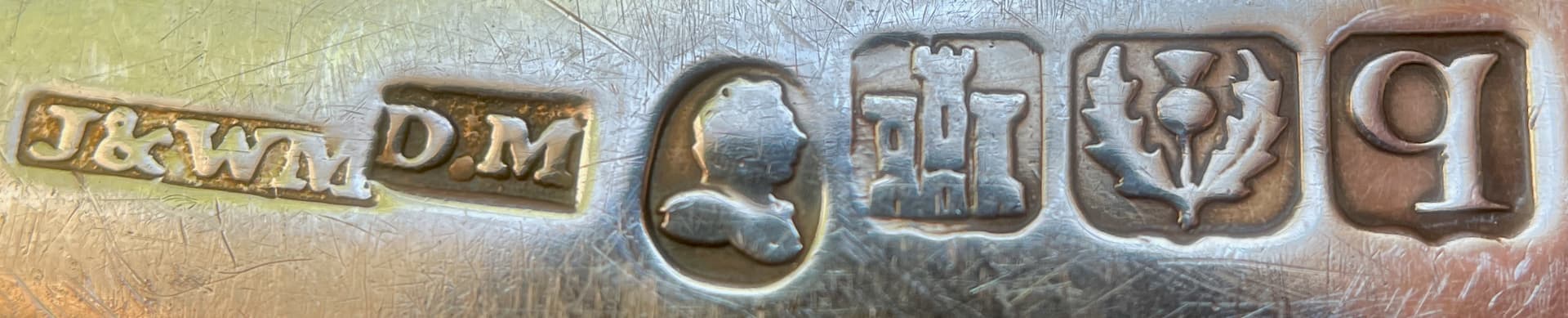
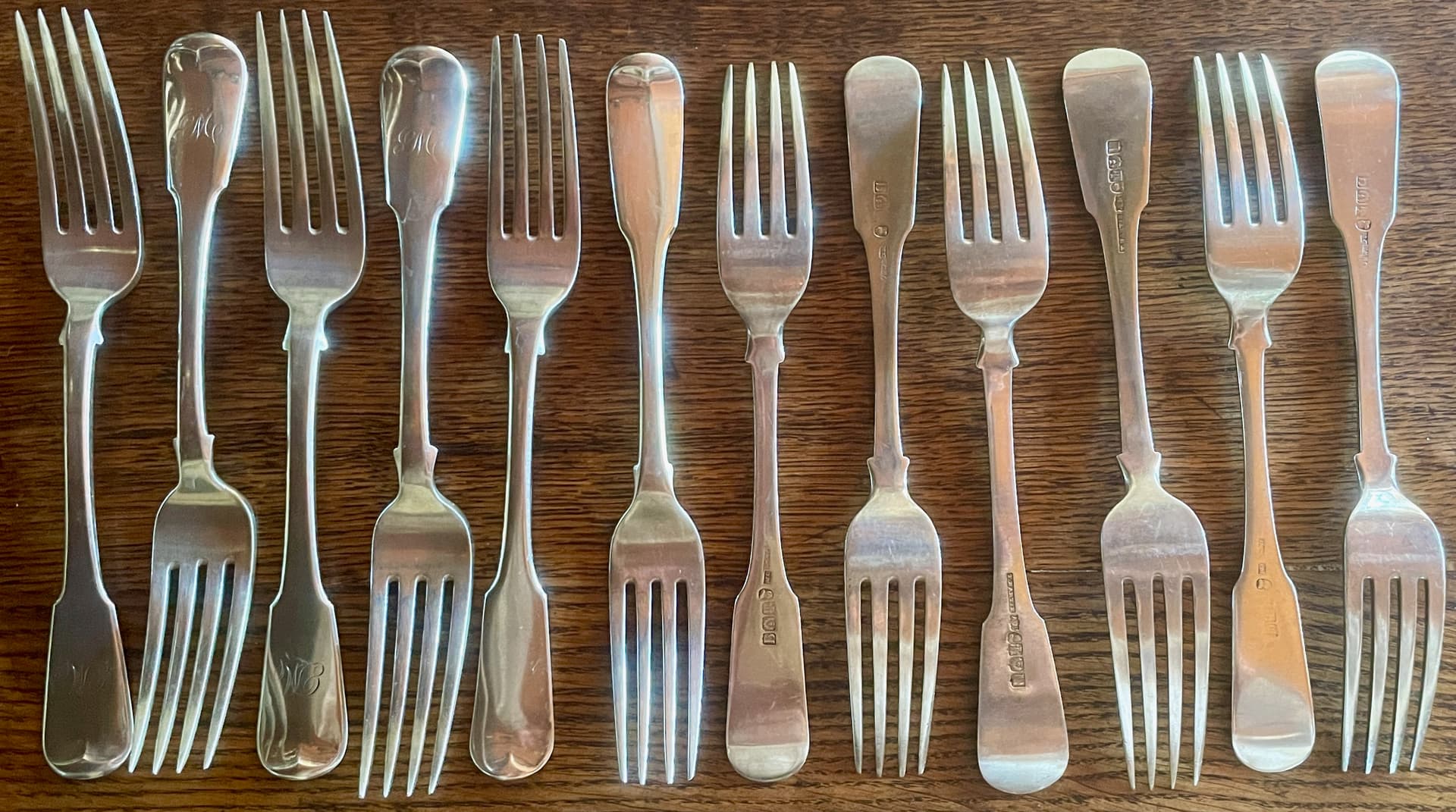
I have 12 Edinburgh forks. 6 of them (dated 1822) each bear two sponsor (or maker) marks: “J&WM” for James & Walter Marshal, and “D.M.” for David Marshal. Similarly, the other six (dated 1826) bear the marks of “T. BARTIE” and “AE” in a shield (for Alexander Edmondston). Why is there more than one ‘maker’s’ mark? Was this a Scottish practice? Were they partners, or what? Any info on this would be gratefully received.
THOMAS BARTIE
Hutcheson Street, Glasgow

Thomas Bartie - Glasgow - 1828

T. Bartie - AE (Alexander Edmonstoun) - Edinburgh - 1824
Thomas Bartie was a member of the Glasgow Goldsmiths’ Company and a Freeman of the Glasgow Hammermen. He served his apprenticeship under John Sid.
Many thanks for this Bartholomew, very interesting. Have you any idea why there should be Bartie’s mark AND Edmondston’s on the same piece though?



Many thanks Bartholomew. I suppose that it was a Scottish speciality to include the retailer on silver items? In any case, I’ve never seen it on English pieces…
I note the “AE” mark is not the same in your example as in mine: mine has the initials in a shield, whilst yours is in a rectangle…
Antique 1829 Scotland Alex Edmonston/James William Marshall Sterling Silver Fork | eBay
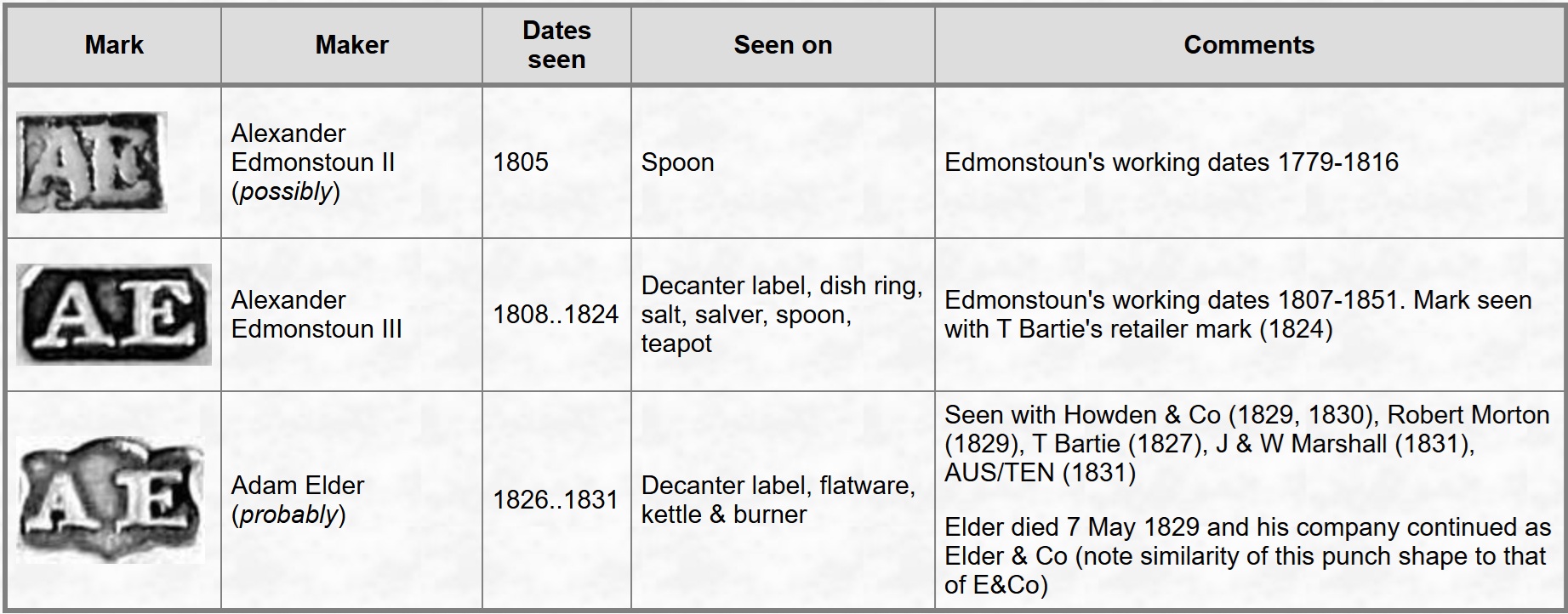

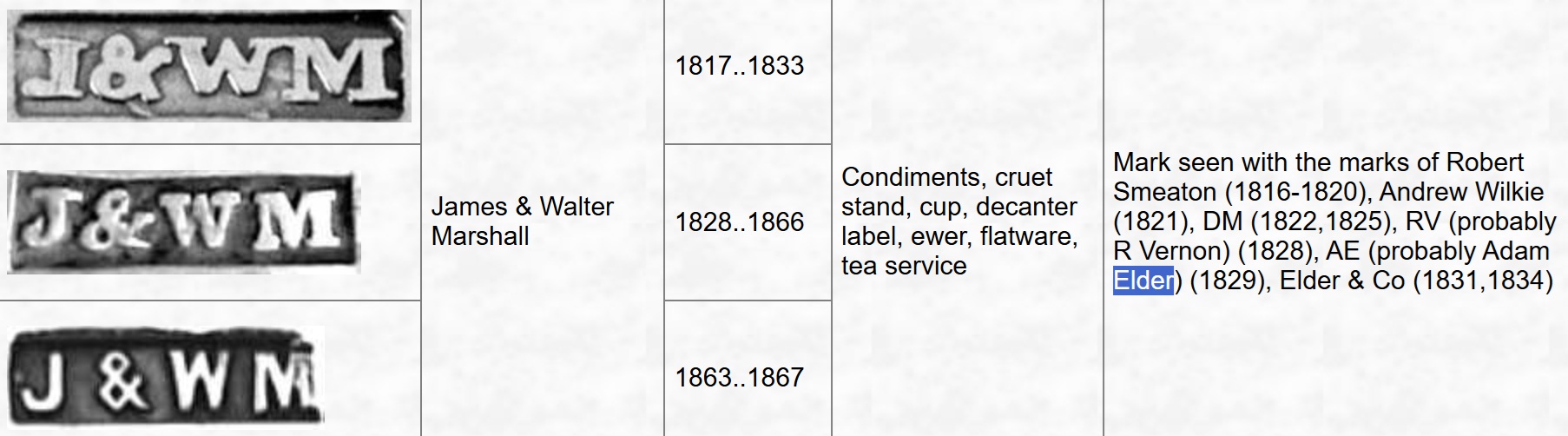
https://www.925-1000.com/forum/viewtopic.php?t=28323
Pair of George IV silver strawberry spoons by Adam Elder | Silver | 14972
1 Like
Very many thanks Bartholomew: I obviously got the maker wrong — it’s Adam Elder, not Alex Edmonstoun. Grateful for your having corrected me!
2 Likes
U welcome, Nick! 
One sometimes sees the opposite case. Items sold by Liberty & Co., for example, often identify the maker only as “Liberty,” but Liberty was just the sponsor/retailer. They commissioned others to manufacture items which they then sold. It can be difficult to identify who the actual silversmith was!
thanks Jeff; yes, of course, I’ve seen pieces marked by Aspreys, without a silversmith mark. But in fact, you don’t know who the actual silversmith was for most items, considering they were probably made in a large concern employing multiple smiths. I mean, someone like Mary Chawner would almost certainly not have made (or possibly not even have known how to make!) flatware etc., but she was the sponsor, and it’s her mark we find on the item.
I forgot to say that the “true” silversmith would have been the one who stamped the journeyman mark on the piece - if there is one.