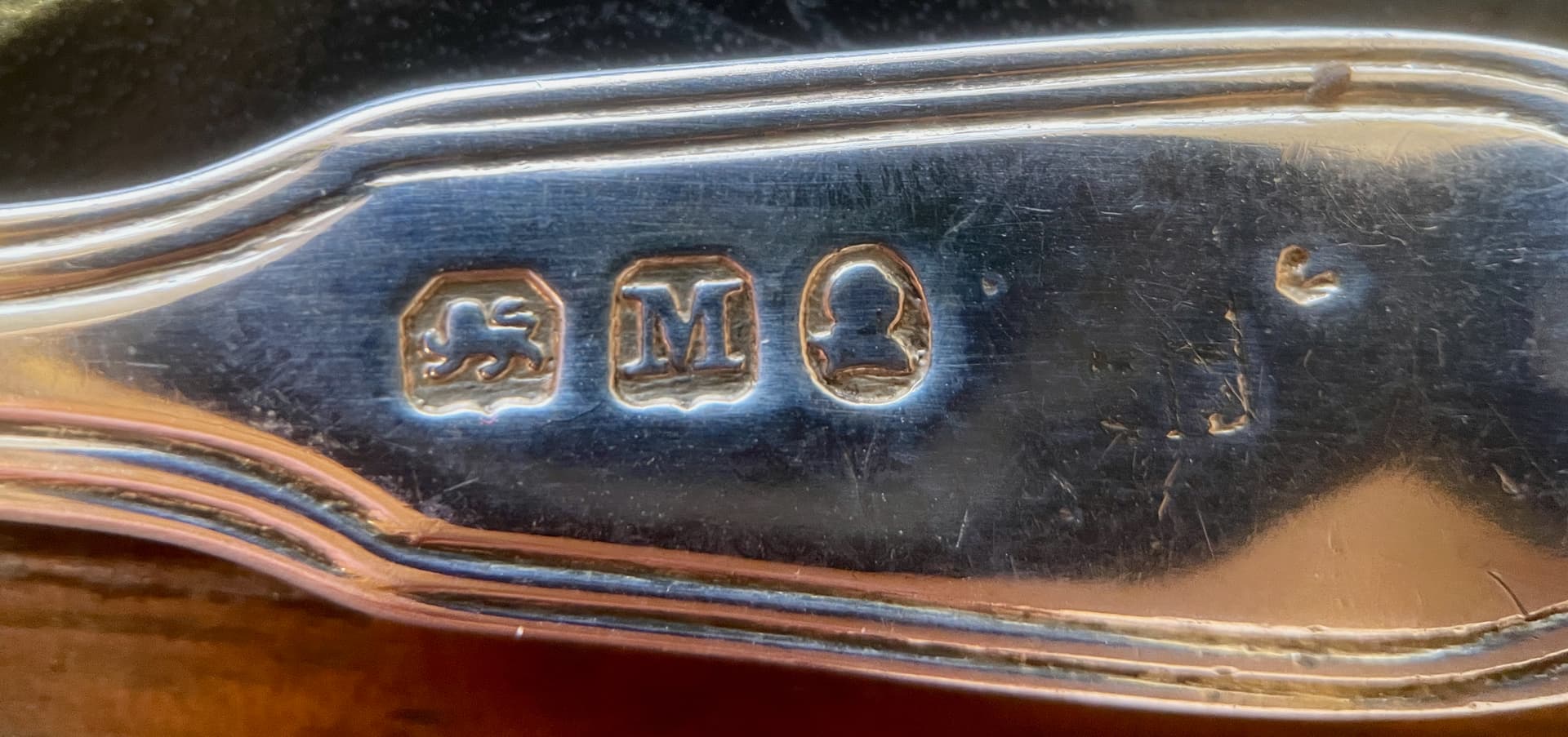
I have a fiddle thread pattern silver egg-spoon, 105cm long. Date letter capital M for 1807, but no town mark. There is possibly the remains of a now illegible maker’s mark to the right of the hallmarks, and a journeyman’s mark, but no town mark. How come?
1 Like
London and Exeter in particular frequently omitted their town mark in the early 1800 period. It seems to have been most prevalent on smaller pieces and may have been an anti-fraud measure - making it impossible to cut out and transfer a hallmark from a small tested piece into a larger sub-standard piece, the larger items being known to have the town mark.
Phil
2 Likes
That’s really interesting Phil, many thanks indeed. I’d like to know more about how the British assay offices worked. Did they really test each and every piece? And how? Did they scrape some metal off the piece? If you know of any literature on the subject I’d be grateful to know. Many thanks , as always.
Nick
1 Like
Whole item photo, please.

1 Like
It’s really irrelevant to your question which has been vey capably answered in the most iluminatory way by Phil.
But the sponsor mark remnants are for a “triple decker” and the existence of a tally mark
points to a large silver manufactory.
Given this is a London mark and the date is 1807-8 there seems to be but a single candidate left, featured at the bottom of p 229 of Jackson’s tome.
Your supplemental question as to how assay offices functioned then and now requires a slightly more complex answer so as not to further mislead and I think I can do no better than to refer you to the Guild’s own website where it says:
“The Office tests precious metals using a combination of non-destructive X-ray fluorescence (XRF) spectrometry and destructive sampling methods like fire assay (cupellation) to determine purity. Items are checked for compliance with legal standards (9, 14, 18, 22ct gold; 925/958 silver; 950/999 platinum/palladium). Upon passing, items are hallmarked by traditional striking or laser, featuring the leopard’s head.”
CRWW
1 Like
I started this thread in May 2024 as can be seen above. It was just a query as to why there should have been no town mark on an English silver spoon in my possession. I cannot imagine why and how it has become contentious. I am sorry for it, but my thread seems to have been taken out of my hands…
1 Like
Nick, this has nothing to do with you. I’m sorry you took it that way. I just enjoy looking through archived dumps and trying to solve puzzles, some more or less successfully. 
2 Likes