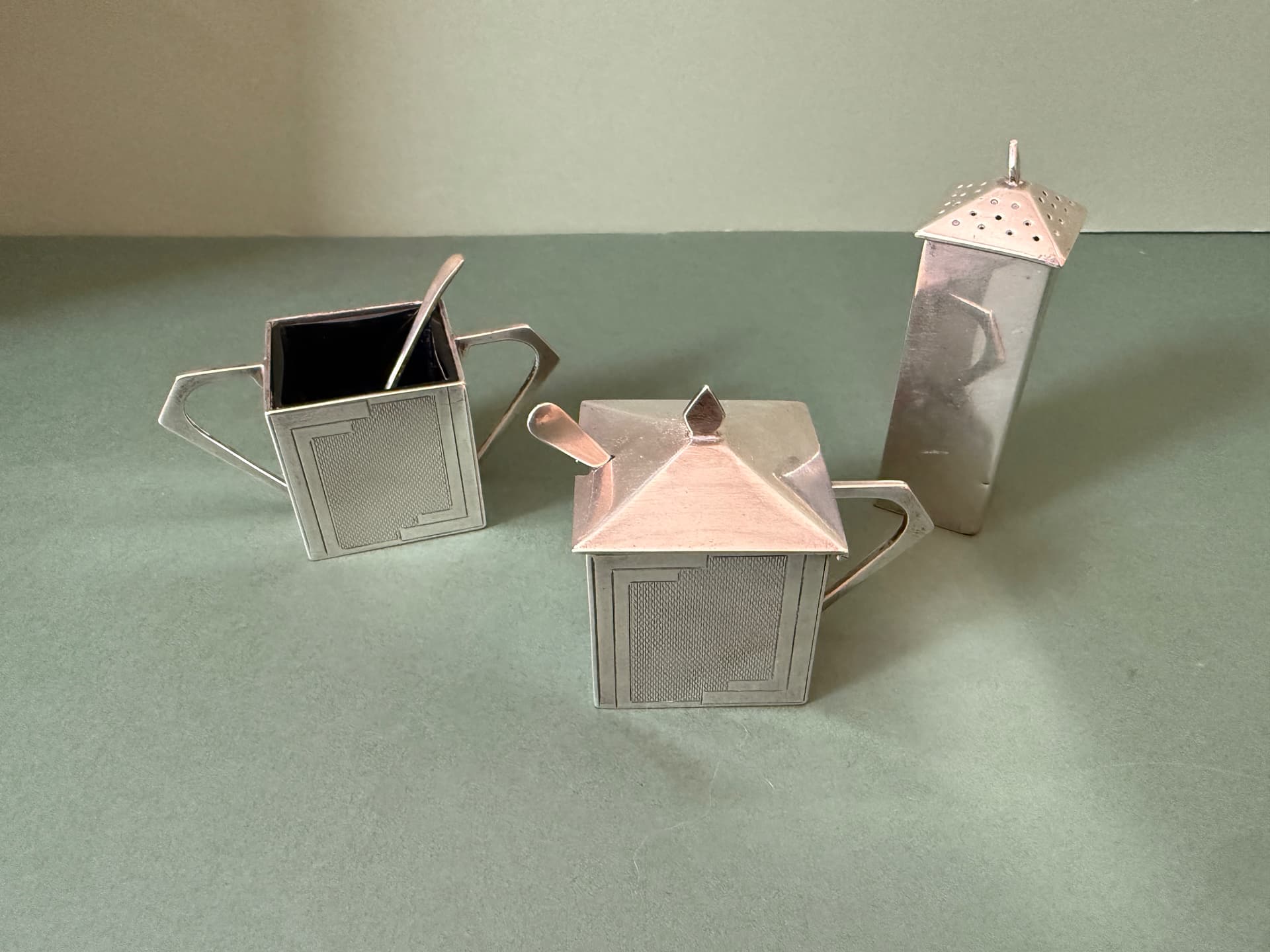
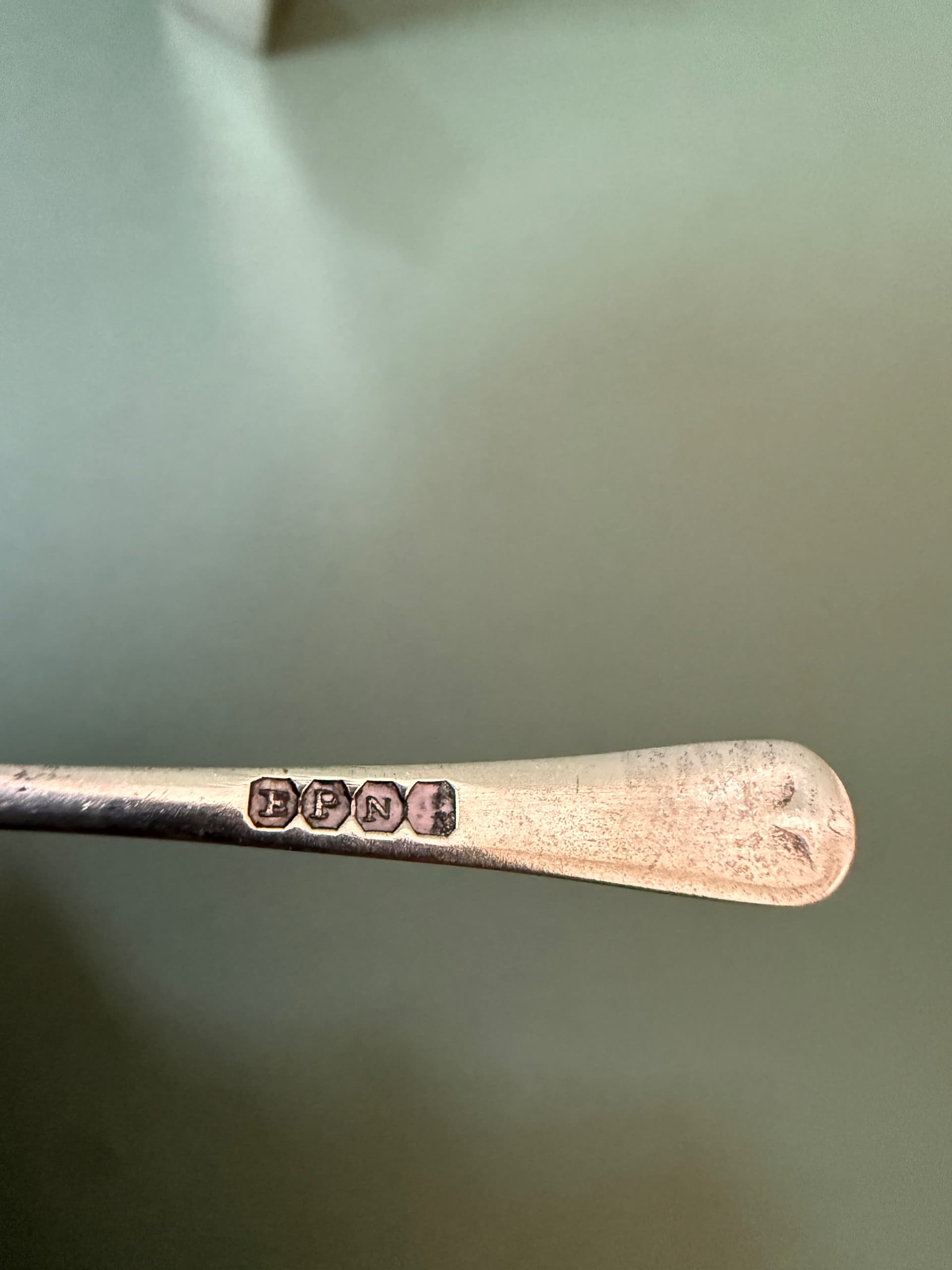
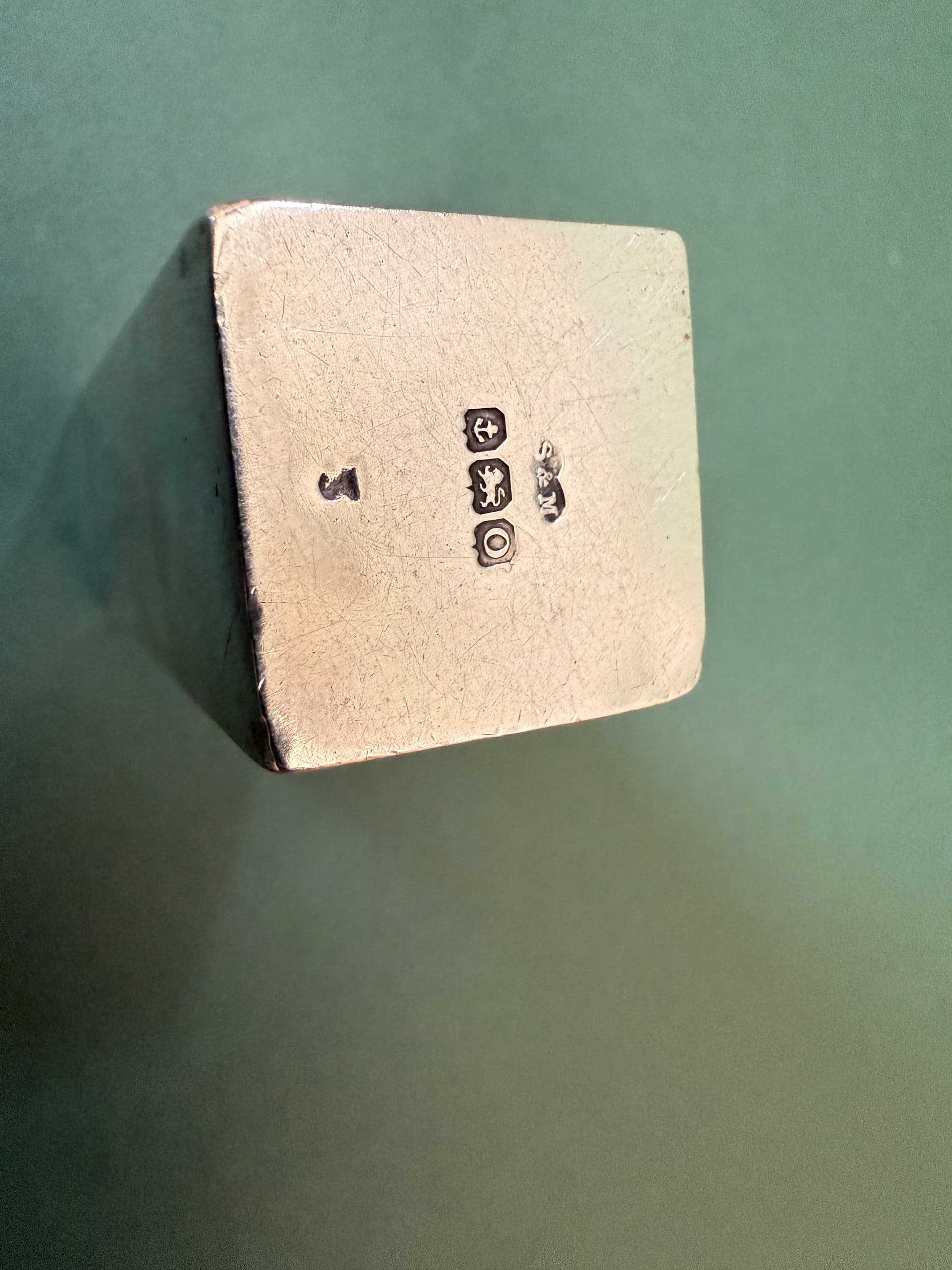
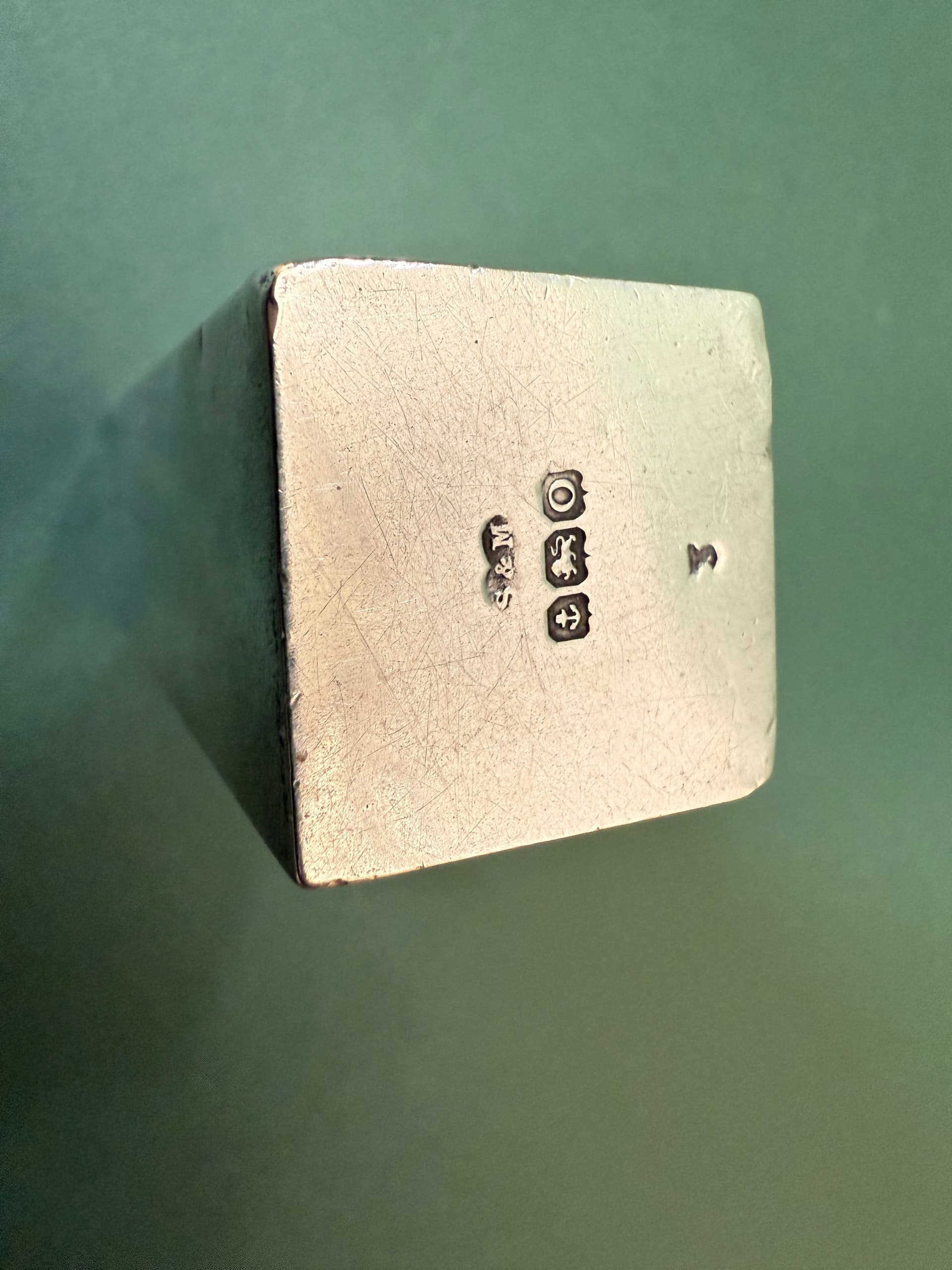
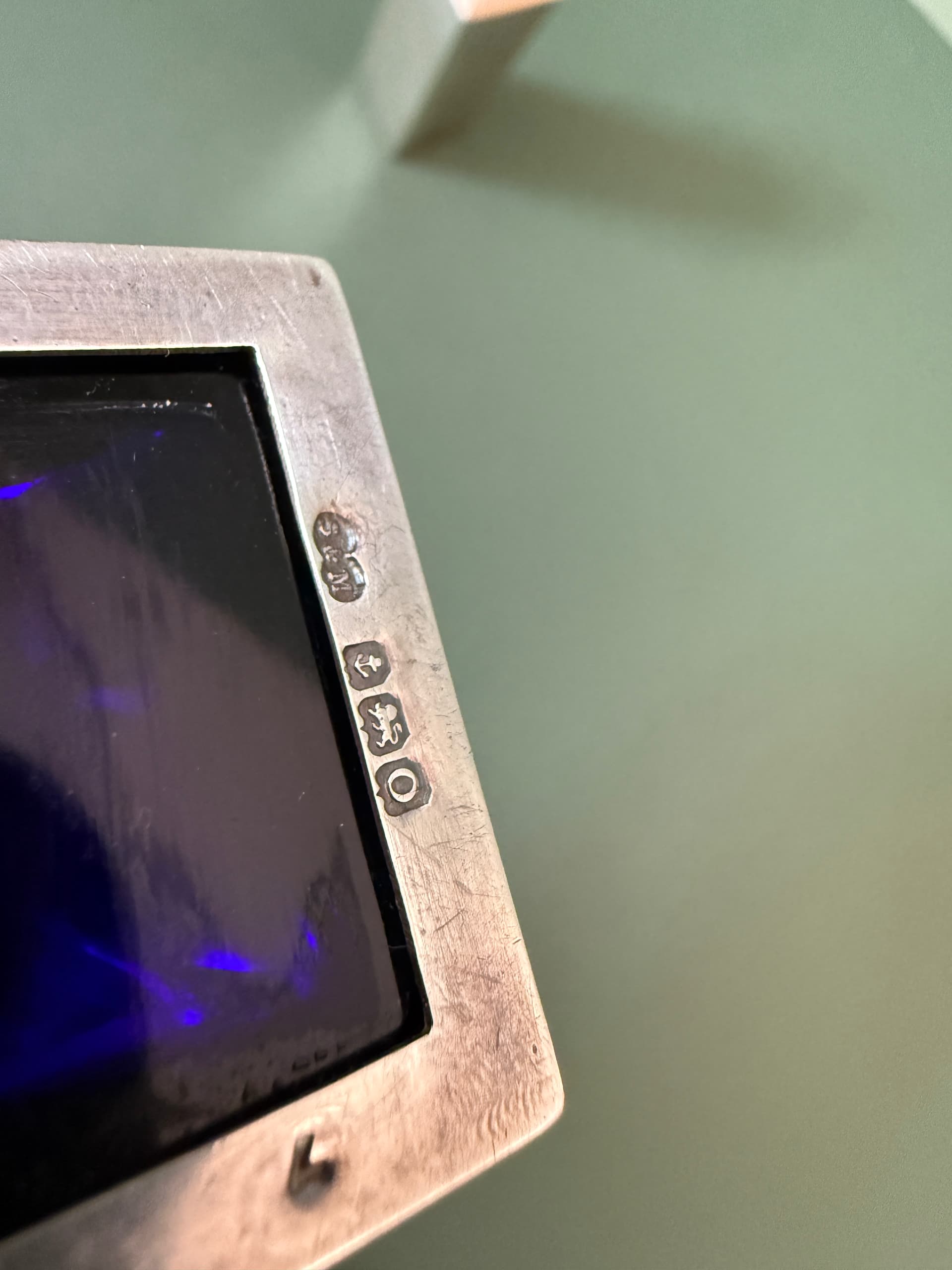
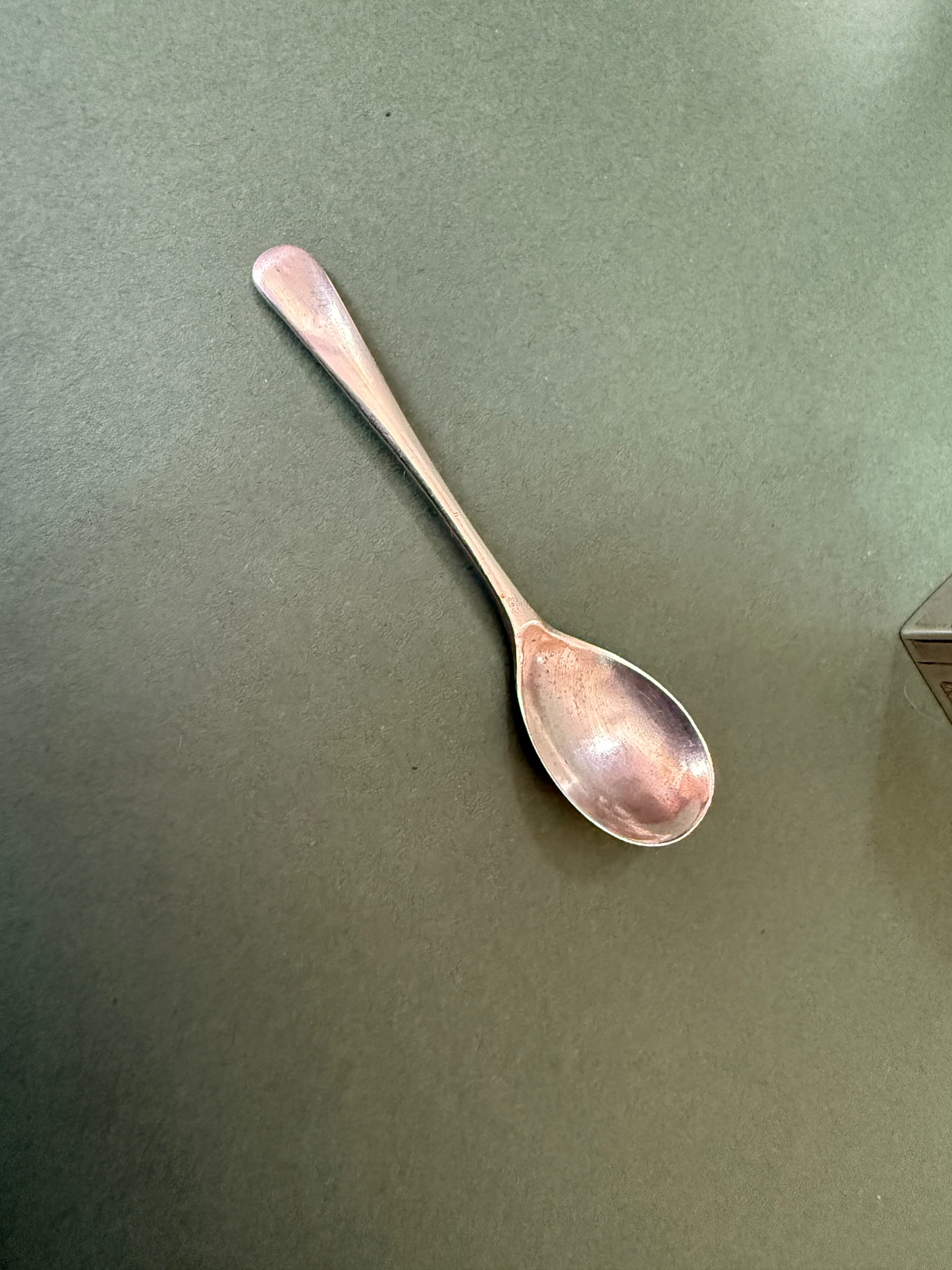
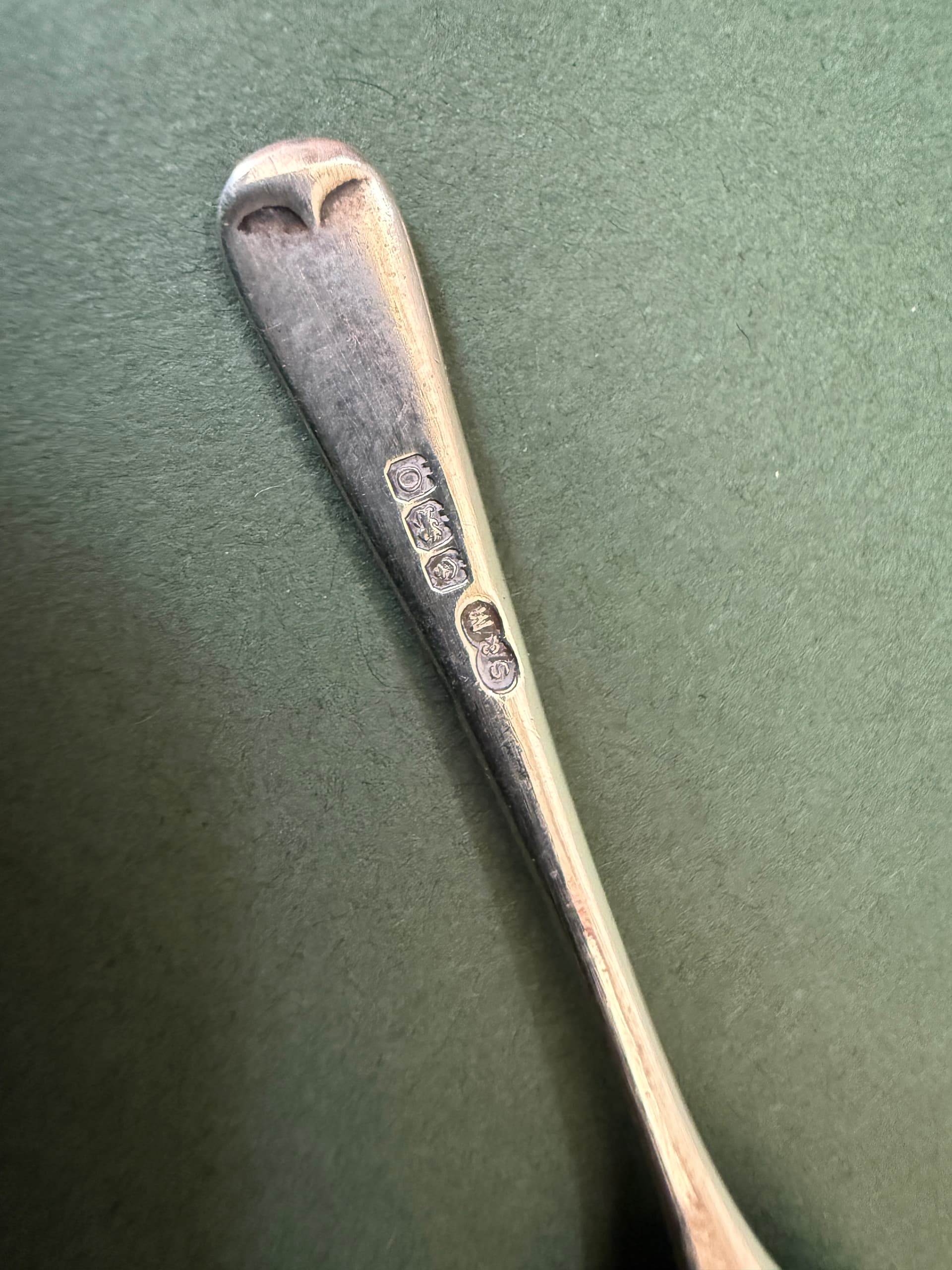
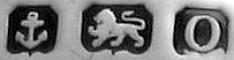
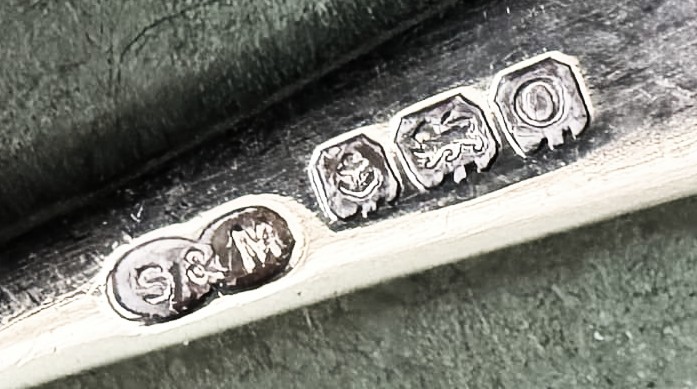
Any description or advice needed please. Silver (I assume solid and not plate?) cruet set with blue glass liners and spoons. Appears to be Sanders & McKenzie, Birmingham, 1938 - am I right? The spoons have different marks, does this mean they’re not original to this set? I’ve seen (but now can’t find) what I thought was an identical set by Levi & Salaman. I assume these can’t be, as the makers mark doesn’t link with that?
Any help appreciated. I will be listing these for sale, so obviously want to get the correct info.
The spoon is plate and definitely not originally part of the set (note the EPNS for electroplated nickel silver). And the Old English pattern doesn’t go at all with the cubist style of the main set. Very cool set but find some spoons more appropriate to the vernacular before selling would be my advice.
I agree with Paul1’s comment about the spoon, and I think you’re correct about the hallmark and maker.
You might, indeed, find another set, virtually identical, by a different silversmith. I’ve got a 20th Century sterling quaich that I’ve seen by two or three different makers, quite a few years apart, but absolutely the same in design.
Yes, telling the difference between the uppercase “O” and the lowercase “o” is almost impossible. But in this case, the style tells the tale. It just shouts, “Look at me! I’m art deco!!!”
Tough to say. Condiment sets (and these would, I think, be more properly called that, since there are no oil or vinegar containers) of similar vintage sell for amounts that are all over the map. The big premiums seem to be attached to pristine boxed sets, but even as “loose” items, the values cover a wide range.
The best you can do is to start by weighing the silver (minus the liners, of course), to get a melt value. Then start looking at “sold” listings to see what kind of money similar sets have brought. In the end, you might have to trust to the auction gods - set the opening bid price to something close to the melt value, and then see what happens.
I can find only one set that’s even remotely like yours. It sold for £55, six years ago, which is considerably less than the melt value. I recently sold a few mustard pots for only a modest premium over melt. After fees, I netted something very close to melt. I could perhaps have gotten more, but only if I were willing to wait around for a few years to find the right buyer. You’re not going to retire to the south of France on the proceeds, in any event.
This spoon is probably exactly what started out with the Cubist mustard pot. Not because it works stylistically, but because the Spencer St. makers of the hollow ware bought in the spoon off someone else and over-stamped it. The EPNS salt spoon is a later associated spoon. The set probably would have regarded the salt as a pinch or dip pot taking it back to the original spoon-less holloware from two hundred years earlier.
Sanders & Mackenzie might have at least vermeil-ed against the damage both salt and mustard do to naked silver.
Cubism is great right up until you need to wash out the corners. I see Elon Musk has made the same mistake with his Telsa so-called cyber electric truck.
Unlike Sanders & Mackenzie, Elon has not made his panels flat but slightly curved. Which means putting them together is nearly impossible and the corners are nearly all out of alignment.
Both pieces appear to have cobalt liners. But yes, one does not want to leave a silver spoon plunged into the contents while they’re sitting in the cupboard.
I don’t see any evidence of an actual over stamp. Perhaps they just didn’t want to go to the trouble of designing a spoon specifically for this set, and used a type of spoon they had in their inventory, or had been producing for years. It’s a fairly plain spoon, and doesn’t actively fight with the art deco design of the salt and mustard. Something with a squared-off handle would have been nice, but the makers were business people, not a roving commission to do good.
No matter the story, it’s a fair bet that Sanders & Mackenzie sold the silver spoon with the set. It would be surprising if some subsequent owner had managed to locate a spoon by the same maker, from the same year. Not impossible, but quite a feat. Someone capitulated when it came to the EPNS spoon, of course, and just grabbed something that was handy.
I hate to argue with two such esteemed members of this site who have both been very helpful with my collection, but there is no way that those Old English pattern spoons went with that set. Obviously the epns one didn’t but neither I think, did the other. Look how the spoon doesn’t even fit properly into the slot in the mustard pot. The original spoons must have been in the vernacular of the set; slim and square. And tiny spoons are the easiest things to lose. A later seller sourced one from the right year and a plate copy and sold it as a set. That’s my story and I’m sticking to it.
Well, you may well be right. But the evidence is what I have to follow and this hollow ware company was not in the silver spoon business. It didn’t make them and wouldn’t have had a big enough demand for them to pre-order either blanks or hot stamp them for the assay office. Again just my opinion and Occam’s razor .
So it bought in this marked spoon from some local spoon manufacturer out of general inventory. Cheaper that way on a low volume, low value item. I agree the chances of it manufacturing this spoon is near zero. It’s a cold stamp. The chances of it manufacturing this spoon on the off chance that years perhaps decades later someone would be looking for a spoon to match with its by then lost spoon set are… well if I seriously thought that was likely to happen I would be buying lottery tickets.
Where Jeff and I part company is he thinks this may not be an over stamp. Again without seeing the item I can not be sure but, well you tell us, is that crescent moon aside the S side of the S&M stamp on the spoon, is that just indent shadow or is there another smaller oval lurking underneath which, I admit, tends to support your theory if there is.
I wrote at some length in this blog about Elizabeth Eaton being over stamped on one of two similar fish knives one of which was sold in the Channel Islands and the other of which remained in the UK market. Again we had the remnants of the EE mark oval peeking out from under the C I over-stamp on one and there we knew it was Eaton because of the tally mark Z as I recall. I’ve kept the two as an object lesson.
As to the lack of fit, that is new information for which I am indebted. Does it make any difference to my view? As always I have an open mind. The EPNS spoon you and I are in complete agreement on.
However there’s a way to prove everybody wrong on the silver spoon: find a spoon that works better, is stamped by the maker company and is somewhat contemporary. I looked rather hard, even came up with a design( basically a stick handle and round bowl) I liked but couldn’t make that link. You may have better luck.
Does it have to be pistols? We’d never get to fire anything, instead enter into a discussion about the silversmith who created the barrel and butt engravings.
Anyway you’ve issued the challenge, so I get to chose the weapons. I chose Irish makers at 20 paces, not because I know much about Irish silversmiths, but because after 1807 registration in the Dublin assay office, which is suddenly mandated by the Brits putting all the assayers in Cork and Limerick out of business, registration of goldsmiths become a complete turkey shoot. Makers and Assay masters on one side and the guys in Dublin Castle on the other.
Now it’s up to our faithful public, well your faithful public anyway to provide the silver bullets.*
CRWW
*
I am always amused by the remarks of the Jesuits working with the HBC to take over the beaver tanning business north of Toronto. The Saugeen Anishnabeg who had run the Cobalt silver mines for over two thousand years, didn’t see the need for sharing. Words then bullets were exchanged. The HBC Chief Factor was hit in the shoulder. The surgeon who dug the musket bullet out discovered it was silver. The defenders has run out of lead.
The Jesuit father, learning of the injury cause quipped, “if we can get them to keep shooting at us we may be able to put the roof on the church in town”
I mean, yeah maybe, but the spoons just look wrong. And an odd size. I bow to your far greater knowledge, but Occam’s razor be damned! I still wonder why go to the trouble of designing a very upmarket, au courant set and then stick in a couple of spoons that look like they came from the 1700’s? Does that make any marketing sense? ps Does Occam’r razor come in sterling? If so I’ll take a baker’s dozen.
Perhaps not , but it probably made excellent economic sense.
Option one is custom design a spoon specific to the hollow ware design and either hand-make each one or, since its a run of say fifty, create a mold and abrogate the cost of that work between 50 buyers instead of several thousand or run up the street and collect a gross of these generic spoons from a local spoon maker, cold stamp them and supply them to the buyers at a closer on the basis, since they are getting them for free (sort of), they aren’t going to complain if it ain’t perfick!
And this isn’t the company that came up with this rather strange design. It was something they were banging out in and around the Jewellery Quarter in Hockley in the north-east of the city. I have seen three other very similar makers. all rather earlier than this set. Some where I have a coffee set which I dislike so much I had forgotten to sell it!
Today it’s still where most of the trade comes from. The museum there is well worth a visit. My wife had a great-uncle who was a young curate there when “The Great War” started. He signed up as an army chaplain, survived four years in Flanders, then stayed on to re-inter the many thousands of dead. He died of Spanish ‘Flu’ – which wasn’t Spanish and wasn’t ‘flu’ it was disease from thousands of rotting bodies. I have his George Unite-made communion set with the teeth marks of hundreds on the paten from when he administered last rights to dying men in the field. Churchill, then his CO, mentioned him in dispatches. The set was shipped out with his other effect to Rosedale, Sask. where his brother was homesteading after the war. There’s a Chaplain’s museum in England dedicated to the 900 or more churchmen who served and died in that war.
My only other thought on this spoon is you might say if there were so many of them cube-ing away why didn’t someone make a cruet spoon that was cubist specific and sell it to everybody Maybe they did, but it wasn’t this firm.
Yes, you mentioned the wife’s great uncle in a previous post, and hinted that you actually had a letter to him from Lt Col Churchill. You could buy a lot of curious cruet sets if you chose to sell that I would think. And I’ll accept your explanation on the spoons though they look particularly ill fitted and gormless in this set.